Features
The Bogusvilleas:A PM’s 1967 visit to the Army Cantonment

by Capt F R A B Musafer, 4th Regt SLA (Retd )
This story goes back to the mid 1960s when then Prime Minister and Minister of Defence and External Affairs, Mr Dudley Senanayake had scheduled a visit to the various Army establishments at the Cantonment at Panagoda, Homagama. This was during his third term of office having been Prime Minister in 1952-1953, 1960 and 1965 to 1970.
The decision to build an army cantonment was taken in 1949 shortly after the first anniversary of Independence when Sir Kanthiah Vaithianathan was the Secretary of the Ministry of Defence and External Affairs.
The cantonment located a few miles from the Homagama town was built at Panagoda on 350 acres of land purchased in 1950. Work commenced on October 10, 1952 when Mr Dudley Senanayake was the Prime Minister and Minister of Defence and External Affairs. The architect commissioned for the job was Tom Neville Wynne-Jones and the construction of the project awarded on tenders to local builders and engineers. The major work was completed in 1959 but it remained as a work in progress well into the late 1960s and beyond.
The main building, majestically facing the Colombo Ratnapura Road referred to as the High Level Road, was opened on December 22, 1959 by then Prime Minister W Dahanayake. This building, a showpiece of the time, housed the senior command structure of Western Force Support Group Brigade Headquarters as then referred to, and the officers and administrative staff of the Ceylon Army General Service Corps.
The frontage, as one sees it driving past, belies the extent of the vast acreage of the cantonment. Hidden from view are a vast assortment of buildings varying from offices of Regimental Headquarters of a few unit formations, two officers and sergeants messes, billets and messing facilities for other ranks, housing for married families, parade grounds, playing fields, workshops, garages, a gymnasium and a sewage and water treatment plant.
A separate complex of the officers married quarters was built at Kandalanda bordering the High Level Road a short distance from the Homagama town whilst the cantonment was situated a few miles further down the road.
The buildings being comparatively new and solid, with the extensive use of granite (kalu gal), hardly needed any exterior maintenance. The landscape however was a different story. In the construction phase most of the rubber trees were felled and the area flattened and leveled by the graders of the 1st Field Engineering regiment to make roads, playing fields, parade squares and whatever. As a result there was hardly any top soil left to enable the healthy growth of any vegetation, plants or flowering shrubs. The exposed clay (kabook) was not a pretty sight when it rained with the un-tarred road surfaces breaking up to form pot holes of mud proving a hindrance to vehicles to both vehicles and pedestrians.
The visit of a very senior officer or a person of importance would trigger a scramble to hurriedly spruce up the buildings and surrounds in the demarcated areas of responsibility. However, this being a very special occasion, demanded a much greater effort than a mere eyewash as it was the country’s Prime Minister who, having laid the foundation stone for construction work in October 1952, was visiting the cantonment.
It was deemed imperative that all unit commanders with their regimental pride, and perhaps their own promotions at stake, did their utmost to impress and have everything spic and span. It was a question of assigning all hands on deck to spruce up the cantonment but with very limited army allocated or individual regimental funds.
The Works Services Regiment together with the Field Engineering Regiment were inundated with requests to bypass the bureaucratic snags and expedite the necessary long neglected work and repairs to be carried out in a hurry.
Buildings were hosed down and some white/colour washed, windows cleaned, floors scrubbed, brass fittings polished. lawns mowed, hedges trimmed and the potholes of the un-tarred road surfaces temporarily filled. Everything had to look good just for that day at least.
This story is confined to the Artillery Officers Mess generally referred to as the “Gunner Mess.” Built on a hilltop of what was previously a rubber estate. It was indeed a very large and impressive two-storey building built with granite and boasting a very spacious dining and ante room, a billiards room, a ladies room, and a well equipped modern kitchen.
From memory there were about 40 rooms that housed lieutenant colonels downwards to second lieutenants with the exception of two officer cadets, the late Brigadier Nalin Angammana and myself.
We were both selected as officer cadets after having completed the Officer Quality Tests and were among the finalists interviewed by the then Secretary Minister of Defence, Mr N Q Dias. Nalin was in a batch of six that was to be trained in Egypt and I in a batch of four to go to Pakistan. The course to Egypt (ungazetted) was canceled with the change of government in 1965 with the training to be conducted in Ceylon instead.
The two and a half year course in the Pakistan Military Academy was cut short to a year owing to the Indo Pakistan war compelling this batch to return and continue their training at the Army Training Centre Tactics Wing at Diyatalawa. As the required mandatory period of training was incomplete, the two batches were subsequently posted to the regiments to mark time as officer cadets which was awkward as we were neither fish, flesh nor fowl, officers or other ranks.
The late Brigadier Angammana, a product of Dharmarajah College, a fine cricketer and an officer and a gentleman, was killed by a landmine in 1995 in the Batticaloa region. He passed out first in his batch and was posted to the 1st Field Regiment of Engineers. His untimely death paved the way for his batch-mate, Gen Ballagalla from Ananda College, to be appointed the Army Commander in 2002.
Most of the officers “living in” (an army term) were young and unmarried from the Artillery, Field Engineers, Signals and Works Services Regiments. The camaraderie that existed between these officers was exceptional.
The mess building hardly needed any overall maintenance. The floors of the large ante room, dining room areas and corridors were regularly polished with black Cardinal polish. This was a task undertaken by the batmen of the officers whenever required but on this occasion there were soldiers detailed to help out as well.
The landscaping around the officers’ mess was drab and colourless. The surroundings had been planted with some dwarf king coconut and grafted mango trees which remained barren and stunted. The area in the front of the U shaped mess entrance had been planted with some flowering shrubs (later replaced by “weeping willows” the trees that lined the entrance to Independence Square ) that were withered, scraggy and provided no colour. In front of the mess was a small pond with four empty flower beds at each corner. It was indeed a challenge to grow anything in the clay soil and thereby neglected.
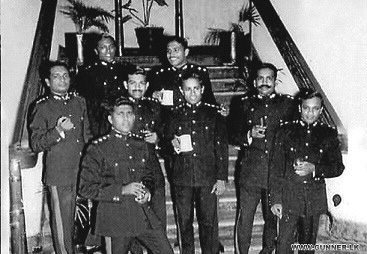
At the Gunner Officers Mess circa 1962/ 63 First row – Capt H Wanasinghe, Second row – Capt Sali Silva, Capt Percy Wijekoon, Capt George Fernando, Lt Gajendran. Lt Rex Fernando. Third row – 2 Lt KWP Guneratne, Lt AHUN Weerakoon
To the rear of the mess was the only other entrance to the cantonment from the Godagama road, referred to as the Habarakada entrance which was unmanned but barricaded denying any vehicle access. This was the status quo till March 1971 just prior to the JVP insurgency when a state of Emergency was declared and security was tightened.
Young officers living in the Gunner Mess returning after a night out, sometimes after dancing classes and an ice cream at Kreme House located in Colpetty would utilize this entrance, having got off the last bus from Pettah on the 190 Godagama route at around midnight. Paying for taxis was not an affordable option for these young and perhaps underpaid officers. Unmarried second lieutenants drew a salary of Rs 220, a lieutenant Rs 270 and an officer cadet Rs 180. Meals based on a ration allowance were provided free in the mess.
The downside was that our mess bills for liquor and extra messing took a large slice of the pay packet at month’s end. Having to be properly attired, maintaining standards befitting an officer, the common cliche was “clean suit and empty pockets!”
The story of the bogusvilleas was an officer’s initiative to accomplish a task given to him with the very limited financial resources at his disposal and the restrictions of time. This was during a time of austerity when the country was going through a difficult economic period and belts were tightened. Furthermore, the army though labeled a ceremonial army, was not used to much pomp, pageantry and luxuries and committed to being frugal and living within its means. There were plenty of items in short supply attributed to the lack of foreign exchange and also to the closure of the Suez canal. Global shipping was being diverted around the Cape of Good Hope, South Africa.
I must transgress here and mention that a gunner officer, on completion of his belated Gunner Young Officers course in the United Kingdom, used his initiative and connections to return to Ceylon by sea via the Cape of Good Hope rather than fly back home in a day, earning himself a good month-long paid holiday on duty!
Capt A P Abeysena (Tony), being an old soldier and a former All Ceylon hockey cap who rose from the ranks and was labeled as a “True Gunner,” was generally a ‘go to’ man to get a job done, was assigned the task of sprucing up the dull and boring colourless surrounds of the officers’ mess.
Built in front of the mess entrance was a small pond about five or six metres square with no fish in it and four empty L shaped flower beds at each corner which impressed no one and was an eyesore.
Tony a very practical individual came up with a creative idea to meet the challenges of costs and beautification within the constraints of time and effort and virtually at no cost.
A day before the PM’s visit, he drove down to Regimental Headquarters at Narahenpita (Colombo- 6) where there was an abundance of purple bougainvilleas in full bloom. He cut a full truck load of branches laden with flowers and transported them to Panagoda, where he planted these branches in the four empty flower beds near the pond. This significantly transformed the drab scenery with a cover of vivid purple and green foliage. It turned out to be a brilliant idea that was lauded by all and sundry .
The following day after the PM was accorded a guard of honour and had visited the various units, he was hosted to tea at the Gunner mess. He may have been so impressed by the colourful purple bougainvilleas and the green foliage that he walked towards the pond and took some photographs. I believe he was a very keen photographer and carried his camera wherever he went.
We were all relieved that the PM’s visit had gone off well and were impressed by Capt. Abeysena’s brainchild that had paid such rich dividends in transforming a drab landscape into one of vivid colour. Someone commented that it was a case of “bullshit baffling brains”. That evening the officers had a good chuckle and a good drink to toast Captain Abeysena’s ingenuity and masterstroke. Necessity being the mother of invention/compromise was in this instance well executed.
Not the end of story
There is a belief and saying “that if you plant a stick in Ceylon it grows”. It really did. In the days that followed there was incessant rain and the branches with the flowers planted took root. It was an incredible sight with the flowers still in bloom which prompted someone to aptly name it the “Bogusvilleas” This story would no doubt illustrate how true it was, irrespective if carbonic or organic fertilizer used in the clay soil of Panagoda or anywhere else in Sri Lanka.
The Gunner Mess was home, in the early days of their careers to the former President Gotabaya Rajapaksa and three former Army Commanders, General Hamilton Wanasinha, General Srilal Weerasooriya, late Gen Lionel Balagalle and a host of other Major Generals and very senior officers.
When I left the Army in 1976 the Bogusvilleas continued to flourish and did so for many more years. To many an old soldier of that era who lived in the Gunner Mess the legend of the bogusvilleas still lives on. So also does the saying: “Old Soldiers never die, they just fade away”. This story is recorded “lest we forget.”