
Features
The Aftermath of Empire – Reappraisal and Reconciliation – (Part 2)


by Professor Chandra Wickramasinghe*
Continued from last week
The author is an Honorary Professor at the University of Buckingham, UK, at the University of Ruhuna, Sri Lanka, and also at the National Institute of Fundamental Studies in Sri Lanka.
He was a former Fellow of Jesus College, Cambridge, Staff Member of the Institute of Astronomy, Cambridge, and former Professor at Cardiff University. He is a pioneer of the discipline of Astrobiology and the author of over 450 scientific papers and some 35 books.
Several generations of British historians, archaeologists and naturalists devoted their entire lives to tirelessly exploring the multiplicity of wonders of India. Studies of the subcontinent’s natural history, archaeology and anthropology are just a few scientific disciplines that enormously benefited from the imperial encounter. The introduction of greenhouses, zoological and botanic gardens to the Western world and much else came directly as a result of the colonial venture.
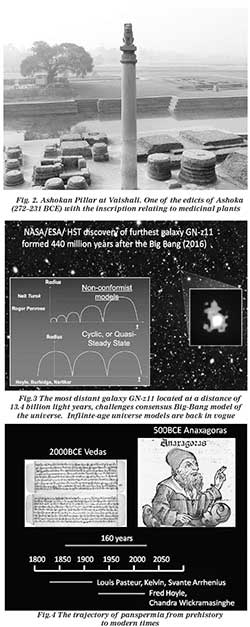
One discovery of great importance is worthy of mention. A large number of stone pillars and columns bearing mysterious inscriptions in a hitherto undeciphered Brahmi script had been scattered across the length and breadth of India and, rather strangely, gone unnoticed for centuries. In the 1830’s it was an English Philologist and scholar James Prinsep (1799-1840) who successfully deciphered these inscriptions. The edicts written in the Bhrami language mentioned a King Devanampriya Piyadasi which Prinsep had initially assumed was a Sri Lankan king. He was later to discover a Pali text from Sri Lanka from which he was able to connect the title Piyadasi with Ashoka, and thus was revealed for a first time a long-hidden secret of Indian history – the life and times of Emperor Ashoka who had reigned between 268 and 232 BCE. Ashoka is famous as the Indian monarch who became a Buddhist and unified a vast part of the Indian subcontinent into a single empire ruling it according to Buddhist principles. H.G. Wells in his “Outline of World History” said of Ashoka that amid tens of thousands of names of monarchs, “Ashoka shines, shines almost alone, a star”.
 In the 1920’s it was again thanks to British archaeologists that we owe the next major discovery – the unravelling of the great Indus valley civilizations of Harappa and Mohenjo-Daro which represents another long-hidden chapter in the prehistory of the Indian subcontinent stretching back to the third millennium BCE. We already had knowledge from Mesopotamian records of a vigorous trade in lapis lazuli that existed between empires in the Mesopotamia and India, but now we could link this precisely with the Indus valley civilizations.
Unravelling a Buddhist heritage
A few British Civil Servants who were posted in Ceylon in the 19th century became assiduous students of Buddhist texts and wrote extensively and enthusiastically about Buddhism. Thomas William Rhys David (1843-1922) was one such scholar who found himself posted as Government Agent near the historic ancient city of Anuradhapura. There he became actively involved in archaeological excavations that led to the discovery of a vast number of inscriptions and manuscripts relating to Buddhism and this triggered his interest. He soon became a formidable Pali scholar, translated many Buddhist Pali texts into English and also wrote extensive commentaries on Buddhism that are still being read today.
The colonial response to Buddhism on the whole had been positive throughout the time of the Empire. H.G. Wells (1866-1946) in his “Outline of World History” writes of Buddhism thus:
“Many of our best modern ideas are in closest harmony with it. All the miseries and discontents of life are due, he (the Buddha) taught, to selfishness. Selfishness takes three forms – one, the desire to satisfy the senses; second, the craving for immortality; and the third the desire for prosperity and worldliness. Before a man can become serene he must cease to live for his senses or himself. Then he merges into a great being. Buddha in a different language called men to self-forgetfulness five hundred years before Christ. In some ways he was nearer to us and our needs. Buddha was more lucid on our individual importance in service than Christ, and less ambiguous upon the question of personal immortality.”
The amazing degree of concordance between Buddha’s view of consciousness and modern post-Jungian ideas in psychology were discussed by me and Daisaku Ikeda in our dialogue many years ago. The practice of Buddhist meditation is becoming increasingly popular in the West today because of its potential to yield mental and physical health benefits. Such practices, however, are looked upon with suspicion by many – now and in the past – as heathen primitive rituals that challenge the cannon of Christian faith. Such a narrow view cannot be interpreted as being any other than a component of racial thinking that prevailed throughout the period of British imperialism and filters down even into our post-colonial modern era.
Buddhist cosmology
In matters relating to cosmology and life in the Universe ideas from Buddhist as well as earlier Vedic traditions have run contrary to the canonical Western world-view. For instance, in the cosmology described in the Anguttara Nikaya (a Buddhist text dated at around the 1st century BCE) it is stated thus:
“As far as these suns and moons revolve, shedding their light in space, so far extends the thousand-fold world system. In it there are a thousand suns, a thousand moons, a thousand inhabited Earths and a thousand heavenly bodies. This is called the thousand-fold minor world system….”
It then goes on to define a hierarchy of world systems, referring to the entire universe as “this sphere of million, million world systems”. Similar views do not dominate scientific thinking in Europe until after the Copernican revolution in the 17th century of the common era. Today, with the recent discoveries of exoplanets in the past decade, the total number of exoplanetary systems in our Milky Way galaxy alone is estimated to exceed 100 billion.
As far back as the first millennium BCE a school of atomism similar to that of Democritus was founded in India, the most important proponent of this school being a philosopher named Kanada (600 BCE). The idea was that atoms are point-sized, indivisible and eternal, each possessing a distinct property and individuality. These concepts were developed further by a burgeoning Buddhist school of atomism that flourished in the 7th century CE.
Aryabhata (476-550CE) was perhaps the first Indian astronomer in the modern mould who discovered an approximation of pi to six significant figures and also correctly maintained that the planets and the Moon shine by reflected sunlight. He also correctly inferred from observations that the daily motion of the stars in the celestial sphere is due to Earth’s rotation about its axis.
From both archaeological and later historical evidence there is no doubt that high levels of advancement in science and technology had been achieved in India long before Aryabhata going back to at least the second millennium before the common era. Vedic Sanskrit texts dated at the 8th century BCE refer to Pythagorean triples (eg. (3,4,5 (5,12,13), (8,15,17)) and display a knowledge of Pythagoras theorem. One of the earliest Indian astronomical texts (Vedānga Jyotiṣa) dates from 1400–1200 BCE, with the currently extant form dating possibly from 700–600 BCE. This latter timespan also corresponds to the dating of the most ancient known “university” in the world, Takshashila in India, which was a centre first of Hindu and later Buddhist scholarship.
Ayurveda and plant-based pharmaceuticals
Developments in the field of ayurvedic plant-based medicine, and including reports of surgical interventions, have been recorded in a variety of sources from the earliest times. In one of the Ashokan pillars (272-231BCE), to which I have already referred, an edict reads: “Everywhere King Piyadasi (Ashoka) erected two kinds of hospitals, hospitals for people and hospitals for animals. Where there were no healing herbs for people and animals, he ordered that they be bought and planted.” There also exist many thousands of ayurvedic texts both in India and Sri Lanka with extensive lists of medicinal herbs and their alleged benefits for curing various ailments. The result of four centuries of colonial rule has unfortunately been to relegate this vast legacy to the “archive of curiosity”.
The few ayurvedic physicians who now practice in India and Sri Lanka still rely on time-hallowed anecdotal accounts of the efficacy of their plant-based medicines. The correct procedure will be for western science to fully explore these claims with chemical analysis and trials, but this has not yet been done. It should be recalled in this context that many drugs currently used in western medicine are indeed derived from plants – aspirin, quinine, digitalis, morphine, codeine – are just a few. It is hard to imagine the medical legacy that would follow from a complete investigation of the thousands of claimed herbal remedies that still remain unexamined.
Transition from ancient to modern science
I have already mentioned the knowledge of land surveying technologies and irrigation schemes that was evident in the Indus valley civilizations of Mohenjo-Daro and Harappa; and these and other technological developments have also been found elsewhere in India and in neighbouring Sri Lanka throughout the period from the beginning of the common era until the time of the arrival of the British in 1600CE.
When the British arrived in India the difference in technological development between Britain and the subcontinent was arguably marginal. Handlooms and weaving technology that were developed and used in Bengal made India (run by the Moghuls) one of the richest countries of the world at this time. In a real sense it could be maintained that the technological advancement of the West took place at the cost of the continued impoverishment of India.
From the beginning of the 20th century many Indian scientists who were trained in British Universities and laboratories made highly significant contributions to the progress of science furthering the dominant scientific paradigms of Western science. A common feature of all these scientists is that their corpus of work supported and did not in any way challenge the major accepted paradigms of the day. Their achievements were thus thought to be a continuing tribute to the prevailing and predominant traditions of western science, and so were readily acknowledged and rewarded. However serious difficulties can arise whenever an ethnically non-European scientist hailing from an ex-colony dares to challenge a reigning paradigm of Western science.
Clash of Orthodoxy and Heresy
It should occasion no surprise to find that most important advances in science with regard to fundamental of issues concerning the Universe and Life have always been subject to cultural and religious constraints. Thus, in the 19th century the unfolding facts of geology that yielded an age of the Earth of some 4 billon years came into sharp conflict with Biblical chronologies of mere thousands of years, and this had initially caused great angst in some circles. Likewise, the facts of biological evolution that were unravelled after Charles Darwin’s Origin of Species was published in 1859 continued to disturb conventional beliefs for several decades.
As already mentioned Buddhist and earlier Vedic cosmologies can be interpreted as being consistent with many aspects of modern and post-modern scientific thought. There are also fundamental differences that can cause consternation in a Western scientific context. In Vedic cosmology the universe is thought to be infinite in spatial extent and cyclic in time– strikingly reminiscent of the modern versions of oscillating universe models. In this context it is worth noting that the currently favoured Big-Bang theory of the Universe with an age of 13.8 billion years is by no means absolutely proved. The very recent discovery of a galaxy designated GN-z11 located at a distance of 13.4 billion light years (implying its formation just 420 million years after the posited Big Bang origin of the Universe) poses serious problems for the current consensus view of cosmology.
Recently Nobel Laureate Roger Penrose has come in among the select band of dissenters from the standard view of a unique Big Bang origin of the Universe 13.8 billion years ago. In a theory called the “conformal cyclic cosmology” Penrose postulates that the universe undergoes an infinite number of cycles in which the Big Bang event 13.8 billion years ago is the most recent cycle of which we are a part – a result strikingly in accord with ancient Vedic and Indian cosmology.
The inescapable fact of Panspermia
Finally, I turn to the age-old problem of our own origins – how we, humans and indeed all of life, came to be. This question has been approached in a multitude of different ways, embracing superstition, religion, philosophy and eventually science. The ideas that prevailed throughout ancient India involved the concept of life being an integral part of the structure of the universe – a view closely aligned to the ideas of panspermia discussed in the West by pre-Socratic Greek philosopher Anaxoragas of Clazomenae who lived around 500BCE. Panspermia implies that “seeds of life” are eternally present in the cosmos and take root whenever and wherever the condition permit.
This concept was vigorously rejected in the Western tradition in favour of the ideas of the more influential Greek philosopher Aristotle in the 3rd century BCE. Aristotle proposed instead that life must arise from non-living inorganic matter whenever the right conditions prevailed, and he cited many instances that were incorrectly regarded as supportive evidence, the most graphic being the statement of “fireflies emerging from a mixture of warm earth and morning dew”. Over a millennium and a half later Saint Thomas Aquinas (1225-1272) essentially co-opted Aristotelian philosophy into church doctrine, so that dissent from any component of it thereafter was effectively construed as heresy. The Aristotlean doctrine of “Spontaneous Generation” was transformed into “Abiogenesis” in modern terms and continues to dominate Western science almost to the present day.
Attempts to re-examine panspermia in the West began in earnest with the French biologist Louis Pasteur in the early 1860’s. Pasteur showed in the laboratory what was already known for larger visible life forms – that life is always derived from pre-existing life of a similar kind. This casual chain of events – life-from-life – is true not only for lifeforms existing today but it is also true throughout the entire record of fossilised life on the Earth. The question that next arises is: when and where this connection cease to operate. The answer could be never – so this then naturally leads to panspermia.
Following the experiments of Pasteur, panspermia came at last to be championed by many contemporary physicists in the late 19th century.
Lord Kelvin declared: “Dead matter cannot become living without coming under the influence of matter previously alive. This seems to me to be as sure a teaching of science as the law of gravitation….”
And the German physicist Herman von Helmholtz wrote in 1874:
“It appears to me a fully correct scientific procedure, if all our attempts fail to cause the production of organisms from non-living matter, to raise the question whether life has ever arisen, whether seeds have not been carried from one planet to another…”.
A similar position was also championed a few years later by the Nobel prize-winning Chemist Svante Arrhenius in his 1908 book Worlds in the Making. But all this enthusiasm was transient. On the basis of poorly designed experiments concerning limits to the viability of microbes in space, the situation soon reverted, and spontaneous generation and abiogenesis came back into vogue.
In the past five decades abiogenesis was confronted with a formidable array of new facts from astronomy, geology, space science and molecular biology, all of which challenged its validity. On the other hand, an ever-increasing number of predictions of panspermia has come to be verified to an astounding degree of precision. Wrong theories do not perform in this way, so it soon became amply clear that panspermia’s star was on the ascendant! The sociology of science now took over: the triumphs of panspermia over rival models began to irritate an ever-increasing body of scientists. This was aggravated by the fact that all attempts to demonstrate the validity of abiogenesis in the most advanced laboratories in the world consistently led to dismal failure.
The trajectory of panspermia from its early roots in the Vedas through to Anaxoragas in the 5th century BCE and into modern times is sketched in Fig.4. The last phase following on from Pasteur led up to the work of the present writer, Fred Hoyle and many collaborators. This unfolding scientific drama is well-documented in a very large number of scientific papers and recent books.
What I would like to reiterate by way of conclusion is that the body of objective scientific evidence in favour of cometary panspermia and against abiogenesis is now compelling and overwhelming. The main reason that this new world view has yet to enter mainstream thinking, and even become more widely known, may be simply because its principal proponent (the present writer) is seen as a heathen and a former colonial subject. In what could be seen as the most egregious travesty of justice serious attempts are being made to “steal” our well-documented priority on these ideas in recent publication of similar ideas but with a deliberate omission of any reference to pioneering work over the past 40 years. In my view overt racism including antagonism for what is seen to be an alien concept is the only conceivable explanation for this conduct. This explanation also provides the only reason for why a long-overdue paradigm shift from planet-centred life to cosmic-centred life – a paradigm shift which is potentially of the most profound importance across the whole of science – is being delayed.
The long colonial encounter between “West” and “East” that began in the 15th and 16th centuries ending barely seven decades ago has in every sense shaped the modern world. Many scars have been left, however, and a priority of the ongoing decolonisation process must not only be to expand on the legacy of this long experience but also to heal its wounds.



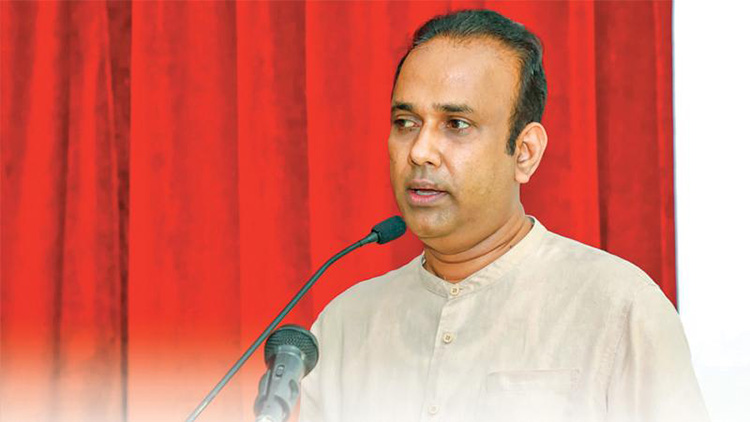
by Dr Gotabhya Ranasinghe
Senior Consultant Cardiologist
National Hospital Sri Lanka
When we sought a meeting with Hon Dr. Ramesh Pathirana, Minister of Health, he graciously cleared his busy schedule to accommodate us. Renowned for his attentive listening and deep understanding, Minister Pathirana is dedicated to advancing the health sector. His openness and transparency exemplify the qualities of an exemplary politician and minister.
Dr. Palitha Mahipala, the current Health Secretary, demonstrates both commendable enthusiasm and unwavering support. This combination of attributes makes him a highly compatible colleague for the esteemed Minister of Health.
Our discussion centered on a project that has been in the works for the past 30 years, one that no other minister had managed to advance.
Minister Pathirana, however, recognized the project’s significance and its potential to revolutionize care for heart patients.
The project involves the construction of a state-of-the-art facility at the premises of the National Hospital Colombo. The project’s location within the premises of the National Hospital underscores its importance and relevance to the healthcare infrastructure of the nation.
This facility will include a cardiology building and a tertiary care center, equipped with the latest technology to handle and treat all types of heart-related conditions and surgeries.
Securing funding was a major milestone for this initiative. Minister Pathirana successfully obtained approval for a $40 billion loan from the Asian Development Bank. With the funding in place, the foundation stone is scheduled to be laid in September this year, and construction will begin in January 2025.
This project guarantees a consistent and uninterrupted supply of stents and related medications for heart patients. As a result, patients will have timely access to essential medical supplies during their treatment and recovery. By securing these critical resources, the project aims to enhance patient outcomes, minimize treatment delays, and maintain the highest standards of cardiac care.
Upon its fruition, this monumental building will serve as a beacon of hope and healing, symbolizing the unwavering dedication to improving patient outcomes and fostering a healthier society.We anticipate a future marked by significant progress and positive outcomes in Sri Lanka’s cardiovascular treatment landscape within the foreseeable timeframe.

by Fr. Emmanuel Fernando, OMI
Jesuit Fr. Aloysius Pieris (affectionately called Fr. Aloy) celebrated his 90th birthday on April 9, 2024 and I, as the editor of our Oblate Journal, THE MISSIONARY OBLATE had gone to press by that time. Immediately I decided to publish an article, appreciating the untiring selfless services he continues to offer for inter-Faith dialogue, the renewal of the Catholic Church, his concern for the poor and the suffering Sri Lankan masses and to me, the present writer.
It was in 1988, when I was appointed Director of the Oblate Scholastics at Ampitiya by the then Oblate Provincial Fr. Anselm Silva, that I came to know Fr. Aloy more closely. Knowing well his expertise in matters spiritual, theological, Indological and pastoral, and with the collaborative spirit of my companion-formators, our Oblate Scholastics were sent to Tulana, the Research and Encounter Centre, Kelaniya, of which he is the Founder-Director, for ‘exposure-programmes’ on matters spiritual, biblical, theological and pastoral. Some of these dimensions according to my view and that of my companion-formators, were not available at the National Seminary, Ampitiya.
Ever since that time, our Oblate formators/ accompaniers at the Oblate Scholasticate, Ampitiya , have continued to send our Oblate Scholastics to Tulana Centre for deepening their insights and convictions regarding matters needed to serve the people in today’s context. Fr. Aloy also had tried very enthusiastically with the Oblate team headed by Frs. Oswald Firth and Clement Waidyasekara to begin a Theologate, directed by the Religious Congregations in Sri Lanka, for the contextual formation/ accompaniment of their members. It should very well be a desired goal of the Leaders / Provincials of the Religious Congregations.
Besides being a formator/accompanier at the Oblate Scholasticate, I was entrusted also with the task of editing and publishing our Oblate journal, ‘The Missionary Oblate’. To maintain the quality of the journal I continue to depend on Fr. Aloy for his thought-provoking and stimulating articles on Biblical Spirituality, Biblical Theology and Ecclesiology. I am very grateful to him for his generous assistance. Of late, his writings on renewal of the Church, initiated by Pope St. John XX111 and continued by Pope Francis through the Synodal path, published in our Oblate journal, enable our readers to focus their attention also on the needed renewal in the Catholic Church in Sri Lanka. Fr. Aloy appreciated very much the Synodal path adopted by the Jesuit Pope Francis for the renewal of the Church, rooted very much on prayerful discernment. In my Religious and presbyteral life, Fr.Aloy continues to be my spiritual animator / guide and ongoing formator / acccompanier.
Fr. Aloysius Pieris, BA Hons (Lond), LPh (SHC, India), STL (PFT, Naples), PhD (SLU/VC), ThD (Tilburg), D.Ltt (KU), has been one of the eminent Asian theologians well recognized internationally and one who has lectured and held visiting chairs in many universities both in the West and in the East. Many members of Religious Congregations from Asian countries have benefited from his lectures and guidance in the East Asian Pastoral Institute (EAPI) in Manila, Philippines. He had been a Theologian consulted by the Federation of Asian Bishops’ Conferences for many years. During his professorship at the Gregorian University in Rome, he was called to be a member of a special group of advisers on other religions consulted by Pope Paul VI.
Fr. Aloy is the author of more than 30 books and well over 500 Research Papers. Some of his books and articles have been translated and published in several countries. Among those books, one can find the following: 1) The Genesis of an Asian Theology of Liberation (An Autobiographical Excursus on the Art of Theologising in Asia, 2) An Asian Theology of Liberation, 3) Providential Timeliness of Vatican 11 (a long-overdue halt to a scandalous millennium, 4) Give Vatican 11 a chance, 5) Leadership in the Church, 6) Relishing our faith in working for justice (Themes for study and discussion), 7) A Message meant mainly, not exclusively for Jesuits (Background information necessary for helping Francis renew the Church), 8) Lent in Lanka (Reflections and Resolutions, 9) Love meets wisdom (A Christian Experience of Buddhism, 10) Fire and Water 11) God’s Reign for God’s poor, 12) Our Unhiddden Agenda (How we Jesuits work, pray and form our men). He is also the Editor of two journals, Vagdevi, Journal of Religious Reflection and Dialogue, New Series.
Fr. Aloy has a BA in Pali and Sanskrit from the University of London and a Ph.D in Buddhist Philosophy from the University of Sri Lankan, Vidyodaya Campus. On Nov. 23, 2019, he was awarded the prestigious honorary Doctorate of Literature (D.Litt) by the Chancellor of the University of Kelaniya, the Most Venerable Welamitiyawe Dharmakirthi Sri Kusala Dhamma Thera.
Fr. Aloy continues to be a promoter of Gospel values and virtues. Justice as a constitutive dimension of love and social concern for the downtrodden masses are very much noted in his life and work. He had very much appreciated the commitment of the late Fr. Joseph (Joe) Fernando, the National Director of the Social and Economic Centre (SEDEC) for the poor.
In Sri Lanka, a few religious Congregations – the Good Shepherd Sisters, the Christian Brothers, the Marist Brothers and the Oblates – have invited him to animate their members especially during their Provincial Congresses, Chapters and International Conferences. The mainline Christian Churches also have sought his advice and followed his seminars. I, for one, regret very much, that the Sri Lankan authorities of the Catholic Church –today’s Hierarchy—- have not sought Fr.
Aloy’s expertise for the renewal of the Catholic Church in Sri Lanka and thus have not benefited from the immense store of wisdom and insight that he can offer to our local Church while the Sri Lankan bishops who governed the Catholic church in the immediate aftermath of the Second Vatican Council (Edmund Fernando OMI, Anthony de Saram, Leo Nanayakkara OSB, Frank Marcus Fernando, Paul Perera,) visited him and consulted him on many matters. Among the Tamil Bishops, Bishop Rayappu Joseph was keeping close contact with him and Bishop J. Deogupillai hosted him and his team visiting him after the horrible Black July massacre of Tamils.
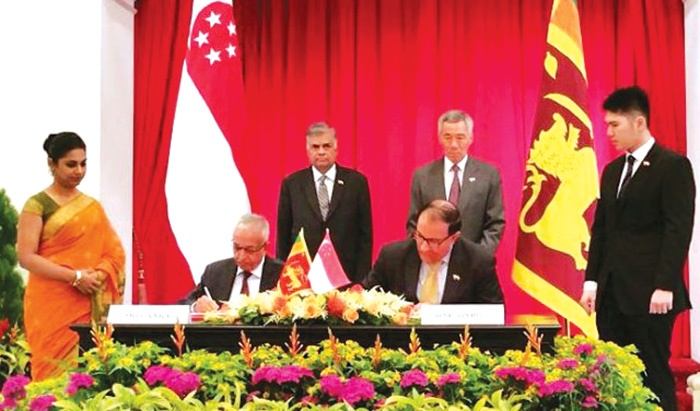
Sri Lanka-Singapore Free Trade Agreement
By Gomi Senadhira
senadhiragomi@gmail.com
“You might tell fairy tales, but the progress of a country cannot be achieved through such narratives. A country cannot be developed by making false promises. The country moved backward because of the electoral promises made by political parties throughout time. We have witnessed that the ultimate result of this is the country becoming bankrupt. Unfortunately, many segments of the population have not come to realize this yet.” – President Ranil Wickremesinghe, 2024 Budget speech
Any Sri Lankan would agree with the above words of President Wickremesinghe on the false promises our politicians and officials make and the fairy tales they narrate which bankrupted this country. So, to understand this, let’s look at one such fairy tale with lots of false promises; Ranil Wickremesinghe’s greatest achievement in the area of international trade and investment promotion during the Yahapalana period, Sri Lanka-Singapore Free Trade Agreement (SLSFTA).
It is appropriate and timely to do it now as Finance Minister Wickremesinghe has just presented to parliament a bill on the National Policy on Economic Transformation which includes the establishment of an Office for International Trade and the Sri Lanka Institute of Economics and International Trade.
Was SLSFTA a “Cleverly negotiated Free Trade Agreement” as stated by the (former) Minister of Development Strategies and International Trade Malik Samarawickrama during the Parliamentary Debate on the SLSFTA in July 2018, or a colossal blunder covered up with lies, false promises, and fairy tales? After SLSFTA was signed there were a number of fairy tales published on this agreement by the Ministry of Development Strategies and International, Institute of Policy Studies, and others.
However, for this article, I would like to limit my comments to the speech by Minister Samarawickrama during the Parliamentary Debate, and the two most important areas in the agreement which were covered up with lies, fairy tales, and false promises, namely: revenue loss for Sri Lanka and Investment from Singapore. On the other important area, “Waste products dumping” I do not want to comment here as I have written extensively on the issue.
1. The revenue loss
During the Parliamentary Debate in July 2018, Minister Samarawickrama stated “…. let me reiterate that this FTA with Singapore has been very cleverly negotiated by us…. The liberalisation programme under this FTA has been carefully designed to have the least impact on domestic industry and revenue collection. We have included all revenue sensitive items in the negative list of items which will not be subject to removal of tariff. Therefore, 97.8% revenue from Customs duty is protected. Our tariff liberalisation will take place over a period of 12-15 years! In fact, the revenue earned through tariffs on goods imported from Singapore last year was Rs. 35 billion.
The revenue loss for over the next 15 years due to the FTA is only Rs. 733 million– which when annualised, on average, is just Rs. 51 million. That is just 0.14% per year! So anyone who claims the Singapore FTA causes revenue loss to the Government cannot do basic arithmetic! Mr. Speaker, in conclusion, I call on my fellow members of this House – don’t mislead the public with baseless criticism that is not grounded in facts. Don’t look at petty politics and use these issues for your own political survival.”
I was surprised to read the minister’s speech because an article published in January 2018 in “The Straits Times“, based on information released by the Singaporean Negotiators stated, “…. With the FTA, tariff savings for Singapore exports are estimated to hit $10 million annually“.
As the annual tariff savings (that is the revenue loss for Sri Lanka) calculated by the Singaporean Negotiators, Singaporean $ 10 million (Sri Lankan rupees 1,200 million in 2018) was way above the rupees’ 733 million revenue loss for 15 years estimated by the Sri Lankan negotiators, it was clear to any observer that one of the parties to the agreement had not done the basic arithmetic!
Six years later, according to a report published by “The Morning” newspaper, speaking at the Committee on Public Finance (COPF) on 7th May 2024, Mr Samarawickrama’s chief trade negotiator K.J. Weerasinghehad had admitted “…. that forecasted revenue loss for the Government of Sri Lanka through the Singapore FTA is Rs. 450 million in 2023 and Rs. 1.3 billion in 2024.”
If these numbers are correct, as tariff liberalisation under the SLSFTA has just started, we will pass Rs 2 billion very soon. Then, the question is how Sri Lanka’s trade negotiators made such a colossal blunder. Didn’t they do their basic arithmetic? If they didn’t know how to do basic arithmetic they should have at least done their basic readings. For example, the headline of the article published in The Straits Times in January 2018 was “Singapore, Sri Lanka sign FTA, annual savings of $10m expected”.
Anyway, as Sri Lanka’s chief negotiator reiterated at the COPF meeting that “…. since 99% of the tariffs in Singapore have zero rates of duty, Sri Lanka has agreed on 80% tariff liberalisation over a period of 15 years while expecting Singapore investments to address the imbalance in trade,” let’s turn towards investment.
Investment from Singapore
In July 2018, speaking during the Parliamentary Debate on the FTA this is what Minister Malik Samarawickrama stated on investment from Singapore, “Already, thanks to this FTA, in just the past two-and-a-half months since the agreement came into effect we have received a proposal from Singapore for investment amounting to $ 14.8 billion in an oil refinery for export of petroleum products. In addition, we have proposals for a steel manufacturing plant for exports ($ 1 billion investment), flour milling plant ($ 50 million), sugar refinery ($ 200 million). This adds up to more than $ 16.05 billion in the pipeline on these projects alone.
And all of these projects will create thousands of more jobs for our people. In principle approval has already been granted by the BOI and the investors are awaiting the release of land the environmental approvals to commence the project.
I request the Opposition and those with vested interests to change their narrow-minded thinking and join us to develop our country. We must always look at what is best for the whole community, not just the few who may oppose. We owe it to our people to courageously take decisions that will change their lives for the better.”
According to the media report I quoted earlier, speaking at the Committee on Public Finance (COPF) Chief Negotiator Weerasinghe has admitted that Sri Lanka was not happy with overall Singapore investments that have come in the past few years in return for the trade liberalisation under the Singapore-Sri Lanka Free Trade Agreement. He has added that between 2021 and 2023 the total investment from Singapore had been around $162 million!
What happened to those projects worth $16 billion negotiated, thanks to the SLSFTA, in just the two-and-a-half months after the agreement came into effect and approved by the BOI? I do not know about the steel manufacturing plant for exports ($ 1 billion investment), flour milling plant ($ 50 million) and sugar refinery ($ 200 million).
However, story of the multibillion-dollar investment in the Petroleum Refinery unfolded in a manner that would qualify it as the best fairy tale with false promises presented by our politicians and the officials, prior to 2019 elections.
Though many Sri Lankans got to know, through the media which repeatedly highlighted a plethora of issues surrounding the project and the questionable credentials of the Singaporean investor, the construction work on the Mirrijiwela Oil Refinery along with the cement factory began on the24th of March 2019 with a bang and Minister Ranil Wickremesinghe and his ministers along with the foreign and local dignitaries laid the foundation stones.
That was few months before the 2019 Presidential elections. Inaugurating the construction work Prime Minister Ranil Wickremesinghe said the projects will create thousands of job opportunities in the area and surrounding districts.
The oil refinery, which was to be built over 200 acres of land, with the capacity to refine 200,000 barrels of crude oil per day, was to generate US$7 billion of exports and create 1,500 direct and 3,000 indirect jobs. The construction of the refinery was to be completed in 44 months. Four years later, in August 2023 the Cabinet of Ministers approved the proposal presented by President Ranil Wickremesinghe to cancel the agreement with the investors of the refinery as the project has not been implemented! Can they explain to the country how much money was wasted to produce that fairy tale?
It is obvious that the President, ministers, and officials had made huge blunders and had deliberately misled the public and the parliament on the revenue loss and potential investment from SLSFTA with fairy tales and false promises.
As the president himself said, a country cannot be developed by making false promises or with fairy tales and these false promises and fairy tales had bankrupted the country. “Unfortunately, many segments of the population have not come to realize this yet”.
(The writer, a specialist and an activist on trade and development issues . )



US sports envoys to Lanka to champion youth development

Rahuman questions sudden cancellation of leave of CEB employees


