Sat Mag
Thanuja: Preserving water, preserving life

By Uditha Devapriya
Water was the cornerstone of ancient Sri Lanka, and for that reason water conservation remained a foremost priority for our rulers. Because of its scarcity, the Mahavamsa-Tika tells us, the earliest immigrants from India who migrated to the island settled in areas where water was available in abundance, in close proximity to the main rivers. Taken together these rivers formed the bedrock of Asia’s greatest hydraulic civilisation. Centuries later, they would lead Emerson Tennent to remark, “No people in country had so great practice and experience in the construction of works for irrigation.”
Prof. K. M. de Silva notes that because of the huge cost of maintaining the tanks and canals that underlay their irrigation schemes, most rulers were content with operating them “at a reasonable level of efficiency” rather than at full capacity. Yet the achievements of Sinhalese civilisation despite this, and despite the inevitable pressure of foreign invasions and changes in the climate, cannot be denied, whichever way you look at it.

At a time when much of Western Europe was facing a water crisis (“Whole towns,” Fernand Braudel writes in Civilization and Capitalism, “were poorly supplied”), Sinhala society went on to flourish, notwithstanding the onslaughts of imperialism. European colonialism would change all that, particularly British colonialism. Colonial officials in the British era neglected the trinity which had made up life here, the wewa, ketha, and dagaba. Henry Ward’s efforts at resuscitating tanks, canals, and village tribunals faltered, so much so that by the late 19th century the ideal of conservation, deeply embedded in our people until then, had morphed into the ideal of preservation: the reservoirs now existed to be studied, as artefacts of a long but vanished past. Never to be revived, they soon languished.
The healthy relationship which had thrived before, between the State and individuals and monasteries, had at this stage disappeared, since colonial officials seemed more interested in the plantation economy than in peasant agriculture. With that came about a discontinuity from the past, so much so that when it comes to conservation today we tend to rely on government and CSR projects. Yet individual initiative is far from lacking. The State, instead of neglecting such initiative, should be recognising it for what it is.
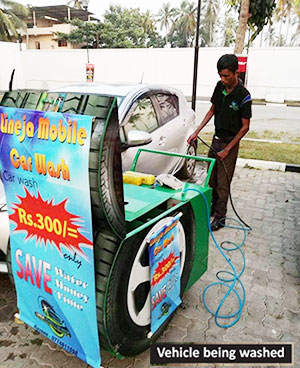
Non-assuming, ever smiling, Thanuja Samarawickrama strongly embodies that kind of go-getting initiative. The founder of Lineja Enterprises, she is well known for her invention: a mobile car washer that has been installed and operated in supermarkets across the country. How such a product can help us conserve water and at the same time make one of the more onerous routines of the vehicle owning middle class of Sri Lanka convenient is summed up in the tagline for the washing machine: “Save Water in the Earth and Save Time in your Life.” Given that vehicle growth has outstripped population growth, saving water and saving time seem to have become two mutually exclusive objectives. Thanuja’s initiative has succeeded in that sense in bringing them together.
“I served as an Accounts Executive at several leading local companies before I left for Dubai to take up that position in a multinational firm,” she began her story. Apparently it was at Dubai that she had come across the inventiveness with which people, including immigrants, tackled water scarcity. “I was struck by how much they valued water. They value it so much that they impute a price to its use, be it drinking or toilet water. I realised then, right there, how ignorant Sri Lankans had become when it came to conservation.” She had particularly been fascinated by how people there were getting around an issue which typically ails dust-choked countries: the washing of vehicles. “Sri Lankans usually require three of four buckets of water; in Dubai, the ratio was about one bucket to three or four cars.”
She hadn’t planned on coming back, but when circumstances beyond her choosing compelled her to return, she decided once and for all that she was going to teach her people how to save water. In a context where vehicle growth rate had risen considerably, and a significant proportion of the country had graduated to the ranks of a consumerist middle class in peripheral urban areas, Thanuja had to find a way to strike a balance between her conservationist ideals and changing socioeconomic realities.


Their “first draft”, however, had not been perfect: “The machine broke down thrice. Each time we made it more compact, more ‘portable’ and ‘mobile’ so to speak. It took several months for us to fine-tune it to our satisfaction.” Having perfected it, the two of them built a workshop in Meegoda to train a group of workers. Befitting her expertise, her friend was appointed as the Technical Manager there.
Naturally, this was the easy part. As Thanuja found out for herself, convincing her intended clientele of the benefits of their machine was easier said than done. “We went to a retail outlet in Ja-Ela. We talked with the managers. They were interested in using our machine and installing it in their premises for their customers. We explained that their customers could use it to wash their cars while they went out shopping. However, the managers didn’t agree to our proposal straight away. They were worried, more than anything else, by the possibility of water leakages to neighbouring homes.”
To pacify the sceptics, Thanuja pleaded for a 14-day test run. They agreed, to her relief. If the machine worked and became a success during the test run, they would take it in. “Those 14 days were the busiest in my life. We had to be at the supermarket early every morning; we had to attend to every vehicle; we had to ensure our staff knew what they were doing; and we had to guarantee there were no water leakages whatsoever.”
Needless to say their efforts paid off, and the once sceptical managers “took it in.” Around three months later, moreover, Thanuja realised that contrary to what she had once thought, “our machine was becoming so popular we needed a good marketing campaign and a strong publicity boost.” That publicity boost came around a year later, in 2018, when she presented her machine to the judge panel at Ath Pavura, the first ever reality TV show in Sri Lanka for social entrepreneurs. Given that its scope went beyond the parameters of CSR projects, Ath Pavura instantly recognised and applauded Thanuja’s product.
Thanuja got a resounding standing ovation from the judges, who agreed to her request for an investment for Rs. 20 million and in fact raised it to Rs. 25 million. It was the publicity boost she had been waiting for, and it helped her so much that “we ended up installing the machine at several supermarket outlets.” She has plans to expand it to other chain stores and go beyond the country, though as she puts it confidently, “It’s only when my machine succeeds in my country that I will take it abroad.”
The significance of what Thanuja did cannot be overemphasised. Water shortages in Sri Lanka may not be as acute as they are in other parts of the world, but in times of drought and of high aridity, particularly in regions which centuries ago had flourished as agricultural and irrigational enclaves, our conscience ought to be piqued by how much this resource is being taken for granted in affluent cities and suburbs. We have a rich history of water and water conservation. Thanuja Samarawickrama, in that sense, has done her part. It’s time we sat down and listened to her, especially given that the country and the world are mired up in an overwhelming humanitarian crisis, in the form of a pandemic.
The writer can be reached at udakdev1@gmail.com