Life style
Thambili : the king of all coconuts

By Zinara Rathnayake
“Those who know, know,” Sudath Fernando tells me, cutting a tender, young thambili at his makeshift kiosk on Galle Road in Colombo. Sudath has been selling thambili – often called ‘king coconuts’ in English – in Colombo since 1991. Some customers come to him as soon as he starts his business at six in the morning. “For them, it’s medicine. They have it daily before their morning tea,” he says.
Sudath is one of the many thambili vendors lining the streets of Colombo who pile up orange-coloured coconuts by the crowded highways and privy alleys. Food often represents one’s class and race in Sri Lanka. Long basmati rice, more expensive than other rice varieties, is cooked in wealthy households. My Sinhalese parents prepare abundant dishes of dry fish and my partner’s Tamil family roll out atta (wholemeal wheat flour) dough into chapatis for dinner. But thambili is neutral. It knows no class, race or religion. As the temperatures have risen in recent years, thambili vendors have sprouted up on the island streets. They often go unappreciated by the locals, but they are the true lifeline of the public on hot Sri Lankan afternoons.
Sri Lankan cuisine is dominated by the coconut. We cook chicken into a fiery red curry using coconut oil. We use coconut milk in the hopper batter, their fluffy meaty centres tapering off into a lacy crisp. We make sambal with scraped coconut and add grated coconut to our mallung, a uniquely Sri Lankan green leafy salad stir-fried in a dry skillet. Some Sri Lankans like to keep their sliced bitter gourd in coconut water until the bitterness dissipates, and in the morning we eat diya bath (leftover rice soaked overnight in water) with kiri hodi, a saute of onions and spices simmered in coconut milk; a hearty breakfast of humble rice meeting rich, creamy kiri hodi sprinkled with salt and lime juice.
But, nothing quite comes close to the joy of sipping a thambili. Slurp it once and you would know; it is truly the king of all coconuts. There were days I begged my mother for thambili. I followed my mother from room to room, and into the garden when she raked fallen leaves.
“Amma, when can I have thambili?”
Every week in the searing hot months, my mother would call the coconut plucker in our village. Bare-chested, his sarong folded into half above his knees, this forty-something man climbed the thambili tree in our garden. He plucked a few nuts which would last the whole week.
To me they were happiness encased in a giant nut. When prepared correctly they could quench thirsts that dried up my scaly lips? my mother would scrape the meat from inside the thambili and mix it with the rich coconut water, adding a tablespoonful of sugar before I gulped it down in the humid afternoons at home.
Coconut trees dot the landscape in Sri Lanka; swaying palms equally fringe the rugged coastline and silvery-silky beaches. But not all of them, or even most of them, are thambili. Thambili directly translates to orange (an apt name due to their bright orange husks, which mark them out as a native Sri Lankan variation from regular green coconuts) and they thrive within the stretching coconut triangle between the capital city, Colombo, and the towns of Kurunegala and Chilaw.
I spent my early childhood years in my mother’s village in Kurunegala falling within this luscious coconut triangle. When I was eight, we relocated to my father’s village near Kandy. Within the first month, my father had planted five coconut trees in our 15-perch garden ? two of them were king coconuts. On blazing hot afternoons, my father, using a blade tied to a long bamboo stick, would pluck thambili for me. It’s this fresh thambili water that puts an end to my afternoon sourpuss. On a steamy, tropical afternoon, there is nothing like thambili water to refresh and rejuvenate, even compared to regular coconut water. It is this quality that makes them the king of all coconuts.
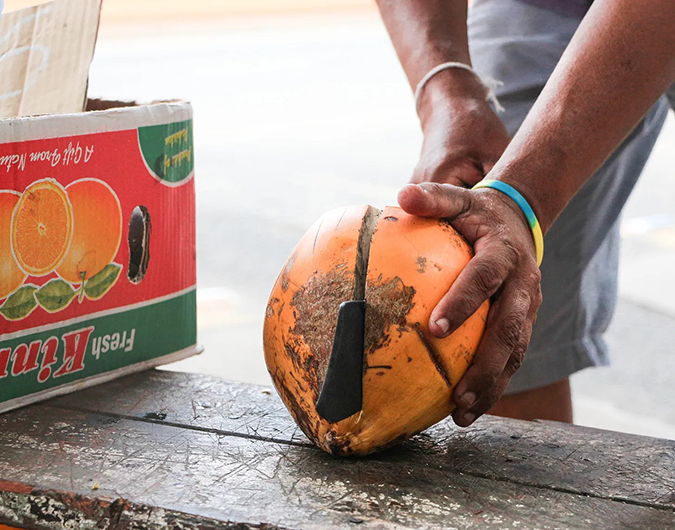
King coconuts take anywhere between 8-14 months to fully mature. “Tender nuts are full of water,” Sudath tells me, noting that these small, tender coconuts have a lighter orange shade. When they grow older and larger in size, they acquire a darker shade of orange. “Older coconuts sell fast because of their sheer size and the attractive colour,” Sudath says, “But it’s the young, small ones that have more water. They are healthier,” he chuckles.
The local palate prefers everything sweet. It is another reason many customers pick large coconuts, as their water contains a distinctive saccharine taste. Oftentimes, Sudath advises his customers to choose a tender coconut. But they seldom listen to him. Sudath’s coconut business is the only income for his family. Dreading customer disapproval and losing his income, he sticks to piles of matured thambili and stocks only a few tender nuts for the connoisseurs, those who, in his words, ‘know’.
Our love for thambili stems from living every day in the year-long tropical climate. While I love walking, it is often a challenge in Sri Lanka. Walking merely a mile in Colombo is exerting. Sweat drips down your forehead after five minutes in the harsh sun. Your cotton shirt is soaked in sweat as if you accidentally passed by a quick rain shower. When we exert and sweat, we lose electrolytes, minerals such as potassium, sodium and magnesium, resulting in fatigue and dehydration. Thambili is packed with these electrolytes: it is nature’s Lucozade. So when we see piles of golden orange lining the pavements from a distance, we know that it is not just another coconut: in Sri Lanka, thambili is happiness.
Thambili is also more than a simple thirst-quencher; it has both culinary and wellness uses. Diwani Welitharage is a pharmacist by profession and explains to me how thambili water helps digestion and metabolism. “Drinking thambili water on an empty stomach early in the morning boosts your energy,” she tells me over the phone. Thambili is not only rich in vitamins but has been credited with everything from anti-aging properties to treating urinary tract infections in Ayurvedic medicine. “Some people drink it with sandalwood powder to help nourish their skin,” Diwani explains.
In her spare time, Diwani loves to study traditional Sri Lankan cuisine and experiments with thambili water, often combining it with lime, rambutan and chia seeds, or cooking baby jackfruit and marshy herbs directly in the water, the acidity softening the starch. But “for health benefits,” Diwani says, “just drink it as it is.”
Given its myriad properties, it’s no surprise that there is now a lot of money to be made from thambili. Thambili water is now packaged and exported globally; famous exporters like Eliya, based in New York, supply it across the globe to the Fairmont chain’s hotels in Dubai and Taj group hotels in New York, promising a taste of “the paradise island” for $60 for a 12-pack. This humble coconut now features in cocktails and trendy drinks in bars, high-end hotels and chic cafés in both Sri Lanka and abroad. A luxe beach resort in Sri Lanka once welcomed me with a chilled thambili mixed with Sri Lankan arrack (a local alcohol made from the fermented sap of coconut flowers) and lime juice. In the scorching heat, I couldn’t have asked for a better welcome drink.
Apinash Sivagumaaran, CEO at the popular Isso restaurants in Colombo and the Maldives, tells me that thambili is a popular item on their drink menus. Apinash and his team studied the market and customer preferences before they opened their first restaurant in 2017. He wanted to incorporate bits and pieces of Sri Lankan coconut culture at Isso in a more luxurious way. Instead of extracting the water into a glass, the giant nut comes to your table, refrigerated and chilled, in homage to the surrounding crowded streets hemmed in with piles of thambili. “It is much more personal,” Apinash says.
None of this, however, really captures the experience of buying thambili from a roadside vendor. A quick thambili stopover on the streets in Sri Lanka often turns into friendly banter with fellow customers and vendors. I fear the water dripping down my clothes, so I would use a straw to sip my thambili. But others, like my father, would keep his mouth pressed to the nut, and gulp it down without a straw. It’s a skill to master.
When Sri Lanka went on a strict, police-managed curfew to control the spread of COVID-19, roadside thambili vendors like Sudath belong to the country’s ‘informal sector’, which contributes to about 40% of the nation’s GDP, took a heavy blow. During the pandemic, thambili sellers, street food vendors and porters have been the worst hit among all of us. People like Sudath, who stand long hours in the sun to quench our thirst, are also the least supported by the government or the authorities.
Sudath tells me that the initial days in the lockdown were very hard. He tried his best to obtain a permit. After a couple of weeks, having contacted a police officer he knew, his permit arrived. He hired a truck, wore a mask and went door to door selling thambili. Business was slow. “I was scared too. I am 50 now and I was scared of bringing the virus home,” he tells me. “But without the business, my family would go hungry.” BBC