
Life style
Taste for good cars


BOOK REVIEW
VINTAGE DENNIS AND ROBEY VEHICLES IN SRI LANKA by Ali Azeez; 60 pages, A5 size, numerous black-and-white and colour illustrations; published privately in 2014.
Copies in PDF format may be obtained free of charge by emailing the author at aliazeez07@gmail.com .
Reviewed by Roger Thiedeman
The pioneers of Sri Lanka’s vintage car movement in 1953 were Capt. E.B. ‘Tabby’ Murrell, Mr. Edward ‘Bugs’ Mason, Mr. H.C. (Chitru) Peiris, and Mr. W.R. Daniel. In following decades the old car ‘baton’ was passed on to other stalwarts, of which Mr. Vere de Mel was one. Another was the author of this book, Mr. Ali Azeez.
Ali’s enthusiasm for motor cars, especially what are today considered vintage and classic automobiles, began at an early age. Born into a family noted for its good taste in cars, it was inevitable that Ali would develop an interest in all things automotive: driving, maintaining, owning, and collecting a variety of vintage vehicles, while reading extensively on the subject. Today he is the proud owner of a 1936 Riley Lynx ‘Special Series’ tourer that once belonged to a close relative, and a 1937 Citroën Traction Avant 11CV Familiale (11B) long-wheelbase saloon. Land Rover is another marque beloved of Ali Azeez.
In time Ali became an active committee member of a succession of veteran/vintage car clubs in Sri Lanka, culminating in him holding senior positions in the Vintage Car Owners’ Club of Sri Lanka (VCOC). That was a period when, in addition to his knack for organising and promoting numerous vintage car rallies, road races and exhibitions, as the VCOC’s Newsletter Editor Mr. Azeez began to research and write ‘dossiers’ tracing the histories of interesting old cars for publication in the Newsletter. The subjects he chose were mostly vehicles owned by club members, but others from Sri Lanka’s motoring past were featured too.
One of Azeez’s in-depth profiles is the only detailed history of one of the rarest and finest cars to grace the roads of old Ceylon: a 1924 Napier 40/50 hp Cunard limousine which was imported by a distinguished member of his family.
In view of the passion, time and energy Ali Azeez selflessly invested in serving the VCOC, his involuntary exit from the club more than a decade ago in circumstances of which he was an innocent victim, can only be described as unjust and senseless.
Despite that blow, Ali Azeez never lost either his love of vintage cars or avid interest in motoring history. If anything, it gave him more time, opportunity and motivation to begin learning about types of vehicles that most other vintage enthusiasts might regard as ‘unglamorous’ and unworthy of their attention. This book is partially the result of that work.
Inspired by photos this reviewer took in 2011 of the Kandy Municipal Council’s preserved 1929 Dennis G-type fire engine, and two Robey steam wagons at the Sri Lanka-German Railway Technical Training Centre (SLGTTC), Ratmalana, Ali began his quest to discover as much as possible about the individual histories and mechanical characteristics of those vehicles. With encouragement from Mr. Brian Elias, a personal friend of Ali’s and Editor of a local newspaper’s motoring supplement, Mr. Azeez contacted several organisations in the UK dedicated to the preservation and history of old fire engines and steam-powered wagons (lorries) and traction engines.
Key members of those societies, with whom Ali forged close relationships, generously provided him with vast amounts of information, including rare photos and excerpts from specialist journals pertaining to that trio of vehicles before and after they arrived in Ceylon. Much of that material has been used in this book, which is all the better and more attractive for their inclusion.
Supporting the author’s text and pictures in both black-and-white and colour of Kandy’s Dennis fire engine, registered G-1010, official Dennis factory records provide more fascinating details. Extracts from Customer Order Books, Works Production Orders, and Chassis Lists and Despatch Records – each occupying a full page of the book for easy reading – comprise a potted ‘biography’ of this historic fire appliance, beginning in 1929 at its birthplace in Surrey, England.
As a bonus, the book contains information and photographs of other Dennis fire engines that served in Ceylon. Most notably a 1955 F8 model used by Britain’s Royal Navy at the dockyard in China Bay, Trincomalee. It later returned to the UK where it is now the prized, pristine possession of a fire engine enthusiast who also proved helpful to Ali in his research project.
Another comprehensive chapter is titled ‘Robey Steam Wagons in Sri Lanka’. Commencing with a brief explanation of the technical aspects of steam propulsion in roadgoing vehicles, the narrative shifts to a short history of Robey & Company, the Lincoln, UK-based makers of the two steam wagons of 1925 and 1928 vintage that are this chapter’s principal subjects.
Official records, correspondence relating to the two Robeys, plus a table of their ‘vital statistics’ aside, photographic coverage of both wagons is particularly impressive. Sure to please any lover of transport nostalgia and memorabilia, not just motor or steam vehicle aficionados, are photos of both vehicles working hard for their then employers, the British Ceylon Corporation (BCC), at various locations around Colombo. Two such ‘period’ pictures in colour are stand-outs, although others in black-and-white from the pages of UK-published Steaming magazine, are equally appealing. More colour pictures depict one of the vehicles (registered C-6037) at VCOC rallies and exhibitions before and after restoration by the SLGTTC.
But Ali Azeez’s interest in vintage motoring goes beyond classic motor cars and the utilitarian commercial types that are this book’s main subjects. As a fervent advocate for the preservation and fostering of Sri Lanka’s motoring heritage, for many years he has been campaigning and lobbying relevant authorities – and anyone else willing to listen – for the establishment of a national motoring museum, with State backing and continuing upkeep.
In a chapter titled ‘Transport Museum: An Immediate Need’ Azeez describes some of the museums in Sri Lanka, extant and defunct, small and large, dedicated to other types of transport. For example, the Old Town Hall Museum in the Pettah (which houses another steam wagon, built by Sentinel), the Sri Lanka Navy’s Museum at the Dockyard, China Bay, and the excellent Sri Lanka Air Force Museum at Ratmalana Airport. In fairness to the author, given that this book was published in 2014, no mention is made of the National Railway Museum at Kadugannawa, which was opened in late December that year.
Not entering into the author’s ‘calculations’ either are the motoring museums established in Sri Lanka over the past few years by a small handful of private and discerning car-collecting connoisseurs. Their extensive, varied and dazzling collections of motor vehicles are displayed in purpose-built ‘showrooms’, one in particular rivalling the facilities of better-known motoring museums overseas. But they are not open to the public, with visitors admitted in small numbers and only by special arrangement with the owners.
Rather, what Ali Azeez would like to see is a unified transport museum, accessible to the general public, that would accommodate, all on the same premises if not under one roof, the many road transport relics currently scattered around various government institutions. To demonstrate his point, he has depicted several of those vehicles within this chapter’s pages. Such a facility might induce private owners of historic vehicles to place some of their precious automotive possessions on public display in a secure environment, perhaps on a rotation basis as determined by the museum’s curators.
Almost as if responding to his own pleas, Ali Azeez cites numerous instances of how and when similar proposals were mooted, attracting tentative interest from the authorities, only for those grand plans to be shelved or disappear altogether. From this reviewer’s pragmatic point of view, the current economic climate in Sri Lanka – COVID-19 notwithstanding – will never be conducive to any such ambitious albeit laudable project getting off the ground, let alone reaching fruition.
Yet that should not detract from Ali Azeez’s well-meant intentions and dreams. Nor from his passion and foresightedness as a lover of all things motoring, not only when he wrote this book but over the years before and since. This slim but pleasing volume, packed with information, historical records, and attractive illustrations, is recommended to anyone interested in all aspects of road transport history, especially in the context of Sri Lanka.



Institute of Hospitality Sri Lanka
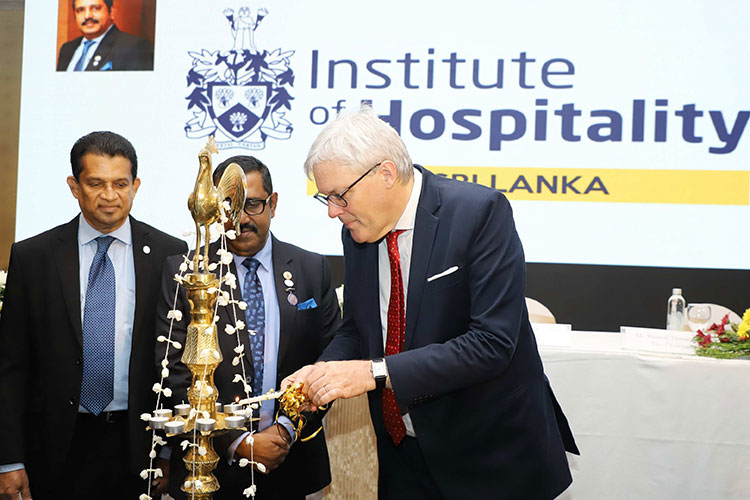
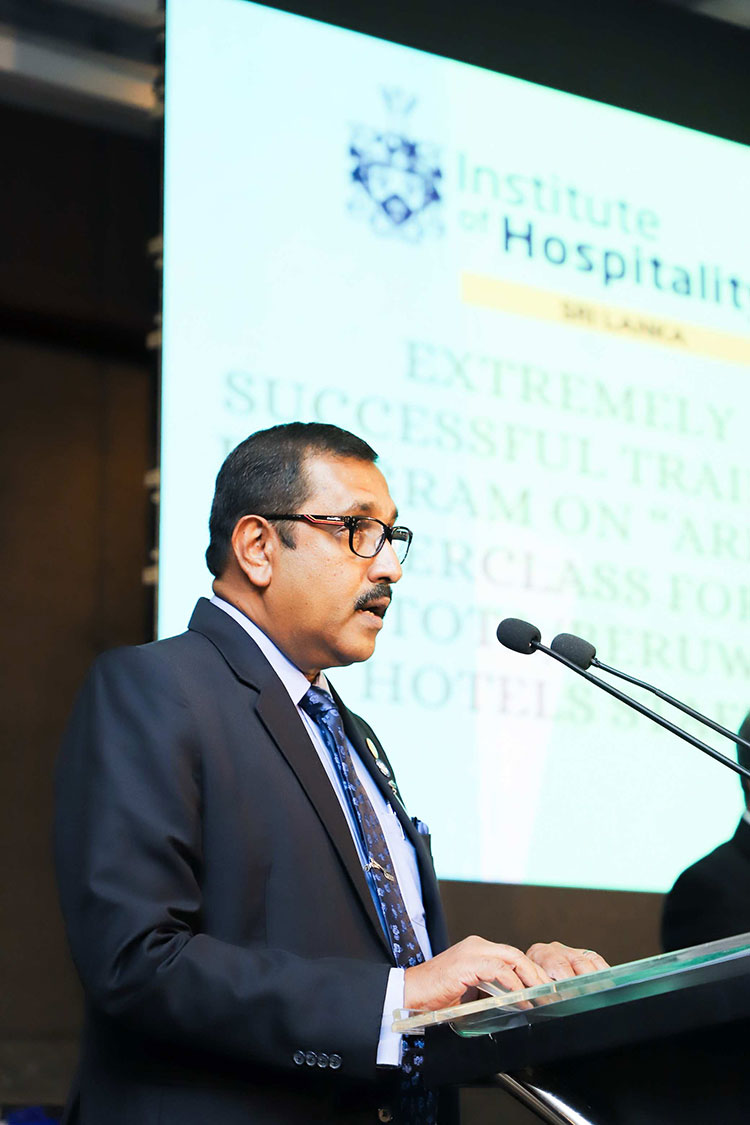
 The 32nd Annual General Meeting (AGM) of the UK-based Institute of Hospitality’s Sri Lanka Chapter was held recently at the Ramada Hotel Colombo,.The event provided an evening of camaraderie , reflection of the past and present achievements,setting new benchmarks for the future
The AGM had the presence of two distinguished guests, the Chief Guest Opposition Leader Sajith Premadasa, and the Guest of Honour British High Commissioner to Sri Lanka, Andrew Patrick. Their inspiring speeches were lauded by all hoteliers who were present at the occasion
A special thanks was extended to Robert Richardson, CEO of the Institute of Hospitality UK, along with his team, sponsors, committee members, and all attendees for making the event memorable.
Dr. Harsha Jayasingh, Past President of the Institute of Hospitality (UK) Sri Lanka Chapter, emphasised the Institute’s longstanding history and the strength of its Sri Lankan branch. “The Institute of Hospitality (IH) UK has a history of 86 years, and we are proud to be the Sri Lanka Branch. IH Sri Lanka is much stronger now with many members from all areas of the hospitality industry,” he stated.
Dr. Jayasingh highlighted the significant role of tourism in Sri Lanka’s economy,. He said tourism it is the third-largest source of revenue for the country. “Tourism accounts for about 13.3% of total foreign exchange earnings and employs 450,000 people directly and indirectly. The hospitality industry in this island of pearl holds tremendous potential for economic growth, job creations, and cultural exchange,” he added.
He also pointed out more women should be attracted to the industry and advocated for the use of technology in hospitality sector to attract the younger generation.
The newly appointed Chairman Ramesh Dassanayake spoke about the challenges faced by the industry, including the reluctance of youth to join the sector. . Dassanayake expressed concerns over the migration of staff between hotels and the overall ‘brain drain’ in the sector. ” We must maintain high standards in the hotel We must try to attract tourists to Sri Lanka, we must have with many facilities Hence, hotel schools and other professional institutions involved in skills development mustincrease their intakes,” he pointed out.
Chief Guest Sajith Premadasa emphasised the importance of eco tourism and said “We need to have an environmental policy related to tourism in place,” . .
The 32nd AGM of the Institute of Hospitality UK, Sri Lanka Chapter, was a testament to the strength and potential of Sri Lanka’s hospitality industry. The insights and commitments shared during the event set a new benchmark for the future.(ZC)



Pix by Thushara Attapathu
Life style
He recognizes human identity beyond boundaries of gender, race, nationality and religion.

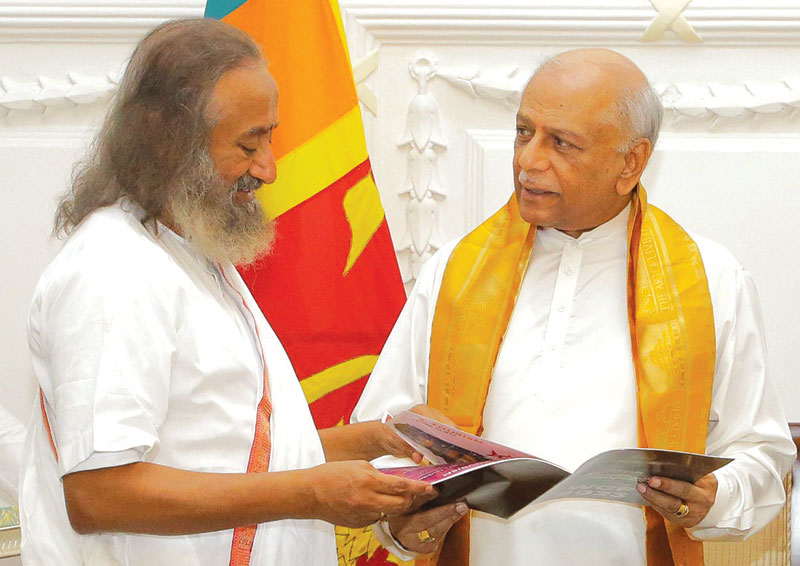
Visit of Sri Gurudev to Sri Lanka
Humanitarian, spiritual leader and Global Ambassador of Peace Gurudev Sri Sri Ravi Shankar (Sri Gurudev) was in Sri Lanka on a three day tour on the invitation of the Prime Minister of Sri Lanka Dinesh Gunewardene. Gurudev who inspired a wave of volunteerism and service to moot one of the largest volunteer-based organisations in the world – The Art of Living – visited the various projects under the aegis of the foundation and launched twelve vocational and technical centers around the island. He was accompanied by thousands of followers from Sri Lanka and around the world.
Gurudev who visited Sri Lanka for the sixth time also had a first day cover launched in honour of his visit. He is a strong proponent of spreading happiness, using the unique Sudarshan Kriya, yoga, meditation and practical wisdom to unite people, empower individuals and transform communities. His programmes provide techniques and tools to live a deeper, more joyous life, while his non-profit organisations recognize the human identity beyond the boundaries of gender, race, nationality and religion.
The Art of Living which has more than 30,000 teachers and over one million volunteers across 180 countries has touched in excess of five hundred million people around the world. CNN called it “Life Changing” and The Washington Post headlined it, “Fresh air to millions”.
In Trincomalee, Gurudev met with war victims and had a heartwarming engagement with the children from the children’s homes run by the Foundation. He also visited the Koneswara Temple in Trincomalee and graced the Kumbhabhishekam at Seetha ecogPnize the human identity beyond the boundaries of gender, race, nationality and religion. Amman temple at Nuwara Eliya. He held discussions with the trustees on the progress of the foundation’s social service projects, while also holding a special event – Ekamuthuwa – attended by a large number of dignitaries and his devotees from around the world.
His time with the Prime Minister was spent discussing the prospects of unity in diversity and uniting Sri Lanka by adding happiness into the formula of living. In addition he had discussions with the Speaker of the Parliament of Sri Lanka Mahinda Yapa Abeywardena, prominent business stewards and civil society leaders.
by Zanita Careem
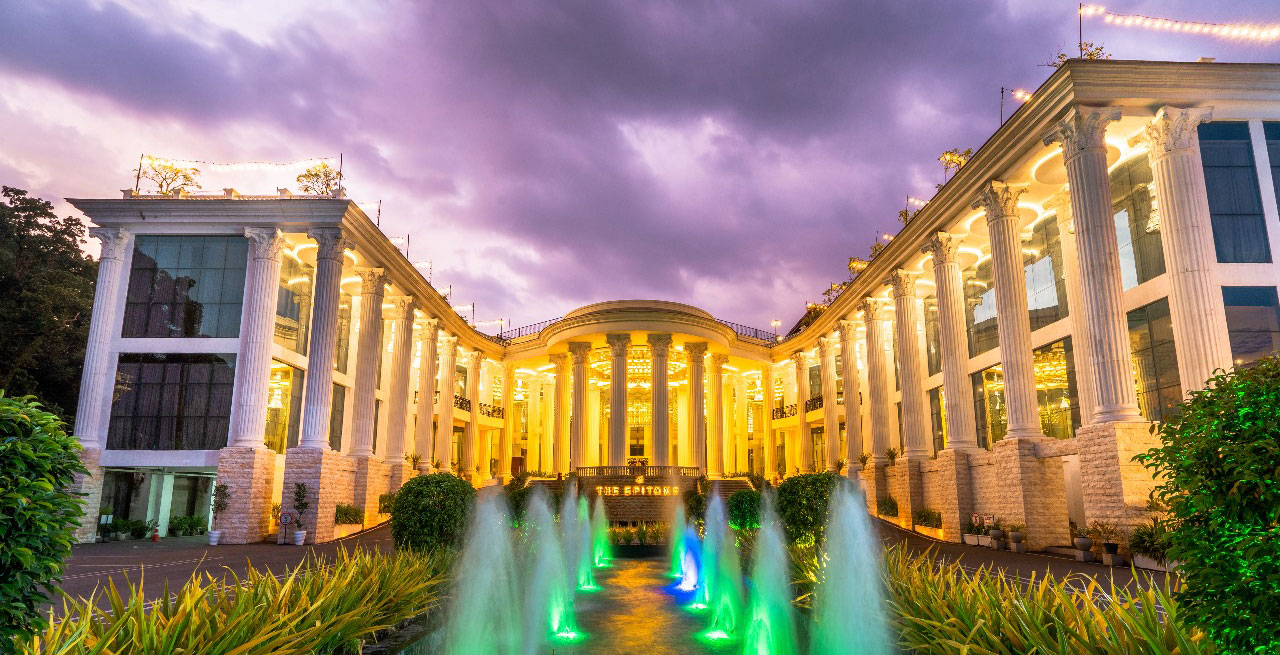
Envison your dream wedding day come to life at the Epitome Hotel, a prestigious city hotel in Kurunegala offering an unrivalled luxury rendors experience for weddings.
The venue is designed to embody opulence and luxury from all quarters for a spectacular wedding in kurunegala,Thier ballroom is the largest banquet facility in Sri Lanka It can be divided into six luxurious pillarless wedding halls on the ground floor and 25pax smaller banquet halls.
It can be easily named as a five star heaven in the heart of the city contributing to a myriad of immense experiences tailored to inspire and delight wedding experiences.
From opulent décor set up to exquisite table decor, lavish food, every detail is meticulously curated to spark your imagination and ignite creativity for a perfect wedding. The previous prestigious wedding shows season one and season two attracted large crowds
were unique events which gave the wedding vendors and potential clients had an opportunity to connect and interact with each other. Beyond being a showcase it was a chance for the wedding vendors to unite and contribute to the vibrancy of the wedding industry. The wedding show covered all area of the bridal industry providing a comprehensive variety of bridal supplies from Sri lanka and became the most popular bridal exhibitions in Kurunegala.This bridal exhibitions allowed brides and grooms to experience first hand the products and services available from suppliers in Sri Lanka
These wedding shows held at The Epitome created a benchmark and gave an opportunity for vendors to create connections to the utmost satisfaction said Harshan Lakshita Executive Director. of the magnificent Hotel
Our wedding shows featured experts and professionals in every field‘ It covered all areas of the bridal industry provided a comprehensive variety of bridal supplies from Sri lanka and became most popular bridal exhibition in this region.We are always open to everyone to join us at our wedding shows in the future. It is an opportunity to discover the incredible talent within our local wedding and bridal vendors to make meaningful relationships and plan thier special day at our breathtaking hotel The Epitome said General Manager Kavinda Caldera
The Epitome Hotel’s bridal show which will be held end of June will buzz with great ideas,advice and inspiration for all those who plan thier dream wedding
…….
The Hotel Epitome’s Wedding Season 3 will marked excellence, celebration and inspiration for those in the wedding industry. The exhibition halls will resonate with ideas on exquisite bridal wear to decor, florists , photography etc and showshowcase the rich tapestry of talent within the local wedding industry. .





US sports envoys to Lanka to champion youth development

Rahuman questions sudden cancellation of leave of CEB employees


