Midweek Review
Suzuki Method in Sri Lanka: Introducing an Actor Training System

By Saumya Liyanage Introduction
In 2019, the Faculty of Graduate Studies, University of Visual and Performing Arts initiated a project titled ‘Suzuki Actor Training Workshop’ with a performance maker and actor trainer Dr Deborah Leiser-Moore from Melbourne, Australia. The objective of this workshop was to introduce a novel approach to actor training through the least explored performer training system in Sri Lanka known as ‘Suzuki Method’ conceived and developed by a well-known Japanese theatre director Tadashi Suzuki. The Suzuki method has been used and taught in many Universities and theatre institutions in the world and this approach to actor training was first popularized in America, Australia, and Europe in the early 80s. However, this approach of actor training was not known to Sri Lankan academia or theatre schools. The dominant performer training paradigm has been the Stanislavski or Method, derived from Stanislavski’s system or later the version of Method acting derived through American actor training tradition. This domination has been a widespread phenomenon in major actor training schools in the world. Yet, in the early 80s and latter part of the decade, the Suzuki method has become one of their major disciplines in actor training curricula, especially in Australia and America. This Suzuki actor training workshop was the first attempt to introduce Tadashi Suzuki’s methodology to a Sri Lankan group of actors.
Tadashi Suzuki
As a theatre student reading for Master’s degree at Flinders University South Australia in early 2002, I was first introduced to Suzuki’s approaches to actor training. My thesis supervisor Prof. Julie Holledge introduced Suzuki’s key texts as I was reading various actor-training methodologies and preparing for writing the thesis. At the time the Suzuki method was one of the popular approaches to actor training in many theatre schools and theatre ensembles in Australia. Suzuki had visited Australia several times and had worked with Australian actors to share his ac


tor training method and his philosophy of theatre. Further his writings and theoretical and methodological promises of actor training have been widely discussed in theatre forums and symposia in Australasia. I first read his key text The Way of Acting (1986) to learn this master’s approaches to theatre, body, and performance. In addition, several key journal papers written by eminent theatre scholars who had practical experience of his theatre making were also my starting point (Allain, 1998, Allain, 2003, Allain, 2019, Goto, 1989a, Kim, 2013). These writings which offered in depth descriptions and analyses of the efficacy of Suzuki method further opened up my horizon to think through Suzuki and his theatre works.
Tadashi Suzuki, an 81-year-old Japanese theatre director first started his theatre career in the 1950s during his undergraduate days at Waseda State University, Japan. As a student theatre activist, with his writing collaborator Betsuyaku Minoru and 12 amateur actors, he founded the Free Stage (Jiyu Butai) theatre group an
d produced theatre works that reflected the ‘turbulent era of his time’ (Goto, 1989, p. 103). As such, Suzuki’s ideas on theatre and the philosophy of actor’s role in theatre were somewhat reminiscent of European avant-gardes such as Antonin Artaud or Jerzy Grotowski. As Artaud and Grotowski rejected the text and its domination in the theatrical experience, Suzuki was also of the view that the centre of the theatrical experience should be the actor and the actor’s co-presence with the audience. His experimentations of theatre works since early 60s to date have emphasised the actor’s body and voice as the kernel of theatrical experience.
He had the conception of finding new ways of doing theatre when he first visited France to take part in an international theatre festival. After returning, Suzuki and his group had found a mountain farmhouse located hundreds of kilometers from Tokyo, and had converted it into a theatre house. Since then Suzuki has explored his actor training and theatre works in Toga Little Theatre in Japan. Toga is a remote village in Japan where Tadashi Suzuki started his theatre practice and still functions as the centre of his theatre and actor training explorations.
Why Suzuki?
I thought of introducing the Suzuki method to Sri Lankan theatre actors for several reasons. I have observed that Sri Lankan theatre and especially its performance practice are diminishing with elaborate technology and stage craft. Further, the actor’s body and its capacity are also marginalized for the sake of proscenium dialogical dramatic acts that we experience in contemporary theatre. Older versions of psychological realism still dominate in theatre and the actor’s capacity, voice, and physical expressions have gradually been forgotten. As I have frequently argued, the ‘primal ritual’ of theatre and actor’s art need to be re-established in order to reinstate a sustainable theatre experience between theatergoers and actors. For theatre audiences in Sri Lanka, whether it is English, Tamil or Sinhala speaking theatres, theatre experience has become a mere proscenium arched framework where people watch daily popular political jargons and obscene jokes brought to entertain them. It is pity to see that the actor’s art has never been in such a poor state where actors on stage perform like marionettes in television soap operas.
The distinction between television screen and theatre is narrowed to a place where a nuclear family saga or political jokes are the core of experience.
In this sense, the Suzuki actor training method is a unique approach to actor training among other performer training pedagogies. It is unique because it focuses on the actor’s development of lower body, stillness, stamina and the presence of the body on stage. On the other hand, it is an innovative actor training method that emphasises the animal-energy in theatre. As Suzuki argues, pre-modern theatre in Japan and elsewhere employed animal-energy to create theatre and stagecraft, and theatre technologies were merely created through human engagement. Suzuki uses this term animal-energy to discuss how raw human engagement is used in traditional theatres such as Noh and Kabuki in Japan and also kuttiyattam and Kathakali dance drama in India or Balinese theatre in Bali, Lombok or in East Java. Talking about his actor training system Suzuki further explains:

As this quotation depicts, Suzuki discusses his discontentment of the current practice of the human body on stage and further discusses how the human race has extended technological innovations to replace perceptual organs. For instance, he explains how the human eye is replaced with the microscopic apparatuses to see what the human eye cannot capture through its naked eye. However, Suzuki’s lament with the modern technology and its domination of human cognition is not a new conceptual position. Since the inception of the industrial revolution, many scholars and philosophers have addressed this issue and notably, the intervention of technology and its impact upon human life was a heated debate.
The invasion of intermedial applications in modern and contemporary theatre is something that we cannot ignore. This intermediality has replicated the natural human body and its performativity on stage by elevating digital and visual power over the human body and theatre at large.
However, the importance of Suzuki’s criticism is that he intends his actors to find true selves and the corporeal presence on stage. In line with this argument, Suzuki has invented a method which emphasizes the lower part of the human body—legs—and its connection to the floor. (This idea of focusing on the lower body and its connection to the earth was not new to Sri Lankan dance practice. However, with the advent of visual medium and digital technology the performer’s focus has been shifted from the floor to the upper body).
The basic activities that Suzuki has formulated to train actors is a series of various stomping methods and walking patterns that allow actors to work as individuals and in groups. In this stomping method, actors are intended to hit the floor vigorously and continue stomping for at least half an hour while keeping their upper bodies still. Therefore, the actor’s endurance and stamina are tested with these rigorous exercise routines. Stomping further allows the actor to see how his/her upper body reacts to the lower body when legs are hitting the ground. The challenge of maintaining the balance, the centre of gravity and energy flow through the pelvic area to the ground, and its equal force towards the upper body is constantly been measured and tested in this actor training method.
Deborah Leiser-Moore
With the concept of eradicating daily routine and mundane habitual behaviors, I had several conversations with Australian actor/director Deborah Leiser-Moore, and finally decided to conduct a week-long Suzuki actor training for a group of selected Sri Lankan actors in mid-2019.
I first met Deborah during my stay at La Trobe University Melbourne while reading for my PhD. I was assigned to teach a few undergraduate classes Asian performance traditions and at the time Deborah was a hired lecturer at the Department of Theatre, La Trobe University Bundoora, Victoria. She wanted to take part in my workshops and later I found that she was going to conduct a series of workshops on Suzuki actor training for undergraduate theatre programme. Associate Prof. Rob Conkie introduced me to Deborah and she invited me to take part in her workshop on the Suzuki method. For the first time in my career as an actor, I was exposed to the Suzuki method which was physically challenging and psychologically draining when I underwent training.
Deborah has studied the Suzuki method and gained first-hand experience of working with the master actor trainer and theatre director Tadashi Suzuki and his actors in Waseda Little Theatre (Waseda Shogekijo) in Japan. In addition, she has studied the work of Ettiene Decroux, and his corporeal mime, and has worked with Richard Schechner’s Rasaboxes. Deborah is a performance maker and actor who has created many solo performances and has performed them in several theatre festivals around the world. She has worked as a sessional lecturer at many Australian Universities such as La Trobe, Wollongong, Sydney, Monash, and University of Western Sydney where she has taught and developed course contents, supervised theses, and theatre productions.
Suzuki Method in Sri Lanka
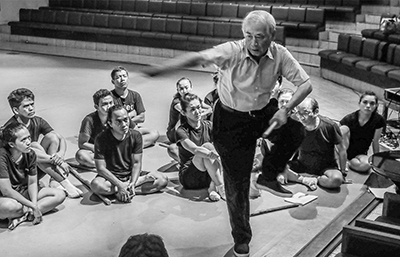
The Suzuki actor training workshop, conceived and developed by Dr Saumya Liyanage and Dr Deborah Leiser-Moore, was mainly focused on the actor’s ‘Present’ in the given moment, developing stamina and deconstructing daily habit body and cultivating a sense of presence and focus on the body and text. The participants were selected through an application process and the workshop was limited to twenty-five actors of both genders. The week-long workshop was designed to work with actors throughout. Deborah conducted her actor training workshop quite similar to what she has learnt during her Apprenticeship in Toga, Japan.
Young and enthusiastic actors and a few dancers were selected to take part in this unique performer training workshop and every moment of working with Deborah was a joyful experience for Sri Lankan actors. These selected actors were either graduates or had professionally worked in the Sinhala or English theatre. Among these actors, there were a few dance graduates who were keen to explore performance genres. However, the Suzuki method is a rigorous and a physically demanding actor training system. Many of the actors were physically and psychologically drained during workshop hours. Sri Lankan actor training taking place in a few university theatre departments and ad-hoc theatre workshops conducted by individuals mainly focuses on theatre exercises derived from European or American teaching and are also very much confined to theatre games. The Suzuki method however, which is fully focused on the actor’s body and the culture of training and its impact upon the actor’s body, is completely different from what Sri Lankan actors have experienced. I believe that the actors who worked with Deborah have questioned themselves, the capacities of their bodies, the connection between the body and their cognitive operations, and interrelation between actors, which would have been a novel eye opener for them.
Conclusion
Deborah wanted to conclude the Suzuki actor training week with a performance demonstration. The actors enthusiastically worked with Deborah to compile what they had learnt throughout the week-long session and later integrated a text written by Prof. Peta Tait with whom they discussed practice-based research and its contemporary development in postgraduate studies in Australia and other countries. Prof. Tait and Dr Deborah also conducted several postgraduate seminars focusing on how performance practice could be a research insight for students who wish to pursue research degrees in theatre and performing arts. I would like to conclude this piece of writing with Prof. Tait’s poem that we used in the final performance demonstration.
I watch the sea below.
I fly further and further – between sky and sea.
The flight takes over my soul.
I can’t feel my body
The island appears beneath as if by magic.
An island silenced by war.
I could never dream up this brilliance.
How could I imagine this richness that leaps at the senses?
War moves people across impossible distances
With a spin of fate, it makes us someone else
Fighting off a force waiting to steal away our lives.
But my war is a strange one.
Where’s the enemy?
Then all goes still and silent
Peta Tait @ Longing
Acknowledgements
The Author of this paper wishes to thank Dr Deborah Leiser-Moore, Emeritus Prof. Peta Tait, La Trobe University Australia, and Associate Prof. Rob Conkie, Dept. of Theatre, La Trobe University, Australia for supporting this actor training project. Further, the author’s gratitude goes to the following people: Natasha Hilary, Samal Hemachandra, and the staff of the FGS, UVPA Colombo who managed the project. Himansi Dehigama and Sachini Senevirathne helped copy editing this paper.
Reference list
Allain, P. (1998). Suzuki Training. TDR/The Drama Review, 42(1), pp.66–89.
Allain, P. (2003). The art of stillness : the theatre practice of Tadashi Suzuki. New York: Palgrave Macmillan.
Allain, P. (2019). Physical actor training 2.0: new digital horizons. Theatre, Dance and Performance Training, 10(2), pp.169–186.
Goto, Y. (1989a). The Theatrical Fusion of Suzuki Tadashi. Asian Theatre Journal, 6(2), p.103.
Kim, J.K. (2013). Suzuki Tadashi’s Intercultural Progress in South Korea. Asian Theatre Journal, 30(1), pp.207–222.
Tadashi Suzuki and Steele, K.H. (2015). Culture is the body : the theatre writings of Tadashi Suzuki. New York: Theatre Communications Group.