Features
SURREY IN A HURRY

CONFESSIONS OF A GLOBAL GYPSY
By Dr. Chandana (Chandi) Jayawardena DPhil
President – Chandi J. Associates Inc. Consulting, Canada
Founder & Administrator – Global Hospitality Forum
chandij@sympatico.ca
Back in England
On October 23, 1983, I arrived in London with my wife, to start a new chapter of dreams, ambitions and also some uncertainty. This was my fourth visit to the United Kingdom (UK). Previously I spent a few months in UK, as a Management Trainee with the Trust House Forte (THF) hotels in London, as a Fellow of the International Labour Organization (ILO) with assignments in four British cities, and also as a tourist in England and Scotland. We were very familiar with London and the nearby areas.

I had finally been accepted to the first batch of the world’s first master’s degree (M.Sc.) in International Hotel Management, at the University of Surrey (UoS). I was planning to be in UK as a full-time graduate student for a maximum of two years, but hopeful to complete my program within a year. To achieve that, I needed to manage my time well to pass all ten courses over a period of two semesters, and then write a dissertation within six months.
Due to unavoidable challenges, I was late by a month to arrive in UK to join the M.Sc. program. I knew that I would have further challenges but I was determined to overcome obstacles and jump over the hurdles to the best of my ability. I was focused on catching up the studies of the missed month within a few days, but I was nervous. Early in the morning of my second day in UK, I arrived at the residence of UoS.
The University of Surrey
I was welcomed by Professor Richard Kotas, the Program Coordinator for the M.Sc. His encouragement during a week in early 1982, that I spent at UoS as part of my ILO Fellowship, was the main reason I joined this program. He was very helpful in assisting me to catch up quickly the month that I had missed. He soon became my life-long mentor.
UoS is a public research university which had received its royal charter in 1966, along with a number of other institutions previously known as colleges of technology. Over the years, the university’s research output and global partnerships have led to it being regarded as one of UK’s leading research universities. UoS’s bachelors’ degree in hotel management and master’s degree in tourism development were generally considered the best British university programs in the field.
Although now, masters’ degrees are common in hotel management, in 1983, it was unique. Most hotel industry leaders in UK at that time, had commenced their careers at the lowest levels of the industry or with craft-level qualifications. They doubted if masters’ degrees were needed for a hands-on trade like hospitality.
The M.Sc. first batch had only nine students but all enhanced the ‘international’ feel of the program. We came from nine different countries – the Bahamas, Cyprus, Greece, Hong Kong, India, Kenya, Nigeria, Sri Lanka and the UK. At age 29, I was the fifth oldest in the batch. We all lived in the main university residence in Guildford for two semesters. It was a nice campus with five restaurants and pubs, a cinema, supermarket, post office, bank and a large sports complex. I was totally content to remain on the campus on my days in Guildford.

Starving and Studying
I quickly settled into my studies and assignments, but I was very unsettled about our cash flow situation. Although, we assumed that my wife could find full-time work easily and quickly, it did not happen as envisaged. I was too busy catching up with my outstanding studies, and did not have free time to do part-time work yet. Our little extra cash kept for a rainy day was gradually evaporating.
I took my cutting down on expenses to a new level. Every week from Monday to Thursday when I stayed at the campus, each day I survived with the same diet – a coffee in the morning, a small egg sandwich by noon and a glass of milk and a banana in the evening. “Chandi, how come that you became so thin?”, my wife asked me one day, with a tear in an eye, when I returned to London. I pretended that I am keeping fit and slim, intentionally.
Within a month, our financial situation improved. My wife found full-time work as a receptionist at a Dutch oil company office in Knightsbridge in London. After many attempts, I found a part-time work as a waiter in Kensington, London during the weekends. Having been a Hotel Manager and the Manager Operations in the John Keells head office, for seven hotels in Sri Lanka, my adjustment to work as a waiter again after 10 years, was not easy.
As I was able to work only for a couple of days, it was not possible to find employment in keeping with my experience and qualifications. We rented a small apartment in West Hampstead in North London. My wife stayed there and I joined her every week, from Thursday evening to Monday early morning. The other three nights, I spent in my tiny room in the campus, studying long hours till early hours in the morning.

A Weekend Waiter at the Bombay Brasserie
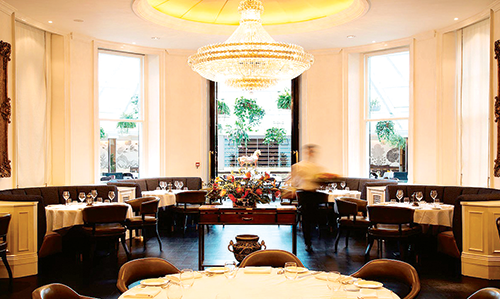
A letter of recommendation from Taj Samudra Hotel in Sri Lanka helped me to secure my first part-time job in London, with a sister hotel of the Taj Group. The General Manager of Baily’s Hotel, then owned and managed by the Taj Hotels of India, assigned me to work in room service at the hotel and their Indian Restaurant – Bombay Brasserie.
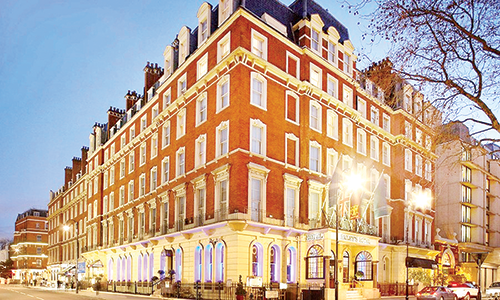
Bailey’s Hotel was one of the earliest, privately built hotels in London. The opening of The Langham on Regent Street in 1865, is generally considered the origin of the true luxury hotels in UK. Bailey’s Hotel was opened eleven years after that in 1876 and three years prior to the opening of the world-famous London hotel, The Savoy. Bailey’s bore the name of the developer, Sir James Bailey, a hotelier and politician.
Due to the location in West London (opposite the Gloucester Road tube station, which had opened in 1872) and the reputation of the owner, Bailey’s Hotel had attracted London’s aristocracy and wealthier inhabitants. A hundred years before I commenced working there, Bailey’s Hotel had been one of the more successful hotels in London with over 300 rooms. It also was very popular with international guests.
In 1983, although the Bailey’s Hotel appeared to be a little faded, the Taj Group had invested wisely to convert its street-front restaurant to become ranked as the best Indian restaurant in UK. It paved the way for Indian and Bombay cuisine in London. When opened in 1982, the high standards of the Bombay Brasserie were compared with a reputed competitor – then most prestigious and oldest existing Indian restaurant in London – Veeraswamy (opened in 1926), located in the Regent Street.
I did split shifts on Saturdays and Sundays, serving lunch and dinner at the Bombay Brasserie. In between my split shifts I had four hours to spare. I asked permission from the management to remain in the Bailey’s Hotel staff canteen during that time, to do my university studies. Other employees often mocked me for bringing a bag full of text books to work. “Are you a book worm?” they jokingly asked me.
I liked the gentle leadership style of the General Manager of the Bombay Brasserie – Mr. Adi Modi. Every Sunday, after the lunch customers left, he invited all kitchen and restaurant staff to sit with him in the restaurant, to consume the sumptuous buffet lunch. He achieved two things from that uncommon action – providing product knowledge to the internal customers and motivating his team. I was certainly motivated with that gesture, and a few years later, adopted similar initiatives as a Food & Beverage Director and hotel General Manager.
A Part-time Banquet Waiter at the Dorchester
As I settled in well at UoS, in addition to the weekends, I was free to work on Thursday evenings and a full-day on Fridays. I could have easily done extra shifts at Bailey’s Hotel and Bombay Brasserie, but I wanted to explore other options. My desire was to gain more diverse experiences in well-known five-star hotels in London.
I used my previous connections in London as well as new contacts to achieve that objective. I knew that five-star experiences would open new doors for me to reach my ambitious, career goal. I wanted to eventually become the General Manager of an international, five-star hotel branded by a top, global hotel corporation. My mid-term career goal was to first become the Food & Beverage Manager of a five-star international hotel. Investing time to gain valuable and high-quality experiences at any level, usually pays good dividends in the long run.
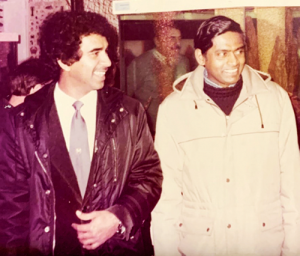

I met Mr. Wilfred Weragoda for the first time in 1974, when I was a final year student of the Ceylon Hotel School (CHS). He had returned from West Germany to Sri Lanka to manage Hotel Samudra. He was a member of the first batch of CHS, and had graduated in 1969. In the early 1980s, Wilfred and his family were living in London. He worked at the Dorchester, as the Food & Beverage Controller. A month after our arrival in UK, my wife and I were invited by the Weragoda family to lunch in their home. “I am impressed with your ambitions and perseverance, Chandana, I will help you to get into the Dorchester” Wilfred assured me.
The Dorchester is a five-star luxury hotel on Park Lane in London, to the east of Hyde Park. It was within walking distance of the Cumberland Hotel in Marble Arch, where I spent the summer of 1979 as a Management Trainee. The Dorchester had opened in 1931, and 50 years later, became a listed building. By 1983, it was generally considered the best five-star hotel in UK and one of the world’s most prestigious and expensive hotels. Throughout its history, the hotel has been closely associated with the rich and famous.


Walking into this iconic hotel in 1983, I was surprised at how well it still retained its 1930s furnishings and ambiance, despite being modernised, on a few occasions. During the Second World War, the strength of its construction gave the hotel the reputation of being one of London’s safest buildings. Leading politicians and military top brass chose it as their London residence. The hotel had since become particularly popular with movie stars, rock stars and super models. Elizabeth Taylor and Richard Burton frequently stayed at the Dorchester throughout the 1960s and 1970s. It was also Michael Jackson’s favourite place to stay in London.
By the end of November, 1983, I became a regular, part-time banquet waiter at the Dorchester. Every Thursday afternoon I left UoS after my last lecture for the week. I dressed in a well-ironed white shirt, black trousers and a pair of black dress shoes for my one-hour bus ride from Guildford to London. I then walked from the Hyde Park Corner straight to work. In the basement of the Dorchester, I put on a blue jacket and a dark blue, bow tie from the uniform room. I loved doing silver service at one of the greatest banquet rooms in UK, every Thursday and Friday. I was proud to be a gentleman, serving ladies and gentlemen who appreciated classy hospitality. Thank you, Wilfred!
I am ready and waiting to serve in the main ballroom of the Dorchester in 1983