Features
Supporting Conservation Education: the story of March for Conservation: Part I

By Ryhana Raheem
This article was prompted by a recent reference to March for Conservation (MfC) by Dr Rohan Pethiyagoda in his absorbing lecture entitled ‘Serendipity: The Discovery of Sri Lanka’s Biodiversity Heritage. The lecture focused on the pioneers who awakened our interest in the rich natural heritage of this island and ended with references to those who continued this work. Among those singled out for mention at the end was March for Conservation (MfC), and Dr Pethiyagoda made a glowing reference to the work MfC had carried out with the young people of Sri Lanka. This unexpected and flattering tribute, decades after MfC had been disbanded, seems to be a favourable opportunity to recall the work that this small but highly committed organization had managed to achieve particularly in Environmental Education (EE).
The beginning – the Marches and the Programmes for Schools
From the start, conservation education was the centre of focus for MfC. The organization which was based at the Department of Zoology, (now the Department of Zoology and Environment Sciences) University of Colombo, was founded in 1980 by Dr R Rudran of the Smithsonian Institution who had received a grant from the New York Zoological Society to fund environmental activities in Sri Lanka. A number of friends and colleagues were invited to Dr Rudran’s house in Colombo to discuss what should be done with the grant. The consensus of everyone at that meeting which included among others, Laki Senanayake, Irangani Serasinghe, Nihal Fernando, Ismeth Raheem, Sarath Kotagama, other naturalists and young academics from the University of Colombo was that knowledge and education had to be harnessed to preserve the natural heritage of the country.
And given the hiatus in environmental activities at that time, it was felt that the target audience should be young adults who would carry the message into the future. To draw young people into the fold, two major suggestions were made – a publicity event which involved a march through the streets of Colombo by school children who would carry posters and banners stressing the need for conservation, and an educational programme- a series of lectures for young adults in the Colombo educational zone. The decision to start with a march led to Sarath Kotagama’s suggestion that we call our organization the March for Conservation. Within days, Laki Senanayake had produced his masterpiece of a logo for MfC incorporating indigenous symbols that captured the centuries old tradition of nature protection and conservation in Sri Lanka .
The first march was a resounding success. Led by two baby elephants, the procession started out at the Dehiwela Zoo and as it wound its way along Galle Road and then Havelock Road, almost every school along the route joined in, carrying posters and banners that reiterated the message of the march. An attractive feature was that many of the schools came along with their school bands. Members of the public too fell in to stride along with the school children and it was an enormous throng of adults and children, accompanied by the sound of exuberant music that gathered finally on Galle Face Green.
In subsequent years, equally successful marches were organized in Colombo, in Polonnaruwa and a most eventful one- from Colombo to Kandy. This last march took place over five days with schools on the Colombo-Kandy road joining the march and marchers staying overnight at temples along the road .The march would halt in the afternoon at a temple, and in the evening, lectures on conservation issues would be held for the local community at the temple premises. The spectacular end was in the centre of Kandy town, which like Galle Face Green in 1980, was filled to capacity with adults and schoolchildren. A most unfortunate incident during this Kandy March was the attack at Kadugannawa on the veteran conservationist Irangani Serasinghe by a monkey who bit her on her eyebrow, narrowly missing her eye.


What the marches had proved was that the young people of the island were more than ready to heed the message of conservation. As one of MfC’s strengths was the availability of members who were academics, the organization was able to nurture this interest by supporting it with carefully thought out educational programmes that provided scientific knowledge on the geography of the island, the fauna, the flora and other topics related to the preservation of Sri Lanka’s biodiversity. At weekends, classrooms in the Faculty of Science at the University of Colombo were filled to capacity with school children from GCE A level classes from 40 schools all over the Colombo district.
This lecture series ended with an Environmental Quiz for which prizes were awarded: hundreds of children attended the Award Ceremony held at the university. This programme was repeated wherever marches were held and different competitions were organized. In Polonnaruwa, for example, the lectures ended with an Art Competition and the organizers were swamped with posters and art work on the theme of environmental conservation.
Unfortunately however the momentum of this effort was disrupted firstly by the ethnic riots of 1983 and more seriously by the JVP uprising of the late 1980s. However the seeds of interest, and more importantly, of relevant scientific information, had been sown and this perhaps contributed to the establishment of young people’s environmental organizations throughout the island in the late 1990s and thereafter.
The Sinharaja Project-Research and Education
While the Schools Programmes were going on, in December 1980, MfC embarked on another area of interest-research in wilderness areas. This too was initiated by a grant received by Dr Rudran, this time from the World Wildlife Fund. The focus of the project was the Sinharaja Reserve which had been subject to controversial logging in the 1970s. MfC’s initiative was to study the effects of deforestation on the small mammals of the forest. Research was the main activity of this project but as so little was known of this forest, MfC took the opportunity to include the Sinharaja Project into its educational efforts and share the knowledge that it had gathered with the general public. In January 1982, the organization disseminated the results of the study at the first-ever Sinharaja Symposium which brought together all the government institutions, universities and other institutions working in the Sinharaja.
In December 1982, MfC brought the forest to the city by organizing a highly acclaimed exhibition on the Sinharaja at the Lionel Wendt Centre in Colombo which drew large crowds of adults and children. The photographic panels that were created for this exhibition were absorbed into MfC’s educational programme as they could be dismantled and provided as a mobile exhibition on Sinharaja to schools all over the island.
The Sinharaja Reserve became a focal point of MfC’s educational efforts and a number of lecture programmes were carried out in situ at the reserve. The research area also became a location for workshops on ecology and conservation. In addition, pains were taken to include those who lived in the Sinharaja area in these educational efforts. In 1984, the young people of the Kudawa village, the western entry point into the Sinharaja , inspired by all that was going on around them, got together to form their own active conservation society.
In 1987, supported by the Natural Resources, Energy and Science Authority (NARESA), MfC produced a publication on this rain forest. In 1990, the authors revised the manuscript of ‘Sinharaja-a Rain Forest in Sri Lanka’ and developed it into what still remains as one of the seminal publications on the island’s best known rainforest reserve. The book was translated into Sinhala and in keeping with MfC’s emphasis on education, given free of charge to schools and sold at a nominal price to members of the public.All this work helped disseminate information and would have fueled public interest in and concern for the Sinhara forest.
The Environmental Education Project -Teacher Training and Pedagogical Support
By 1990, MfC had a great deal of experience in EE garnered by working consistently with schools on a systematic programme of learning enrichment. However, the organization had also come to realize that although there was no dearth of interest in the environment, teacher knowledge and skills were at a low, almost minimal level. In 1989, MfC had in fact, begun an inquiry into the factors affecting the teaching of EE at secondary level in Sri Lankan schools. This inquiry which was carried out in collaboration with NARESA and in consultation with the National Institute of Education (NIE) chose to survey schools in three regions, each representative of a distinct geographical/ecological area.

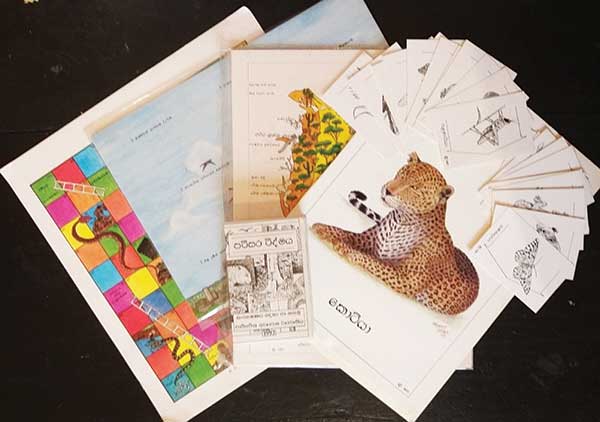
Activity Cards, games and booklets created forthe EE Project
The three regions chosen were the Western Province (industrialized/urban, Wet Zone), the Uva Province (montane/rural) and the Southern Province (coastal Wet Zone). The inquiry included a questionnaire survey which was followed up by consultative workshops with the teachers. By 1991, three very successful workshops had been held-one at the NARESA Auditorium in Colombo, the second at St Aloysius College, Galle and the third at Dharmadutha College in Badulla. One of the most satisfying results of the inquiry was the very active participation of the teachers who had definite ideas on their wants and needs vis-à-vis EE. Among the problems listed was the dearth of appropriate teaching/learning materials and teacher aids, the lack of audio-visual equipment and inadequate numbers of motivated, knowledgeable personnel.
Another interesting and unexpected finding was that the teachers emphasized that the links between environmental NGOs and the teachers should be strengthened. They felt that this would enable them to be better informed on controversial topics which impinged on their own communities such as the siting of industries in rural areas and the use of pesticides in agriculture and daily life. Furthermore the teachers also believed that the motivation and commitment of NGO volunteers was far more inspiring, and that the training imparted by conservation NGOs was more valuable than those of teacher educators.
This exchange of ideas thus provided useful insights as to how issues in EE could be remedied and in the next stage of this project, MfC decided to address itself to one of the central concerns- the lack of appropriate pedagogic material.
This EE project had as its objectives not merely the creation of educational aids but also the improvement of teaching methodologies and was designed to wean teachers away from teaching only from the book. The teaching aids designed were carefully prepared in accord with the syllabus being used at the time for Grades six, seven and eight and included different types of teaching/learning activities ranging from scholastic/ academic to fun-filled creative exercises.
All the lessons centred on resources that a teacher or child could find in a Sri Lankan school wherever it was located. Training workshops were held to introduce the teachers to the new material and provide guidance as to how to use them. In January 1993, the teaching packages were introduced into classrooms in Colombo, Galle and Badulla. In May 1993, evaluative workshops were held to gauge the effectiveness of the packages and gather information on teacher reactions with a view to improving the teaching aids.
Teacher reaction to the project was overwhelmingly enthusiastic, and paid tribute to many aspects of the project. These reactions are summed up by one participant who stated
“In my 23 years of teaching, including eight as a Master Teacher, I have attended numerous workshops conducted by many agencies. But, in my opinion, these workshops by March for Conservation have been the most enjoyable and useful – and the ones that I gained most from, professionally speaking.”
Other means of teacher enhancement were also established by MfC which included field workshops at the Peradeniya Botanical Gardens, the Sinharaja Reserve and the Horton Plains National Park. These workshops supported teacher knowledge of the wealth of natural resources in the country and also provided training in basic field techniques used to assess biological diversity. It was hoped that the workshops would instill greater enthusiasm amongst the teachers and motivate them to pass on this enthusiasm and newly gained knowledge to their students.[To be continued}
(Ryhana Raheem , Emeritus Professor, Open University of Sri Lanka is a Founder member of MfC and co-author of “Sinharaja- A Rain Forest in Sri Lanka”. She was the Chief Coordinator, MfC (1980 – 1983), Project Coordinator, MfC- Naresa EE project (1989 – 1993) and Project Director, BSEP (1994- 1998)