Midweek Review
Sumathy’s Ingirunthu

(Here and Now):
The Malaiyaha and Memory of the World 1823-2023
“It is intensely composed. I greatly appreciated the tension and obstacles to resolution along the way. We so rarely now see films that place that kind of creative demand/opportunity on the viewer.”
Anne Blackburn (Professor of South Asian & Buddhist Studies, Cornell University, 2017).
by Laleen Jayamanne
Structure and Process
Sumathy Sivamohan’s film Ingirunthu (2012), is astutely described here by Anne Blackburn. She highlights the unusually open ways in which shots, scenes and sequences are structured, which makes it difficult to immediately categorise the film generically and neatly thematise its several concerns and scope though it’s not a ‘difficult’ film, being very watchable. As the quotation indicates, the film invites us to think freely and imaginatively about what we have seen. As a film critic/scholar, I welcome this rare opportunity to provide a critical response, attentive to the film’s ethico-aesthetic crafting of Sivamohan’s own personal engagement (as an outsider) with vital aspects of life of the Malaiyaham people of the hill-country of Lanka. The experiences of this ethnic group, originally brought from South India as indentured labour to work in the coffee and tea plantations, by the Colonial British administration of Ceylon in the early 19th Century, have never been presented in all their historical complexity and violence, on film.
They, as an ethnically marked social group, speaking Tamil, have been hidden in plain sight. Sivamohan herself, as a Jaffna Tamil and Professor of English, who translates fluently between both Tamil and English, is a performer. She is well aware of the historical differences and tensions between the Jaffna Tamils and the Malaiyaha people whose very citizenship has been the site of post-colonial political violence and struggle. Among other stark differences, the differences in accents must be a powerful sonic marker of this fraught historical legacy which I can only imagine and read about because I don’t know Tamil. Within this historical context, the title of the film about the ‘here and now’ of Malaiyaha every-day-life is also presented as ‘Sumathy’s ‘here and now’ (in the credits), meaning that the very process of making of the film was part of the film’s story, folded into its telling. It’s worth recording that Sivamohan’s crew were multi-ethnic (as they continue to be in her practice), as was the case in the robust era of popular Sinhala cinema, from 1947 into the ’60s, when many technicians, producers, directors and musicians were both Muslim and Tamil. And of course, the star of the Lankan national cinema, Daisy Daniel or Rukmani Devi, was a Tamil who spoke and sang in a perfect Sinhala accent.
Intensive Composition
Also, the specification of what Blackburn calls ‘intensive composition’ invites a sustained conceptualisation, in terms of exploring the varying moods, tones, atmosphere and competing rhetorical moves of the film. This is the rich dynamic domain of sensations, feelings and emotions, which experiences have hardly impinged on the sensibilities of the Sinhala majority nation of Lanka except when the Malaiyaha people became an electorally significant block, as was the case with the Dalit of India. But we do know, as a general fact, the essential role their labour plays in the tea industry and the economy of the nation. But this awareness has mainly been culturally capitalised as picturesque images on tourist brochures or post cards of Malaiyaha women plucking tea with a smile or as smiling romantic couples in Sinhala genre films, driving sports cars through these scenic landscapes, singing love songs. The Malaiyaha people’s every-day life, their very here and now struggles, joys and aspirations have not been of much interest to the Lankans who may have glimpsed, through mist, their inadequate layams or line-housing (dotting beautiful hill-country landscapes, carpeted with lush green tea bushes), from a train window as we rode past them on up-country holidays, while their children waved to us.
Mobile Frames

Historians and theorists of Early Cinema (1895-1907), have linked the film frame to the window frame of trains, with their similar powers of mobility, selection and focus, unlike that of the still-photographic or painterly frames. They have also pointed out that historically, trains and the cinematic apparatus are technological products of 19th Century industrial modernity. The steam train and the movie camera are siblings, mechanical apparatuses that have transformed human civilization through industrialisation of production, distribution and consumption. They have also created new speeds in transportation and made human vision and mind adjust to the mechanisation of perception through technology. Some of the earliest black and white archival photographs (of those who became the Malaiyaha folk, as they arrived in Ceylon from several South Indian regions), are of them standing on railway platforms next to trains. Several scenes of the film take place at the Radella Station while trains wind through the landscape, tooting, from time to time. Some of the landscape shots are taken through train windows. Also, a popular genre of actuality films in the silent era were shot with the two mobile frames in concert. Among the very first films screened in Paris in 1895 was one simply called Arrival of a Train at the Station (1min) by the Lumiere Brothers.
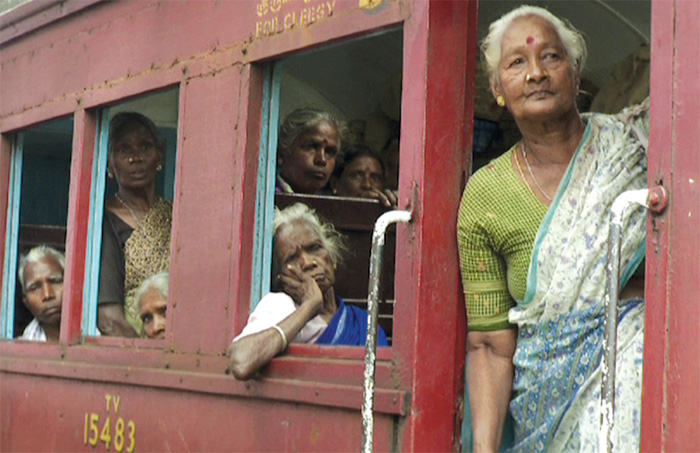
One of the most powerful sequences in Ingirunthu takes place on the railway platform and on the train, taking a ‘repatriated’ group of Malaiyaha people back on their trek to India, which their own ancestors took on perilous boats and then on foot to the hill country, to create the coffee and tea plantations by clearing jungles, which also led to the building of the train tracks for commercial transport of goods. The shots of the women seated within the train compartments, the young girls hanging out of the several windows, become emotionally charged (intensive), because we have by then come to know some of them a little in the film; who they are, their families and their daily routines. They are now the victims of the 1964 ‘Sirima-Shasthri Pact’ of repatriation of some 500,000 Malaiyaha people back to India. A printed archival document and a voice over reportage provides this information. Then we are shown these handful of people subjected to its violent decree, shifting from historical document to the story embedded in framed shots on the railway platform and within the carriages. These doubly enframed shots (camera-frame and train window-frame) encompass a vast duration, and in so doing they become truly epic-memory (non-subjective), images of historical State violence and injustice done to the Malaiyaha citizens of Ceylon. This enframing, of history and individual memory within epic-memory, is a form of ‘intensive’ composition, the individuation of abstract historical forces (State decrees, statistics), that Blackburn spoke of. The intensity (dynamism), of this silent sequence is remarkable and we also become aware of how it is created (through enframing), at the same time, which is part of its Epic, rather than Dramatic structure. We see here how the mobile framed images are saturated with both thoughts and feelings. They also give us access to a deep historical time at a global scale of colonial expansion, of industrialisation of time, while keeping the individual subjects with their own person stories and the small provisional collective also in focus. This is intensive composition of time, intimating the dynamics of several competing durations within this silent sequence of shots, an epic memory or a ‘memory of the world’. I recall here the ‘Memory of the World’ archive, which is a UNESCO instrument for the preservation of the audio-visual heritage of mankind.
Modern Time
Railway travel in the 19th Century necessitated the standardisation and synchronisation of time and the invention of watches in the West. These in turn empowered the British Imperial project in the colonies. But these epic-shots and scene on the train are at the same time also individually tragic in terms of each person’s unique life story which the industrial magic of the camera acknowledges with its enframed close-ups of faces in clusters, one woman crying silently. The handsome middle-aged grandmother, of the orphaned, now adult mute Esther Valley, who we met at the beginning of the film (keening for her dead daughter and orphaned grand-child), is foregrounded at a window in profile, in a large handsome close-up, even as the train pulls out. This sequence leaves a sharp memory trace of the group and of the women focused on by the cinematic close-up with its unique sensory values of magnification of detail. The only person who stands on the platform watching the departing train, the silent witness to this historical wrenching of people he knew, from their homes, kin and country of birth, is Peter, the man with a piano accordion with whom the film opens.
The Accordion Player as Chorus
Ingirunthu opens with a man (Peter) walking towards us wearing a white verti, long white shirt, a dark wool vest and a multi coloured turban. He appears to carry something strung on his shoulder which we can’t quite see. His face has a natural intensity even in repose and as he walks forward and looks up, we cut to a large banner strung across the road announcing the arrival of MG Ramachandran, popular star of Tamil South India cinema who was in fact born in Kandy, Ceylon. Popularly known as MGR, he has a huge fan base on the estate with even a statue to him sporting a pair of dark glasses and a lamp lit in his honour. As Peter turns round to look, film music swells up and we cut to a clip of MGR in an open landscape near the Himalayas singing a song about his sacred homeland (janma bhumi), earth. We are now wafted into a very popular Tamil genre film musical routine which is played out for a while which cuts to the formal meeting welcoming the star to the estate. We get the feeling that this is not going to be a documentary about the tea estates. Peter joins the jostling crowd but soon leaves and next we see him seated alone in an open landscape playing his accordion for the first time, only to be chased off by a cop because his music would interfere with the proceedings of the meeting. The appearance of a cop out of nowhere is because of the presence of the star and the excited fans, one realises. But there is a hint of an undercurrent in that odd scene of casual censorship of music in the middle of a tea estate at night.
Sivamohan speaks of her process of creating the character of Peter in the following way:
“I wrote the character of Peter because I had met Shakthivel and spoken to him. I was fascinated by him and the role he could play as a figure who cuts across time. But wanted to give him palpable social space, too, in the layam. I wanted to begin with the MGR scene and Peter attending the event. I think he said he went to see him when he came to Hatton. If I’d not met Shakthivel and not had that conversation one evening in his layam I don’t think I would have had that figure. Doubt it. He triggered a lot”.
It would certainly have been a very different film without him! We can see that this character has a liminal presence, both a person living within the community but also one who stands apart watching, not least because of the accordion he carries and plays at whim. In real life he actually played his accordion in a band. But in the film narrative it’s unclear what he does in the community for a living, which ambiguity is emphasised as he is always dressed impeccably in white and disappears after the 1983 race-based violence, leaving his accordion on a railway bench. But he returns for the funeral (of two murdered political activists), almost like a phantom presence, as he lightly walks across Esther Valley’s room where she is absorbed in a picture book. At the film’s opening Peter enters a house where her grandmother (who we later see in close-up on the deportation train), is keening at the death of her own daughter who has left an orphaned infant who is Esther Valley. Peter goes up to the hanging cloth cradle, looks at the infant and then up repeatedly as he hears a distant hymn. A cut reveals the infant’s mother’s small funeral procession winding its way through the estate. When Peter goes out and is seated with hands clasped as in prayer, the parish priest comes up to him trying to soothe him with religious platitudes about heaven. He stands up respectfully and tells the priest firmly that the child has no mother and no father here, refusing the religious consolation of a hereafter.