Features
Sumathy’s Ingirunthu : (Here and Now)

The Malaiyaha and Memory of the World 1823-2023
by Laleen Jayamanne
Continued From Yesterday
When Sivamohan was growing up in Jaffna in a Christian home (prior to the civil-war), her three sisters and mother listened to and also sang African-American Gospel music (what we then called Spirituals). She also said that her mother read poetry to her as a child, about the experience of slavery there, suggesting the source of that music. An awareness of the Blues came a little later, she said, perhaps, as I thought to myself, brought back by her older sisters (Nirmala and Rajani) returning from College, radicalised by their experiences in the US during the anti-Vietnam war and the Civil Rights Movements of the late 1960’s. Sivamohan’s autobiographical impulses, obliquely folded into this her first film, are important for me to acknowledge here, because they are undoubtedly a condition of its possibility, an integral part of its politics. A feminist politics too, which introduced the new idea that the ‘personal is also political.’ This scene in the restaurant therefore, is not a purely functional sociological scene locating the Researcher in Colombo. It’s edited with a feel for the mannerist rhythms of Georgia (just like Ray Charles’ iconic performance of it seen on You-Tube), which cut across time and space and connect with the feelings of loss and homesickness of the homeless Malaiyaham people of Lanka. Song can do this, especially the Blues.
On the estate, the Researcher is keen to hear about the history of a legendary militant female estate worker by the name of Meenakshi Amma, in the spirit of recovering a female oral-history of political struggle in the 1930s. As she enquires about her from the social worker on the estate, the film abruptly cuts to a surprising musical interlude of a young Meenaskshi Amma singing a song to ‘Lanka Matha’, (“Mother Lanka”) amidst tea bushes, surrounded by a few women dressed as they did in the archival photographs. The actress playing Meenakshi Amma is in a contemporary bright orange handloom sari and red blouse. It’s a startling interruption and moving in its intensity when the other women (young and old) join in chorus, one beating a hand drum and others carrying long poles, stretching out their right hands in a gesture of supplication (‘Aren’t we also yours?’) to Lanka Matha, even as they move slowly in a solemn procession through the tea bushes, to the pulse of the drum.
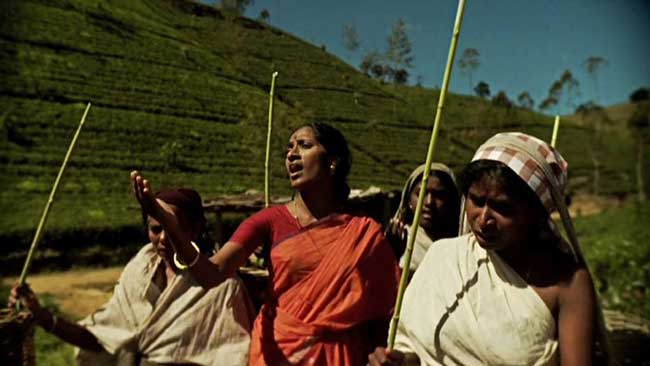
Meenashi Amma
There is another allegorical scene, equally startling for a different reason. A white manager of a plantation arrives on a white horse to examine if the male workers have pruned the tea bushes to the exact specification of 15 inches, no more, no less. As he gets off the horse, the overseer (or Kankani) swiftly opens up a black umbrella to shield the white master from the sun–though he wears a wide brimmed hat. With mounting melodramatic fury he shouts at the bent workers pruning with sharp knives, ordering them to prune at an exact 15 inches. As he yells at them, ‘Imbecile, Imbecile,’ one of the workers lunges at him with his knife which cuts to the master’s blood splattered face, then to drops of blood on unpruned tea leaves and then to what appears to be a totally severed white arm lying on the earth. There are no cries. The allegory cuts
deeply through its restrained melodramatic articulation, to an entire field of perfectly pruned brown tea stumps, concluding a melodramatic scene with an intensive epic-memory of the world, which includes the bloodied earth itself.
The Burning Tea Bush
However, the most startling disjunction happens when (at the ending of Meenakshi Amma’s collective song) the film cuts to Peter sitting, playing his accordion, beside a burning tea bush. It’s also an allegorical scene because the crackling flames don’t seem to burn up the tea bush. So, it evokes for me a biblical resonance with God manifesting through a burning bush, to address Moses at his most troubled moment in the desert when leading the exodus of former Jewish slaves to the promised land. A fiery image in a Tarkovsky film flashes by in memory. Burning a tea bush is illegal, a punishable offence, but it continues to burn and crackle without turning to ashes, while the accordion music floats in the night-time air. Here, Peter playing his accordion beside the fiery tea bush, becomes an iconic chorus powerfully crystalising many sensations, emotions and thoughts stirred up by the film; a memory of the world for sure.
That Ingirunthu could weave this heterogeneity of autonomus, intensive, poetically allegorical scenes and story lines of a marginalised community into a coherent whole of sorts, is a sign of the film’s inclusive, modern, epic-narrative vision. It is not a plotted film where all lines converge on a narrative resolution as a drama would. As Blackburn said, ‘the tension and obstacles to resolution’ of dramatic conflicts offer us a kind of creative opportunity rarely seen in films. The two sequences, of Meenakshi Amma’s song and Peter at the burning bush playing his accordion, offer startling poetic allegorical images, within a film which is about the epochal political history of exploitation of Malaiyaha labour, presented variously as a chronicle with archival documents, as well as enactments of everyday life through ethnographic observation and dramatized scenes. Epic vision and narration are inclusive of the lyric and the dramatic, as Brecht has shown us. They have the aesthetic amplitude to shows us this bitter earth, its life, even the most insignificant, as well as the buried layers of violence and the collective struggles to change them.
The Bindunuwewa Massacre
The July ‘83 race riots and the government-led programme’s effects infiltrate the estate in one strand of the narrative which is constructed with thriller overtones. The police and army presence gradually increases with interrogations and incidents. There is also physical infighting among various political and union factions. The newspaper montage in all three languages of the massacre of 26 Tamil male inmates at the Bindunuwewa ‘open’ rehabilitation camp for Tamil political prisoners, sends shock waves across the community, because one of them was of Malaiyaha origin. Sarasa’s young brother has been arrested and interned in a camp. The Tiger separatist politics of Jaffna and the ongoing civil war, appeared not to concern a few of the disaffected youth but create tension and fear on the estate. In an unusual framing, a young man gives a speech in a rhetorical mode, to no one in particular, saying ‘there are no tigers or lions here.’ The close-shot cuts to an informal group discussing the massacre and the murder of two political activists in a fight at the funeral of the victim of the massacre.
The meeting breaks up for them all to attend the funeral. In an extraordinarily tense sequence, we are shown, in a long-wide shot, not the funeral, but each of the adults of the community, dressed neatly in white, walking briskly through the layam to the funeral, in pairs and singly, silently. One feels the entire presence of the community gathering for this funeral which we are not shown. (Whereas we were shown the small Christian procession of mourners holding little crosses and a wreath, carrying Esther Valley’s mother’s coffin, across the landscape, singing a hymn.) Rituals for the dead when presented on film often create a profound sense of a community, give it a collective vitality, united in grief.
Hindu Kovil Festival
Similarly collective, the very large excited crowd enjoying the Hindu religious festival and dance parade at the Kovil is presented at first, in the observational mode of an ethnographic gaze. We see the intensity of the devotional ritual within the inner sanctum of the Kovil. Then the camera moves into a complex participatory mode, following a thriller-political plot line connecting Esther Valley with a figure trying to get her to identify a photograph by bribing her with a necklace. Refusing in fear, she runs away from him into the crowd. Then the participatory camera moves closer in to take in the transsexual dancers, one in traditional attire and three striking, tall figures in contemporary dress.
Moving closer to them, the camera and editing begin to move with them, fascinated by their thoroughly global dance moves, while the dancers’ intense focus is rather more internal, somewhat like those of Tamil women dancing at Kataragama. The fact that this complex celebratory scene of the festival was filmed without getting official permission makes its intensity and aesthetic richness, all the more remarkable. Getting a glimpse of Sarasa beautifully dressed in a shiny light blue sari and bejewelled, is an added bonus after having seen this graceful woman mostly in her drab work attire, carrying one child and holding the other by hand, walking tall with her basket and pole.
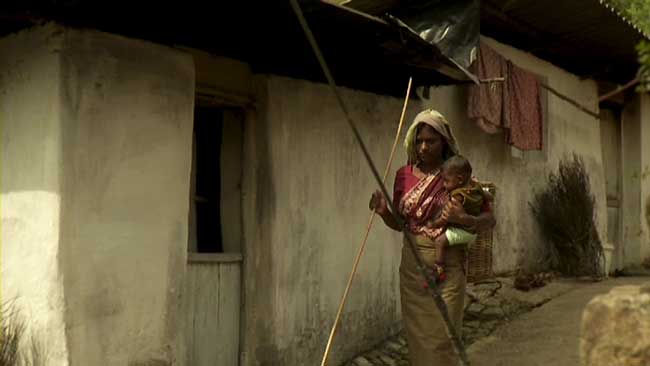
Sarasa
The relationship between Sarasa and her husband (marked by accelerating violent assaults on her), leads to an accidentally caused fire which becomes a conflagration. As their house burns Esther Valley and others run into the layam to rescue the children and the whole image is consumed by flames. A brief shot of a small figure rugged up to ward off the night time chill stands nearby looking towards us in a mid-shot. It’s held long enough to make one wonder if that was the director Sivamohan herself, who determined the conflagration in the layam as a narrative climax but has undercut its melodramatic effect.
Instead of ending there or perhaps with its aftermath, refusing to answer ‘what happened?’, the film cuts to the day after. The final scene is of a quiet morning showing the estate and its long winding road down which a well-dressed young woman in a salwar kameez, walks briskly. We follow her on to the main road which is also empty with just two stray dogs and a distant car. As she comes closer, we seem to remember her as perhaps a minor figure who appears in a scene or two with the Researcher. And so, in the here and now of this ending, this young woman, detached from the several story lines we have followed, walks away from the tea estate with a brisk purposiveness.
Cinema and Belief in this World
Within the estate there is a large ample intersection shaded by trees, with a shrine, where four streets meet. And we see in a mid-long-shot, young children neatly dressed in white uniforms or blue trousers and white shirts, wearing socks and shoes, walking happily to school in clusters, while the women go to work with their baskets and poles. We have seen a well-run creche where pre-schoolers play with wooden toys that help their hand-eye coordination and recognition of basic shapes and colours. One is left wondering if the younger generations who are getting educated will create a day when there are no more men and women willing to work on these tea estates, under the conditions we have observed up close.
This thought is not entirely fanciful any more than those two allegorical scenes of Meenakshi Amma singing amidst the tea bushes with her group of workers or Peter playing his accordion beside the crackling tea bush on fire, are fanciful. After all, we have been made receptive by MGR’s unexpected star appearance, singing a song about his mother-land, (carrying of all things a small suitcase), at the very opening of the film, to expect from cinema something in addition to and more than the representation of reality, a simple mirroring of what is. We will remember here MGR’s cinematic appeal, which surely must have helped this Tamil man born in Lanka in becoming the Chief Minister of Tamil Nadu.
Film creates (as Deleuze the French philosopher who loved the cinema said) a capacity to restore our belief in this world, that is belief in its as yet unactualized potential. Following Jean Luc Godard, he also said that, ‘film is a form that thinks’. Ingirinthu, with its political sophistication and ethico-aesthetic values is able to achieve this. My effort here has been to work through the implications of Anne Blackburn’s two ideas cited at the beginning. In doing so, I have explored some of the intricacies of the work that has gone into creating this specific feeling of ‘belief in this world’, by Sivamohan and all her collaborators, especially the (non)actors, most of whom were from the estate.
Ingirunthu is a carefully and deeply researched film, with Sivamohan spending time with the Malaiyaha people over a considerable period of time, getting to know them, sometimes staying with them and building trust. Both in terms of the choice of the marginalised Malaiyaha people as her subject, and in its experimental aesthetics it is (in my opinion) a singular, pioneering work within the history of Lankan cinema. The 200th anniversary of the arrival of the Malaiyaha folk to this Island of Dhamma, Sri Lanka, seems a fitting time to revive and celebrate this film and their survival skills, with public screenings and discussions.