Features
STARTING OFF WITH A BANG! – Part 34

CONFESSIONS OF A GLOBAL GYPSY
By Dr. Chandana (Chandi) Jayawardena DPhil
President – Chandi J. Associates Inc. Consulting, Canada Founder & Administrator – Global Hospitality Forum
chandij@sympatico.ca
Having started as the new Food & Beverage Manager and Executive Chef of Hotel Ceysands on October 1, 1977, I was on a fast track to re-organize my departments. As I had exactly one month to organize the re-opening of these departments, I had no time to waste. I worked around the clock and went to my apartment only to get 

A Hotel in two Towns
The location of Hotel Ceysands was unique. A hotel on a beach strip located between sea water and fresh water was romantic and provided a lot of opportunities for a variety of water sports. All guest areas were on the river bank on the sea side in the town of Bentota. The ancient name of this town was derived from a mythical story which claims a demon named ‘Bem’ ruled the ‘tota’ or river bank.
All employee areas, the main entrance to the hotel property and the security post were on the river bank on the land side in another town – Aluthgama (new town). This town had a small center with some interesting shops, a bustling local market and a busy bus station. Although not as beautiful as Bentota, Aluthgama was active and generally hectic. The most famous attraction near this town is the famous Buddhist temple – Kande Vihara (temple on the hill). It was built in the year 1734 and has been formally recognised by the government as an archaeological site.
The architecture of Hotel Ceysands was not as grand as its neighbour – Bentota Beach Hotel, but was designed to suit the shape of the available land. A major challenge for the new managing agents – Walkers Tours and the hotel re-opening management team was that the poor interior design had no clear concept. During the short period of time available to restart the tourist season in 1977, only some urgent work was done, enough to create a more welcoming first impression. The major refurbishing was planned after six months, during the 1978 tourist off season.

Learning Complex Cultures
I spent a short time to quickly familiarize myself with the culture of the area, that of the company which owned Ceysands – Ceylinco Limited and new managing agents – Walkers Tours and their owner – John Keells Group.
Ceylinco was a well-established group of companies, led by its second generation of owners headed by Mr. Lalith Kotelawala as the Chairman. He had built the renamed Ceylinco into a major company (in later years expanded to have over 500 subsidiary companies). Their head office was at the then tallest building in Sri Lanka – Ceylinco House in Colombo. Ceylinco owned and operated three hotels – Ceylinco Hotel in Colombo with the famous 14th floor restaurant Akasa Kade, San Michele Island Resort by Bolgoda Lake and Hotel Ceysands.
In 1977, a majority of the management team of Ceysands were managers previously recruited by Ceylinco, and whose loyalty was clearly with Ceylinco Group. These managers included the Hotel Manager – Alan Silva, Boats & Maintenance Manager – Mendis, and the Executive Housekeeper – Malini Kotelawala (an aunt of the Chairman and a cousin of the third Prime Minister of Ceylon – General Sir John Kotelawala). The General Manager of the hotel, Captain Wicks, a senior executive of Walkers Tours had a challenge. He realized that he must gradually encourage the loyalty and support of these managers who were used to a different style of leadership. Not everybody liked too many changes.
Two years later, in 1979, I befriended Mr. Lalith Kotelawala and his wife, Sicille who occasionally stayed at Hotel Swanee which they loved. I was the Manager of that Keells hotel at that time. In 1981, by then, as a corporate executive, I took over the management of Ceylinco Hotel on behalf of John Keells group and re-organized the hotel. Mr. Lalith Kotelawala once told me that, “It is best that my company relies on professionals in your business to manage our hotels.”

Walkers Tours, then the leading tour operator and hotel management company was founded in 1969. A visionary businessman and lawyer, Mr. Sriyantha Senaratne had been the Managing Director since 1971. When Walkers Tours was acquired by John Keells Group of companies in 1972, he continued in that position. Captain Wicks enjoyed reporting to him. I met Mr. Senaratne once at Hotel Ceysands during our pre re-opening period. I had a brief chat with this soft-spoken gentleman. I was impressed to hear that it was he who led the commencement of the Habarana Village hotel project. He was also passionate about tourism development in the Maldives. I was pleased when the new uniforms, material and supplies arrived with the logo. It was very similar to opening of a new hotel.
John Keells Group, the owning company of Walkers Tours was founded in Ceylon by Britishers in the 1870s. It was initially set up as a manufacturer of tea and essential foods. During the 1970s after the then socialist government nationalized tea estates, the company mainly focused on new opportunities in tourism. Under the leadership of then Chairman Mark Bostock, John Keells became a diverse group of companies. He once told a group of executives including me, that in the early 1970s, he was invited to a meeting by then Prime Minister of Sri Lanka who initiated the nationalizing of tea estates. He said, “The Madam Prime Minister told me that tea is not the only business one can do when a rich company has a multi-talented and experienced team. Mrs. B. planted some seeds in my mind!” Today, John Keells Holdings PLC (JKH) is Sri Lanka’s largest listed company on the Colombo Stock Exchange. It is also the undisputed leader of the tourism and hospitality industries in the country.
Planning, Developing, and Training
In my planning work I focused mainly on human resources, new menus, supplies, logistics (in coordination with the boat department), food and beverage controls. Filling all job vacancies in the kitchen, restaurant and bars, plus arranging on the job training for new employees was a top priority. As time was limited, I did some quick ‘train the trainer’ sessions for all the supervisors in my departments. After that, I directed them to devote considerable amount of time in training the new recruits. I spent time checking their skills after the training.
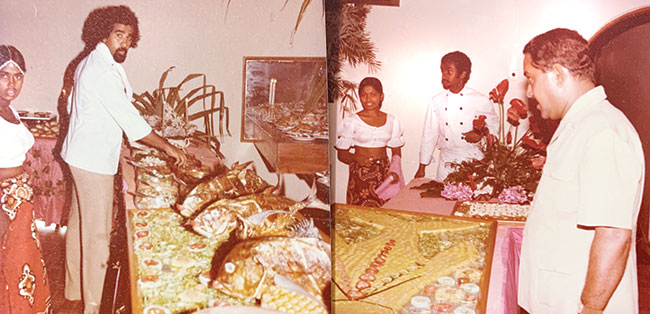
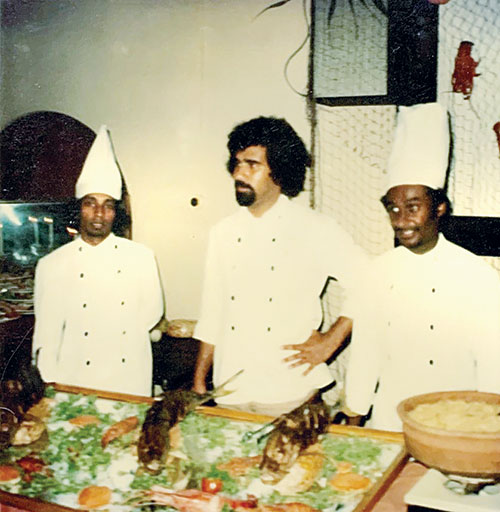
Before the new management took over the hotel, Ceysands did not have many large buffet products. Based on tour groups requests, I re-trained the kitchen brigade to prepare large buffets for all dinners. To strengthen the kitchen, I personally selected two excellent kitchen interns from the Ceylon Hotel School. These students – Mallawarchchi and Lokuge were only a few years younger to me. They both were eager to acquire knowledge and dreamt of becoming Executive Chefs in the future. I became their mentor and inspiration. They were a great addition to my team. Two of them helped in my efforts to re-train the kitchen brigade which included highly experienced cooks and newcomers.
I devoted a considerable amount of time to do all menu planning, requisitioning, seasoning all main courses, doing all buffet decorations and arrangements, as well as all the à la carte cooking. My background in visual art including sculpture continued to be useful in culinary arts. I made sure that appropriate assistants under-studied me on all these tasks. The experience I gained at the Coral Gardens Hotels helped me to build good team spirit among the kitchen brigade and the young teams who worked at the restaurant and bars. We worked very hard and felt that we were fully ready to re-open the hotel by the end of October, 1977.

Coach loads of tourists arrived on Walkers Tours buses soon after the tourist season began in early November, 1977. As predicted, the occupancy shot up to 100% within days. Being managed by the largest tour operator of the island meant that the hotel management team did not have to worry about any marketing and sales. Captain Wicks was a little worried that something would go wrong as we hardly had enough time to train all the new employees.
My strategy of recruiting very young service employees with big smiles and great attitudes, rather than experienced employees from other hotels, worked well. One can train employees basic service skills fairly quickly, but no one can be trained to smile and have the right service attitude. The tourists and tour leaders loved our service staff and the quality and variety of food we presented. We certainly commenced the season with a bang!


As most of our guests stayed at Ceysands for two weeks, it was essential that we provided a wide variety of entertainment and activities. I learnt a lot from Captain Wicks about organization, logistics and public relations, and he learnt from me about hospitality operations. We both were quick learners. Alan was supportive of our innovative ideas and plans. At the age 23, I was the youngest among seven departmental heads and executives of Ceysands, but was the most experienced in terms of hospitality operations. Captain Wicks was 20 years older than me and Allan was 15 years older than me.
“I am told by the European tour leaders that the perfect resort is where the management team works and plays while making the guests happy” Captain Wicks told Alan and me. “Of course, Captain, that is right. Let’s make Ceysands the most active hotel in the south coast of Sri Lanka!”, I contributed optimism to the vision. The team agreed on that goal.