
Features
Sri Lanka’s ancient hydraulic civilisation and birth of Sinhala Buddhist nationalism

by Satyajith Andradi
Sri Lanka continues to be in the grips of many high profile crises of recent origin such as the COVID–19 pandemic, chronic difficulties in servicing foreign debts, shortages of essential items such as food and fuel, skyrocketing cost of living, and crop failures due to the ban of chemical fertilisers, to name a few . However, the national question, which has tormented the country for decades, continues to be one of her biggest problems, if not the greatest.
Sinhala Buddhist nationalism features prominently in any discourse on Sri Lanka’s national question. Its detractors often derogatorily call it by terms such as Sinhala Buddhist imperialism, Sinhala Buddhist chauvinism, and Sinhala Buddhist racism, whilst its protagonists call it Sinhala Buddhist patriotism or simply patriotism. Meanwhile, somewhat esoteric and ephemeral terms such as Sinhala Buddhist majoritarianism, kinguistic nationalism, and ethnocracy are used for it in learned discourse. Further, Sinhala Buddhist nationalism is very often discussed with reference to personages of Sri Lanka’s ancient history such as Dutugemunu and Elara. Hence, it is useful to trace the genesis and early phases of development of Sinhala Buddhist nationalism during Sri Lanka’s ancient past, in order to enhance our understanding of the subject.
Sri Lanka’s ancient agrarian revolution powered by irrigation engineering
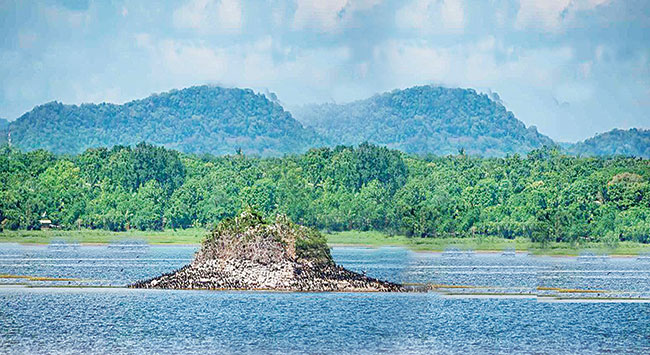
As in our own age, in the distant past too, various races migrated from one land to another for various reasons such as the search for greener pastures and the forced eviction by intruding tribes. From about the sixth century BC, Sri Lanka too, which until then was thinly populated by primitive hunter gatherers, experienced an influx of migrants from overseas. Some of them, who had a knack for agriculture, settled in the arid north central plains of the island, which were covered with wooded forests and shrub jungles, as those one could still see in places such as Wilpattu. As direct rain water was often inadequate and undependable for growing paddy, these pioneer settlers cultivated the art of conserving water by building small artificial reservoirs called tanks, and convert the hostile arid terrain into paddy fields with the water thus conserved. Thereby they were able to establish a firm foothold in pre-historic Sri Lanka. These rough, tough, and enterprising pioneer settlers came to be known as ‘Sihala’ or Sinhalese, whose founding fathers were, according to legends, Vijaya and his band of seven hundred followers, who came to Sri Lanka from northern India. Other migrant tribes, either perished in this hostile physical environment, like the traders devoured by Kuveni, or got suppressed and assimilated by the dominant Sinhalese. This was a social process, which had some affinity to the process of natural selection in the biological world – a case of social Darwinism, so to speak. The Sinhalese went on to build progressively bigger tanks, weirs, canals, and complex irrigation systems connecting all such innovative creations with rivers which flowed from the distant wet mountains. As a result, the erstwhile wild and hostile terrain of Sri Lanka’s north central plains were converted into a vast blue and green tapestry of thousands of artificial lakes and lush paddy fields studded with dagobas of immaculate white. The formidable physical challenges posed by the nature were surmounted with an audacious human response. This monumental transformation, which took place more than thousand years ago, inspired many people of modern times. A notable person amongst them was the British planter, archaeologist, and author John Still ( 1880 – 1941 ) of Jungle Tide fame, who in turn drew the insightful attention of Arnold Toynbee, the eminent scholar of comparative history and civilizations ( Arnold J Toynbee; A study of history ; abridgement by D C Somervell ). The agrarian revolution powered by advanced irrigation systems was the bedrock, the backbone, and the material basis of the fully-fledged hydraulic civilization of ancient Sri Lanka. The elaborate social, political, cultural and religious institutions of that civilisation constituted, as Marx would say, its superstructure.
The birth of the ancient agrarian revolution based on irrigation engineering pre-dates the arrival of Buddhism in the island in the third century BC. The medium sized tank ‘Abhaya Wewa’, which is also known as Basawak Kulama, in Anuradhapura, built in the fourth century BC by king Pandukabhaya, proves the point. The next important tank, Tissa Wewa, was built in Anuradhapura during the reign of Devanampiyatissa ( 250 BC – 210 BC ). Irrigation engineering witnessed a quantum leap during the reign of the great Vasabha ( 67 AD – 111 AD ). During his reign, in addition to many large tanks, the Elahera canal was built. This canal diverted the waters of the Ambanganga, a tributary of the Mahaweli river originating from the Matale hills, to the tanks in the arid north central plains. The next great period of tank building was the reign of Mahasena ( 274 AD – 301 AD ), during which many tanks including the giant Minneriya Wewa was constructed. Mahasena’s achievements were equaled or surpassed during the reign of Dhatusena ( 455 AD – 473 AD ), during which huge tanks such as the Kalawewa and the Yoda Wewa were constructed, damming the Kala Oya and the Malwathu Oya respectively. However, the greatest irrigation engineering feat during the reign of Dhatusena was the construction of the Yoda Ela, also known as Jayaganga, a fifty four mile long canal which carried water from the Kalawewa to the Tissawewa in Anuradhapura. Further significant additions to the irrigation infrastructure were made during the reigns of Moggallana II ( 531 AD – 551 AD ) and Aggabodhi II ( AD 604 – AD 614 ). The former constructed the huge Nachchaduwa Wewa near Anuradhapura, augmented the Nuwara Wewa in Anuradhapura ( History of Ceylon, University of Ceylon: editor; S. Paranavitana ) and built the Padaviya tank by damming the Ma Oya (K M De Silva; A History of Sri Lanka ), whist the latter constructed the Kantale, Giritale, and Kaudulla tanks. Thereafter, the expansion of the irrigation systems seems to have subsided for several centuries till the time of Parakramabahu the Great ( 1153 – 1186 ). This king is considered to be the greatest tank builder of Sri Lanka (ibid ). The massive Parakrama Samudraya in Polonnaruwa, which was created by combining three tanks including the Topawewa, is undoubtedly his finest achievement in the field of tank building. It has to be been noted no other king after him built major tanks.
The ancient agrarian revolution powered by irrigation engineering had many important economic, social, political, religious, and cultural implications and outcome. On the economic sphere, it phenomenally increased the extent of arable land by making it possible to bring vast swathes of erstwhile arid forest land under the plough through irrigation. Further, it would have, most probably, facilitated a significant migration from small scale peasant subsistence farming to more productive large scale farming. Anyway, the obvious economic outcome of the ancient agrarian revolution was the generation of ever increasing agricultural surpluses over and about what was needed to feed the peasants and other agricultural labourers. These massive economic surpluses enabled the kings and their ruling elites to invest enormous resources in the expansion of the irrigation infrastructure, in maintaining the irrigation technocracy and the royal bureaucracy, in building impressive Buddhist monuments such as the great stupas, in patronizing outstanding Buddhist scholarship of international repute, and in constructing awe inspiring secular monuments such as Kasyapa’s Sigiriya rock fortress and royal palace.
On the social and political spheres, the elaborate irrigation systems stretching across vast swathes of farmlands, inexorably led to centralized control of agriculture through irrigation management. The technocrat who controlled the spills and the sluices of the tanks and weirs came to dominate the peasant who ploughed the fields, sowed the seeds, and harvested the crops. This entailed the ascendency of the state bureaucracy including the irrigation engineering technocracy, which in turn called for a unified and highly centralized state.
Pandukabhaya and birth of Sinhala state
It was mentioned earlier that the first significant tank was built by Pandukabhaya in the fourth century BC. It is interesting to note that he was also the first ruler of the Anuradhapura kingdom. Prior to him, the main Sinhala presence in Sri Lanka constituted a conglomerate of Sinhala settlements situated between the Kala Oya and the Malvattu Oya, loosely connected by tribal and family ties. It is evident that Pandukabhaya forcefully subjugated these semi-autonomous settlements and united them under his leadership. Thus the first Sinhala state was born. No doubt, this was in response to a historical necessity of the agrarian revolution, which called for an efficient centralized state. Certainly, this nascent state had nothing to do with Sinhala Buddhist nationalism or patriotism. In the first place, Buddhism was yet to be introduced to Sri Lanka. Further, the Sinhala state was yet to perceive a real threat from non – Sinhalese. It was young, vibrant and self- confident. It was, in modern parlance, an absolute monarchy.
Devamanpiyatissa and the birth of the Sinhala- Buddhist state
Buddhism was introduced to Sri Lanka by the great Mauryan emperor Asoka during the reign of Devamanpiyatissa ( 250 – 210 ) at a time when the ancient agrarian revolution was in full swing. As already mentioned, it was during this period that the Tissa Wewa was built. The peaceful conversion of the country to Buddhism received unreserved royal patronage. The nascent Sinhala state became a Sinhala Buddhist state. Numerous lands and viharas were gifted to the Maha Sanga. These included the Thuparama dagoba, and the spacious Mahamegha park in Anuradhapura, in which the sacred Bodhi tree Sri Maha Bodhi was planted. This signaled the establishment of the Mahaviharaya, the centre of Theravada Buddhist Church in Sri Lanka. No doubt, the doctrine of the Buddha, which laid down a well –structured spiritual path to freedom from existential suffering through the taming of the senses, struck a chord with the well-structured thinking of the Sinhalese irrigation engineers, which provided a path to freedom from material want by taming wild and hostile nature, with technological innovations.
Like Pandukabhaya’s Sinhala state, the nascent Sinhala Buddhist state during Devanampiyatissa’s had nothing to do with Sinhala Buddhist nationalism or patriotism. It did not perceive a real threat from non – Sinhalese or non-Buddhists. Like Pandukabhaya’s state, it was young, vibrant and self- confident.
The Sinhala Buddhist state under siege
Devanampiyatissa’s Sinhala Buddhist kingdom was in state of blissful harmony, arguably unparalled in Sri Lanka’s long history. However, this state of affairs was to be dramatically disrupted after a short period of time due to game-changing external and internal interventions. The major external challenge came from Tamil adventurers from south India bent on plundering the growing wealth of Sri Lanka’s hydraulic civilization. The main internal challenge came from the growing Mahayana tendencies amongst sections Sri Lanka’s Maha Sangha, which had traditionally been the custodian and standard bearer of Theravada Buddhism in Sri Lanka and abroad. Sinhala Buddhist Nationalism was born as a response to these challenges from within and without.
The first major challenge to the young Sinhala Buddhist state emerged thirty years after the death of Devanampiyatissa. Sena and Guttika, two Tamil brothers engaged in horse trading, captured the Anuradhapura kingdom and reigned for twenty two years. A few years after the Sinhalese regained the kingdom, the second successful invasion from South India was launched. This was led by the Chola prince Elara, who reigned in Anuradhapura for forty four years. The Sinhalese under Dutugemunu vanquished Elara and regained the kingdom. Dutugemunu’s reign ( 161 BC – 137 BC ) was a watershed in the Sri Lanka’s history. The island, which hitherto consisted of several kingdoms, was unified under his leadership. The Sinhala Buddhist state became, in present day parlance, a unitary state. However, less than four decades after Dutugemunu’s death, Anuradhapura was captured and occupied again by south Indian Tamils from 103 BC to 89 BC. They were expelled by Vattagamini ( Valagamba ) , who reigned from 89 BC to 77 BC. Thereafter, for more than five hundred years, Sri Lanka was free from foreign occupation. It was during this period that her ancient irrigation witnessed its first great flowering. However, it was during this period that the serious internal threats to the Sinhala Buddhist state emerged. They came in the form of Mahayana challenges to the uncontested supremacy of the Mahavihara led Theravada Buddhist Church, which was a main pillar of the Sinhala Buddhist state. The initial threat came in the first century BC with the establishment of the rival Abhayagiri monastery by Valagamba, which harboured dissenters. The immediate response of the Theravada Buddhist Church to this was the writing down of the Tripitaka at Aluvihara during that king’s reign. The next threat, which was of a much greater magnitude, was the intrusion of Mahayana thinking in the form of Vaitulyavada in the third century AD, during the reign of Mahasena ( 274 AD – 301 AD ), with the fanatical support of that monarch. This was somewhat contemporaneous with the rise of Mahayana in south India under the guidance of great masters such as Nagarjuna. Anyway, the Theravada Buddhist Church eventually prevailed by winning back the king to its side with great difficulty.
The long peace of half a millennium, which commenced with the reign of Valagamba, ended with the invasion from south India in 429 AD. This resulted in the reign of six Tamils kings in Anuradhapura for twenty seven years, until Dhatusena liberated the country from the foreign yoke. Thereafter, the country did not experience invasions from abroad for about four centuries. Ancient Sri Lankan irrigation witnessed its second great flowering. However, during ninth and tenth centuries, Sri Lanka got caught up in the geo-political rivalries amongst south Indian Tamil kingdoms of Pallavas, Pandyas and Cholas. At that time the Hindu Tamil civilization of south India was in its ascendency, whilst the aging Sinhala Buddhist civilization was in a state of stagnation, if not decay. The end result was the conquest of Anuradhapura and the north central plains of Sri Lanka by the Cholas in the closing decade of the tenth century. This dealt a crippling blow to Sri Lanka’s ancient hydraulic civilization. The Sinhalese were, under Vijayabahu I, able to expel the Cholas from the Island in 1070, and under Parakramabahu the Great, revive the ancient hydraulic civilization. Sri Lanka’s ancient irrigation witnessed its third and last flowering. However, the revival was short lived. The invasion by the marauding Kerala army of Magha of Kalinga in 1215 dealt the death blow to the ancient hydraulic civilization. The Sinhalese, who had populated the north central plains since sixth century BC, migrated en masse to the south west and the central hills. The irrigation works were abandoned and went into disrepair. The hostile arid jungles, which were banished by Sinhalese pioneers, returned to the north central plains with a vengeance. The ancient hydraulic civilization of the Sinhalese, which had flourished for more than one thousand five hundred years, came to an end.
The ancient hydraulic civilization and Sinhala Buddhist Nationalism
Sinhala Buddhist Nationalism, like many other –isms, constitute an ideology; an outlook. As already mentioned, it was born as a response to the external and internal challenges to the ancient Sinhala Buddhist state, which was an integrate part of the ancient hydraulic civilization. But, how do we conceptualise this ideology of Sri Lanka’s distant past? Fortunately, the ancient chronicles – Dipavamsa, Mahavamsa, and Chulavamsa, and the last two chapters of the Pujavaliya, come to our assistance. However, it should be cautioned that the ideologies contained in these ancient documents represent , more likely, the views held by their respective authors and their contemporary societies than by the personages of their narratives.
It seems that the internal threat to the Theravada Buddhism by Mahasena’s aggressive promotion of Vaitulyavada prompted the writing of the two oldest exiting chronicles of Sri Lanka – the Dipavamsa, written in the fourth century AD, and the Mahavamsa, composed in the sixth century AD. The fact that the narratives of both works end with the death of Mahasena points in that direction. Anyway, both emphasize that the island was freed from the Yakkas by the Buddha to make way for the Sinhalese settlers and the establishment of the Buddhist doctrine. This amounts to an imprimatur for Sinhala Buddhist exclusivity in Sri Lanka, which goes back, at least, as far as the fourth and sixth centuries. However, the treatment of the Sinhala king Dutugemunu and the Tamil king Elara by the two authors differ significantly. For instance, whilst the Dipavamsa devotes a mere twelve verses to Dutugemunu, the Mahavansa devotes eleven out of its thirty two chapters to him. Clearly, Dutugemunu is the favourite king of the author of the Mahavamsa. Further, whilst both chronicles admire Elara as an incomparably just king, the Dipavamsa, unlike the Mahavamsa, takes note of his outstanding spiritual qualities. More strikingly, the Mahavamsa, in chapter twenty five seeks to lend a Buddhist imprimatur to Dutugemunu’s war with Elara. This is certainly inconsistent with the letter and spirit of the Metta Sutta, as much as the crusades of medieval Christendom authorized by the papacy was inconsistent with the letter and spirit of Jesus’ utterance ” Put your sword in its place, for all who take the sword will perish by the sword” ( Matthew 26; 52 ). In fact, the Mahavamsa’s stance on the Dutugemunu- Elara war is reminiscent of the ideas on ‘just war’ advocated by St. Augustine and the Bhagavad Gita. Most probably, the south Indian invasions of the fifth century prompted the sixth century author of Mahavamsa to take a more militant Sinhala Buddhist stance than the fourth century author of the Dipavamsa.
The first part of the Chulavamsa, which was most probably composed in the early part of the thirteenth century, provides useful information about the period from the death of Mahasena to the end of the ancient hydraulic civilization. The last two chapters ( chapters 33 and 34 ) of the Pujavaliya briefly covers this period in addition to history up to the death of Mahasena. The Pujavaliya was composed in the mid thirteenth century, shortly after the collapse of the hydraulic civilization. Whilst the three chronicles were composed in Pali, the Pujavaliya was written in Sinhala.
The Chulavamsa and the Pujavaliya, in comparison with the Dipavamsa and the Mahavamsa, take a more hostile approach towards non – Sinhala Buddhist actors. For instance, unlike the Dipavamsa and the Mahavamsa, the Pujavaliya perceives Elara merely as a malevolent personage bent on destroying the Buddhist Church. The more virulent Tamil invasions from the ninth century onwards, would have contributed towards this more aggressive Sinhala Buddhist nationalism.
We have seen how the dynamics of the ancient hydraulic civilization gave birth Sinhala Buddhist Nationalism. The hydraulic civilization itself perished as a result of the devastating invasion of Magha of Kalinga. However, Sinhala Buddhist Nationalism did not perish with that civilization. On the contrary, it has continued to live as a potent ideology of Sri Lanka, right up to the present day.



by Dr Gotabhya Ranasinghe
Senior Consultant Cardiologist
National Hospital Sri Lanka
When we sought a meeting with Hon Dr. Ramesh Pathirana, Minister of Health, he graciously cleared his busy schedule to accommodate us. Renowned for his attentive listening and deep understanding, Minister Pathirana is dedicated to advancing the health sector. His openness and transparency exemplify the qualities of an exemplary politician and minister.
Dr. Palitha Mahipala, the current Health Secretary, demonstrates both commendable enthusiasm and unwavering support. This combination of attributes makes him a highly compatible colleague for the esteemed Minister of Health.
Our discussion centered on a project that has been in the works for the past 30 years, one that no other minister had managed to advance.
Minister Pathirana, however, recognized the project’s significance and its potential to revolutionize care for heart patients.
The project involves the construction of a state-of-the-art facility at the premises of the National Hospital Colombo. The project’s location within the premises of the National Hospital underscores its importance and relevance to the healthcare infrastructure of the nation.
This facility will include a cardiology building and a tertiary care center, equipped with the latest technology to handle and treat all types of heart-related conditions and surgeries.
Securing funding was a major milestone for this initiative. Minister Pathirana successfully obtained approval for a $40 billion loan from the Asian Development Bank. With the funding in place, the foundation stone is scheduled to be laid in September this year, and construction will begin in January 2025.
This project guarantees a consistent and uninterrupted supply of stents and related medications for heart patients. As a result, patients will have timely access to essential medical supplies during their treatment and recovery. By securing these critical resources, the project aims to enhance patient outcomes, minimize treatment delays, and maintain the highest standards of cardiac care.
Upon its fruition, this monumental building will serve as a beacon of hope and healing, symbolizing the unwavering dedication to improving patient outcomes and fostering a healthier society.We anticipate a future marked by significant progress and positive outcomes in Sri Lanka’s cardiovascular treatment landscape within the foreseeable timeframe.

by Fr. Emmanuel Fernando, OMI
Jesuit Fr. Aloysius Pieris (affectionately called Fr. Aloy) celebrated his 90th birthday on April 9, 2024 and I, as the editor of our Oblate Journal, THE MISSIONARY OBLATE had gone to press by that time. Immediately I decided to publish an article, appreciating the untiring selfless services he continues to offer for inter-Faith dialogue, the renewal of the Catholic Church, his concern for the poor and the suffering Sri Lankan masses and to me, the present writer.
It was in 1988, when I was appointed Director of the Oblate Scholastics at Ampitiya by the then Oblate Provincial Fr. Anselm Silva, that I came to know Fr. Aloy more closely. Knowing well his expertise in matters spiritual, theological, Indological and pastoral, and with the collaborative spirit of my companion-formators, our Oblate Scholastics were sent to Tulana, the Research and Encounter Centre, Kelaniya, of which he is the Founder-Director, for ‘exposure-programmes’ on matters spiritual, biblical, theological and pastoral. Some of these dimensions according to my view and that of my companion-formators, were not available at the National Seminary, Ampitiya.
Ever since that time, our Oblate formators/ accompaniers at the Oblate Scholasticate, Ampitiya , have continued to send our Oblate Scholastics to Tulana Centre for deepening their insights and convictions regarding matters needed to serve the people in today’s context. Fr. Aloy also had tried very enthusiastically with the Oblate team headed by Frs. Oswald Firth and Clement Waidyasekara to begin a Theologate, directed by the Religious Congregations in Sri Lanka, for the contextual formation/ accompaniment of their members. It should very well be a desired goal of the Leaders / Provincials of the Religious Congregations.
Besides being a formator/accompanier at the Oblate Scholasticate, I was entrusted also with the task of editing and publishing our Oblate journal, ‘The Missionary Oblate’. To maintain the quality of the journal I continue to depend on Fr. Aloy for his thought-provoking and stimulating articles on Biblical Spirituality, Biblical Theology and Ecclesiology. I am very grateful to him for his generous assistance. Of late, his writings on renewal of the Church, initiated by Pope St. John XX111 and continued by Pope Francis through the Synodal path, published in our Oblate journal, enable our readers to focus their attention also on the needed renewal in the Catholic Church in Sri Lanka. Fr. Aloy appreciated very much the Synodal path adopted by the Jesuit Pope Francis for the renewal of the Church, rooted very much on prayerful discernment. In my Religious and presbyteral life, Fr.Aloy continues to be my spiritual animator / guide and ongoing formator / acccompanier.
Fr. Aloysius Pieris, BA Hons (Lond), LPh (SHC, India), STL (PFT, Naples), PhD (SLU/VC), ThD (Tilburg), D.Ltt (KU), has been one of the eminent Asian theologians well recognized internationally and one who has lectured and held visiting chairs in many universities both in the West and in the East. Many members of Religious Congregations from Asian countries have benefited from his lectures and guidance in the East Asian Pastoral Institute (EAPI) in Manila, Philippines. He had been a Theologian consulted by the Federation of Asian Bishops’ Conferences for many years. During his professorship at the Gregorian University in Rome, he was called to be a member of a special group of advisers on other religions consulted by Pope Paul VI.
Fr. Aloy is the author of more than 30 books and well over 500 Research Papers. Some of his books and articles have been translated and published in several countries. Among those books, one can find the following: 1) The Genesis of an Asian Theology of Liberation (An Autobiographical Excursus on the Art of Theologising in Asia, 2) An Asian Theology of Liberation, 3) Providential Timeliness of Vatican 11 (a long-overdue halt to a scandalous millennium, 4) Give Vatican 11 a chance, 5) Leadership in the Church, 6) Relishing our faith in working for justice (Themes for study and discussion), 7) A Message meant mainly, not exclusively for Jesuits (Background information necessary for helping Francis renew the Church), 8) Lent in Lanka (Reflections and Resolutions, 9) Love meets wisdom (A Christian Experience of Buddhism, 10) Fire and Water 11) God’s Reign for God’s poor, 12) Our Unhiddden Agenda (How we Jesuits work, pray and form our men). He is also the Editor of two journals, Vagdevi, Journal of Religious Reflection and Dialogue, New Series.
Fr. Aloy has a BA in Pali and Sanskrit from the University of London and a Ph.D in Buddhist Philosophy from the University of Sri Lankan, Vidyodaya Campus. On Nov. 23, 2019, he was awarded the prestigious honorary Doctorate of Literature (D.Litt) by the Chancellor of the University of Kelaniya, the Most Venerable Welamitiyawe Dharmakirthi Sri Kusala Dhamma Thera.
Fr. Aloy continues to be a promoter of Gospel values and virtues. Justice as a constitutive dimension of love and social concern for the downtrodden masses are very much noted in his life and work. He had very much appreciated the commitment of the late Fr. Joseph (Joe) Fernando, the National Director of the Social and Economic Centre (SEDEC) for the poor.
In Sri Lanka, a few religious Congregations – the Good Shepherd Sisters, the Christian Brothers, the Marist Brothers and the Oblates – have invited him to animate their members especially during their Provincial Congresses, Chapters and International Conferences. The mainline Christian Churches also have sought his advice and followed his seminars. I, for one, regret very much, that the Sri Lankan authorities of the Catholic Church –today’s Hierarchy—- have not sought Fr.
Aloy’s expertise for the renewal of the Catholic Church in Sri Lanka and thus have not benefited from the immense store of wisdom and insight that he can offer to our local Church while the Sri Lankan bishops who governed the Catholic church in the immediate aftermath of the Second Vatican Council (Edmund Fernando OMI, Anthony de Saram, Leo Nanayakkara OSB, Frank Marcus Fernando, Paul Perera,) visited him and consulted him on many matters. Among the Tamil Bishops, Bishop Rayappu Joseph was keeping close contact with him and Bishop J. Deogupillai hosted him and his team visiting him after the horrible Black July massacre of Tamils.
Sri Lanka-Singapore Free Trade Agreement
By Gomi Senadhira
senadhiragomi@gmail.com
“You might tell fairy tales, but the progress of a country cannot be achieved through such narratives. A country cannot be developed by making false promises. The country moved backward because of the electoral promises made by political parties throughout time. We have witnessed that the ultimate result of this is the country becoming bankrupt. Unfortunately, many segments of the population have not come to realize this yet.” – President Ranil Wickremesinghe, 2024 Budget speech
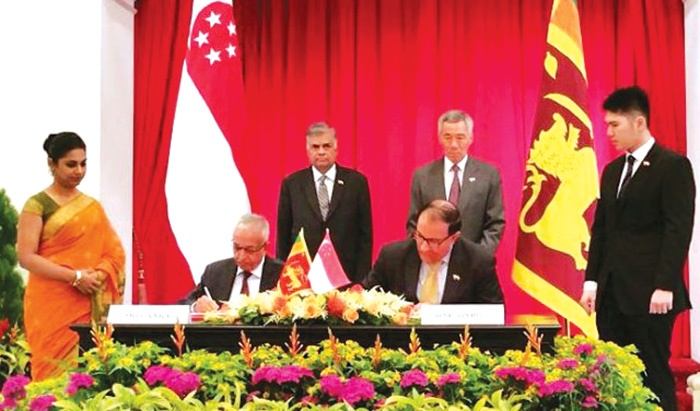
Any Sri Lankan would agree with the above words of President Wickremesinghe on the false promises our politicians and officials make and the fairy tales they narrate which bankrupted this country. So, to understand this, let’s look at one such fairy tale with lots of false promises; Ranil Wickremesinghe’s greatest achievement in the area of international trade and investment promotion during the Yahapalana period, Sri Lanka-Singapore Free Trade Agreement (SLSFTA).
It is appropriate and timely to do it now as Finance Minister Wickremesinghe has just presented to parliament a bill on the National Policy on Economic Transformation which includes the establishment of an Office for International Trade and the Sri Lanka Institute of Economics and International Trade.
Was SLSFTA a “Cleverly negotiated Free Trade Agreement” as stated by the (former) Minister of Development Strategies and International Trade Malik Samarawickrama during the Parliamentary Debate on the SLSFTA in July 2018, or a colossal blunder covered up with lies, false promises, and fairy tales? After SLSFTA was signed there were a number of fairy tales published on this agreement by the Ministry of Development Strategies and International, Institute of Policy Studies, and others.
However, for this article, I would like to limit my comments to the speech by Minister Samarawickrama during the Parliamentary Debate, and the two most important areas in the agreement which were covered up with lies, fairy tales, and false promises, namely: revenue loss for Sri Lanka and Investment from Singapore. On the other important area, “Waste products dumping” I do not want to comment here as I have written extensively on the issue.
1. The revenue loss
During the Parliamentary Debate in July 2018, Minister Samarawickrama stated “…. let me reiterate that this FTA with Singapore has been very cleverly negotiated by us…. The liberalisation programme under this FTA has been carefully designed to have the least impact on domestic industry and revenue collection. We have included all revenue sensitive items in the negative list of items which will not be subject to removal of tariff. Therefore, 97.8% revenue from Customs duty is protected. Our tariff liberalisation will take place over a period of 12-15 years! In fact, the revenue earned through tariffs on goods imported from Singapore last year was Rs. 35 billion.
The revenue loss for over the next 15 years due to the FTA is only Rs. 733 million– which when annualised, on average, is just Rs. 51 million. That is just 0.14% per year! So anyone who claims the Singapore FTA causes revenue loss to the Government cannot do basic arithmetic! Mr. Speaker, in conclusion, I call on my fellow members of this House – don’t mislead the public with baseless criticism that is not grounded in facts. Don’t look at petty politics and use these issues for your own political survival.”
I was surprised to read the minister’s speech because an article published in January 2018 in “The Straits Times“, based on information released by the Singaporean Negotiators stated, “…. With the FTA, tariff savings for Singapore exports are estimated to hit $10 million annually“.
As the annual tariff savings (that is the revenue loss for Sri Lanka) calculated by the Singaporean Negotiators, Singaporean $ 10 million (Sri Lankan rupees 1,200 million in 2018) was way above the rupees’ 733 million revenue loss for 15 years estimated by the Sri Lankan negotiators, it was clear to any observer that one of the parties to the agreement had not done the basic arithmetic!
Six years later, according to a report published by “The Morning” newspaper, speaking at the Committee on Public Finance (COPF) on 7th May 2024, Mr Samarawickrama’s chief trade negotiator K.J. Weerasinghehad had admitted “…. that forecasted revenue loss for the Government of Sri Lanka through the Singapore FTA is Rs. 450 million in 2023 and Rs. 1.3 billion in 2024.”
If these numbers are correct, as tariff liberalisation under the SLSFTA has just started, we will pass Rs 2 billion very soon. Then, the question is how Sri Lanka’s trade negotiators made such a colossal blunder. Didn’t they do their basic arithmetic? If they didn’t know how to do basic arithmetic they should have at least done their basic readings. For example, the headline of the article published in The Straits Times in January 2018 was “Singapore, Sri Lanka sign FTA, annual savings of $10m expected”.
Anyway, as Sri Lanka’s chief negotiator reiterated at the COPF meeting that “…. since 99% of the tariffs in Singapore have zero rates of duty, Sri Lanka has agreed on 80% tariff liberalisation over a period of 15 years while expecting Singapore investments to address the imbalance in trade,” let’s turn towards investment.
Investment from Singapore
In July 2018, speaking during the Parliamentary Debate on the FTA this is what Minister Malik Samarawickrama stated on investment from Singapore, “Already, thanks to this FTA, in just the past two-and-a-half months since the agreement came into effect we have received a proposal from Singapore for investment amounting to $ 14.8 billion in an oil refinery for export of petroleum products. In addition, we have proposals for a steel manufacturing plant for exports ($ 1 billion investment), flour milling plant ($ 50 million), sugar refinery ($ 200 million). This adds up to more than $ 16.05 billion in the pipeline on these projects alone.
And all of these projects will create thousands of more jobs for our people. In principle approval has already been granted by the BOI and the investors are awaiting the release of land the environmental approvals to commence the project.
I request the Opposition and those with vested interests to change their narrow-minded thinking and join us to develop our country. We must always look at what is best for the whole community, not just the few who may oppose. We owe it to our people to courageously take decisions that will change their lives for the better.”
According to the media report I quoted earlier, speaking at the Committee on Public Finance (COPF) Chief Negotiator Weerasinghe has admitted that Sri Lanka was not happy with overall Singapore investments that have come in the past few years in return for the trade liberalisation under the Singapore-Sri Lanka Free Trade Agreement. He has added that between 2021 and 2023 the total investment from Singapore had been around $162 million!
What happened to those projects worth $16 billion negotiated, thanks to the SLSFTA, in just the two-and-a-half months after the agreement came into effect and approved by the BOI? I do not know about the steel manufacturing plant for exports ($ 1 billion investment), flour milling plant ($ 50 million) and sugar refinery ($ 200 million).
However, story of the multibillion-dollar investment in the Petroleum Refinery unfolded in a manner that would qualify it as the best fairy tale with false promises presented by our politicians and the officials, prior to 2019 elections.
Though many Sri Lankans got to know, through the media which repeatedly highlighted a plethora of issues surrounding the project and the questionable credentials of the Singaporean investor, the construction work on the Mirrijiwela Oil Refinery along with the cement factory began on the24th of March 2019 with a bang and Minister Ranil Wickremesinghe and his ministers along with the foreign and local dignitaries laid the foundation stones.
That was few months before the 2019 Presidential elections. Inaugurating the construction work Prime Minister Ranil Wickremesinghe said the projects will create thousands of job opportunities in the area and surrounding districts.
The oil refinery, which was to be built over 200 acres of land, with the capacity to refine 200,000 barrels of crude oil per day, was to generate US$7 billion of exports and create 1,500 direct and 3,000 indirect jobs. The construction of the refinery was to be completed in 44 months. Four years later, in August 2023 the Cabinet of Ministers approved the proposal presented by President Ranil Wickremesinghe to cancel the agreement with the investors of the refinery as the project has not been implemented! Can they explain to the country how much money was wasted to produce that fairy tale?
It is obvious that the President, ministers, and officials had made huge blunders and had deliberately misled the public and the parliament on the revenue loss and potential investment from SLSFTA with fairy tales and false promises.
As the president himself said, a country cannot be developed by making false promises or with fairy tales and these false promises and fairy tales had bankrupted the country. “Unfortunately, many segments of the population have not come to realize this yet”.
(The writer, a specialist and an activist on trade and development issues . )



US sports envoys to Lanka to champion youth development

Rahuman questions sudden cancellation of leave of CEB employees


