Features
SRI LANKA SHOULD CLOSE DOWN MOST OF OUR OVERSEAS MISSIONS AS A STEP TOWARDS REDUCING PUBLIC EXPENDITURE

By Sanjeewa Jayaweera
A couple of recent news items that got my attention were:
(1)”The Government has decided to strictly restrict state expenses owing to the grave financial crisis the government was facing. Finance Minister Basil Rajapaksa has informed the Cabinet that state revenue has decreased drastically as the economy faces a severe crisis due to the Covid pandemic. It was not sufficient even for recurrent expenditure. The government has also decided to suspend all recruitment for state service.”
(2)”High Commissioner-designate of Sri Lanka to India Milinda Moragoda assumes duties in New Delhi, at a simple ceremony held at the High Commission of Sri Lanka in New Delhi on 30 August 2021.”
Given the perilous state of the economy, the need to restrict and reduce state expenditure is mandatory. That it should have been done several decades ago by successive governments is to state the obvious. The salary cost of government employees and pensions is estimated to account for 80 per cent of government revenue. This expenditure at present is a fixed cost unless the government takes a bold step to enforce a pay cut on government servants. Although it might sound outrageous, many establishments struggling to survive have done it in the private sector. No doubt such a measure will be unpopular, particularly when the cost of living is increasing. But, let alone a pay cut, the Principals and Teachers, have stuck work demanding salary increments. For the GOSL, it is undoubtedly “The Hobson’s choice.”
The need to manage costs prudently has always been a priority in the private sector. As a former Chief Financial Officer of a chain of hotels between 1995 and 2005, I experienced this challenge firsthand as tourism bore the brunt of the consequences of the war waged by terrorists. Every time a bomb explosion took place, there was a sharp decline in hotel occupancy and revenue. Mere survival was difficult. We, of course, did not have the luxury of printing money as the GOSL has done to manage the deficit. Even obtaining a bank overdraft was difficult as Banks’ were wary of lending money to the hotel sector. The hotel industry was deemed not creditworthy, just as presently the GOSL is considered by overseas lenders.
In such circumstances, we had to examine every expense item and determine whether it belonged to the category of “Absolutely Necessary.” Any expenditure outside that definition was eliminated. It was not a pleasant task, but it had to be done. It is in that context that I wish to propose that the GOSL carry out a serious and dispassionate review as to how many of our embassies and high commissions in overseas countries are “Absolutely necessary.”

The cost of maintaining our overseas resident missions according to the Sri Lanka Budget Estimates for 2021 is Rs. 11 billion, which at an exchange rate of Rs 190 for 1 US Dollar is US Dollars 58 million. What needs to be understood is that all expenditure of our foreign missions needs to be remitted in US Dollars. Staff salaries, rent, and other establishment costs are incurred in foreign currency. I understand many local companies are presently struggling to obtain even US $ 20,000 from banks to import urgently needed spare parts for their factory machinery.
It is possible that the shortage of foreign exchange may be temporary. However, Sri Lanka has for many decades run a significant budget deficit where recurrent expenditure is well over revenue. In such circumstances, a pertinent question is whether the bulk of the US $ 58 million spent in maintaining overseas resident missions should be eliminated and what would be the ramifications for the country.
In determining how many of our overseas resident missions are superfluous and should be closed down, we need to understand the role and function of an Embassy / High Commission in a foreign country.
The Vienna Convention of 1963 has outlined the role and functions as follows (summarized) :
“The functions of a diplomatic mission consist, inter alia, in representing the sending State in the receiving State; protecting in the receiving State the interests of the sending State and its nationals, within limits permitted by international law; promoting friendly relations between the sending State and the receiving State, and developing their economic, cultural and scientific relations; negotiating with the Government of the receiving State; ascertaining by all lawful means conditions and developments in the receiving State, and reporting thereon to the Government of the sending State.”
Although I am no expert on international relations, I feel the section stating “promoting friendly relations and developing economic, cultural and scientific relations” should be the critical criteria in determining the need for a resident mission in an overseas country. I am well aware that consular services extended to Sri Lankans living in overseas countries are also essential. However, I contend that we do not need an ambassador and a plethora of diplomatic officers to carry out this necessary but mundane function.

In terms of promoting friendly relations between Sri Lanka and the nation to where they have been posted, I contend that our ambassadors and diplomats currently have a minimal role to play. At present international relations are based on policy set out by the GOSL. The best of personal efforts by our ambassadors and diplomats will bear no result if the GOSL pursues policies deemed by the other country to be unacceptable to them. For example, I can only assume that our ambassadors and diplomats based in the Middle East and other Muslim countries were pulling their hair and struggled to maintain “friendly relations” when GOSL followed a policy of not allowing Muslims to bury those who passed away to COVID. Similarly, our close relations with China have impacted our relations with many others. To a large extent, the concept of “Non-Aligned” as practiced in the 1960s and 1970s has been replaced with “You are either with us or against us.” In the last three decades, China has been the “bogeyman” for the USA and their allies, whilst before that, it was the Soviet Union during the Cold War.
A couple of two separate but distinct incidents that my father, a career diplomat, encountered when serving abroad more or less explains the fallacy that having an overseas resident mission facilitates friendly relations.
In either 1973 or 1974, when serving in Pakistan, the embassy received an urgent telex from Colombo requesting that a message from Mrs Sirima Banadaranaike be handed to Mr Zulfikar Ali Bhutto, the Prime Minister (PM) of Pakistan. The request was for Pakistan to send an urgent shipload of rice to Colombo due to an impending shortage. My father, acting for the Ambassador, met Mr Bhutto within 12 hours of requesting the Pakistani foreign ministry to meet with the PM. Mr Bhutto met him around midnight at his official residence dressed in his pyjamas and dressing gown and greeted my father. “Mr Jayaweera, what is that I can do for our good friend Madam Bandaranaike?” The PM immediately took action upon the request for help.
In June 1987, when India violated Sri Lanka’s sovereignty and territorial integrity by entering our airspace and dropped “parripu”, my father, who was then the Ambassador to West Germany, was instructed to seek an urgent meeting with the West German Foreign Minister and request that a statement be issued expressing concern over the violation of our airspace. However, despite his best efforts, he was not given an appointment for nearly three weeks. He was then politely told that it was a bilateral issue between Sri Lanka and India, and as such, there was no desire on West Germany’s part to get involved!
The immediate response in Pakistan was solely due to the far-sighted foreign policy pursued under Mrs Bandranaike whilst in West Germany, the realities of realpolitik and trade superseded all other concerns. In neither instance was my father able to influence the decision.
In terms of developing economic relations, I believe our foreign missions do not play any meaningful role. For example, in the hotel industry that I worked for over a decade, tourist arrivals to Sri Lanka were solely due to the efforts of the private companies and their partners in overseas countries. The only time our ambassadors got involved was when invited to light the traditional oil lamp at the Sri Lankan pavilion at an international travel fair! Many would argue that even the Tourist Board and the Ministry of Tourism have hardly contributed.
In a similar vein, I am sure those engaged in exporting garments, tea, spices, and various other products and services would say the same. Their efforts and business contacts have enabled such exports, and that our resident missions have hardly played any role.
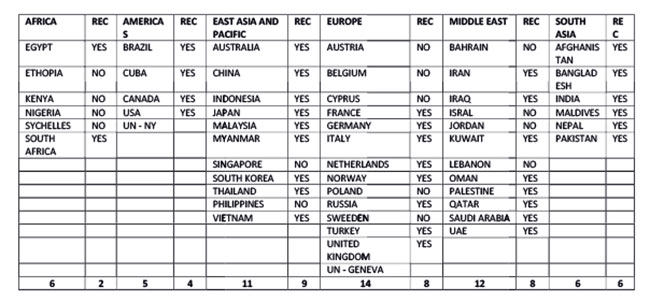
In the schedule included in this article, I have listed the countries where we have established resident missions. The number is 54 (information taken from the foreign ministry website). I have also indicated in the same schedule which of those countries have reciprocated by establishing resident missions in Colombo.
REC – RECIPROCAL WHERE THE OTHER COUNTRY HAS AN EMBASSY IN COLOMBO
NUMBER OF SRI LANKA RESIDENT MISSIONS OVERSEAS INCLUDING THE UNITED NATIONS = 54
NUMBER OF COUNTRIES HAVING RESIDENT MISSIONS IN SRI LANKA = 41
LIBYA, NEW ZEALAND, ROMANIA, AND SWITZERLAND HAVE RESIDENT MISSIONS IN COLOMBO DESPITE SRI LANKA NOT HAVING A RESIDENT MISSION IN THOSE COUNTRIES. IN ADDITION, THE EEC AND THE HOLY SEE POPE HAVE RESIDENT MISSIONS IN COLOMBO.
Another critical aspect of this debate is that successive governments have appointed people outside the foreign service as ambassadors and high commissioners since independence. These appointments are invariably granted as “santhosams” to their political supporters and since the 1980’s to a few retired service commanders. Thus, they are correctly referred to as “political appointments.” But, unfortunately, many of them are totally unsuitable and poorly trained in the art of diplomacy. Unfortunately, all governments have conveniently overlooked this lacuna. As a result, the poor taxpayers and career diplomats trained in the art of diplomacy have suffered.
In this regard, even Mrs Bandaranaike, who my father and other foreign service officials at the time considered to be the best Foreign Minister, erred. This is despite her government in 1970 appointing the first batch of career diplomats as Ambassadors.
I remember the background of those appointed as ambassadors to Russia and Pakistan, where my father was posted. One gentleman was a person who had appeared for Mrs Bandaranaike in a court case involving, I believe, a land dispute, whilst the other was a very young businessman who no doubt had supported the party financially. Both the gentlemen, as I remember, were “nice” people and sensible enough to let the career diplomats manage the challenges of running the embassy. However, I would contend that they and many other political appointees have had a pleasurable “holiday” at the expense of the taxpayers of Sri Lanka. There have been, of course, exceptions like Shirley Amerasinghe, Neville Kanakaratne and may be of recent vintage Dayan Jayatillake and S. Skandakumar.
The reason why I highlighted the news item of Milinda Moragoda (MM) assuming duties in New Delhi is only because, since January 2020, our High Commission in India has functioned without a High Commissioner. This is despite the parliamentary committee of high posts in August 2020 approving MM’s appointment. The reasons for the lengthy delay in traveling to New Delhi is not in the public domain.
When carrying out the review, it is necessary to determine how the Sri Lanka High Commission in India functioned without a High Commissioner for well over 18 months. It is acknowledged that India is the single most important overseas mission for Sri Lanka. Therefore, the question to be answered is whether relations between Sri Lanka and India were negatively impacted in the absence of a High Commissioner for 18 months?
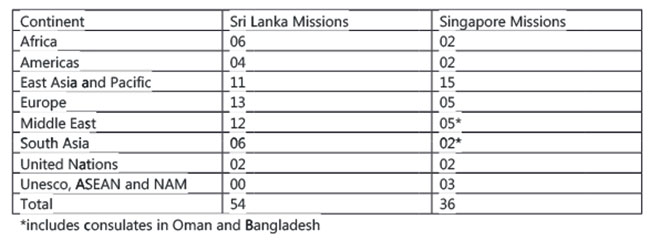
I was astonished that Singapore does not have an embassy in Colombo despite the two countries’ close relations. A review of the Singapore foreign ministry website indicates that the Ambassador appointed to Sri Lanka is based in the Foreign Ministry in Singapore. The schedule given in the article shows the number of Embassies and High Commissions that Singapore has worldwide against what Sri Lanka has. It is evident that the visionary leaders of Singapore have once again made a dispassionate decision about establishing overseas missions based on commonsense, prudence and need.
*includes consulates in Oman and Bangladesh
There is precedence for countries closing down overseas resident missions due to financial constraints. For example, the Sri Lanka foreign ministry progress report for 2018 states that Nigeria closed down its embassy in Colombo in 2017 due to financial hardship. Need we say more?
Taking all I have highlighted and applying the expenditure criteria of “Absolutely Necessary”, I believe that GOSL can quickly close down many (over 50 per cent) of our overseas missions without any negative impact on our relations with those countries.