Features
Some election reminiscences

A csynic once remarked that politics in Sri Lanka is ‘Poly tricks’ or ‘Podi tricks’, adding that half of the reputation of a politician was ruined by lies and the other half by the truth.
It was also his view that the gift of the gab and the toothy smile did not make one a politician. Nor does being obscure, inept, ill-educated, clueless, nonentities, verbosity.
Honesty, consistency, ability, hanydwork and commitment appear to be things of the past.
As usual various promises which could never be kept are made at elections.
The world’s first politician is said to have been Christopher Colombus. For, he did not know where he was going and also did not know where he had been. All that, he did at people’s expense.

From 1947 a voter had to mark the ballot paper with a Cross (x) opposite the symbol of a candidates and drop it into a common ballot box.
In this constituency, the majority of the voters were semi-rustic humble people. And this candidate went from house-to-house canvassing. “I am contesting this seat and my symbol is the lamp. I hope you are voting for me,” he said.
“Of course Mahattaya, need you ask us that? We are certainly voting for you.” “When you get the ballot paper, please make a cross opposite my symbol.”
At the next house too, he introduced himself. “Why the devil should we vote for you? And what have you done for us? We are going to vote for the clock,” they rudely told him.
“Well, that is your privilege. Then in the square opposite my symbol (lamp), in the ballot paper, mark a cross to show that you reject me.”
In 1931, the Anuradhapura seat in the State Council comprised the entire North Central Province. Today, the NCP has been broken up into 10 seats, as the population has increased ten-fold, thanks to the colonisation schemes of the late Father of the Nation, D.S Senanayake. In 1931, one of the contestants for the Anuradhapura Seat was an Englishman named H.R. Freeman, a retired Government Agent who preferred to live with his beloved peasants of the Vanni. Freeman’s election campaign was a novel and even casual one. He did not ever ask a voter directly for his vote. He would walk into a village, and sit on a rock or a tree stump by the road, and when the adoring peasants surrounded him, as they always did, he would tell them in a very matter-of- fact manner, “‘When you get that piece of white paper and put it inside the BLUE box, I go to the Council.” And the villagers would immediately raise their hands to Heaven and cry “Sadhu! Sadhu! Sadhu!” “And if you put the paper into the RED box,” Freeman would continue, “I go to England.” “Apoi, hamuduruwane,” the villagers would wail, “Don’t do that! We will put the paper into your blue box!” The mini-meeting being over, Freeman would pick up his umbrella, and go on to the next ‘meeting’.


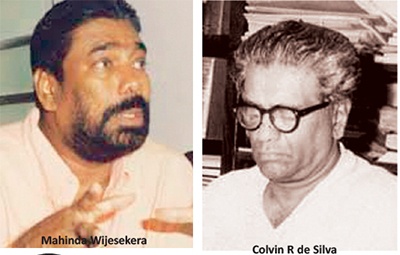
During the General Election in 1989, Ranjan Wijayawardena, one of the UNP candidates for the Matara District, arrived at the Matara Textile Industries Centre premises with some of his supporters to hold an unscheduled election meeting. Just then, Mahinda Wijesekera, an SLFP candidate, also arrived at the same venue to have a meeting of his own. The two rival candidates conferred, and decided to have a joint meeting. Wijesekera was the first to speak and outlining and explaining the policies of the SLFP, he appealed to all those who were not going to vote for his party or him, to vote for Ranjan Wijewardena. Ranjan in turn, after explaining the policies of his party, exhorted those who were not voting for him, to vote for Mahinda Wijesekera. At the end of the meeting, the huge crowd that was present gave the two rival candidates a standing ovation for the sportsmanship they had displayed. Incidentally, both candidates were returned to Parliament from the Matara District.
At this time the election fever was hotting up. with even candidates from the same party fighting for the preferencial votes, on which depended their being elected to Parliament. It was in this atmosphere that an election meeting was held at the Mahajana Pola at Galewala in Matale. A candidate was speaking, when he saw a rival candidate from another party coming towards the Pola, about to turn back, on seeing the meeting of the rival group in progress. The speaker stopped speaking and hailed his rival over the loudspeaker. “I say, Mr…, don’t go! Come up here and join me!” The invitation was accepted, and the candidate who was speaking, introduced his rival to the crowd, adding that there would be so many who would not vote for him (the speaker), and appealed to them to vote for his rival. The rival candidate, when he was asked to speak, replied in the same vein, adding that his rival candidate was a very honest man just the sort of man needed in politics.”
Dr. S. A. Wickramasinghe, the leader of the Communist Party was on his feet, addressing one of his own election meetings, when a man came up to him and whispered something urgently in his ear. Dr. Wickramasinghe stopped his speech abruptly and rushed off the stage and into a waiting car. The message was from his rival candidate, Sarath Wijesinghe, saying that Wijesinghe’s only daughter was seriously ill. After attending to the patient, Dr. Wickremasinghe returned and continued his speech, but not a word did he say about where he had gone, and why. He could have made a tremendous political capital out of it, but, the gentleman that he was, he did not.
Many years ago, and a certain MP noted for his quick temper and impulsive ways sought re-election. One day, while he was going round the electorate, canvassing, a supporter of his rival was rather rude to the MP.
The MP gave the man back in kind, and as the verbal exchange became heated, the MP drew back his fist and let his constituent have it on the jaw. Three of the man’s teeth were broken and he immediately went to the police station and made an entry against the MP. The parliamentarian was charged with grievous hurt, and the- case was postponed. Supporters, and especially speakers at the election meetings of the rival candidate, were strictly warned by their party hierarchy not to refer in any way to the incident as the matter was ‘sub judice’. But one irrepressible speaker was not to be put off so easily. Speaking at one of the MP’s rival’s meetings, this man said, “Sahodarawaruni it is nice to be loved by one’s wife. But my wife is overdoing her solicitousness for me. Every time I address a meeting and go home, she promptly grabs me and counts my teeth to see if any are missing!”
Talking of belligerent MPs, there was this not too popular chap who was nominated by his party to a certain seat. On the nomination day, as he returned home from the Kachcheri after handing in his papers, there were the usual wayside receptions and garlands. He was garlanded no less than nine times. The candidate reached his house, and leaping out of his car, grabbed his chief political catcher by the arm, and dragged him inside. Soon the people who had gathered at his house heard a loud altercation and the sound of a few slaps. They rushed into the house to see what the matter was, only to hear the would-be MP shout, Yakko, I gave you money for TEN garlands, and I got only nine!”
In one election, the doughty LSSPer Robert Gunawardena, was challenged by a prominent Buddhist coming from a very famous family which had been in the forefront of the battle for the emancipation of Buddhists and Buddhism from the restrictions placed on them by the British Raj. In his manifesto, this information of his famous family and that fact that he went to Dambadiva (the historical name for India) twice a year on pilgrimage were mentioned as qualifications. At one of his own election meetings, Robert Gunawardena, held up his opponent’s manifesto and said with withering scorn, “Sahodarawaruni, if going to Dambadiva twice a year is a qualification, then my barber is more qualified than this candidate, for that fellow goes to Dambadiva FOUR times a year!” (What Robert did not mention was that his barber was an Indian).
“In the general election of 1965 an SLFP Minister seeking re-election, had got off the stage after his speech, at one of his own election meetings, and surrounded by his cheering supporters, was making his way to his car to go to another meeting. He opened the door of his vehicle, but before he could get in, the huge crowd, surged forward, and the Minister’s hand got wedged in the door.
“Atha Atha!” (hand, hand!), yelled the politico, wincing in pain.
JAYAWEWA!” shouted the crowd, thinking he was referring to the SLFP symbol.
“Na, na, magey atha!” screamed the politico.
“Jayawewa!” roared the crowd….
Led by Somaweera Chandrasiri, the Poet of the Revolution, ‘hitivana kavi’ (impromptu verses) played an integral part at election meetings. Once when Ariyawansa Pathiraja, the famous Sinhala poet, was addressing an election meeting at Kotte, someone whispered to him that people from the enemy camp were recording his speech. Pathiraja immediately stopped his speech, and broke out into an impromptu verse:
Jathiya wanasala mage mulu rata holla
Newathath awuth apage chandaya illa
Tape karanawalu mun ayinak alla
Patigatha wenna honda hoowak daapalla
(“They’ve ruined our nation and shaken our country to its foundations. And now, once again they [impertinently] ask for our votes. Apparently they are furtively recording [my speech]. Let’s sound a big hoot they can tape.”) And the crowd responded with a mighty hoot!
About thirty years ago, a prominent local Marxist leader was addressing a public meeting, his theme being the equitable distribution of wealth. As he spoke, a young man in the crowd yelled out, “Everybody knows you are a very rich capitalist, Sahodaraya, so why don’t you set an example by distributing YOUR wealth among the people?”
The Marxist leader put his hand into his pocket, and taking out a ten-cent coin, tossed it to the young man. “I am worth about ten lakhs,” said the Marxist. “The population of this country is about ten million, and if my wealth is distributed among them, each person will get exactly ten cents! And now that you have got your share of my wealth, Sahodaraya allow me to go on with my speech!”
During one of those regular S. de S. Jayasinghe – Colvin R de Silva bouts for the Dehiwala-Galkissa Seat at one General Election, S de S. Jayasinghe speaking at one of his own election meetings said confidently, “I am winning this election, nonawaruni mahathwaruni! For my name begins with ‘Jaya’; Jaya for victory!” Speaking at one of his meeting a few days later,’ Dr. Colvin R. de Silva said, “I am told that my opponent Mr. Jayasinghe is bragging that he is going to be victorious, because his name begins with ‘Jaya’. Yes, Sahodara Sahodariyani! because his name begins with ‘jaya’ he may seem to win at the beginning, but come election day and I shall be the winner, for MY name ENDS with WIN.