
Features
Situlpauwa, Veddas, building a bungalow at Thenaddi Bay on idyllic East coast

Excerpted from te authorized biography of Thilo Hoffmann by Douglas B. Ranasinghe
(Continued from last week)
Thilo continues: “The Ven. Bhikkhu Sumedha, a long-time friend who had grown up in Switzerland, spent his early hermit years as a Buddhist monk at Situlpauwa and at the top of Vedahitikanda. He later obtained higher ordination, and died in Kandy in 2006. On his occasional visits to Colombo, dana was regularly offered at our house. Situlpauwa was then a jungle-covered site with only an occasional hermit monk in residence, and wildlife roaming freely through it. Today, as a result of restoration and development, the jungle has given way to concrete, electric lights, noise and commerce.”
During his time in Sri Lanka Thilo has been dismayed to witness such change, in diverse ways, at countless holy and historical places. He adds one example: “We may perhaps record two different alterations at the famous Koneswaram Temple, on Swami Rock at Trincomalee. The entire temple has been ‘restored’ and renovated, covering under cement and plaster and layers of glossy new paint all traces of its ancient history.
“It is also the site of an act of vandalism. There on a stone pillar was an inscription in high relief recording the death of a young Dutch woman who in the 18th century threw herself over the precipice after watching her lover’s ship sail away. This was chiselled away in the 1980s, a testimony to the prevalent politico-religious chauvinism.”
Veddas
In 1950 Thilo and Mae visited the Pollebedda Veddas in the company of Dr R. L. Spittel. After Thilo finished work at the office on Friday, they drove through the night to Maha Oya, via Haputale, Badulla and Bibile. In the early morning Spittel took them to Pollebedda, deep in the dry zone jungle, where a small and reasonably typical Vedda community was living.
Dr Spittel pointed out two younger men whom he described as “good throwbacks” and who, though of mixed blood, showed external characteristics of the Vedda race. He explained that the pure Veddas had ceased to exist some 20 years earlier as by then they had all been absorbed in the Sinhalese and Tamil populations. Thilo adds that other authorities with first-hand knowledge of the Veddas agree with this view. A dance was performed, and the visitors observed the families in their daily activties. Most had huts to live in, and were cultivating. There was one tent-like hut covered with pieces of tree bark. Rats were an item in the diet.
Twenty-six years later, in July 1976, the Hoffmanns again visited Pollebedda, which is about 15 km south of Maha Oya along the Rambukkan Oya. They camped out in a vain bid to see a rare bird, the broad-billed roller, which had been reported there. The place had changed beyond recognition, the thick forest had been cleared, and chenas had turned it into a ‘scrub desert’. A school building and teachers’ quarters had been put up. There was no trace of the Vedda settlement. Thilo explains:
“Today’s `show-Veddas’ of Dambana (so styled by the Seligmanns even a century ago), led by the offspring of a southern Sinhalese, masquerade as true Veddas for a gullible public. There is the strong impression that an outside ‘guru’ is instructing them in some of the old Vedda facts and customs obtained from the literature, e.g. the present name of the ‘chief, or the offering of bees’ honey to the sacred Tooth Relic. If you discount the costume and appendages (axe, bow and arrow) none of the Dambana villagers even look like Veddas.
Well before the Maduru Oya National Park had been declared, large areas in it north of Dambana and Maha Oya had been cleared of jungle and settled. Village infrastructure had been established, schools and ancillary buildings constructed. ‘Vedda life’ had been greatly restricted and consisted chiefly of poaching (not with bow and arrow) as in all villages in jungle areas.
When the Park was declared all the people living within its boundaries and in the bed of the new reservoir were given alternative land and habitations in newly developed areas. The people of Dambana, although the village itself is not in the Park, were offered irrigable land and houses below the nearby Ratkinda reservoir.
All accepted and moved except the fake Vedda chief Tisahamy, a Sinhalese who had shrewdly adopted the name of Dr Spittel’s hero, and his family. He successfully defied law and authority, lived in a large house in the midst of a banana plantation just inside the National Park boundary, and, with his young offspring play-acted the Vedda for assorted local and foreign tourists. Supported by sponsors and gurus, he even obtained an order from the District Court which forced the Wildlife Department to demolish the gate they had put up at the boundary of the Park.
Time went by and the new Tisahamy died. Recent history was quickly forgotten, and with the help of journalists, gullible politicians, foreign and local anthropologists the Vedda race was miraculously resuscitated. The settlers from Ratkinda now returned to Dambana, as the life of a show-Vedda had become full of promise.
Soon the motley crowd became even the internationally acknowledged representatives of the ‘indigenous people’ of Sri Lanka, and their leaders put in an expenses-paid appearance at the Permanent Forum of Indigenous People of the UN in Geneva, Switzerland. Local intellectuals and politicians recognized this set-up early as a god-sent opportunity to gain status and publicity. The highest authorities were persuaded to accord the “Veddas” privileges not given to any others, such as free movement and hunting, with guns, within the National Park.
This is the story of a scrappy bunch of villagers who by ruse and the cunning ‘PR-ship’ of their leader and his advisors became the `indigenous people’ of Sri Lanka, and as such are being cuddled by the State, the tourists and some of the island’s elite. Others have joined the bandwagon and, true to form, new demands are being presented.
If these, or other, villagers want to re-enact Vedda customs and habits in order to generate attention and income for themselves then that is their business. But they cannot expect nor be given special rights and privileges under the laws of the country.
The East
Few today are aware that the southern part of the Eastern Province, including Batticaloa, was virtually cut off from the rest of the country until the mid 20th century. At the time of Thilo’s first visits the motorable road ended at Polonnaruwa. Then, the railway bridges at Manampitiya and Valaichchenai (which had been opened in 1928) were converted to dual rail and road use, and connecting roads built, which allowed for the first time relatively easy access to that part of the East of Sri Lanka.
Before this Batticaloa could be reached from Colombo by road only via Beragala (below Haputale, at 3,500 ft, or 1,100 m a.s.1.) – Wellawaya – Pottuvil, or even more tediously via Badulla – Passara – Bibile – Eravur; and before the Second World War only by boat. To get to Batticaloa from Trincomalee ferries had to be used at seven places and the 80-mile (130 km) trip needed a full day.
Until the Second World War there had been a coastal shipping service for cargo and passengers. The vessels were named after the wives of past British Governors: Lady Manning, etc. and the line was called ‘the Lady line’. The small steamboats berthed at all coastal towns of some importance: Chilaw, Negombo, Colombo, Beruwela, Galle, Hambantota, Arugam Bay, Batticaloa, Kalkudah, Trincomalee and KKS. Until recently the remnants of the old piers could be seen at Hambantota and Kalkudah.
The East thus very much led a life of its own. It was and is distinctly different from the North. Its coconut industry – this too is not well known – was pioneered by British proprietary planters who settled there in the 19th century. The transformation of the Eastern Province began with the Gal Oya Development Project in the 1950s. Even until the end of that decade there was a change in the direction of milestones near Siyambalanduwa, because the road had been constructed starting from both ends.
The Eastern Province has a great touristic potential, but its development should be undertaken with circumspection and responsibility. Earlier attempts, especially at Kalkudah and Passikudah and to some extent at Arugam Bay and in the wider Trincomalee area, do not inspire much hope that natural and traditional assets will be suitably protected and preserved.
Thenaddi Bay
In the 1960s Thilo purchased a piece of land on the beach at Thenaddi Bay, a few miles north of Valaichchenai. For several years he had been searching for a suitable site on the East coast between Panama and Trincomalee. Then one day Mr S.V.O. Somanader of Kalkudah, who knew of his interest, drew his attention to a plot available at Kayankerni. Thilo had a look at the one-inch map, and instantly bought it without having seen it!
It proved to be a ‘dream’ location, alone in the centre of the wide bay with sandy, tree-fringed beaches and with crystal-clear blue water, except during the north-east monsoon when the sea is rough.
The tiny village of Kayankerni is a stronghold of the so-called Coast Veddas, a group of people who Thilo says are “as racially mixed as their forest-dwelling relatives, who deny any connection”. Here also is a small and simple temple in which the mysterious Kapal-Theivam (Kapalpei) ceremony is celebrated. The powerful deity is a foreigner who arrived in a ship. In the temple compound the wooden model of a ship is displayed atop a high pole.
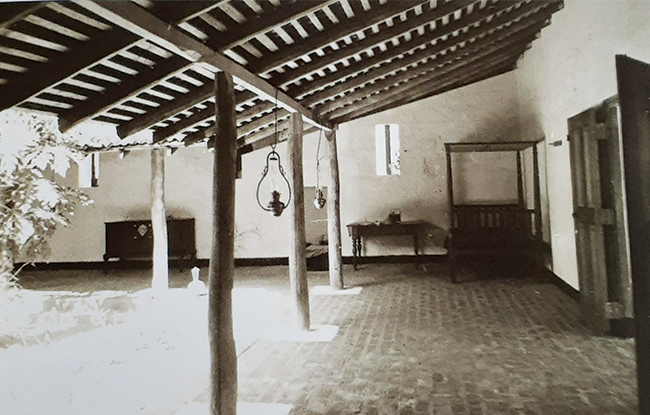
First, the basic unit of the holiday home was constructed: a fortress-like large rectangle of 15-foot high white walls, roofs sloping inward, an open inner courtyard with a well in its centre, and a wide seaward veranda. Thilo received enthusiastic and active assistance from his friend Lalith Senanayake.
In the following years, sporadically, many additions were made: bedrooms, a roof-top veranda with a spiral staircase; a guest-house, separate but connected by a covered passageway, with `meda midula’ and kitchen; a boathouse, a water tower, a garage, and eventually a two-storied rear wing.
Xavier Jobin and Stanley Gnanam, both of Baurs’ Palugaswewa Estate, with their wide experience in building, contributed greatly, also to necessary alterations and repairs; and Mr S. M. Sathiacama, then an engineer at Baurs, was very helpful. The very extensive roofs were covered with country tiles, which were frequently damaged by playful monkeys – who also “harvested” all the coconuts, well before maturity, on the 20-odd palms near the house!
Geoffrey Bawa, who was a friend of the Hoffmanns, called it “the best non-architect house I have seen”. There was no electricity. Kerosene fuelled the lamps at night and the refrigerator.For Thilo, working and sweating in the house and land was a regular and satisfying recreation. There was always something needing repair or maintenance or development. The first and often exasperating task on arrival was to start the fridge and the motor of the water pump. One of the most exhilarating moments of Thilo’s life, he recounts, was when he struck water some 10 or 12 feet down a hot and narrow cement tube. It was the first well on the property, and the main house was then built around it.
In the rear of the property Thilo developed his own little jungle from “the most thorny and impenetrable thicket in the world”. Along the beach he planted wind and salt resistant shrubs and palmyra palms.
For many years the Hoffmanns and their friends spent the most memorable weekends and holidays in this “magical” place, considered by some as the best times of their lives. There were marvellous coral reefs at the northern end of the bay, and others several miles long fringed the bay towards the open sea. These were rich in marine life, and comparable to the Maldives. There was fishing, diving, and snorkeling as well as underwater photography.
They did excursions up and down the coast to Trincomalee, the Baron’s Cap area – Toppigala, later of LTTE fame, locally called Kudumbi Kanda – and other remote inland wildlife areas. In most of these elephants were numerous. There was a fibreglass boat with outboard motor, which was later seized by the LTTE. They often went to Tamankaduwa, where elephants congregate in large numbers at times; up to more than 200 together have been observed by Thilo in that area1. Occasionally elephants even visited his property.
Thilo knew all the unique villus along the Mahaweli Ganga, which are fed and maintained by water from the river. They are part of the great biological diversity in the neglected Flood Plains and Somawathiya National Parks and adjoining protected areas; some of these form beautiful, wide landscapes, known to few. Their restoration now as effective conservation areas is a national duty.
The coast northward of the bungalow to Panichchankerni, Vakarai, Verugal, and especially from Ichchilampatai to Foul Point and Seruwawila, was little affected by any modern influences. Thinly populated – with a temporary migration during the south-west monsoon of fishermen from the west coast – it appeared as it would have centuries ago: lagoons, mangroves, a vast extent of jungle in the hinterland, rocky outcrops in forests and along the shore sticking out of the sea like monuments, coral reefs, the white beaches, venerable old trees, lonely temples and holy places.
From February to October there was almost permanent good weather, turning hot in May with the strong blowing of the warm kachan wind from the land. Blue sky, blue water, wide sandy beaches and the green fringe of ancient forest trees exemplified here the wonder of nearly untouched nature with man a small, well-fitting part of it – man and nature in balance. To add to all this, remarks Thilo, there is a wonderful smell of the flowering goda ratmal (Ixora arborea).
Seasonally the warm and calm water teems with tiny fluorescent organisms. At night the shallow waves running along the smooth shore light up like a moving illumination, and a swimming person is outlined with brightness in the clear water. Again, seasonally, the coastal jungle would be alive with swarms of fireflies sparkling at night, larger than elsewhere in the island.
At times, depending on climate and wind, the coastal water would be invaded by vast numbers of jellyfish. These beautiful, translucent creatures make swimming virtually impossible, not so much because of their sting but the unpleasant sensation of touch. Some, of course, are dangerous such as the Portuguese man-of-war which Thilo has observed on both the west and east coasts.
Also dangerous to bathers are the estuarine stingrays which seasonally bury themselves in the sand along the shallow shore and so become nearly invisible. They can inflict very painful wounds when trod upon.
In the 1970s much fuss was made about the sudden proliferation of the crown-of-thorns starfish, a beautiful blue and black inhabitant of tropical coral reefs. It was feared that the reefs would be destroyed. Panicked countermeasures were taken. The very people who were exploiting the reefs for the live fish trade were employed at great cost to spear and kill the starfish. The effect was the opposite of what was desired. The ‘blue stars’ were everywhere and visibly depleted the corals. In the early 1980s it all just died down, and in 1982 Thilo could not find a single crown-of-thorns in the extensive reefs around Thenaddi Bay.
During the north-east monsoon interesting items were washed ashore, for instance ambergris, a fatty grey substance, derived from sperm whales, and worth its weight in gold. On one occasion the part skeleton of a whale shark was left behind by the tide.
Twice, large fishing boats or rafts from Burma, across the Bay of Bengal, had been washed up on the wide beach near the bungalow. They were made of bamboo well tied together with string. A hut-like upper structure held a fireplace. Thilo found them unbelievably sturdy, intact after being storm-driven thousands of miles across the sea. Eventually both of them disintegrated on the wave-battered beach.
But, increasingly, ugly waste is also being swept ashore. Blobs of tar from boiler waste illegally discharged from passing ships, and literally millions of pieces of plastic in all colours and shapes originating from garbage on land and at sea now litter the sandy beaches.
(To be continued)


by Dr Gotabhya Ranasinghe
Senior Consultant Cardiologist
National Hospital Sri Lanka
When we sought a meeting with Hon Dr. Ramesh Pathirana, Minister of Health, he graciously cleared his busy schedule to accommodate us. Renowned for his attentive listening and deep understanding, Minister Pathirana is dedicated to advancing the health sector. His openness and transparency exemplify the qualities of an exemplary politician and minister.
Dr. Palitha Mahipala, the current Health Secretary, demonstrates both commendable enthusiasm and unwavering support. This combination of attributes makes him a highly compatible colleague for the esteemed Minister of Health.
Our discussion centered on a project that has been in the works for the past 30 years, one that no other minister had managed to advance.
Minister Pathirana, however, recognized the project’s significance and its potential to revolutionize care for heart patients.
The project involves the construction of a state-of-the-art facility at the premises of the National Hospital Colombo. The project’s location within the premises of the National Hospital underscores its importance and relevance to the healthcare infrastructure of the nation.
This facility will include a cardiology building and a tertiary care center, equipped with the latest technology to handle and treat all types of heart-related conditions and surgeries.
Securing funding was a major milestone for this initiative. Minister Pathirana successfully obtained approval for a $40 billion loan from the Asian Development Bank. With the funding in place, the foundation stone is scheduled to be laid in September this year, and construction will begin in January 2025.
This project guarantees a consistent and uninterrupted supply of stents and related medications for heart patients. As a result, patients will have timely access to essential medical supplies during their treatment and recovery. By securing these critical resources, the project aims to enhance patient outcomes, minimize treatment delays, and maintain the highest standards of cardiac care.
Upon its fruition, this monumental building will serve as a beacon of hope and healing, symbolizing the unwavering dedication to improving patient outcomes and fostering a healthier society.We anticipate a future marked by significant progress and positive outcomes in Sri Lanka’s cardiovascular treatment landscape within the foreseeable timeframe.

by Fr. Emmanuel Fernando, OMI
Jesuit Fr. Aloysius Pieris (affectionately called Fr. Aloy) celebrated his 90th birthday on April 9, 2024 and I, as the editor of our Oblate Journal, THE MISSIONARY OBLATE had gone to press by that time. Immediately I decided to publish an article, appreciating the untiring selfless services he continues to offer for inter-Faith dialogue, the renewal of the Catholic Church, his concern for the poor and the suffering Sri Lankan masses and to me, the present writer.
It was in 1988, when I was appointed Director of the Oblate Scholastics at Ampitiya by the then Oblate Provincial Fr. Anselm Silva, that I came to know Fr. Aloy more closely. Knowing well his expertise in matters spiritual, theological, Indological and pastoral, and with the collaborative spirit of my companion-formators, our Oblate Scholastics were sent to Tulana, the Research and Encounter Centre, Kelaniya, of which he is the Founder-Director, for ‘exposure-programmes’ on matters spiritual, biblical, theological and pastoral. Some of these dimensions according to my view and that of my companion-formators, were not available at the National Seminary, Ampitiya.
Ever since that time, our Oblate formators/ accompaniers at the Oblate Scholasticate, Ampitiya , have continued to send our Oblate Scholastics to Tulana Centre for deepening their insights and convictions regarding matters needed to serve the people in today’s context. Fr. Aloy also had tried very enthusiastically with the Oblate team headed by Frs. Oswald Firth and Clement Waidyasekara to begin a Theologate, directed by the Religious Congregations in Sri Lanka, for the contextual formation/ accompaniment of their members. It should very well be a desired goal of the Leaders / Provincials of the Religious Congregations.
Besides being a formator/accompanier at the Oblate Scholasticate, I was entrusted also with the task of editing and publishing our Oblate journal, ‘The Missionary Oblate’. To maintain the quality of the journal I continue to depend on Fr. Aloy for his thought-provoking and stimulating articles on Biblical Spirituality, Biblical Theology and Ecclesiology. I am very grateful to him for his generous assistance. Of late, his writings on renewal of the Church, initiated by Pope St. John XX111 and continued by Pope Francis through the Synodal path, published in our Oblate journal, enable our readers to focus their attention also on the needed renewal in the Catholic Church in Sri Lanka. Fr. Aloy appreciated very much the Synodal path adopted by the Jesuit Pope Francis for the renewal of the Church, rooted very much on prayerful discernment. In my Religious and presbyteral life, Fr.Aloy continues to be my spiritual animator / guide and ongoing formator / acccompanier.
Fr. Aloysius Pieris, BA Hons (Lond), LPh (SHC, India), STL (PFT, Naples), PhD (SLU/VC), ThD (Tilburg), D.Ltt (KU), has been one of the eminent Asian theologians well recognized internationally and one who has lectured and held visiting chairs in many universities both in the West and in the East. Many members of Religious Congregations from Asian countries have benefited from his lectures and guidance in the East Asian Pastoral Institute (EAPI) in Manila, Philippines. He had been a Theologian consulted by the Federation of Asian Bishops’ Conferences for many years. During his professorship at the Gregorian University in Rome, he was called to be a member of a special group of advisers on other religions consulted by Pope Paul VI.
Fr. Aloy is the author of more than 30 books and well over 500 Research Papers. Some of his books and articles have been translated and published in several countries. Among those books, one can find the following: 1) The Genesis of an Asian Theology of Liberation (An Autobiographical Excursus on the Art of Theologising in Asia, 2) An Asian Theology of Liberation, 3) Providential Timeliness of Vatican 11 (a long-overdue halt to a scandalous millennium, 4) Give Vatican 11 a chance, 5) Leadership in the Church, 6) Relishing our faith in working for justice (Themes for study and discussion), 7) A Message meant mainly, not exclusively for Jesuits (Background information necessary for helping Francis renew the Church), 8) Lent in Lanka (Reflections and Resolutions, 9) Love meets wisdom (A Christian Experience of Buddhism, 10) Fire and Water 11) God’s Reign for God’s poor, 12) Our Unhiddden Agenda (How we Jesuits work, pray and form our men). He is also the Editor of two journals, Vagdevi, Journal of Religious Reflection and Dialogue, New Series.
Fr. Aloy has a BA in Pali and Sanskrit from the University of London and a Ph.D in Buddhist Philosophy from the University of Sri Lankan, Vidyodaya Campus. On Nov. 23, 2019, he was awarded the prestigious honorary Doctorate of Literature (D.Litt) by the Chancellor of the University of Kelaniya, the Most Venerable Welamitiyawe Dharmakirthi Sri Kusala Dhamma Thera.
Fr. Aloy continues to be a promoter of Gospel values and virtues. Justice as a constitutive dimension of love and social concern for the downtrodden masses are very much noted in his life and work. He had very much appreciated the commitment of the late Fr. Joseph (Joe) Fernando, the National Director of the Social and Economic Centre (SEDEC) for the poor.
In Sri Lanka, a few religious Congregations – the Good Shepherd Sisters, the Christian Brothers, the Marist Brothers and the Oblates – have invited him to animate their members especially during their Provincial Congresses, Chapters and International Conferences. The mainline Christian Churches also have sought his advice and followed his seminars. I, for one, regret very much, that the Sri Lankan authorities of the Catholic Church –today’s Hierarchy—- have not sought Fr.
Aloy’s expertise for the renewal of the Catholic Church in Sri Lanka and thus have not benefited from the immense store of wisdom and insight that he can offer to our local Church while the Sri Lankan bishops who governed the Catholic church in the immediate aftermath of the Second Vatican Council (Edmund Fernando OMI, Anthony de Saram, Leo Nanayakkara OSB, Frank Marcus Fernando, Paul Perera,) visited him and consulted him on many matters. Among the Tamil Bishops, Bishop Rayappu Joseph was keeping close contact with him and Bishop J. Deogupillai hosted him and his team visiting him after the horrible Black July massacre of Tamils.
Sri Lanka-Singapore Free Trade Agreement
By Gomi Senadhira
senadhiragomi@gmail.com
“You might tell fairy tales, but the progress of a country cannot be achieved through such narratives. A country cannot be developed by making false promises. The country moved backward because of the electoral promises made by political parties throughout time. We have witnessed that the ultimate result of this is the country becoming bankrupt. Unfortunately, many segments of the population have not come to realize this yet.” – President Ranil Wickremesinghe, 2024 Budget speech
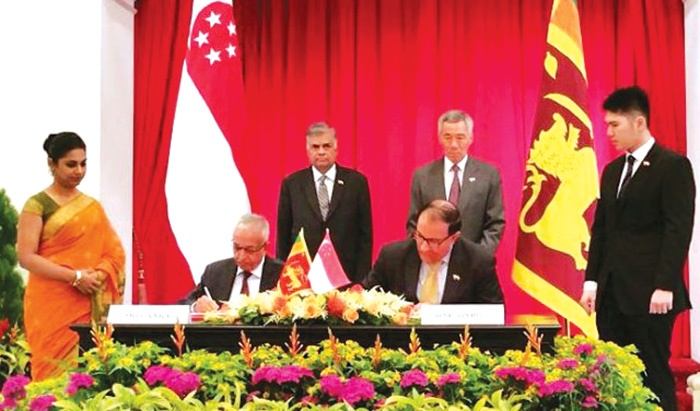
Any Sri Lankan would agree with the above words of President Wickremesinghe on the false promises our politicians and officials make and the fairy tales they narrate which bankrupted this country. So, to understand this, let’s look at one such fairy tale with lots of false promises; Ranil Wickremesinghe’s greatest achievement in the area of international trade and investment promotion during the Yahapalana period, Sri Lanka-Singapore Free Trade Agreement (SLSFTA).
It is appropriate and timely to do it now as Finance Minister Wickremesinghe has just presented to parliament a bill on the National Policy on Economic Transformation which includes the establishment of an Office for International Trade and the Sri Lanka Institute of Economics and International Trade.
Was SLSFTA a “Cleverly negotiated Free Trade Agreement” as stated by the (former) Minister of Development Strategies and International Trade Malik Samarawickrama during the Parliamentary Debate on the SLSFTA in July 2018, or a colossal blunder covered up with lies, false promises, and fairy tales? After SLSFTA was signed there were a number of fairy tales published on this agreement by the Ministry of Development Strategies and International, Institute of Policy Studies, and others.
However, for this article, I would like to limit my comments to the speech by Minister Samarawickrama during the Parliamentary Debate, and the two most important areas in the agreement which were covered up with lies, fairy tales, and false promises, namely: revenue loss for Sri Lanka and Investment from Singapore. On the other important area, “Waste products dumping” I do not want to comment here as I have written extensively on the issue.
1. The revenue loss
During the Parliamentary Debate in July 2018, Minister Samarawickrama stated “…. let me reiterate that this FTA with Singapore has been very cleverly negotiated by us…. The liberalisation programme under this FTA has been carefully designed to have the least impact on domestic industry and revenue collection. We have included all revenue sensitive items in the negative list of items which will not be subject to removal of tariff. Therefore, 97.8% revenue from Customs duty is protected. Our tariff liberalisation will take place over a period of 12-15 years! In fact, the revenue earned through tariffs on goods imported from Singapore last year was Rs. 35 billion.
The revenue loss for over the next 15 years due to the FTA is only Rs. 733 million– which when annualised, on average, is just Rs. 51 million. That is just 0.14% per year! So anyone who claims the Singapore FTA causes revenue loss to the Government cannot do basic arithmetic! Mr. Speaker, in conclusion, I call on my fellow members of this House – don’t mislead the public with baseless criticism that is not grounded in facts. Don’t look at petty politics and use these issues for your own political survival.”
I was surprised to read the minister’s speech because an article published in January 2018 in “The Straits Times“, based on information released by the Singaporean Negotiators stated, “…. With the FTA, tariff savings for Singapore exports are estimated to hit $10 million annually“.
As the annual tariff savings (that is the revenue loss for Sri Lanka) calculated by the Singaporean Negotiators, Singaporean $ 10 million (Sri Lankan rupees 1,200 million in 2018) was way above the rupees’ 733 million revenue loss for 15 years estimated by the Sri Lankan negotiators, it was clear to any observer that one of the parties to the agreement had not done the basic arithmetic!
Six years later, according to a report published by “The Morning” newspaper, speaking at the Committee on Public Finance (COPF) on 7th May 2024, Mr Samarawickrama’s chief trade negotiator K.J. Weerasinghehad had admitted “…. that forecasted revenue loss for the Government of Sri Lanka through the Singapore FTA is Rs. 450 million in 2023 and Rs. 1.3 billion in 2024.”
If these numbers are correct, as tariff liberalisation under the SLSFTA has just started, we will pass Rs 2 billion very soon. Then, the question is how Sri Lanka’s trade negotiators made such a colossal blunder. Didn’t they do their basic arithmetic? If they didn’t know how to do basic arithmetic they should have at least done their basic readings. For example, the headline of the article published in The Straits Times in January 2018 was “Singapore, Sri Lanka sign FTA, annual savings of $10m expected”.
Anyway, as Sri Lanka’s chief negotiator reiterated at the COPF meeting that “…. since 99% of the tariffs in Singapore have zero rates of duty, Sri Lanka has agreed on 80% tariff liberalisation over a period of 15 years while expecting Singapore investments to address the imbalance in trade,” let’s turn towards investment.
Investment from Singapore
In July 2018, speaking during the Parliamentary Debate on the FTA this is what Minister Malik Samarawickrama stated on investment from Singapore, “Already, thanks to this FTA, in just the past two-and-a-half months since the agreement came into effect we have received a proposal from Singapore for investment amounting to $ 14.8 billion in an oil refinery for export of petroleum products. In addition, we have proposals for a steel manufacturing plant for exports ($ 1 billion investment), flour milling plant ($ 50 million), sugar refinery ($ 200 million). This adds up to more than $ 16.05 billion in the pipeline on these projects alone.
And all of these projects will create thousands of more jobs for our people. In principle approval has already been granted by the BOI and the investors are awaiting the release of land the environmental approvals to commence the project.
I request the Opposition and those with vested interests to change their narrow-minded thinking and join us to develop our country. We must always look at what is best for the whole community, not just the few who may oppose. We owe it to our people to courageously take decisions that will change their lives for the better.”
According to the media report I quoted earlier, speaking at the Committee on Public Finance (COPF) Chief Negotiator Weerasinghe has admitted that Sri Lanka was not happy with overall Singapore investments that have come in the past few years in return for the trade liberalisation under the Singapore-Sri Lanka Free Trade Agreement. He has added that between 2021 and 2023 the total investment from Singapore had been around $162 million!
What happened to those projects worth $16 billion negotiated, thanks to the SLSFTA, in just the two-and-a-half months after the agreement came into effect and approved by the BOI? I do not know about the steel manufacturing plant for exports ($ 1 billion investment), flour milling plant ($ 50 million) and sugar refinery ($ 200 million).
However, story of the multibillion-dollar investment in the Petroleum Refinery unfolded in a manner that would qualify it as the best fairy tale with false promises presented by our politicians and the officials, prior to 2019 elections.
Though many Sri Lankans got to know, through the media which repeatedly highlighted a plethora of issues surrounding the project and the questionable credentials of the Singaporean investor, the construction work on the Mirrijiwela Oil Refinery along with the cement factory began on the24th of March 2019 with a bang and Minister Ranil Wickremesinghe and his ministers along with the foreign and local dignitaries laid the foundation stones.
That was few months before the 2019 Presidential elections. Inaugurating the construction work Prime Minister Ranil Wickremesinghe said the projects will create thousands of job opportunities in the area and surrounding districts.
The oil refinery, which was to be built over 200 acres of land, with the capacity to refine 200,000 barrels of crude oil per day, was to generate US$7 billion of exports and create 1,500 direct and 3,000 indirect jobs. The construction of the refinery was to be completed in 44 months. Four years later, in August 2023 the Cabinet of Ministers approved the proposal presented by President Ranil Wickremesinghe to cancel the agreement with the investors of the refinery as the project has not been implemented! Can they explain to the country how much money was wasted to produce that fairy tale?
It is obvious that the President, ministers, and officials had made huge blunders and had deliberately misled the public and the parliament on the revenue loss and potential investment from SLSFTA with fairy tales and false promises.
As the president himself said, a country cannot be developed by making false promises or with fairy tales and these false promises and fairy tales had bankrupted the country. “Unfortunately, many segments of the population have not come to realize this yet”.
(The writer, a specialist and an activist on trade and development issues . )



US sports envoys to Lanka to champion youth development

Rahuman questions sudden cancellation of leave of CEB employees


