
Features
SIR PONNAMBALAM ARUNACHALAM (1853-1924)


On the 98th Death Anniversary which falls on January 9, 2022 Compiled by Sega Nagendra and Suresh Murugaser, great grandchildren of Sir P. Arunachalam
FAMILY
Ponnambalam Arunachalam was the youngest Son of Gate Mudaliyar A. Ponnambalam.
He was born on September 14, 1853, to a highly respected and a well-educated professional family originally from Manipay, Jaffna.
Gate Mudaliyar Arumuganathapillai Coomaraswamy, his maternal grandfather, was the Tamil representative of the first Legislative Council established in 1834, following the recommendations of the Colebrooke-Cameron report of 1832. Colebrooke, coming from England, which was agitating for reform of the electoral system, was surprised at the autocratic powers exercised by the Governor of Ceylon since 1802. He effected a reduction of those powers by setting up an Executive and Legislative Council.
Sir Muttu Coomaraswamy, who was Arunachalam’s mother’s brother, had been a friend of Lord Houghton, Palmerston and Disraeli, in the London of the 1860’s. Sir Muttu was the first Ceylon Tamil (and probably, the first Asian) to receive a Knighthood, and the first non-Christian Asian to be called to the English Bar.
Sir Muttu’s only son, Dr. Ananda Coomaraswamy, world-famous art critic and author, who played a pivotal role in the cultural revival of India and Ceylon (including the proliferation of Buddhism in the latter), died in 1947 in Boston USA where he had worked in the Fine Arts Department for many years.
Both the elder brothers of Sir Ponnambalam Arunachalam were educated at the Colombo Academy (now Royal College), and then at Presidency College, Madras.
His eldest brother Ponnambalam Coomaraswamy had a distinguished career as a Proctor and was the Nominated Tamil Member of the Ceylon Legislative Counsel from 1893.
The next eldest child of the family, his brother, Ponnambalam Ramanathan, an Advocate, succeeded their uncle, Sir Muttu Coomaraswamy as the Nominated Tamil Representative, serving from 1879-1893, and later on from 1921 to 1924. Ponnambalam Ramanathan was also elected to the Legislature as Member for the Northern Province (Northern Division) seat, and occupied it from 1924 till his death in 1930. In addition to this appointment, Ramanathan was the island’s Solicitor-General from 1893-1906 for a period of 13 years, acted as Attorney-General on several occasions, and retired as a pensionable officer in 1906.
EDUCATION
Like his older brothers, Ponnambalam Arunachalam had his early education at the Colombo Academy, but, having won the English University Scholarship in 1870, he entered Christ College, Cambridge. He took with him a reputation as a student of exceptional merit, recommended by Sir Walter Sendall, Director of Public Instruction. At Cambridge, he proceeded to annex the Foundation Scholarship.
While at Cambridge, Arunachalam distinguished himself in both Classics and Mathematics. In the records of Christ College he is referred to as a “brilliant mathematician and an able classics scholar”.
As a student, Ponnambalam Arunachalam was in a position to watch the changes made by Disraeli to the voting system in Britain, and stored his observations for future reference.
Arunachalam had qualified for the Bar in England and was looking forward to a legal career, but on his return to Ceylon in 1875 his uncle Sir Muttu Coomaraswamy persuaded him to sit for the Civil Service examination. He did so, and his talent and academic excellence ensured that he was the first Ceylonese to enter the prestigious Civil Service through open competition.
GOVERNMENT CAREER
Arunachalam was not appointed to the Government Agent’s office in Colombo and then to a series of judicial posts in various parts of the island. This was a policy unofficially adopted by the British Government of the day, which effectively debarred outstanding Ceylonese from taking high office in Government and instead appointed them to various parts of the Island in different capacities, such as District Judges, Police Magistrates, and Commissioners of Requests.
When he was District Judge of Batticaloa and in the Fourth Class of the Civil Service, Sir Arthur Gordon appointed Arunachalam over the heads of about thirty seniors, among whom was Mr. (later Sir) Alexander Ashmore, to act in the office of the Registrar-General and Fiscal of the Western Province. A protest memorandum was lodged with the Secretary of State. But Sir Arthur Gordon, who obviously recognized merit when he found it, had his way and Arunachalam took office as Registrar-General.
Arunachalam now set himself to reform the Fiscal’s office which had become a den of corruption and inefficiency He reorganised the departments of Land Registration and Registration of Births, Deaths and Marriages, for which he was warmly congratulated by the Governor. The Times of Ceylon, reporting at the time Arunachalam entered the departments, on the Administration Reports on Land Registration and Vital Statistics, observed that they were places where chaos and corruption held merry sway. Fraud was rife. Dishonest deals often took precedence over genuine dealings, and everybody’s property and title were endangered.
The measure of the man may be seen in the way he set about reforming the Registrar-General’s Department. Sitting by the side of the various clerks as they performed their tasks, he patiently learned their work before launching the reforms by which he stopped the unconscionable delays and dishonesty prevailing in the registration of deeds, and ended the practice by which official work was being conducted as a form of private practice with fees levied privately for its discharge.
He started a real Record Room, supplied it with a system and an index, and founded a Benevolent Society which saved many a clerk from the grasp of money-lenders as well as from social disgrace and penury, paid many widows and orphans, and made clerical lives lighter and brighter. These activities were noticed by a distinguished American statistician, who informed the Governor of Ceylon that “there is not published in the entire United States a report equally valuable and comprehensive”.
Governor Sir West Ridgeway entrusted the organisation of the 1901 Census of Ceylon to Arunachalam. The report elicited the thanks of both the Governor and Secretary of State. But it was Armand de Souza, Editor of the Ceylon Morning Leader, an influential paper of the day, who wrote:
“The curious reader…. will find the Report which introduces the Census of 1901 perhaps the most luminous dissertation on the ethnological, social and economic conditions of the Island. In Sir P. Arunachalam’s Account of the history and religions of the Island in his Census Report would be found the language of Addison, the eloquence of Macaulay and the historical insight of Mommsen”.
In 1906 Arunachalam was appointed to the Legislative Council. In 1912 Governor Sir Henry McCallum nominated him to the Executive Council, as a personal appointment; and on his retirement from the Public Service in 1913, he was knighted in recognition of his distinguished service to the country.
POST-RETIREMENT
In 1913, a new phase in Arunachalam’s life began. In this year he joined a political movement demanding self-governance for the people of Ceylon. In an historic lecture entitled ‘’Our Political Needs”, given at the insistence of D.R.Wijewardene, Arunachalam crystallised the arguments for self-government.
In 1915 he was elected the first President of the Ceylon Social Service League for the upliftment of the poorer classes in Ceylon.
In 1917 he founded the Ceylon Reform League, and
In 1919 he delivered an address to a Sinhalese conference under the patronage of F.R.Senanayake, for the purpose of organising Peoples’ Associations throughout the Sinhalese districts of the Island for political, social and economic improvement. This movement directly gave birth to the Lanka Maha Jana Sabha.
HIS VISION
Arunachalam’s unstinted commitment to his dream of “Unity is Strength” illustrates the strong unity that existed at that time amongst the people of Ceylon, when Sinhalese, Tamils, Moors, Burghers were united in their approach to social reform. Unfortunately, the country now marches to a different drum resulting in mass exodus of many talented individuals and their progeny!
NATIONAL ORGANISATIONS
On December 11, 1919, the Ceylon National Congress was inaugurated, with the unanimous election of Arunachalam as its first President. It was he who advised various political organizations such as the Ceylon National Association, the Ceylon Reform League, the Chilaw Association, and the Jaffna Youth Association to unite into one body and lodge a joint appeal for political reform.
The Jaffna league joined the Ceylon National Congress on a condition: namely, that in a reformed Legislative Council there would be a special seat for the Tamils of the Western Province.
LEGISLATIVE COUNCIL
The reformed Legislative Council of 1921 did not have a seat for a Tamil.
The Low Country Association, with 11 voters elected Sir Henry De Mel in 1921, whilst the Town of Colombo with an electorate of 4,325, elected his Brother-in-Law, Sir James Peiris, unopposed. The vast number of people felt this to be the cause of Sir Ponnambalam’s untimely resignation from being the first President of the newly formed Ceylon National Congress (CNC), to form which he had exerted so much effort, persuasion and energy for quite some time. They all expected Sir Ponnambalam to be elected as the member for Colombo Town and Sir James Peiris who was a prominent member of the Low Country Products Association, to be elected by that body.
FATHER OF UNIVERSTY EDUCATION AND “SWABASHA”
Sir Ponnambalam Arunachalam’s contribution to the field of education was that of a pioneer. In his notes to the Director of Public Instruction, he stated that the fundamental defect in the system of elementary education in Ceylon was that English was employed as the medium of instruction.
In a real sense, as has been pointed out, he was the father of the concept of ‘Swabasha’. Unfortunately, this idea was worked upon by later politicians who mis-read it, totally rejecting English, which could have been the link language unifying the different ethnic groups of Ceylon. Since at that time the people of Ceylon were still functioning as a united family, the need for a link language did not assert itself. The paths of History are littered with missed opportunities, and sadly, this was one of them.
Sir Ponnambalam Arunachalam has been rightly called the Father of the Ceylon University Movement as he was responsible for the Ceylon University Association which was formed in January 1906. In his memorandum to the Governor, Sir West Ridgeway, requesting the Government to appoint a Commission to report on educational progress and needs, Arunachalam appealed to the Government to create a “Ceylon University”; or at least to raise Royal College to the status of a University College, which would be of lasting benefit to the people and a fitting monument to His Excellency’s rule in Ceylon. He suggested that Ceylon and Indian History and Geography could replace English History and Geography on the curriculum of such an institution. “His Excellency on 15 October decided to take no action” was the negative response he received from the Governor’s Secretary.
ACHIEVEMENTS IN A NUTSHELL
Looking back on Sir Ponnambalam Arunachalam’s career, we contemplate a life studded with immense contributions in a range of different fields of endeavour. Those contributions by which he will always be remembered include
His membership and Presidency of the Royal Asiatic Society
His role as Founder President of the Ceylon Saiva Paripalana Sabhai (a religious organisation which encourages the practice of Hinduism)
The re-organisation of the Registrar-General’s Department (a Herculean task, magnificently performed)
The formation of the Ceylon National Congress, whose real potential for national unity was destroyed by the petty self-interest of some influential sections of the Sinhalese
His original and outstanding contribution to the establishment of the Ceylon University College.
The steadfast belief in the unity of his country’s various communities in a single sovereign state, which he carried with him throughout his life.
THE FINALE
By then, Sir Ponnambalam was an exhausted and tired genius, perhaps disillusioned, yet one who understood human nature and became more forgiving and gracious. Towards the end of 1923, he undertook a pilgrimage to visit the Sacred Shrines in India. In the midst of his devotions at Madurai in South India, he passed away on January 9, 1924, leaving behind him memories of a noble life well spent in the service of his Country and his people.
THE TRIBUTES
The day after his death, the “Ceylon Daily News” described him in an Editorial as ‘’the most powerful personality in Ceylon’’ and the “Times of London” described him as ‘’Founder of modern Ceylon’’.
When Professor Marrs, the first Principal of the University College, heard of Arunachalam’s death at Madurai on January 9, 1924, while on a pilgrimage worshipping at the Hindu temples in South India, he summoned the students of the University College to the main hall and addressed them in these words:
“Gentlemen, I have asked you to assemble here at this hour as a mark of respect to the memory of one who was in a very real sense the Father of the University project in Ceylon. Little or nothing has been said of that side of his activities which to those who were in close touch with him was the inspiration of his latter days – the side which concerns you and me as members of an institution so dear to his heart, the Ceylon University College Sir Ponnambalam Arunachalam presided over the Public Meeting which was called to consider the question of the establishment of a University in Ceylon on January 19, 1906. From that day to the day of his decease Sir Ponnambalam Arunachalam has pursued his object to use his own words, “without let or restraint”, undeterred by the doubts of men without vision or the delay to which an untried project must, I suppose, always be subjected by conservers of tradition”.
Sir Ponnambalam Arunachalam has been honoured by the erection of his statue in Parliament Square in 1930, and by the unveiling of his portraits at Royal College and at the Offices of both the Ceylon National Congress and the Ceylon Social Service League. His name graces Arunachalam Hall, the first Hall of Residence to be opened to students at the University of Peradeniya in 1951, and a commemorative one-rupee postage stamp was issued in his memory on March 10, 1977. His philosophical and religious contributions were collected and published in 1937, with the title “Studies and Translations”.
In his ‘’Message to the Country’’ published by his good friend D.R. Wijewardene (who had returned from Cambridge with a degree in Law and as a Barrister, and persuaded Sir Ponnambalam Arunachalam to resume his political activities) in the very first issue of the ‘’Ceylon Daily News’’ of January 3, 1918, he declared :
‘’ In our zeal for political reform we must be on our guard against making it an end. We seek it not to win rights but to fulfil duties to ourselves and our Country. People have a distinct task to perform. Our youth will seek their own well-being. They will work in unity so that all the intellectual forces defused among men may obtain the highest development in thought and action. With our youth inspired by such ideas, I would like to see our Country rise with renewed splendour to be a beacon light to all lands. ‘’
The next substantial reference to him was by the late, great Mr. D.R. Wijewardene himself, who was his great friend and admirer. On the occasion of Ceylon’s independence, he rose from his sick bed, whilst in retirement in 1948, and in ‘’Ceylon Daily News’’ reflecting on events over 32 years earlier, he wrote: – ‘’ In those days, the national consciousness was dormant and there was nothing in the spirit of the times to stir it to life and activity. Later, largely as a result of Sir Ponnambalam Arunachalam’s work, the fire of the national soul was quickened. When he delivered his epoch-making address on April 2, 1917 on ‘’Our Political Needs’’ at the Masonic Hall, that leader of imperishable memory set in motion influences that were to change the history of this Country. It was both a starting point and a blue-print for the important Constitutional changes that followed.
The immediate outcome of that meeting was the formation of the Ceylon National Congress. It was then that the national movement which has brought Ceylon to the threshold of Independence received its stimulus. Public opinion began to speak for the first time with a firm tone’’.
Sir Ponnambalam Arunachalam stands out as an outstanding leader of honesty, integrity and achievement, and is a beacon to us all.
Most of us would have been satisfied by association with one or other of such monumental endeavours. But Sir Ponnambalam Arunachalam seems to have been a human dynamo – a true nationalist and patriot of Ceylon.
A short time after Sir Ponnambalam Arunachalam’s death, grateful people honoured his memory by erecting his statute in the grounds of Parliament House. It was unveiled by the Governor, Sir Herbert Stanley on April 3, 1930. It was the first statute to adorn these premises, and stood in solitary splendour till the statute of his brother Ramanathan was erected in 1953. The inscription of the statute reads as follows:
SIR PONNAMBALAM ARUNACHALAM
1853 -1924
Scholar, Statesman, Administrator, Patriot
Erected by a Grateful People in
Testimony of a life nobly spent
In the service of his country and
Signal services as the champion of
A reformed legislature and of
His matchless devotion and
Steadfastness in the cause
Of the Ceylon University



by Dr Gotabhya Ranasinghe
Senior Consultant Cardiologist
National Hospital Sri Lanka
When we sought a meeting with Hon Dr. Ramesh Pathirana, Minister of Health, he graciously cleared his busy schedule to accommodate us. Renowned for his attentive listening and deep understanding, Minister Pathirana is dedicated to advancing the health sector. His openness and transparency exemplify the qualities of an exemplary politician and minister.
Dr. Palitha Mahipala, the current Health Secretary, demonstrates both commendable enthusiasm and unwavering support. This combination of attributes makes him a highly compatible colleague for the esteemed Minister of Health.
Our discussion centered on a project that has been in the works for the past 30 years, one that no other minister had managed to advance.
Minister Pathirana, however, recognized the project’s significance and its potential to revolutionize care for heart patients.
The project involves the construction of a state-of-the-art facility at the premises of the National Hospital Colombo. The project’s location within the premises of the National Hospital underscores its importance and relevance to the healthcare infrastructure of the nation.
This facility will include a cardiology building and a tertiary care center, equipped with the latest technology to handle and treat all types of heart-related conditions and surgeries.
Securing funding was a major milestone for this initiative. Minister Pathirana successfully obtained approval for a $40 billion loan from the Asian Development Bank. With the funding in place, the foundation stone is scheduled to be laid in September this year, and construction will begin in January 2025.
This project guarantees a consistent and uninterrupted supply of stents and related medications for heart patients. As a result, patients will have timely access to essential medical supplies during their treatment and recovery. By securing these critical resources, the project aims to enhance patient outcomes, minimize treatment delays, and maintain the highest standards of cardiac care.
Upon its fruition, this monumental building will serve as a beacon of hope and healing, symbolizing the unwavering dedication to improving patient outcomes and fostering a healthier society.We anticipate a future marked by significant progress and positive outcomes in Sri Lanka’s cardiovascular treatment landscape within the foreseeable timeframe.

by Fr. Emmanuel Fernando, OMI
Jesuit Fr. Aloysius Pieris (affectionately called Fr. Aloy) celebrated his 90th birthday on April 9, 2024 and I, as the editor of our Oblate Journal, THE MISSIONARY OBLATE had gone to press by that time. Immediately I decided to publish an article, appreciating the untiring selfless services he continues to offer for inter-Faith dialogue, the renewal of the Catholic Church, his concern for the poor and the suffering Sri Lankan masses and to me, the present writer.
It was in 1988, when I was appointed Director of the Oblate Scholastics at Ampitiya by the then Oblate Provincial Fr. Anselm Silva, that I came to know Fr. Aloy more closely. Knowing well his expertise in matters spiritual, theological, Indological and pastoral, and with the collaborative spirit of my companion-formators, our Oblate Scholastics were sent to Tulana, the Research and Encounter Centre, Kelaniya, of which he is the Founder-Director, for ‘exposure-programmes’ on matters spiritual, biblical, theological and pastoral. Some of these dimensions according to my view and that of my companion-formators, were not available at the National Seminary, Ampitiya.
Ever since that time, our Oblate formators/ accompaniers at the Oblate Scholasticate, Ampitiya , have continued to send our Oblate Scholastics to Tulana Centre for deepening their insights and convictions regarding matters needed to serve the people in today’s context. Fr. Aloy also had tried very enthusiastically with the Oblate team headed by Frs. Oswald Firth and Clement Waidyasekara to begin a Theologate, directed by the Religious Congregations in Sri Lanka, for the contextual formation/ accompaniment of their members. It should very well be a desired goal of the Leaders / Provincials of the Religious Congregations.
Besides being a formator/accompanier at the Oblate Scholasticate, I was entrusted also with the task of editing and publishing our Oblate journal, ‘The Missionary Oblate’. To maintain the quality of the journal I continue to depend on Fr. Aloy for his thought-provoking and stimulating articles on Biblical Spirituality, Biblical Theology and Ecclesiology. I am very grateful to him for his generous assistance. Of late, his writings on renewal of the Church, initiated by Pope St. John XX111 and continued by Pope Francis through the Synodal path, published in our Oblate journal, enable our readers to focus their attention also on the needed renewal in the Catholic Church in Sri Lanka. Fr. Aloy appreciated very much the Synodal path adopted by the Jesuit Pope Francis for the renewal of the Church, rooted very much on prayerful discernment. In my Religious and presbyteral life, Fr.Aloy continues to be my spiritual animator / guide and ongoing formator / acccompanier.
Fr. Aloysius Pieris, BA Hons (Lond), LPh (SHC, India), STL (PFT, Naples), PhD (SLU/VC), ThD (Tilburg), D.Ltt (KU), has been one of the eminent Asian theologians well recognized internationally and one who has lectured and held visiting chairs in many universities both in the West and in the East. Many members of Religious Congregations from Asian countries have benefited from his lectures and guidance in the East Asian Pastoral Institute (EAPI) in Manila, Philippines. He had been a Theologian consulted by the Federation of Asian Bishops’ Conferences for many years. During his professorship at the Gregorian University in Rome, he was called to be a member of a special group of advisers on other religions consulted by Pope Paul VI.
Fr. Aloy is the author of more than 30 books and well over 500 Research Papers. Some of his books and articles have been translated and published in several countries. Among those books, one can find the following: 1) The Genesis of an Asian Theology of Liberation (An Autobiographical Excursus on the Art of Theologising in Asia, 2) An Asian Theology of Liberation, 3) Providential Timeliness of Vatican 11 (a long-overdue halt to a scandalous millennium, 4) Give Vatican 11 a chance, 5) Leadership in the Church, 6) Relishing our faith in working for justice (Themes for study and discussion), 7) A Message meant mainly, not exclusively for Jesuits (Background information necessary for helping Francis renew the Church), 8) Lent in Lanka (Reflections and Resolutions, 9) Love meets wisdom (A Christian Experience of Buddhism, 10) Fire and Water 11) God’s Reign for God’s poor, 12) Our Unhiddden Agenda (How we Jesuits work, pray and form our men). He is also the Editor of two journals, Vagdevi, Journal of Religious Reflection and Dialogue, New Series.
Fr. Aloy has a BA in Pali and Sanskrit from the University of London and a Ph.D in Buddhist Philosophy from the University of Sri Lankan, Vidyodaya Campus. On Nov. 23, 2019, he was awarded the prestigious honorary Doctorate of Literature (D.Litt) by the Chancellor of the University of Kelaniya, the Most Venerable Welamitiyawe Dharmakirthi Sri Kusala Dhamma Thera.
Fr. Aloy continues to be a promoter of Gospel values and virtues. Justice as a constitutive dimension of love and social concern for the downtrodden masses are very much noted in his life and work. He had very much appreciated the commitment of the late Fr. Joseph (Joe) Fernando, the National Director of the Social and Economic Centre (SEDEC) for the poor.
In Sri Lanka, a few religious Congregations – the Good Shepherd Sisters, the Christian Brothers, the Marist Brothers and the Oblates – have invited him to animate their members especially during their Provincial Congresses, Chapters and International Conferences. The mainline Christian Churches also have sought his advice and followed his seminars. I, for one, regret very much, that the Sri Lankan authorities of the Catholic Church –today’s Hierarchy—- have not sought Fr.
Aloy’s expertise for the renewal of the Catholic Church in Sri Lanka and thus have not benefited from the immense store of wisdom and insight that he can offer to our local Church while the Sri Lankan bishops who governed the Catholic church in the immediate aftermath of the Second Vatican Council (Edmund Fernando OMI, Anthony de Saram, Leo Nanayakkara OSB, Frank Marcus Fernando, Paul Perera,) visited him and consulted him on many matters. Among the Tamil Bishops, Bishop Rayappu Joseph was keeping close contact with him and Bishop J. Deogupillai hosted him and his team visiting him after the horrible Black July massacre of Tamils.
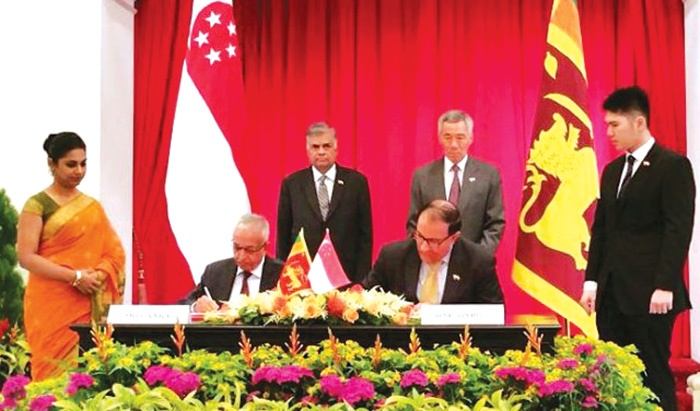
Sri Lanka-Singapore Free Trade Agreement
By Gomi Senadhira
senadhiragomi@gmail.com
“You might tell fairy tales, but the progress of a country cannot be achieved through such narratives. A country cannot be developed by making false promises. The country moved backward because of the electoral promises made by political parties throughout time. We have witnessed that the ultimate result of this is the country becoming bankrupt. Unfortunately, many segments of the population have not come to realize this yet.” – President Ranil Wickremesinghe, 2024 Budget speech
Any Sri Lankan would agree with the above words of President Wickremesinghe on the false promises our politicians and officials make and the fairy tales they narrate which bankrupted this country. So, to understand this, let’s look at one such fairy tale with lots of false promises; Ranil Wickremesinghe’s greatest achievement in the area of international trade and investment promotion during the Yahapalana period, Sri Lanka-Singapore Free Trade Agreement (SLSFTA).
It is appropriate and timely to do it now as Finance Minister Wickremesinghe has just presented to parliament a bill on the National Policy on Economic Transformation which includes the establishment of an Office for International Trade and the Sri Lanka Institute of Economics and International Trade.
Was SLSFTA a “Cleverly negotiated Free Trade Agreement” as stated by the (former) Minister of Development Strategies and International Trade Malik Samarawickrama during the Parliamentary Debate on the SLSFTA in July 2018, or a colossal blunder covered up with lies, false promises, and fairy tales? After SLSFTA was signed there were a number of fairy tales published on this agreement by the Ministry of Development Strategies and International, Institute of Policy Studies, and others.
However, for this article, I would like to limit my comments to the speech by Minister Samarawickrama during the Parliamentary Debate, and the two most important areas in the agreement which were covered up with lies, fairy tales, and false promises, namely: revenue loss for Sri Lanka and Investment from Singapore. On the other important area, “Waste products dumping” I do not want to comment here as I have written extensively on the issue.
1. The revenue loss
During the Parliamentary Debate in July 2018, Minister Samarawickrama stated “…. let me reiterate that this FTA with Singapore has been very cleverly negotiated by us…. The liberalisation programme under this FTA has been carefully designed to have the least impact on domestic industry and revenue collection. We have included all revenue sensitive items in the negative list of items which will not be subject to removal of tariff. Therefore, 97.8% revenue from Customs duty is protected. Our tariff liberalisation will take place over a period of 12-15 years! In fact, the revenue earned through tariffs on goods imported from Singapore last year was Rs. 35 billion.
The revenue loss for over the next 15 years due to the FTA is only Rs. 733 million– which when annualised, on average, is just Rs. 51 million. That is just 0.14% per year! So anyone who claims the Singapore FTA causes revenue loss to the Government cannot do basic arithmetic! Mr. Speaker, in conclusion, I call on my fellow members of this House – don’t mislead the public with baseless criticism that is not grounded in facts. Don’t look at petty politics and use these issues for your own political survival.”
I was surprised to read the minister’s speech because an article published in January 2018 in “The Straits Times“, based on information released by the Singaporean Negotiators stated, “…. With the FTA, tariff savings for Singapore exports are estimated to hit $10 million annually“.
As the annual tariff savings (that is the revenue loss for Sri Lanka) calculated by the Singaporean Negotiators, Singaporean $ 10 million (Sri Lankan rupees 1,200 million in 2018) was way above the rupees’ 733 million revenue loss for 15 years estimated by the Sri Lankan negotiators, it was clear to any observer that one of the parties to the agreement had not done the basic arithmetic!
Six years later, according to a report published by “The Morning” newspaper, speaking at the Committee on Public Finance (COPF) on 7th May 2024, Mr Samarawickrama’s chief trade negotiator K.J. Weerasinghehad had admitted “…. that forecasted revenue loss for the Government of Sri Lanka through the Singapore FTA is Rs. 450 million in 2023 and Rs. 1.3 billion in 2024.”
If these numbers are correct, as tariff liberalisation under the SLSFTA has just started, we will pass Rs 2 billion very soon. Then, the question is how Sri Lanka’s trade negotiators made such a colossal blunder. Didn’t they do their basic arithmetic? If they didn’t know how to do basic arithmetic they should have at least done their basic readings. For example, the headline of the article published in The Straits Times in January 2018 was “Singapore, Sri Lanka sign FTA, annual savings of $10m expected”.
Anyway, as Sri Lanka’s chief negotiator reiterated at the COPF meeting that “…. since 99% of the tariffs in Singapore have zero rates of duty, Sri Lanka has agreed on 80% tariff liberalisation over a period of 15 years while expecting Singapore investments to address the imbalance in trade,” let’s turn towards investment.
Investment from Singapore
In July 2018, speaking during the Parliamentary Debate on the FTA this is what Minister Malik Samarawickrama stated on investment from Singapore, “Already, thanks to this FTA, in just the past two-and-a-half months since the agreement came into effect we have received a proposal from Singapore for investment amounting to $ 14.8 billion in an oil refinery for export of petroleum products. In addition, we have proposals for a steel manufacturing plant for exports ($ 1 billion investment), flour milling plant ($ 50 million), sugar refinery ($ 200 million). This adds up to more than $ 16.05 billion in the pipeline on these projects alone.
And all of these projects will create thousands of more jobs for our people. In principle approval has already been granted by the BOI and the investors are awaiting the release of land the environmental approvals to commence the project.
I request the Opposition and those with vested interests to change their narrow-minded thinking and join us to develop our country. We must always look at what is best for the whole community, not just the few who may oppose. We owe it to our people to courageously take decisions that will change their lives for the better.”
According to the media report I quoted earlier, speaking at the Committee on Public Finance (COPF) Chief Negotiator Weerasinghe has admitted that Sri Lanka was not happy with overall Singapore investments that have come in the past few years in return for the trade liberalisation under the Singapore-Sri Lanka Free Trade Agreement. He has added that between 2021 and 2023 the total investment from Singapore had been around $162 million!
What happened to those projects worth $16 billion negotiated, thanks to the SLSFTA, in just the two-and-a-half months after the agreement came into effect and approved by the BOI? I do not know about the steel manufacturing plant for exports ($ 1 billion investment), flour milling plant ($ 50 million) and sugar refinery ($ 200 million).
However, story of the multibillion-dollar investment in the Petroleum Refinery unfolded in a manner that would qualify it as the best fairy tale with false promises presented by our politicians and the officials, prior to 2019 elections.
Though many Sri Lankans got to know, through the media which repeatedly highlighted a plethora of issues surrounding the project and the questionable credentials of the Singaporean investor, the construction work on the Mirrijiwela Oil Refinery along with the cement factory began on the24th of March 2019 with a bang and Minister Ranil Wickremesinghe and his ministers along with the foreign and local dignitaries laid the foundation stones.
That was few months before the 2019 Presidential elections. Inaugurating the construction work Prime Minister Ranil Wickremesinghe said the projects will create thousands of job opportunities in the area and surrounding districts.
The oil refinery, which was to be built over 200 acres of land, with the capacity to refine 200,000 barrels of crude oil per day, was to generate US$7 billion of exports and create 1,500 direct and 3,000 indirect jobs. The construction of the refinery was to be completed in 44 months. Four years later, in August 2023 the Cabinet of Ministers approved the proposal presented by President Ranil Wickremesinghe to cancel the agreement with the investors of the refinery as the project has not been implemented! Can they explain to the country how much money was wasted to produce that fairy tale?
It is obvious that the President, ministers, and officials had made huge blunders and had deliberately misled the public and the parliament on the revenue loss and potential investment from SLSFTA with fairy tales and false promises.
As the president himself said, a country cannot be developed by making false promises or with fairy tales and these false promises and fairy tales had bankrupted the country. “Unfortunately, many segments of the population have not come to realize this yet”.
(The writer, a specialist and an activist on trade and development issues . )



US sports envoys to Lanka to champion youth development

Rahuman questions sudden cancellation of leave of CEB employees


