Features
SIR JOHN’S BIRTHDAY

– Oh! To be in Lanka, now that April’s here
by ECB Wijeyesinghe
This (the article was written in April 1978 – editor) is a month of memories, when the odd things that happened some time ago sound like April Fool’s Day hoaxes. Some people who habitually forget their wife’s birthday still recall vividly April 5, 1942, as the day on which we realized that all is fair in love and war.
It was a very hot and dry season and people of all faiths, especially the Christians on that Easter Sunday, were praying for a break in the weather. Instead of the gods, our friends the Japanese, who were not as friendly then as they are now, answered the prayer with a rain of bombs. I happened to be a stringer for the Associated Press (AP) at the time and was permitted to be in places which were banned to the local populace.
Ten minutes after the “all clear” was sounded I was on the job, covering the airs raid on Colombo with a dear, departed friend of mine, whose name was Darlin Karunaratne. I was permitted to take a good look at the crumpled remains of an enemy bomber brought down by our A-A guns on the Galle Face Green. It was like a bit of stage-managed business designed to dispel, the panic that gripped the city. Curiously enough it was almost at the same spot that DS. Senanayake slipped off his horse 10 years later.

SUSPICION
There are people who say that Freedom shrieked when Senanayake fell and that it took over 25 years to pacify her. Anyhow foreign correspondents had to be ultra-careful during that war which everybody thought was going to end all wars. Some innocent and foolish fellows who thought too little and wrote too much were suspected of being enemy agents.
The Censor was there, of course, but after the despatch was filed, Sir Geoffrey Layton, who was virtually the dictator of Ceylon at the time, imagined there was something between the lines. His vocabulary was limited – but the few words he uttered could not be found in any respectable dictionary. April is also notorious as the month which the insurgents chose in 1971 to launch their Festival of Tragedy.
It is best to sweep the events that followed under the carpet. But this must be said for their leaders. They waited till April 5 to fire their first shot. Was it because, like the Japanese, they did not want to spoil Sir John Kotelawala’s Birthday Party at Kandawala ?
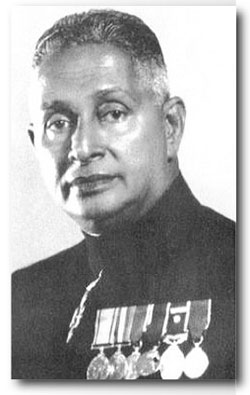
On the fourth day of the fourth month of the year of grace 1897, presumably at four o’clock when the cocks began to crow, a son was born unto his mother, Alice, a sweet and gracious woman. She had two equally nice sisters, one was married to the President’s (JRJ) uncle, Colonel T.G. Jayewardene, and the other to F.R. Senanayake.
John Lionel, they say, came into this world with a terrific yell. He has been a howling success since then, admired and respected, even by his enemies, for his human qualities. The Kotelawalas of Bandaragama had a peculiar affinity for their neighbours, the Attygalles of Madapatha. The families lived amicably on either side of the Kelani River, despite the fact that they were close relatives.
There was the occasional brawl, but the fights usually ended in a draw, and both sides licked each other’s wounds at the mutual marriage feasts which occurred with clockwork regularity. Sir John will tell you that his mother was an Attygalle, his grand-mother was an Attygalle and his great-grand mother was an Attygalle. There does not appear to have been much of a choice for either party. The fact of the matter is that the Attygalle females of old were a tough lot and made an instant appeal to the equally tough Kotelawalas.
For examples, Sir John’s father was one of the 23 bonnie babies born to one Attygalle dame. In any other country she would have qualified for the highest possible honours; but the Government of the time thought it was not advisable to have too many Kotelawalas at large and discouraged them from breeding on a large scale.
There is another thing that attracted the Kotelawalas to the Attygalles. Besides being born fighters their families did things on a lavish scale. To say that they lived on the fat of the land is more than a figure of speech. As a result the Bandaragama folk developed certain intestinal ailments which threatened to become chronic.
A remedy had to be found, and the Attygalles found it. It was the famous Madapatha Pill, which for generations has been a specific for dysentery and other stomach disorders, and pulverised the bacilli that caused them. This pill –not to be confused with the other ones recommended by the FPA. worked like magic. The Kotelawalas were now at liberty to eat, drink and make merry to their heart’s content, so long as the pill was at hand.
CYRIL’S SONG
Many people believe that the ingredients that go into the Madapatha Pill are still a family secret, despite the fact that Dharmasena Attygalle, the MP for Kesbewa, is Deputy Minister of Health. He was the last repository of the secret, if any. There was another Deputy Minister of Health who might have given away the Madapatha secret. He was Cyril E.Attygalle, who was mainly responsible for the splendid hospital that now adorns Ratnapura, a town he represented in Parliament for nearly 10 years.
Cyril, unlike his forbears and kinsmen who followed the medical tradition, was cast in a musical mould. Whenever he had a bit of leisure he wrote songs. He kept on writing harmless stuff under the nom-de plume “Kaluwa” until he met his future wife. Then he penned the immortal lyric, “Girl of my dreams, I love you.” He married her, and that put an end to his writing sentimental ditties, though the couple lived happily ever afterwards.
Still the melody lingers on and “Girl of my dreams” can be heard occasionally on the radio. In the old days it used to be sung by the celebrated Negro duo, Layton and Johnstone, but the purchasers of the copyright have now passed it on to the pop music stars who have their own ideas about interpreting dreams about girls. Incidentally the publishers who paid only Rs. 800. for Cyril Attygalle’s song must have made a fortune from it, because love is a thing which is popular anytime, anywhere and anyhow. It is the only four-letter word that even priests and monks can use freely.
NICE GESTURE
That reminds me that when I wrote last week that the Venerable Narada paid his tribute of tears to another illustrious monk, his dead teacher, Brother James of St. Benedict’s, there was another
fine gesture which deserved to be recorded. It was Dutch Burgher, Eric La Brooy, who accompanied the Buddhist monk to the catafalque. When Brother James was alive, the Ven. Narada often used to visit his aged teacher and touch his hand before departing. This time, Eric says, he could not do so.
Eric La Brooy, the former boss of Colombo Apothecaries Ltd., is the only Burgher I know who takes his Buddhist studies seriously. With his added knowledge of the world he might have made a good Buddhist missionary abroad. He cannot, however, become a Bhikkhu because he happens to be married. His wife, Coralie, is the daughter of Hilaire Jansz, a former editor of the ‘Ceylon Observer,’ who has inherited most of the good qualities of her wonderful father. Eric La Brooy must have accumulated a lot of merit in his previous births to acquire such a wife.
(From MEN AND MEMORIES published in 1978)