
Life style
“Selling the Family Silver” and India-SL bilateral relations


by Dr Sarala Fernando
A remark attributed to the US Congress that “Sri Lanka is a valuable piece of real estate” had made the news here hinting at the strategic value of our island location while some had connected the remark to the MCC, an economic project integral to the US pivot to the Indo Pacific.
This sudden interest in Sri Lanka’s land assets made the headlines after Harvard economists in 2016 advised on the incorporation of a land project under the MCC to address constraints to national growth by a re-survey, re-valuation and deed grants on lands around the country. Local experts argued that such a programme would lead to pressure on smallholders to sell land to more powerful entities for commercial exploitation increasing rural poverty, environmental and wild life destruction and water scarcity.
 The Harvard economists and the MCC have come and gone. However, it seems the spirit of their view of land as a commodity is still alive judging by recent government decision to release nearly 1.5 million acres of other state forests to be repurposed for development work. This has become a hot topic of discussion and environmentalists have filed court cases to revert to the previous protection provided to unrecognized forest covers.
The silent constituents, the trees and the animals have felt the brunt of this decision with the increased deforestation and destruction of mangroves, the killing of large mammals like elephants and even our prized leopards and most recently hundreds of birds found dead, probably poisoned, off Wilpattu. Are there criminal gangs behind the sudden spate of shooting of tuskers and snaring of leopards, questions still not answered by the authorities? The government focus on land has extended to the urban areas where long standing wholesale markets, social and sports clubs have been taken over by the UDA with scant explanation of the reasons behind the seizures and plans for redevelopment of these valuable lands (urban housing/recreation for the public?). Selling lands, the equivalent of the proverbial “family silver” is to be expected in these extraordinary times where Sri Lanka has heavy foreign debt obligations.
However since the government land acquisition strategy remains opaque, without consultation or explanation of any business plan, public protests are now spreading even to non-agricultural foreign investment proposals ranging from allocating the ECT terminal in Colombo port and the KKS port to India, to mining of titanium from sands in Mannar – a water scarce area – to an Australian company . Land issues came to the fore early when the Tourism authorities set up a one-stop shop for new hotel construction despite the crisis in the hotel industry with the Covid epidemic and drying up of tourist flows. In other countries, empty hotels are being taken over by the government and converted to new uses like urban housing; however our authorities seem more concerned about allocating land in water shortage areas like Kalpitiya and Mirissa for 600 room hotels, so called “foreign” investments promoted by local barons.
In Yala, a new foreign managed hotel has suddenly emerged and is said to be destined for those “high spending” East European tourists irrespective that Yala is suffering from over-tourism and the animals are more in need of food and water. Added to the confusion, in parliament it was announced that the source of the second wave of Covid infection had been traced to a Ukrainian pilot and now the public is in a panic over the pilot project to bring in hundreds of Ukrainian tourists.
Public protests are spreading in agriculture areas with the Mahaweli authorities demarcating lands for large scale foreign investment taking from forest reservations and commons, dislocating animal feeding grounds and overriding even the demands of the local villagers for protection of their rights to customary land and forest use.
A recent news item featured the Agriculture Ministry offering Rs 700 million to local farmers to grow fruit for a foreign multinational company which will provide the plants and drip technology and presumably buy the fruit cheap and retain the export earnings for its own profit! What will be the value addition for the government if they have also provided tax concessions for the foreign investor? Even more serious, what will be the negative impact of these tasteless new hybrids on our heritage varieties of delicious local pineapple and bananas? Once the valuable land is allocated, the promised foreign money transfer may not even take place, the foreign investor’s preference usually being to bring in little foreign exchange and to borrow from local banks. Thus, when there is trouble, the “footloose” foreign investor gets away leaving local banks and insurances saddled with non-performing loans.
From the time of the Greek civilization, people have been lamenting over the vagaries of weather and other threats invariably faced by agriculture, which makes large scale operations a risky business. The problem is that tax concessions are being offered today to promote large- scale agriculture without the safeguards to prevent expensive failures. Even local large plantation companies are finding it difficult to operate today with all their experience, given the issues of soil depletion, non use of chemical pesticides and fertilizer and rising labour costs. Yet it seems an intrepid developer with more experience in seafaring than agriculture had demanded 40,000 acres to grow maize – (mind you he may not have heard about the fallworm crisis). Fortunately those in charge of the Mahaweli lands had allocated only 5,000 acres for a trial project but still this is hardly a good example of due diligence which should look for experience in agriculture rather than the usage of prison labour, as announced by the entrepreneur.
Before it is too late, we should learn from the experience of our neighbour India. I recall a lecture by the eminent Dr M. S. Swaminathan many years ago at the Lakshman Kadirgamar Institute (then Sri Lanka Institute of International Relations) where he prophesied that the intensive agriculture “green revolution” would eventually render barren productive areas of their country due to heavy chemical applications degrading the soil. In India today, they are returning to traditional farming practices to revive the soil, re-foresting and trying to connect the farmer to the markets.
Instead of cattle grazing on open land, sheds are being constructed within the village and herders encouraged to bring feed to the cattle. Should we not even now look to small, smart and more sustainable practices to make small farmers more independent? Talking with farmers growing organic high value rice varieties on their lands in Wellawaya with support from Jetwing, it seems they still have faith in traditional practices, calling the mechanical harvester “boothaya” and preferring to bring down buffaloes from Bandarawela to the tractor! Bangladesh is tapping the Indian experience in elephant conservation which is a new area of their bilateral cooperation. Private sector investors in India have recently set up a hospital for treatment of sick domesticated elephants with ultra modern equipment.
Here in Sri Lanka, despite the interest of private philanthropists, the government appears unwilling to give land for an elephant sanctuary or “soft” release area for translocated bull elephants. A central question is why, as a Buddhist nation, Sri Lankans have not included into the Constitution, the protection of animals and living creatures as illustrated in every step of the Gautama Buddha’s life journey and his preachings? Even today, many proposals to strengthen the environmental safeguards and ethical treatment for animals have been sent to the Committee to prepare a new Constitution, but no one has even received an acknowledgement! By contrast, the Indian Constitution is way ahead of us, Article 51-A (g) which deals with Fundamental Duties of the citizens states: “It shall be the duty of every citizen of India to protect and improve the natural environment including forests, lakes, rivers and wildlife and to have compassion for living creatures.”
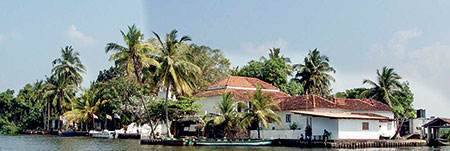
Our land endowment also includes the small islands, over 100 around the mainland, enabling extension over expanses of territorial seas. Instead of pushing only commercial fisheries, should the government not think about declaring a marine sanctuary zone all around our island, a domestic security Zone of Peace with proper management safeguards for national land and maritime resources? Sri Lanka received too many multi-day boats after the tsunami, several of which have been converted to nefarious purposes like illicit immigration and smuggling.
Furthermore, why prioritize investment in commercial fisheries at a time when global attention is being called to clean
ing the oceans, replenishing fish stocks, restoring coral reefs and mangroves affected by rising sea waters and ocean temperature rise? Protecting our seas and coastline should be given high priority since our island is in the vicinity of some of the busiest sea lanes in the world and vulnerable to disasters such as New Diamond oil tanker which caught fire off the East Coast.
Cooperation with India has been vital in this regard throughout the years as they have access to both expertise and stocks of fire fighting foam which can be quickly deployed.
While enhancing cooperation with India in addressing marine disasters and security issues such as smuggling, illicit immigration and terrorism/criminal related activities of mutual concern, as a small state with no pretensions for offensive power projection, we should feel free to disagree with India on the imperatives of high defence spending and partnering with the US on security manoeuvres in the Indian Ocean with their latest weaponry.
The recent Malabar naval exercises by the Quad in the Bay of Bengal and naval sonars are believed to have impacted the unprecedented beaching of some 100 pilot whales in Kalutara around the same time, rescued after a marathon effort by our navy and volunteers.
(Sarala Fernando, retired from the Foreign Ministry as Additional Secretary and her last Ambassadorial appointment was as Permanent Representative to the UN in Geneva. Her Ph.D was on India-Sri Lanka relations and she writes now on foreign policy, diplomacy and protection of heritage).



Institute of Hospitality Sri Lanka
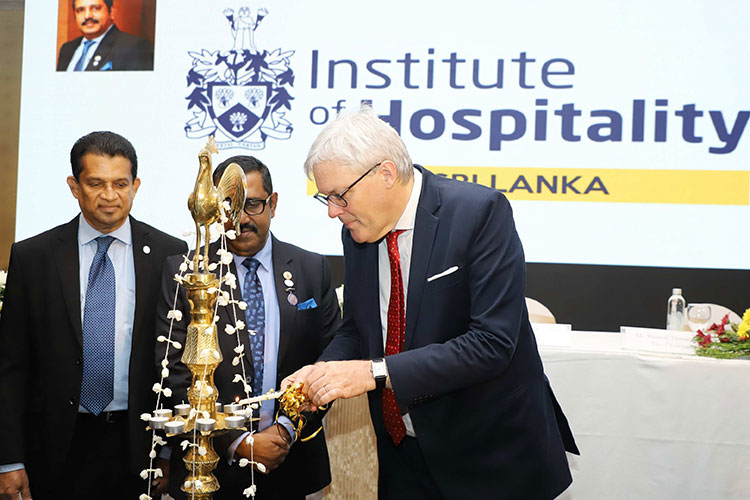
 The 32nd Annual General Meeting (AGM) of the UK-based Institute of Hospitality’s Sri Lanka Chapter was held recently at the Ramada Hotel Colombo,.The event provided an evening of camaraderie , reflection of the past and present achievements,setting new benchmarks for the future
The AGM had the presence of two distinguished guests, the Chief Guest Opposition Leader Sajith Premadasa, and the Guest of Honour British High Commissioner to Sri Lanka, Andrew Patrick. Their inspiring speeches were lauded by all hoteliers who were present at the occasion
A special thanks was extended to Robert Richardson, CEO of the Institute of Hospitality UK, along with his team, sponsors, committee members, and all attendees for making the event memorable.
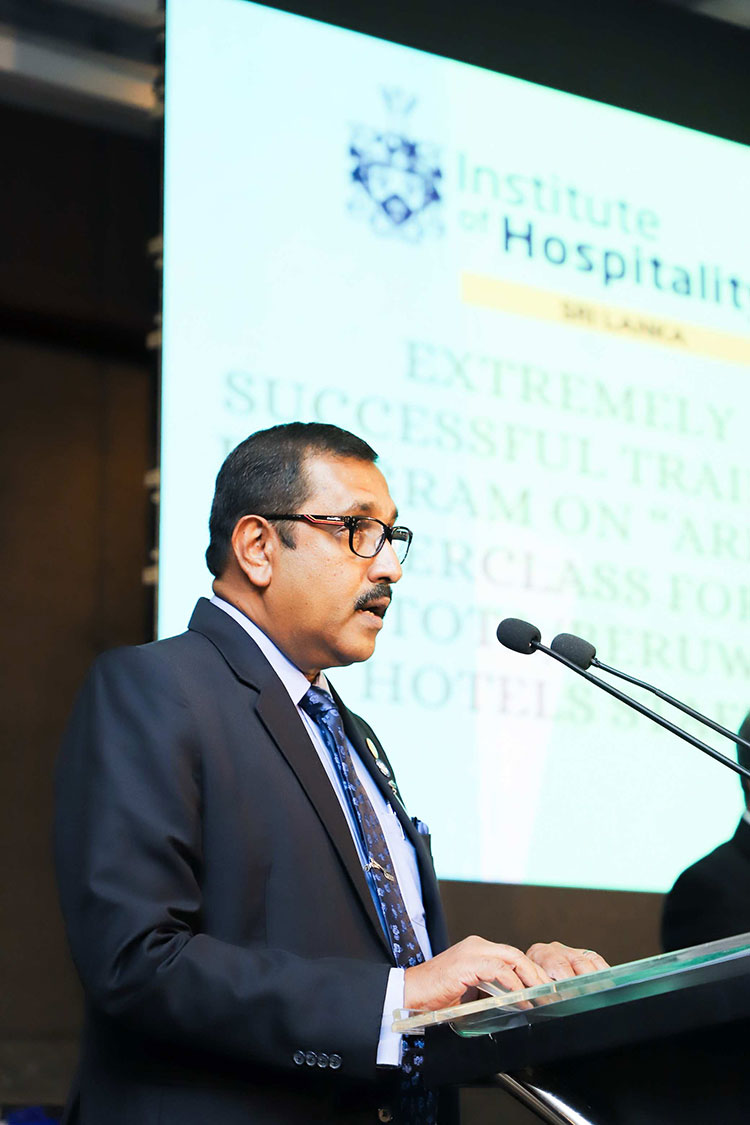
Dr. Harsha Jayasingh, Past President of the Institute of Hospitality (UK) Sri Lanka Chapter, emphasised the Institute’s longstanding history and the strength of its Sri Lankan branch. “The Institute of Hospitality (IH) UK has a history of 86 years, and we are proud to be the Sri Lanka Branch. IH Sri Lanka is much stronger now with many members from all areas of the hospitality industry,” he stated.
Dr. Jayasingh highlighted the significant role of tourism in Sri Lanka’s economy,. He said tourism it is the third-largest source of revenue for the country. “Tourism accounts for about 13.3% of total foreign exchange earnings and employs 450,000 people directly and indirectly. The hospitality industry in this island of pearl holds tremendous potential for economic growth, job creations, and cultural exchange,” he added.
He also pointed out more women should be attracted to the industry and advocated for the use of technology in hospitality sector to attract the younger generation.
The newly appointed Chairman Ramesh Dassanayake spoke about the challenges faced by the industry, including the reluctance of youth to join the sector. . Dassanayake expressed concerns over the migration of staff between hotels and the overall ‘brain drain’ in the sector. ” We must maintain high standards in the hotel We must try to attract tourists to Sri Lanka, we must have with many facilities Hence, hotel schools and other professional institutions involved in skills development mustincrease their intakes,” he pointed out.
Chief Guest Sajith Premadasa emphasised the importance of eco tourism and said “We need to have an environmental policy related to tourism in place,” . .
The 32nd AGM of the Institute of Hospitality UK, Sri Lanka Chapter, was a testament to the strength and potential of Sri Lanka’s hospitality industry. The insights and commitments shared during the event set a new benchmark for the future.(ZC)



Pix by Thushara Attapathu
Life style
He recognizes human identity beyond boundaries of gender, race, nationality and religion.

Visit of Sri Gurudev to Sri Lanka
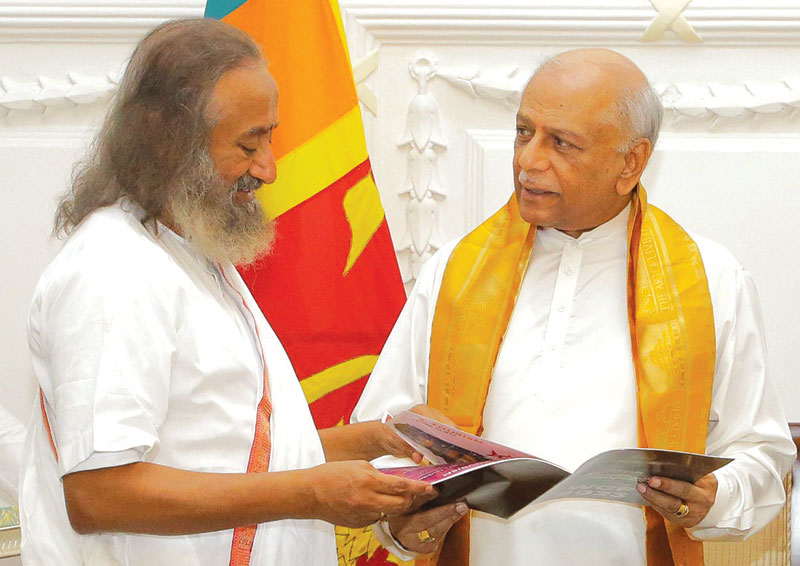
Humanitarian, spiritual leader and Global Ambassador of Peace Gurudev Sri Sri Ravi Shankar (Sri Gurudev) was in Sri Lanka on a three day tour on the invitation of the Prime Minister of Sri Lanka Dinesh Gunewardene. Gurudev who inspired a wave of volunteerism and service to moot one of the largest volunteer-based organisations in the world – The Art of Living – visited the various projects under the aegis of the foundation and launched twelve vocational and technical centers around the island. He was accompanied by thousands of followers from Sri Lanka and around the world.
Gurudev who visited Sri Lanka for the sixth time also had a first day cover launched in honour of his visit. He is a strong proponent of spreading happiness, using the unique Sudarshan Kriya, yoga, meditation and practical wisdom to unite people, empower individuals and transform communities. His programmes provide techniques and tools to live a deeper, more joyous life, while his non-profit organisations recognize the human identity beyond the boundaries of gender, race, nationality and religion.
The Art of Living which has more than 30,000 teachers and over one million volunteers across 180 countries has touched in excess of five hundred million people around the world. CNN called it “Life Changing” and The Washington Post headlined it, “Fresh air to millions”.
In Trincomalee, Gurudev met with war victims and had a heartwarming engagement with the children from the children’s homes run by the Foundation. He also visited the Koneswara Temple in Trincomalee and graced the Kumbhabhishekam at Seetha ecogPnize the human identity beyond the boundaries of gender, race, nationality and religion. Amman temple at Nuwara Eliya. He held discussions with the trustees on the progress of the foundation’s social service projects, while also holding a special event – Ekamuthuwa – attended by a large number of dignitaries and his devotees from around the world.
His time with the Prime Minister was spent discussing the prospects of unity in diversity and uniting Sri Lanka by adding happiness into the formula of living. In addition he had discussions with the Speaker of the Parliament of Sri Lanka Mahinda Yapa Abeywardena, prominent business stewards and civil society leaders.
by Zanita Careem
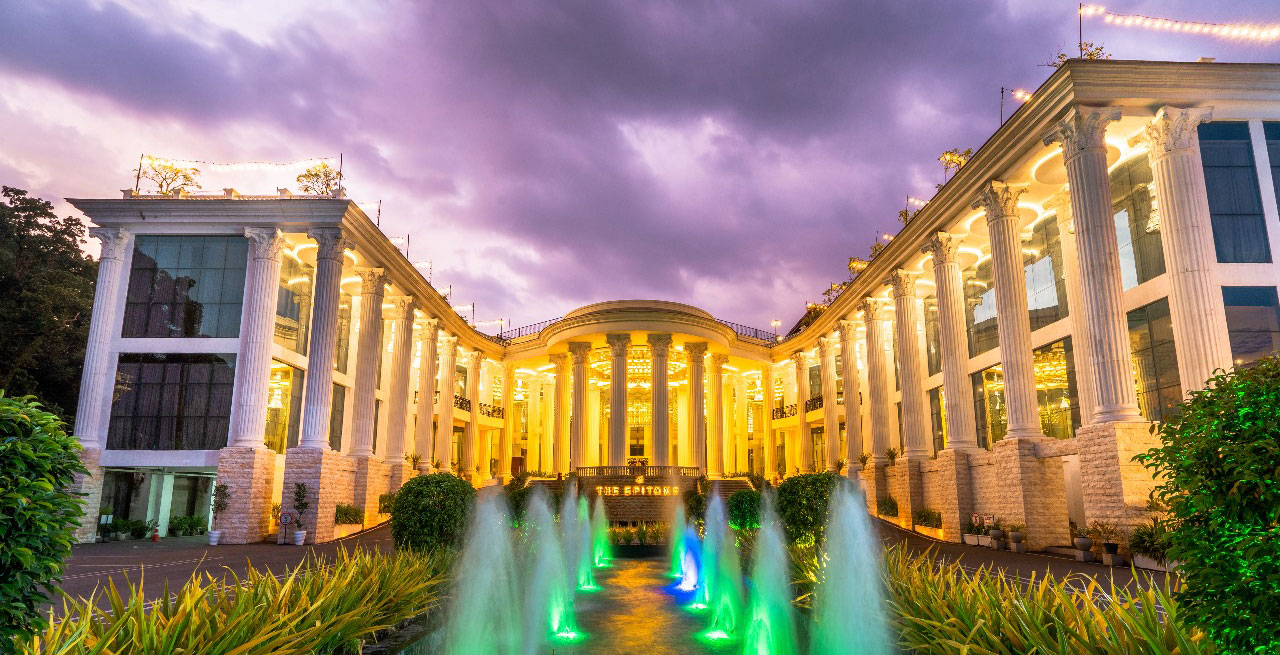
Envison your dream wedding day come to life at the Epitome Hotel, a prestigious city hotel in Kurunegala offering an unrivalled luxury rendors experience for weddings.
The venue is designed to embody opulence and luxury from all quarters for a spectacular wedding in kurunegala,Thier ballroom is the largest banquet facility in Sri Lanka It can be divided into six luxurious pillarless wedding halls on the ground floor and 25pax smaller banquet halls.
It can be easily named as a five star heaven in the heart of the city contributing to a myriad of immense experiences tailored to inspire and delight wedding experiences.
From opulent décor set up to exquisite table decor, lavish food, every detail is meticulously curated to spark your imagination and ignite creativity for a perfect wedding. The previous prestigious wedding shows season one and season two attracted large crowds
were unique events which gave the wedding vendors and potential clients had an opportunity to connect and interact with each other. Beyond being a showcase it was a chance for the wedding vendors to unite and contribute to the vibrancy of the wedding industry. The wedding show covered all area of the bridal industry providing a comprehensive variety of bridal supplies from Sri lanka and became the most popular bridal exhibitions in Kurunegala.This bridal exhibitions allowed brides and grooms to experience first hand the products and services available from suppliers in Sri Lanka
These wedding shows held at The Epitome created a benchmark and gave an opportunity for vendors to create connections to the utmost satisfaction said Harshan Lakshita Executive Director. of the magnificent Hotel
Our wedding shows featured experts and professionals in every field‘ It covered all areas of the bridal industry provided a comprehensive variety of bridal supplies from Sri lanka and became most popular bridal exhibition in this region.We are always open to everyone to join us at our wedding shows in the future. It is an opportunity to discover the incredible talent within our local wedding and bridal vendors to make meaningful relationships and plan thier special day at our breathtaking hotel The Epitome said General Manager Kavinda Caldera
The Epitome Hotel’s bridal show which will be held end of June will buzz with great ideas,advice and inspiration for all those who plan thier dream wedding
…….
The Hotel Epitome’s Wedding Season 3 will marked excellence, celebration and inspiration for those in the wedding industry. The exhibition halls will resonate with ideas on exquisite bridal wear to decor, florists , photography etc and showshowcase the rich tapestry of talent within the local wedding industry. .







US sports envoys to Lanka to champion youth development

Rahuman questions sudden cancellation of leave of CEB employees


