Features
Searching for Dayan Jayatilleka

By Uditha Devapriya
A public intellectual is more than an academic. He is a thinker and a doer, a mover and a shaker. He wields considerable influence and sometimes popularity. He does not just reflect critically on policy, he also helps shape it. Though not always in the limelight, he must be ready to get up on the public stage, to interact with people without pandering to them. Intellectuals are by nature reserved and introspective. Public intellectuals are no less so. But they are more active in popular movements, taking part in them and leading them. They cannot be ivory towers, and they cannot be ideological purists.
In Sri Lanka almost anyone can parade himself as an intellectual – if he tries hard enough. But it is difficult to be a public intellectual. One is either an activist or a thinker. We have compartmentalised these two roles so much that we tend to view them in isolation. If it is hard to think of an intellectual who is also an activist, it is because intellectuals prefer to operate from their cloistered monasteries. Reduced to teaching and lecturing and making speeches, many of them end up trapped in echo chambers.
It goes without saying that there are virtually no public intellectuals in Sri Lanka. That space has more or less faded away. Yet there was a time when such individuals were not rarities, when our newspapers, journals, and magazines devoted reams of column space for them to debate, confront, and engage with each other. If such engagements indicated Sri Lanka’s intellectual trajectory back then, the diminution of them today points to a rupture of that trajectory. But I am not an evergreen cynic here. There are signs that things are changing: young radical-progressive columnists are making the waves, questioning accepted axioms and challenging establishment political and academic figures.

with Maithripala Sirisena
But what or who, you may ask, is the prototype for the public intellectual in Sri Lanka? This is not an easy question to answer, not least because there isn’t one specific or correct answer. In the golden era of Sri Lankan or Ceylonese journalism, we had Regi Siriwardena, Tarzie Vittachi, and Mervyn de Silva. A. J. Gunawardena and Ajith Samaranayake came of age in the next generation, as did Qadri Ismail. They wrote on specific themes and emerged as leading voices in their specific domains. And yet, who among them exuded an elan which resonated with multiple generations, including the present?
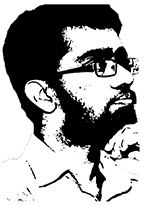
Going by his interventions over the last four decades, I think Dayan Jayatilleka fits that bill easily. Something of a controversial figure, Jayatilleka has today become our foremost political and foreign policy analyst, even if his analyses do not appeal to everyone. But then public intellectuals are not out there to get mass acceptance: they should not stake their reputation on popularity. They do try to appeal to their public. But not by pandering to it. In this, Jayatilleka has been a polarising intellectual: in the eyes of his critics, he has shifted so many times that he has become a reflection of his people. As he himself puts it, these shifts have only echoed the mood and temperament of the Sri Lankan electorate.
“If the Sri Lankan electorate didn’t opt for one government and then the other, we would have had the same government throughout. This is the kind of change that happens in every democracy. I would say that my underlying political values have not changed.”
A commentator, an author, a diplomat, and many other things besides, Jayatilleka has lived through and confronted some of the most tumultuous political events of the last half-century, in this country. He was born in 1956, was 15 when April 1971 broke out, 21 when J. R. Jayewardene took office, 31 when Ranasinghe Premadasa followed suit, and 53 when the 30-year war against the LTTE ended. In one sense, these events have never actually ended: they remain with us in their most essential form, bonding us to an eternal recurrence in a Nietzschean sense. Jayatilleka frequently engages with them, reminding us that though the past is another country, we seem condemned to live in it.
Consequently, there are very few articles that he has written which do not resonate with the young and the old. Whether he is reflecting on the war, the ethnic conflict, or the crisis of legitimacy in the Sri Lankan State, he speaks with an intellectual vigour which can disarm his critics. This, of course, should not compel one to side with his views all the way through. Not a few of these articles have invited criticisms, and Dr Jayatilleka has responded to them all. Yet even while disagreeing with them, one feels that he is the opposite of what Susan Sontag wrote of George Lukacs, that he is “many things to many men.”
While not disputing the essence of that statement – which thinker in the history of thought has not appeared as many things to many people? – it must be noted that Jayatilleka has been too consistent in many of his views to bear out such a characterisation. The charge most frequently levelled at him, from the 1980s, is that he has shifted sides and cited the most redoubtable philosophers – Gramsci, Althusser, Zizek, Buddha, Jesus, the great Marx himself – in defence of his shifts. Some of his writings, his actions, have been questioned and invited the most heated controversy. It is pointless to go through them all. But the crux of it all is that we cannot take him seriously because he does not seem to take himself seriously: he has changed too many times to think otherwise.
In fairness, and as a student and follower of politics and international relations myself, I understand where these arguments are coming from. But not where they lead to. The argument that public intellectuals must stick to one position and abide by it no matter what is ridiculous and self-defeating. This is so particularly in a country like Sri Lanka, where presidents, prime ministers, and politicians change so often he or she takes on completely different, contradictory, personalities, where what was politically defensible yesterday becomes morally indefensible today. Jayatilleka’s attitude to the likes of Mahinda Rajapaksa, Sajith Premadasa, and Anura Kumara Dissanayake underlies this well.
Ironically, some of Jayatilleka’s own critics have been as guilty of the crime they attribute to him. The insurrectionists of 1971, to give one example, were once fired by visions of equality and solidarity, but over time found their home in a bourgeois liberal space, in which they became critics of many of the ideals they had advocated in their youth. They found their home in a “radical” third way centre, first in the Chandrika Kumaratunga government and later in the Maithripala Sirisena Ranil Wickremesinghe government.
That both these regimes became anything but liberal, radical, or centrist, that they shifted to the right over time, does not seem to have deprived their intellectual defenders of credibility – even as they accuse Jayatilleka of, yes, lacking any credibility. That they got their reading of the political moment wrong – in effect becoming the Karl Roves of Sri Lanka – does not seem to have worried them in the least.
By comparison, Jayatilleka’s fealty to the ideals that animated his youth has been more solid, even if I disagree with some of them. When sections of the left drifted away to a rather amorphous left-liberal NGO-fied space in the 1980s, they inadvertently became prey to the most dubious political projects. As Rajiva Wijesinha has pointed out in Representing Sri Lanka, the very meaning of liberal politics changed, leaving in its wake a grotesque caricature of what it once had been. Briefly put, the United National Party, and some of its most right-wing figureheads, became the preferred icons of these new liberals – even as it spouted the most right-wing tenets imaginable. Jayatilleka proved to be an exception here: a pragmatist radical-progressive – a liberal realist, if one may say so.
All this calls for a new way of looking at the man, his thinking, his beliefs. Sontag praised Lukacs for being “marginal and central in a society which makes the position of the marginal intellectual almost intolerable.” I am not sure how true this is of Lukacs, but it is somewhat true of Jayatilleka. Certainly, he occupies an ambivalent place in our political-intellectual landscape.

In Geneva
On the one hand, his achievements are considerable, going by the number of books and essays published, awards and accolades won, and international mentions and honours. On the other hand, he has managed to anger if not alienate various political groups to the extent of becoming their bête noire.
Not surprisingly, many of these groups have tried to square him with the values of rival camps, without much success. Thus we have Dayan Jayatilleka the champion of minorities, Dayan Jayatilleka the supporter the 13th Amendment, and also Dayan Jayatilleka the latent chauvinist and Dayan Jayatilleka the stooge of majoritarian regimes: in effect, a “Sinhala Tiger” and a “hardcore federalist” rolled into one.
Studying the man on the basis of these descriptions would be like looking at a broken mirror: you see bits and pieces of yourself in shards of glass, but they never congeal into a total picture. No. To search for Jayatilleka, we must look into another mirror.
When my friend, colleague, and research partner in crime Uthpala Wijesuriya and I were called to come up with a catalogue of Jayatilleka’s articles, from the 1970s to the present, we were afforded the chance of not just looking at that mirror, but constructing one for others to look into. Up to now, the reading public in Sri Lanka has never been given a chance to look at just how the country’s leading public intellectual has evolved over time. This calls for an exhaustive but representative collection: a political anthology. A year after we were called to put together such a collection, we are confident that Sri Lankans, especially those interested in its politics and foreign policy, will finally get their chance.
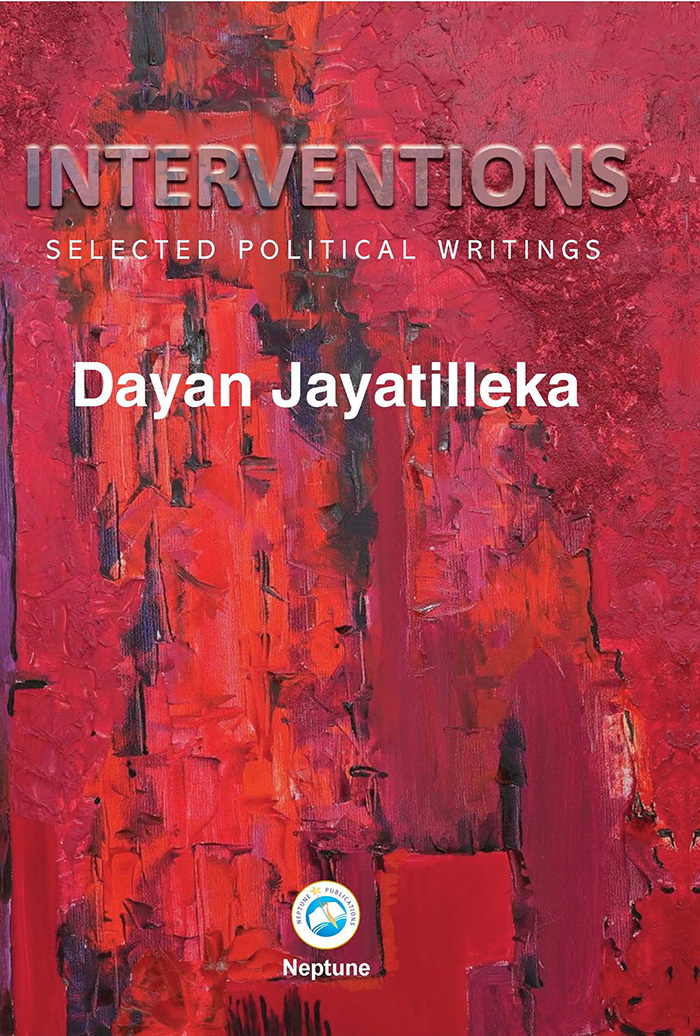
“Interventions: Selected Political Writings”, a collection of Dayan Jayatilleka’s political writings over the last half century, will be launched today. It will be available at leading bookstores in the country soon. For more information, you can contact the publishers, Neptune Publications, at , or the editors, Uditha Devapriya and Uthpala Wijesuriya, at .
Uditha Devapriya is a writer, researcher, and analyst based in Sri Lanka who contributes to a number of publications on topics such as history, art and culture, politics, and foreign policy. He can be reached at . Together with Uthpala Wijesuriya, he leads an informal art and culture research collective called U & U.