
News
Scientific team completes part of ongoing study on gene pool of 700 Lankan elephants

by Ifham Nizam
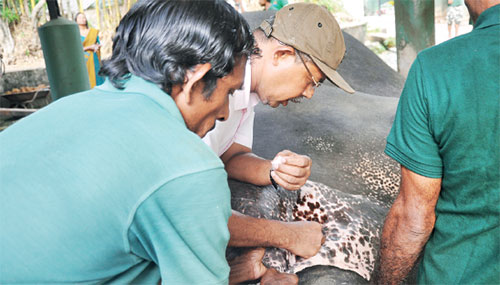
An eight-member scientific team has completed a comprehensive part of an ongoing study on the gene pool of 700 Sri Lankan elephants.
Department of Wildlife Conservation (DWC) and Agricultural Biotechnology Centre (AgBC) of the University of Peradeniya, are conducting a research on DNA analysis of wild elephants in Sri Lanka funded by the Ecosystem Conservation and Management Project (ESCAMP).
The scientific team comprises Ranjan Marasinghe, R. M. R. Nilanthi Rajapakse, H.A. Bhagya Hathurusinghe, Chandana Sooriyabandara, Dr. C. H. W. M. R. Bhagya Chandrasekara, Nuwan Jayawardana, M. Madawika Kodagoda, Dr. R. C. Rajapakse and Prof. Pradeepa. C. G. Bandaranayake.
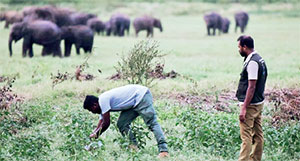 “The study will clearly indicate the differences of the Sri Lankan elephant as a sub species. Our molecular methodology is based on using elephant dung, and the test is similar to the Covid-19 PCR test”, Researcher R. M. R. Nilanthi Rajapakse told The Sunday Island.
“We have already sequenced and assembled the genome of the Sri Lanka Wild Elephant (Elephas maximus maximus), the type subspecies of the Asian elephant. Comparative genomics work continues with available Asian and African elephant genomic data with the objective of identifying specific set of markers for the identification of Sri Lankan elephants”, the team said.
The first part of the research focused on 100 elephants, and it has now increased to 700 with continued focus on elephants in the forest patches etc., they remarked.
The project aims to examine the within-species genetic structure of the wild elephant across its range to better understand how genetically distinctive regional populations are and deviations of Sri Lankan elephants with those of other countries and how that might affect its conservation.
Conservation and management of elephants in Sri Lanka has become an important issue given the escalation of the Human-Elephant Conflict (HEC) and international trade of wild elephants.
The Asian elephant, Elephas maximus, is an umbrella species in tropical forests. Wild elephants play important roles in maintaining forest dynamics such as opening animal trails in the forests, creating open gaps that facilitate seed and acting as a seed disperser for large-seed fruit species. The conservation status of the Asian elephant has been recognized as an endangered species since 1986. Wild Asian elephants are currently distributed mainly in the South and Southeast Asia.
Habitat loss and fragmentation, anthropogenic disturbance, illegal poaching and HEC have been considered as significant threats to the Asian elephants, resulting in population decline and fragmentation. These threats resulted in skewed sex ratio and disruption of social organization.
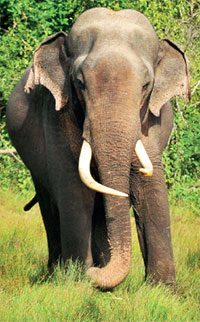 Acquiring information of wild populations is important for effective conservation and management of wild elephants.
Wild elephants in Sri Lanka is estimated to be between 5,000 and 6,000, according to the last survey conducted by the DWC in 2011. This is a relative high number considering the small size of the country (65,610 sq. km) and the human population of over 21 million.
For management of elephants in the wild, monitoring the changes in the structure and composition of the populations would be far more useful than estimating elephant numbers.
Therefore, genetic methods will be useful for management and conservation plan such as individual and sex identification, population size estimation, population sex ratio, genetic diversity, relatedness among individuals in a population, gene flow among populations, detection of bottleneck event, phylogeography of particular species, detection of hybridization, providing evidence of illegal wildlife poaching, including being a tool for genetic management of a population and long-term monitoring of the managed population.
It provides genetic information of the populations that could not be obtained from field data collection alone. Genetic methods, on the other hand, provide reliable information on population structure and facilitate investigation of genetic effects on small and fragmented populations. Advance genetic methods also provide better estimations on population size with reasonable cost and time.
Further, tracking of ivory poaching would also be possible if a reference genetic database of the natural populations is available.
Molecular genetics studies on elephants’ date back to 1990s. Micro satellite markers have been the preferred choice and have played a major role in ecological, evolutionary and conservation research on elephants over the past 20 years.
However, technical constraints especially related to the specificity of traditionally developed micro satellite markers have brought to question their application, specifically when degraded samples are utilized for analysis. Therefore, the team analyzed the specificity of 24 sets of micro satellite markers frequently used for elephant molecular work.
“First, we optimized the DNA extraction protocol for elephant dung which can even be used for samples reach the lab within a week’s time because all previous studies depended on fresh dung samples collected less than 24 h time”, the team said.
“Comparative wet lab analysis was done with blood and dung DNA in parallel with in silico work. Our data suggest cross-amplification of unspecific products when field-collected dung samples are utilized in assays. The necessity of Asian elephant specific set of micro satellites and or better molecular techniques are highlighted”, the team pointed out.
The necessity of insilico analysis for testing specificity of SSRs is highlighted for other wild animals, for example, leopards. Nevertheless, the current study suggests that the analysis should extend beyond the human genome especially when dung DNA is used as starting materials. Therefore, the specificity of primers is a critical factor deciding the success of traditional SSR based methods adopted for such analysis.
Based on their study, no primer set out of 24 tested SSRs could be recommended for future work when the elephant dung is used as the starting material. If blood samples are drawn carefully with no human or other contamination, those with no multiple hits in the elephant genome, for example, EMU06 and EMU07 could still be used. As such, results of the previous studies done with elephant dung would be questionable with the evidence gathered from current findings.
“Nevertheless, no one could challenge the past since the revolutionary technologies pawed the path for the success of current studies. However, our results suggest the necessity of revisiting available methods. Alternatively, more specific,” the team stressed.



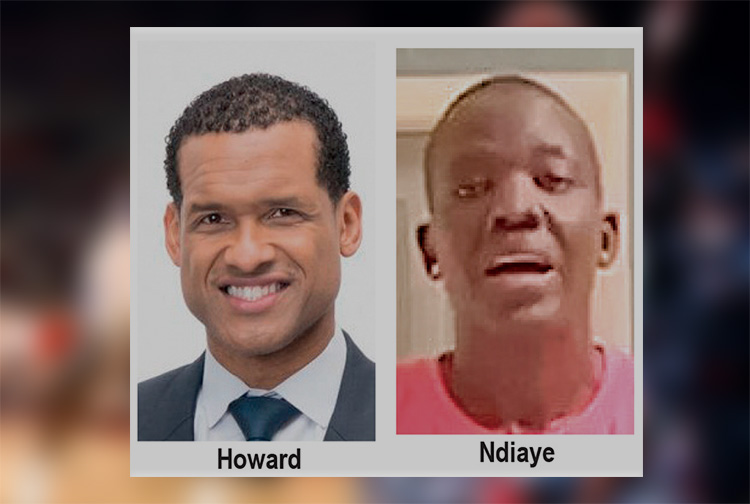
The U.S. Embassy in Colombo welcomed the U.S. Sports Envoys to Sri Lanka, former National Basketball Association (NBA) and Women’s National Basketball Association (WNBA) players Stephen Howard and Astou Ndiaye, from June 8 through 14.
The Public Diplomacy section of the U.S. Embassy said that it would launch a weeklong basketball program intended to harness the unifying power of sports, made possible through collaboration with Foundation of Goodness and IImpact Hoop Lab.
While in Sri Lanka, Howard and Ndiaye, both retired professional basketball players, will conduct a weeklong program, Hoops for Hope: Bridging Borders through Basketball. The Sports Envoys will lead basketball clinics and exhibition matches and engage in leadership sessions in Colombo and Southern Province for youth aged 14-18 from Northern, Uva, Eastern and Western Provinces, offering skills and leadership training both on and off the court. The U.S. Envoys will also share their expertise with the Sri Lanka Basketball Federation, national coaches, and players, furthering the development of basketball in the country. Beyond the clinics, they will collaborate with Sri Lankan schoolchildren to take part in a community service project in the Colombo area.
“We are so proud to welcome Stephen and Astou as our Sports Envoys to Sri Lanka, to build on the strong people-to-people connections between the United States and Sri Lanka,” said U.S. Ambassador Julie Chung. “The lessons that will be shared by our Sports Envoys – communication, teamwork, resilience, inclusion, and conflict resolution – are essential for leadership development, community building, equality, and peace. The U.S. Sports Envoy program is a testament to our belief that sports can be a powerful tool in promoting peace and unity.”
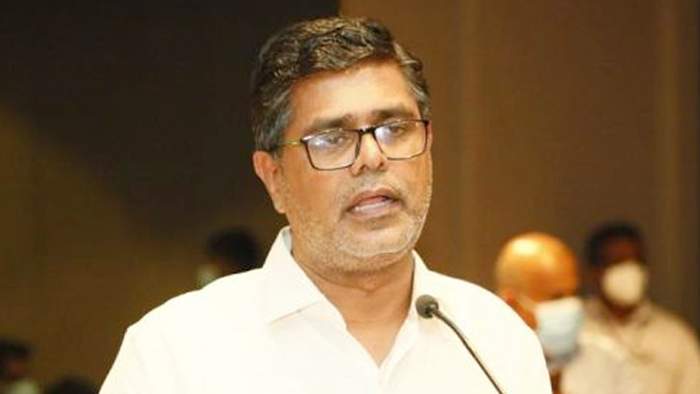
SJB Colombo District MP Mujibur Rahuman in parliament demanded to know from the government the reasons for CEB suspending the leave of all its employees until further notice from Thursday.
MP Rahuman said that the CEB has got an acting General Manager anew and the latter yesterday morning issued a circular suspending leave of all CEB employees with immediate effect until further notice.
“We demand that Minister Kanchana Wijesekera should explain this to the House. This circular was issued while this debate on the new Electricity Amendment Bill was pending. There are many who oppose this Bill. The Minister must tell parliament the reason for the urge to cancel the leave of CEB employees,” the MP said.However, Speaker Mahinda Yapa Abeywardena prevented Minister Wijesekera responding to the query and said that the matter raised by MP Rahuman was not relevant.
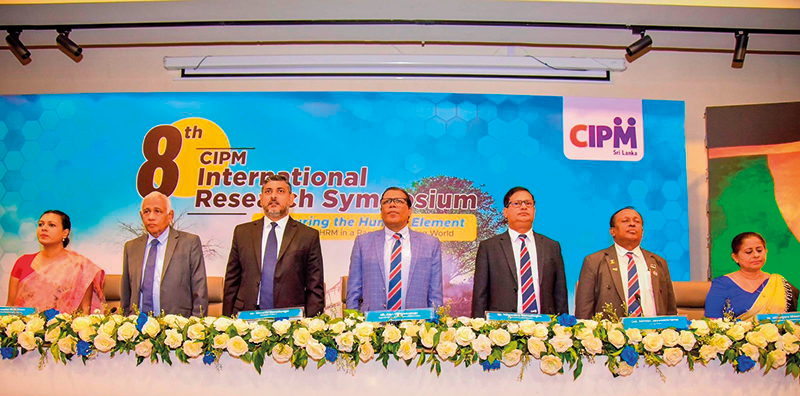
The Chartered Institute of Personnel Management (CIPM) successfully concluded the 8th Annual CIPM Symposium, which took place on 31st May 2024. Themed “Nurturing the Human Element—Redefining HRM in a Rapidly Changing World,” the symposium underscored the pivotal role of human resource management (HRM) in today’s dynamic global landscape. Since its inception in 1959, CIPM has been dedicated to advancing the HR profession through education, professional development, and advocacy, solidifying its position as Sri Lanka’s leading professional body for HRM.
Ken Vijayakumar, the President of the CIPM, graced the occasion as the chief guest. The symposium commenced with the welcome address by the Chairperson, Prof. Arosha Adikaram, followed by the Web Launch of the Symposium Proceedings and Abstract Book by the CIPM President. The event featured distinguished addresses, including a speech by Chief Guest Ken Vijayakumar, President of CIPM, and an address by Guest of Honor Shakthi Ranatunga, Chief Operating Officer of MAS Holdings Pvt. Ltd., Sri Lanka.
The symposium also featured an inspiring keynote address by Prof. Mario Fernando, Professor of Management and Director of the Centre for Cross Cultural Management (CCCM) at the University of Wollongong, Australia.
Vote of Thanks of the inauguration session was delivered by Dr. Dillanjani Weeratunga, Symposium Co-chair.
The symposium served as a comprehensive platform for researchers to present their findings across a wide range of critical topics in HRM. These included Cultural Diversity and Inclusion, Talent Development and Retention, Ethical Leadership and Corporate Social Responsibility, Adapting to Technological Advancements, Mental Health and Well-being at Work, Global Workforce Challenges, Employee Empowerment, and Reskilling and Upskilling.
The plenary session was led by Prof. Wasantha Rajapakse. Certificates were awarded to the best paper presenters during the valedictory session, followed by a vote of thanks delivered by Kamani Perera, Manager of Research and Development.
The annual symposium of CIPM was a truly inclusive event, attracting a diverse audience that spanned undergraduates, graduates, working professionals, research scholars and lecturers. This widespread interest highlights the symposium’s significance in the field of HRM, offering a unique opportunity for everyone to network and learn from scholarly brains.The CIPM International Research Symposium was sponsored by Hambantota International Port, Sri Lanka Institute of Information Technology (SLIIT), E B Creasy & Co. PLC, and Print Xcel Company.



US sports envoys to Lanka to champion youth development

Rahuman questions sudden cancellation of leave of CEB employees


