
Life style
Scientific marine tourism: how ready are we?

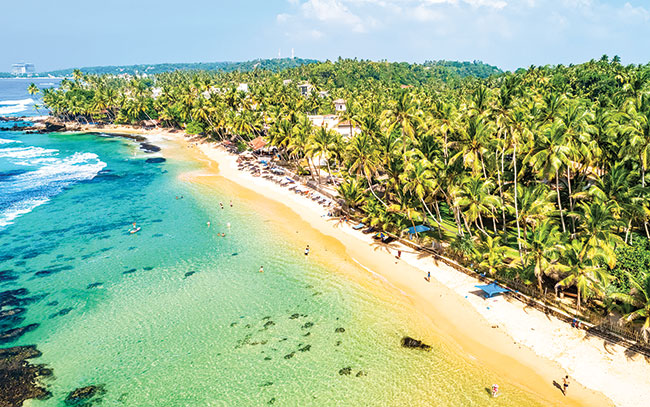
Sri Lanka’s potential for ‘eco and science-based marine tourism’, though immense, has still not been properly tapped. To promote this unconventional tourism product, sustainable environmental practices are fundamental. We spoke to several stakeholders who moot collaborative efforts and community participation in making these best practices a reality.
*The highly diverse Lankan coastline abundant with natural resources is now showing obvious evidence of degradation and destruction.
*The pandemic has made things worse by adding disposable facemasks to the growing plastic menace
*The ‘polluter pays’ principle which is strictly applied in developed parts of the world is grossly neglected here
*Sustainable environmental practices can reflect very positively on the overall branding of the country
BY RANDIMA ATTYGALLE
Face masks piled up on the beach and empty plastic bottles entangled in a coral reef do not fit into the idyllic picture a tourist will envisage of our island. We have been taking our coastline of 1,620 km, abundant with golden dunes, coconut groves and a lot more enabling livelihoods for millions, for granted. The highly diverse Lankan coastline abundant with natural resources is now showing obvious evidence of degradation and destruction.
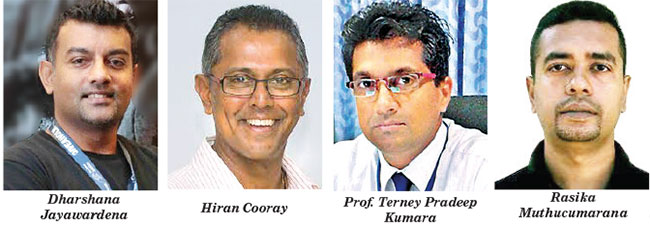
Our coastal belt with its enormous capacity for tourism is largely threatened by coastal pollution, unethical fishing practices and climate change, says the Former Head of Department of Oceanography, University of Ruhuna and former GM of the Marine Environment Protection Authority (MEPA), Prof. Terney Pradeep Kumara. “The need to have sustainable management of the coastal belt is urgent. While more than 11 million of people live in coastal districts, nearly 62% of local industries are also located in this zone. If we are to attract high end tourists whose revenue matters to the country, we need to act now in managing our coastal resources.”
Sri Lanka’s potential for ‘eco and science-based tourism’, though enormous, has still not been properly understood or tapped, says Prof. Terney. He explains that sustainable environmental practices are fundamental to promote this modern tourism product. “Given our highly diverse ecosystems and our orientation in the Indian Ocean, our marine heritage-both natural and archaeological, is very rich. Corals, for example, can only not determine events of the past such as volcanic eruptions, rising sea levels, mass flooding etc. but they can also predict the same. If we look at pollen, larvae and cysts of different organisms, they can say how ecologically we are connected through genetic matter, animal migration etc. Then we have several shipwrecks which form part of our marine heritage. They are historically important not only to us but to the whole world showing evidence of trade relations and technological evolution and exchange of sea fare. To sustain all of this, coastal management is a must.”
The ocean expert alludes to best practices in South Africa, Australia and the Maldives where tourism goes beyond leisure and makes it a learning experience as well and thereby diversifies the tourism industry. “The reach for scientific eco-tourism is vast and if we market our resources along those lines, going beyond the region, we can attract a sizable segment from Russia, Europe and Canada as well.”
High level multi-sectoral collaborations are proposed by Prof. Terney to address the challenges to sustainable coastal management strategies. Having technical staff equipped with sound scientific knowledge and experience on the boards of SLTDA and SLTPB which are responsible for tourism promotion, equipping hotels with professionals who could empower tourists, enhancing field-based manpower, collating research-based data scattered among various agencies, regulating diving centres (some of which support illegal activities such as spear fishing among tourists) and giving more teeth to the existing environmental and coastal protection laws and increasing the legal literacy among tour guides and local communities are among some of his proposals.
The plastic waste generation here at home is alarming, warns Prof. Terney. “A considerable amount of plastic waste is generated here and a good majority of it ends up in the sea threatening marine life. The pandemic has made things worse by adding disposable facemasks to the growing plastic menace.” The ‘polluter pays’ principle which is strictly applied in developed parts of the world by multi-nationals is grossly neglected in our part of the world, charges the scholar. “Compared to their business scale, the amount these multinationals spend to recover the environment in developing and underdeveloped countries is a pittance,” observes Prof. Terney. The absence of a system of collecting all waste as in the case of Singapore, one of the best Asian models, makes Lankans selfish and also lackluster towards the environment, he goes on to say.
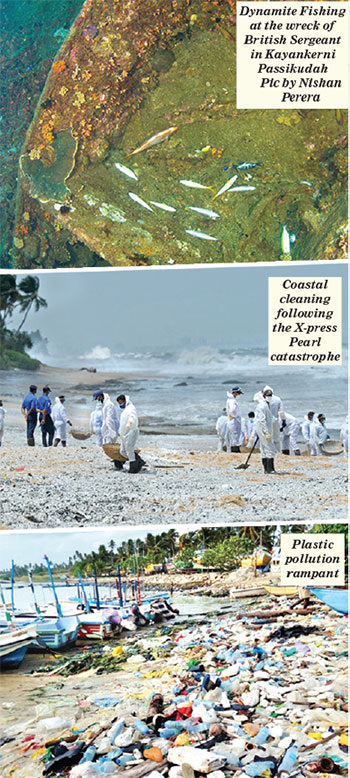 Citing the recent oil spillage catastrophe in our seas of which the environmental damage is yet to be quantified, Prof. Terney calls for urgent amendments to the current laws, some of which have ‘grey areas’. He also moots modern standards and beach certification programmes such as Blue Flag (the world’s most recognized voluntary awards for beaches, marinas and sustainable boating tourism operators) and other leading standards for sustainable marine tourism practices such as Green Fins and Green Key.
Most well-seasoned travelers look for countries and organizations which practice sustainability before selecting their destination and therefore the impact of sustainable environmental practices on high-end tourism cannot be undermined, says, Chairman, Jetwing Symphony PLC and the Chair of the Advisory Committee to the Ministry of Tourism, Hiran Cooray. “Sustainable environmental practices can reflect very positively on the overall branding of a country and unethical practices can obviously hurt us,” says the hospitality leader who cites the example of Boracay in Philippines where the destination had to be closed for almost a year to get it cleaned up. “If our beaches and rivers get inundated with plastic waste and other pollutants, no one will get close to them and automatically we will be out of business.”
The well traveled hotelier explains that New Zealand is a fine example of a destination branded as ‘100% pure’. “They walk the talk by setting very high standards of environmental protection and awareness among people.” Education is the key to sustainable practices, remarks Cooray who goes on to note that there are no quick solutions but the only way is to believe in clean cities and villages and work hard collectively to educate the masses.
Protection of tourism assets and involving the community in conservation and revenue sharing are the two most important lessons Sri Lanka can learn from other Asian counterparts such as the Maldives, Malaysia, Indonesia and the Philippines- countries which generate millions of dollars annually from marine tourism, points out techdiver, underwater explorer and photographer Dharshana Jayawardena. Questioning the logic of promoting tourism while it is exploited illegally, Jayawardena charges that in certain areas of the country, usage of illegal fishing nets, dynamite fishing and spear fishing is taking its toll decimating the marine ecosystem. “For instance, the wreck and the corals of the World War II SS British Sergeant are destroyed by dynamite fishing regularly and in Unawatuna dive operators complain that while they are showing marine life to SCUBA divers, a few dive centers break the rules and engage in illegal spearfishing shocking the tourists they are guiding. Both dynamite fishing and spearfishing is illegal in Sri Lanka but still happens rampantly.”
‘Over tourism’, as the explorer explains, can also destroy tourism assets. “In other countries, there is a daily limit to the number of tourists who can visit the national parks, ensuring that the marine eco system has a respite. Pigeon Island National Park of ours which is suffering from overcrowding and pollution can benefit from a model like this.”
In a lot of Asian countries, most of the revenue earned by a tourism asset directly goes back to the community surrounding the asset. People in the area are involved in providing services as well as earning a majority of revenue from the park fee which goes to community development in the area. “This provides a strong incentive for the community towards conservation and protection of the tourism assets as they benefit most from it. It can also be thought of a redirection of tax revenue made from tourism businesses in the area are directly reinvested back to provide better quality of life to people in the area and the tourists, instead of the money disappearing forever in the treasury,” maintains Jayawardena.
Rasika Muthucumarana, Maritime Archaeologist from the Maritime Archaeology Unit of the Central Cultural Fund in Galle says that marine pollution expedites the deterioration of wrecks and artefacts resulting from chemical reactions. “The inland waste flowing through rivers and canals ultimately end up in the ocean at a huge cost. Pollution also distracts marine life from wrecks. Shipwreck diving is a popular form of marine tourism and environmental hazards, largely due to plastic pollution can discourage potential tourists,” says Muthucumarana. The marine pollution resulting in unclean waters and lower visibility could affect divers. “There are also hazards posed by ‘ghost nets’ entangled in wrecks and corals. Marine pollution also places the divers at increased health risks,” notes the maritime archaeologist who calls for higher penalties and fines for polluters.



Institute of Hospitality Sri Lanka
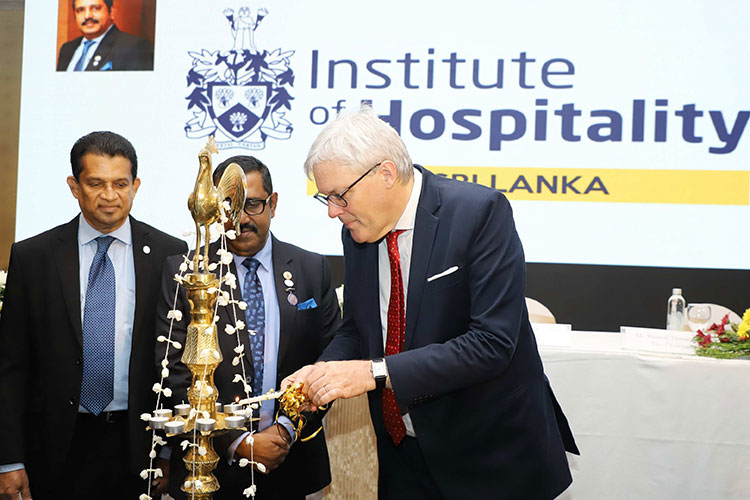
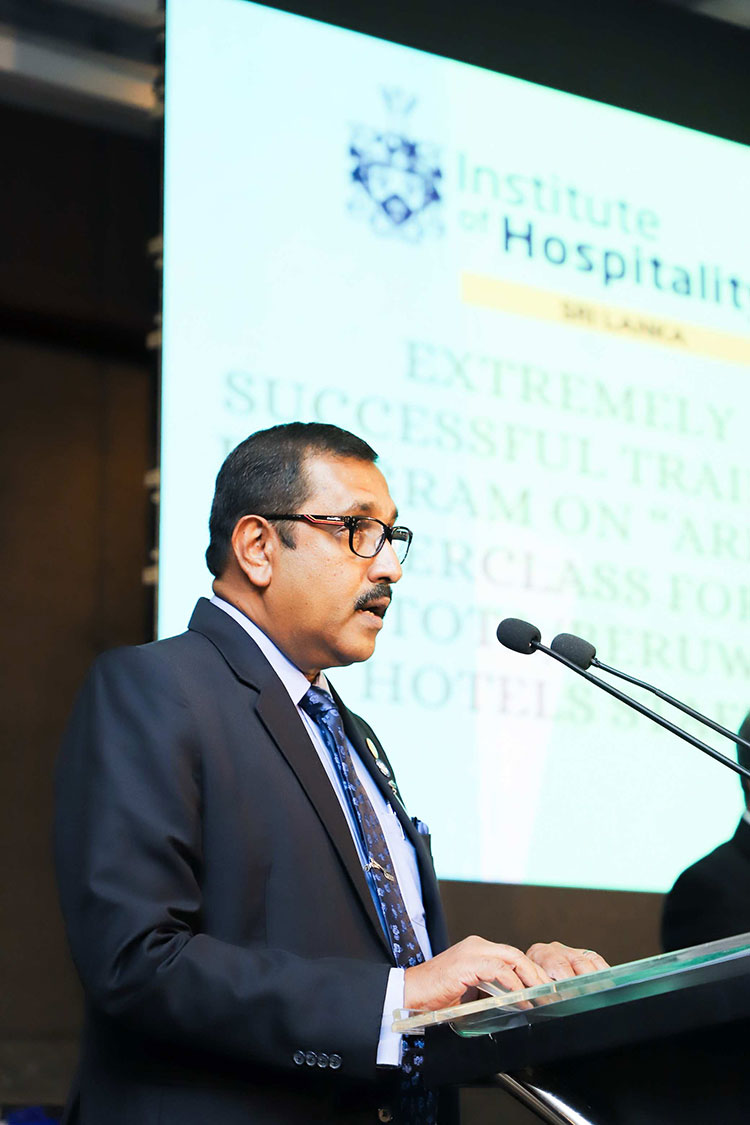
 The 32nd Annual General Meeting (AGM) of the UK-based Institute of Hospitality’s Sri Lanka Chapter was held recently at the Ramada Hotel Colombo,.The event provided an evening of camaraderie , reflection of the past and present achievements,setting new benchmarks for the future
The AGM had the presence of two distinguished guests, the Chief Guest Opposition Leader Sajith Premadasa, and the Guest of Honour British High Commissioner to Sri Lanka, Andrew Patrick. Their inspiring speeches were lauded by all hoteliers who were present at the occasion
A special thanks was extended to Robert Richardson, CEO of the Institute of Hospitality UK, along with his team, sponsors, committee members, and all attendees for making the event memorable.
Dr. Harsha Jayasingh, Past President of the Institute of Hospitality (UK) Sri Lanka Chapter, emphasised the Institute’s longstanding history and the strength of its Sri Lankan branch. “The Institute of Hospitality (IH) UK has a history of 86 years, and we are proud to be the Sri Lanka Branch. IH Sri Lanka is much stronger now with many members from all areas of the hospitality industry,” he stated.
Dr. Jayasingh highlighted the significant role of tourism in Sri Lanka’s economy,. He said tourism it is the third-largest source of revenue for the country. “Tourism accounts for about 13.3% of total foreign exchange earnings and employs 450,000 people directly and indirectly. The hospitality industry in this island of pearl holds tremendous potential for economic growth, job creations, and cultural exchange,” he added.
He also pointed out more women should be attracted to the industry and advocated for the use of technology in hospitality sector to attract the younger generation.
The newly appointed Chairman Ramesh Dassanayake spoke about the challenges faced by the industry, including the reluctance of youth to join the sector. . Dassanayake expressed concerns over the migration of staff between hotels and the overall ‘brain drain’ in the sector. ” We must maintain high standards in the hotel We must try to attract tourists to Sri Lanka, we must have with many facilities Hence, hotel schools and other professional institutions involved in skills development mustincrease their intakes,” he pointed out.
Chief Guest Sajith Premadasa emphasised the importance of eco tourism and said “We need to have an environmental policy related to tourism in place,” . .
The 32nd AGM of the Institute of Hospitality UK, Sri Lanka Chapter, was a testament to the strength and potential of Sri Lanka’s hospitality industry. The insights and commitments shared during the event set a new benchmark for the future.(ZC)



Pix by Thushara Attapathu
Life style
He recognizes human identity beyond boundaries of gender, race, nationality and religion.

Visit of Sri Gurudev to Sri Lanka
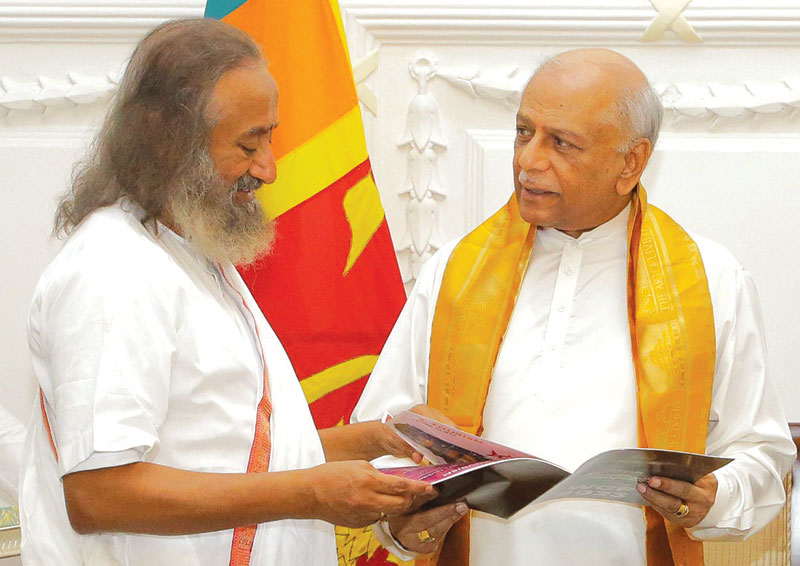
Humanitarian, spiritual leader and Global Ambassador of Peace Gurudev Sri Sri Ravi Shankar (Sri Gurudev) was in Sri Lanka on a three day tour on the invitation of the Prime Minister of Sri Lanka Dinesh Gunewardene. Gurudev who inspired a wave of volunteerism and service to moot one of the largest volunteer-based organisations in the world – The Art of Living – visited the various projects under the aegis of the foundation and launched twelve vocational and technical centers around the island. He was accompanied by thousands of followers from Sri Lanka and around the world.
Gurudev who visited Sri Lanka for the sixth time also had a first day cover launched in honour of his visit. He is a strong proponent of spreading happiness, using the unique Sudarshan Kriya, yoga, meditation and practical wisdom to unite people, empower individuals and transform communities. His programmes provide techniques and tools to live a deeper, more joyous life, while his non-profit organisations recognize the human identity beyond the boundaries of gender, race, nationality and religion.
The Art of Living which has more than 30,000 teachers and over one million volunteers across 180 countries has touched in excess of five hundred million people around the world. CNN called it “Life Changing” and The Washington Post headlined it, “Fresh air to millions”.
In Trincomalee, Gurudev met with war victims and had a heartwarming engagement with the children from the children’s homes run by the Foundation. He also visited the Koneswara Temple in Trincomalee and graced the Kumbhabhishekam at Seetha ecogPnize the human identity beyond the boundaries of gender, race, nationality and religion. Amman temple at Nuwara Eliya. He held discussions with the trustees on the progress of the foundation’s social service projects, while also holding a special event – Ekamuthuwa – attended by a large number of dignitaries and his devotees from around the world.
His time with the Prime Minister was spent discussing the prospects of unity in diversity and uniting Sri Lanka by adding happiness into the formula of living. In addition he had discussions with the Speaker of the Parliament of Sri Lanka Mahinda Yapa Abeywardena, prominent business stewards and civil society leaders.
by Zanita Careem
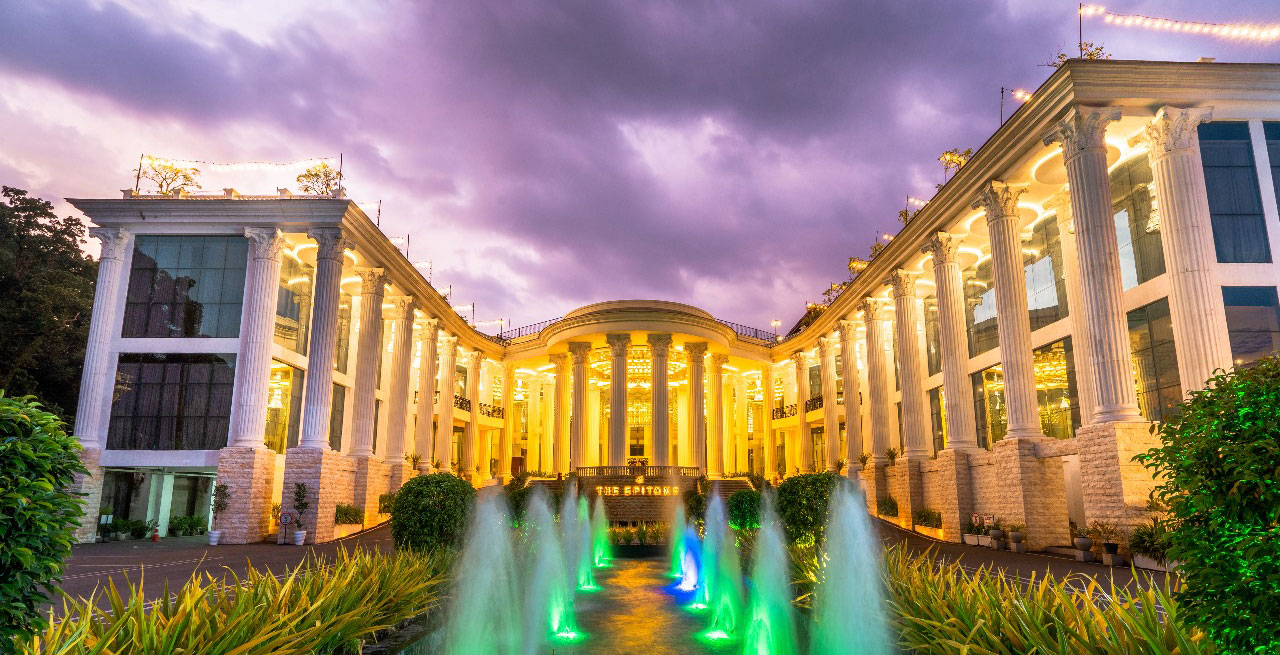
Envison your dream wedding day come to life at the Epitome Hotel, a prestigious city hotel in Kurunegala offering an unrivalled luxury rendors experience for weddings.
The venue is designed to embody opulence and luxury from all quarters for a spectacular wedding in kurunegala,Thier ballroom is the largest banquet facility in Sri Lanka It can be divided into six luxurious pillarless wedding halls on the ground floor and 25pax smaller banquet halls.
It can be easily named as a five star heaven in the heart of the city contributing to a myriad of immense experiences tailored to inspire and delight wedding experiences.
From opulent décor set up to exquisite table decor, lavish food, every detail is meticulously curated to spark your imagination and ignite creativity for a perfect wedding. The previous prestigious wedding shows season one and season two attracted large crowds
were unique events which gave the wedding vendors and potential clients had an opportunity to connect and interact with each other. Beyond being a showcase it was a chance for the wedding vendors to unite and contribute to the vibrancy of the wedding industry. The wedding show covered all area of the bridal industry providing a comprehensive variety of bridal supplies from Sri lanka and became the most popular bridal exhibitions in Kurunegala.This bridal exhibitions allowed brides and grooms to experience first hand the products and services available from suppliers in Sri Lanka
These wedding shows held at The Epitome created a benchmark and gave an opportunity for vendors to create connections to the utmost satisfaction said Harshan Lakshita Executive Director. of the magnificent Hotel
Our wedding shows featured experts and professionals in every field‘ It covered all areas of the bridal industry provided a comprehensive variety of bridal supplies from Sri lanka and became most popular bridal exhibition in this region.We are always open to everyone to join us at our wedding shows in the future. It is an opportunity to discover the incredible talent within our local wedding and bridal vendors to make meaningful relationships and plan thier special day at our breathtaking hotel The Epitome said General Manager Kavinda Caldera
The Epitome Hotel’s bridal show which will be held end of June will buzz with great ideas,advice and inspiration for all those who plan thier dream wedding
…….
The Hotel Epitome’s Wedding Season 3 will marked excellence, celebration and inspiration for those in the wedding industry. The exhibition halls will resonate with ideas on exquisite bridal wear to decor, florists , photography etc and showshowcase the rich tapestry of talent within the local wedding industry. .







US sports envoys to Lanka to champion youth development

Rahuman questions sudden cancellation of leave of CEB employees


