Features
Samantha, a labour of love

First artificially inseminated foal in Sri Lankan
By Sajitha Prematunge and Lalantha Wanniarachchi
Tall and stout by Sri Lankan standards, Samantha, was quite oblivious to her historical significance. She is the first artificially inseminated foal in Sri Lanka. From the former Director of Forestry and Environment Division, Mahaweli Authority turned breeder, Palitha Samarakoon, who tried to get mare Thulvaan to conceive but in vain, to the veterinary team at Peradeniya University, Veterinary Science Faculty, the coming of the now happy and healthy filly was something akin to childbirth. Samantha was the culmination of years of hard work and months of anxious anticipation.
A casual conversation with Peradeniya University, Veterinary Science Faculty, Senior Lecturer Prof Basil Alexander convinced Samarakoon that artificially inseminating a mare was not altogether impossible. Ten doses of semen, of Arabian pedigree, were brought from a stud farm in California at Rs 100,000 each. Thulvaan of the seventh generation from Upali Wijewardene’s stock was the ideal candidate.
Veterinary marvel
The insemination was professionally carried out by Senior Lecturer Dr Dammika Perera together with Alexander and Anil Pushpakumara of the Veterinary Science Faculty. Of course, a straightforward artificial insemination, as that of Samantha’s, was probably a cake-walk for a Department that introduced to Sri Lanka, technologies such as embryo transplantation to create high standard cattle over a decade ago. While a cow gives birth to an average of eight to 10 calves during her lifetime, they have thousands of eggs in their ovaries. In a bid to utilise the maximum reproductive potential of genetically superior female animals with high milk production capacity, multiple embryos harvested from such cows were transferred to recipient cows to complete gestation.
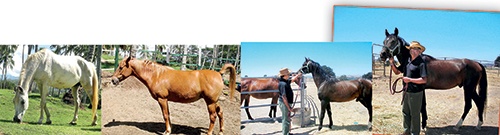

However, Dr. Perera explained that artificially inseminating a mare was a novel experience. “The mare has to be in heat for the egg to be fertilised. We had to prime the womb with hormone treatment for maximum effect,” Perera explained the process. “Then we had to make sure she was in fact in heat by looking for signs such as changes in the vaginal opening and passage.” According to Perera, cervical tone has to be monitored and hormone treatment continued till desired tone is achieved. Ultrasound scans of the uterus, examination of ovaries, regular scans to monitor egg diameter and further hormone treatment to bring eggs to the desired size are all a part of the artificial insemination process.
“It is only after ensuring that everything is satisfactory that we take the sperm out of cold storage, bring it down to room temperature and inseminate the mare.” This is followed by further hormone treatment and scans at 12-hour periods. “By the 15th day we can determine whether the mare has successfully conceived. Scans are done at the end of the first and second trimesters to monitor the growth of the foetus, identify any abnormalities and interventions to rectify such abnormalities, carried out.”
Dr. Perera is treading unfamiliar territory. Consequently, his job requires critical thinking and a certain amount of derring-do, as it were. He admitted that although veterinarians must be aware of all the state-of-the-art research in the field, foreign research was not directly applicable to a country like Sri Lanka due to geographical and climactic differences. “Some are economically not viable. Research can’t be undertaken lightly because that would lead to waste of valuable resources. It has to be targeted at finding what works for our country.”
The gestation period of a mare is 11 months and 15 days, give or take 15 days more, said Samarakoon. But Samantha, being of good pedigree, consequently quite well-developed, was a feisty one and Thulvaan was forced to deliver 15 days ahead of schedule.
Animal lover
Samarakoon became the proud owner of a cow on his seventh birthday, when his mother bought it for him from an auction at the Kundasale farm for Rs. 80. Thus began his love for animals. He later graduated to elephants and crocodiles, but it goes without saying that he had a soft spot for horses. Samarakoon joined the Mahaweli Authority in 1979. He believed that having hands on experience was vital for him to perform his duties as the Director of Forestry and Environment Division. Samarakoon was responsible for successfully completing a 12 million tree planting project, a feat not achieved by any department since. “But to this day no one has expressed interest in acquiring that knowledge,” said Samarakoon, ruefully.
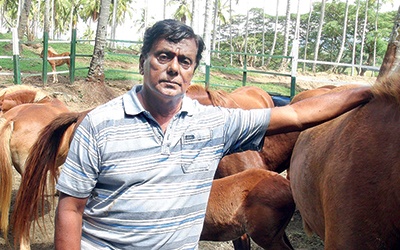

Breeding a stock that were originally groomed for racing proved difficult as no records on their breeding capacity existed and there was a shortage of bloodlines. Samarakoon explained that it’s difficult to find studs of higher pedigree in the country. To make matters worse, the only stud was put down after it broke a leg. To date there are no studs in stables, only male foals. “It’s difficult to maintain studs because they tend to inbreed and impregnate mares that are too young,” explained Samarakoon, leading to a degenerate progeny. “You could lose control of the breeding programme.”
When a horse was killed in his stables, by insurgents who didn’t approve of his stern administration at the Authority, Samarakoon became disillusioned. He was forced to quit after 25 years in the Mahaweli Authority. Fortunately, in 1999, Rifle Corps Commanding Officer at the time, Colonel Ranjith Ellegala invited Samarakoon to continue his work at the Rifle Corps Headquarters premises, Pallekele. Samarakoon made sure to improve the bloodline of horses every new generation. Samarakoon believes that the progeny of the horses that he has bred can be improved to international standards.
Costs
Samarakoon explained that a horse of good breeding in Sri Lanka was priced somewhere between one million to 1.5 million rupees. For comparison, the world’s most expensive race horse, the Irish thoroughbred Galileo, is estimated at 180 million Euros, a staggering USD 215 million. The costs are just as exorbitant, according to Samarakoon. It costs Rs 500,000 to 600,000 per annum to raise a horse and he says there are no monetary benefits for him in horse breeding. His only reward is the foal he gets once a year. Samarakoon sells the male foals to those who are willing to provide a good home.
But he has donated a choice few to various establishments. He has offered 13 of the choicest studs to Sri Lanka Army and some to Sri Lanka Police. The last one, approximately Rs 400,000 in value, was gifted to the Gajaba Regiment Headquarters, Anuradhapura, three months ago. Three horses were offered to Sri Lanka Military Academy at Diyatalawa. Several more horses worth four million rupees were gifted to Sri Lanka Rifle Corps Headquarters, in reciprocation of allowing him to use the land for his breeding programme. Samarakoon still maintains these horses.
His free ranging horses at Pallekele are shampooed, groomed and examined for ticks regularly. He is of the opinion that horses raised for breeding purposes should not be ridden. “The animal’s mentality changes when it’s ridden,” said Samarakoon. “The bit alone weighs 750 to 800 grammes.
The high feed cost was another major concern at the inception of the programme. Most of the money allocated for the project was used up for horse feed. Armed with 40 years of experience in livestock breeding and farming, Samarakoon set about finding local alternatives. He substituted the feed with a locally concocted diet of energy and protein rich grains. The six locally sourced ingredients are mixed according to the ratio specified by Samarakoon, based on years of experience, depending on the nutritional requirements of individual horses. “For example, the diet of a weak animal is adjusted to provide more protein.” The horses are fed four to five kilos each twice a day in addition to being allowed to graze to their heart’s content in the 80 acre land belonging to the Rifle Corps Headquarters.
Samarakoon said calcium was vital to maintaining the bone strength, especially those of horses’ legs. Theirs is a curious diet of a calcium rich mixture, eggs, carrot and even banana. “Eggs are the most cost effective protein rich substance in Sri Lanka,” said Samarakoon. “And banana is a great laxative.” But, true to the idiom about the carrot and the stick, horses and donkeys, love carrot. Samarakoon said imported horses were fed on imported grain such as oats, bran and barley, supplemented by special imported vitamins.
“My horses are local and don’t need that. My objective is to breed truly local horses fed on a local diet.” About 70 percent of their diet consists of grass. Race horses require a specialised high protein diet. Samarakoon, who has reared Australian and Pakistani horses is of the view that even imported horses can be trained to consume local feed. “In fact, they come to like the variety of the local diet.” The diet introduced by Samarakoon costs only Rs 15,000 to 20,000, whereas maintaining them on imported feed would cost Rs 125,000 to 150,000 a month. The mash proved ideal for weight and height gain and blood tests proved that his diet plan was far better balanced than the imported variety.
Naturalised
The original objective of the breeding programme was to cross the Delft stock of ponies with horse or thoroughbred to produce a half-breed, a Sri Lankan horse, ideal in height, size and spirit. “You can turn a horse into a pony and a pony into a horse. In fact, the Delft ponies were once full-sized horses. But after their caretaker died, with nobody to care for them, they naturalised,” explained Samarakoon. He opined that instead of spending millions on importing stud sperm from abroad, horses could be cross-bred with Delft ponies to create a richer gene pool. “But not in the natural element of the ponies. They have evolved to the tough living conditions, drinking salt water and eating whatever little plant life is left during the dry season. A few could be taken out and introduced to the breeding programme.” Of course, if any government authority were to initiate such a programme, Samarakoon would be more than willing to give it a go.
With a lifespan 25 years, a horse is fit for riding for 20 years. “Speed is the benchmark of a pedigree and all the breeding in the world would do no good if they are not used in racing,” said Samarakoon. He pointed out that both Boossa and Colombo race courses had been closed down long back, and the only remaining horse racing venue, the Nuwara-Eliya racecourse, was in danger of closure. If there are no races, what will breeders like Samarakoon do? “This is a passion, not a business,” said Samarakoon. He is willing to take on a not so business-minded partner, who would take the reins, after he retires. He is ready to impart knowledge gathered over five decades on raising and breeding horses, to anyone interested in experimenting with horse breeding.