
Features
Rituals in a village community at Paiyagala 75 years ago

by Jayantha Perera
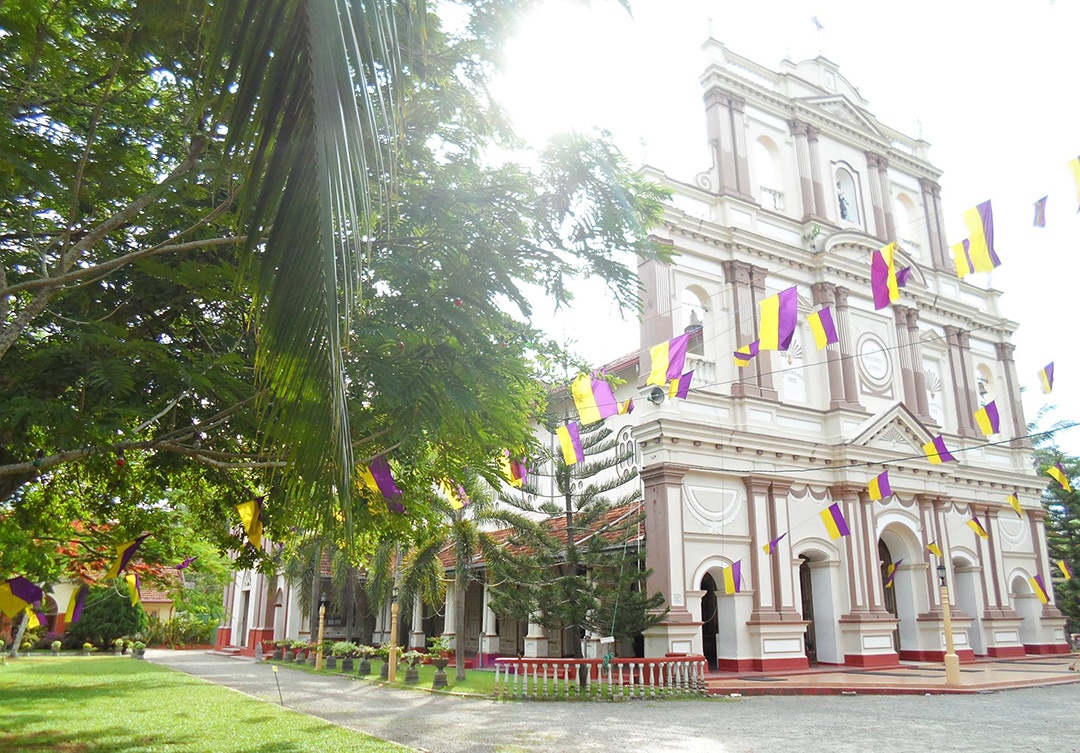
St. Joseph church in Paiyagala has a beautiful façade and a belfry. Its nave is broad, with stunning floor designs. A magnificent painting of the creation of the universe covers the vault. Two short rows of colonnades support the two aisles, broadening the space in the nave. A short, narrow gravel road connects the church compound with Colombo-Matara road, and the church’s backyard is only about 200 yards from the Colombo-Matara railway line and the beach. The feast of St. Joseph is the main annual event in Paiyagala.
In the late 1950s, the Church Committee discussed with the Italian parish priest, who ruled the catholic community, the desirability of celebrating the church’s feast on May 1, Labour Day. Several parishioners opined that celebrating the feast on Labour Day might drag the church into national politics. Some others worried that parishioners might go to Colombo to celebrate Labour Day instead of the church feast. A few threatened to become parishioners of Kuda Paiyagala church, which was only half a kilometre from St. Joseph’s. In his Sunday sermon, the parish priest advised the ‘rebels’ not to harm the village solidarity. Ultimately, the warring parties buried their hatchets and aligned with the Committee’s decision to celebrate the church feast on May 1.
In 1962, Nihal, my brother, and I reached Paiyagala ten days before the day of church feast. At the Kalutara main bus stand, we bought two packets of inguru dosi (ginger fudge) for Aachcho (maternal grandmother) as Amma (my mother) instructed. We met Aachcho at the bus stand. She was in a long-sleeved white embroidered jacket and a floral cloth. She wore no slippers. Her graying hair added more charm to her face. She kissed and took us to the dining table, where she kept our favourite walithalapa (steamed rice pudding) and a bunch of kolikuttu bananas. She told us that we should spend time with her at the church and explained the importance of ‘confession’ before the vespers (evening prayers on the eve of the church feast).
Aachcho had arranged with a coconut toddy tapper to deliver a large bowl of mee raa (unfermented toddy) to her daily. She added crushed black pepper, sliced red onions, and green chillie to the toddy bowl. One hour later, she gave us a glass of mildly fermented toddy. She treated toddy as a medicinal tonic for children which kills harmful worms and improves appetite.
The Church Committee painted the church walls, polished the wooden pews and the floral floor, and repaired the church roof, expecting the monsoon rains. It collected donations from catholic families in the parish and discussed with them how to decorate the sorole (procession) path of the statue of St Joseph. Those who had colorful banners washed them a week before the feast and tied them to poles across roads. The Committee hoisted a flagstaff with many bright flag lines in front of the church. The parish priest blessed the flagstaff, and nuns from a nearby convent distributed sweetmeat to the participants.
The Church Committee invited about 25 women to the church compound on the eve of the church feast to cook rice and fish for the grand almsgiving on the following day. The Committee got cooking utensils from the convent. Local businessmen donated rice, thunapaha (spices), cooking oil, firewood, and small brown paper bags. One fisherman donated a large Maduwa (stingray) fish. Several women cleaned and cut the fish into large pieces. Another group of women prepared fresh thunapaha for the fish curry while young women washed and de-stoned the rice.
A woman who was known for her culinary prowess supervised the cooking gangs. She directed several young girls to mix spices, tamarind paste, and salt in large clay pot. She also checked the heaps of fish pieces and decided how many pots were needed to cook them. Then, she studied the spice mixture – color and taste – before pouring it into each fish pot in different proportions. She controlled the heat of the firewood under each pot by pulling out or adding pieces of firewood. (Many years before, Aachcho’s mother supervised the cooking of fish and rice at the church compound. She had never tasted the mixture of thunapaha before adding it to fish pots, Aachcho declared proudly.)
The cooking of rice had its own rituals. The supervisor recited a short prayer that ended with “Jesus, Mary, Joseph” before putting a handful of destoned and washed rice into each large cooking pots. After that the girls filled the pots with rice and water as the supervisor directed. Before the rice was cooked, a handful of rice was thrown out with water from each rice pot. The thrown rice was the food for hobgoblins and other harmless spirits hovering around in the cooking space. Devotees considered them as community members who celebrate the feast.
The parishioners worried that the monsoons might spoil the feast. When dark clouds appeared on the horizon, the parish priest brought the statue of St Joseph from its glass box on the top of the altar to a temporary altar next to the cooking station. With the statue overlooking the cooking area, women did their work without worrying about the weather.
While women cooked food, vendors descended on the gravel road with goodies. They sold sweetmeat, toys, laminated pictures of Jesus, Mary, and Joseph, plastic balls and bats, prayer books, and rosaries. On the eve of the feast, Aachcho broke her clay coin jug, counted the money and bought toys for her grandsons. She bought me a small toy boat. The vendor poured water into a basin and filled the tiny detachable capsule in the boat with paraffin. The boat moved on the water when he lit the wicker connected to the capsule.
The ice cream man was the most popular person among the vendors. Young boys and girls lined up to buy popsicles, each costing five cents. A woman sold Buundi aluwa (halva) claiming that the aluwa was from the Maldives Islands. The Achchar (pickle) woman had a profitable business and sold a small packet of veralu achchar (wild olive pickle) for three cents.
Before the vespers, Aachcho took Nihal and me to a nearby well, pulled several buckets of water, and bathed us. She had a special soap for the occasion. It was an expensive, imported cake of Goya soap. Afterwards, she dressed us in clean clothes. Just before we went to the church, thaththa (my father) and Amma with two younger brothers arrived.
Vespers were at eight in the evening and a musical show preceded it. A band played popular English and Sinhala songs and hymns. The chief of the band played a piano accordion while dancing. Once he fell off the stage creating chaos and cutting off the nearby noisy generator’s power supply. It took about ten minutes to restore electricity.
At a corner of the church compound, two fishermen auctioned fish. They invited the school principal to bid first. After bidding he put five-rupee note to a tin box. Afterwards, each bidder put one rupee into the box. The last bidder took the fish home, and the fishermen donated the money to the church.
Although liquor and smoking were not allowed in church premises, a few men gathered after sunset behind the church to consume alcohol. The priest and the Church Committee knew what was going on behind the church, but did not intervene. Thaththa explained that the vespers night was for all parishioners—sinners and saints— to enjoy life.
When the church bells rang at 8 pm, the band took a break. Through loudspeakers, the sacristan announced that vespers would start soon. Ten priests who had come to help the parish priest conduct vespers entered the church in procession from the church front door. The parish priest followed them with the statue of St Joseph collected from the open-air altar and re-installed it on the church altar. Devotees occupied pews, and some waited in the church compound. The highlight of the service was the twin sermon delivered by two priests on family values and the lessons to be learned from St. Joseph.
Soon after the vespers, devotees remained in the churchyard to watch fireworks. The parish priest blessed heaps of fireworks. Two men pushed the crowd away from the firework station. Chakra (revolving crackers) appeared first, shooting stars, flower blasts, and rockets followed. A rocket rose as high as 60 meters or more before blasting into different floral designs. Onlookers compared the quality of fireworks with that of the previous year. Someone whispered to thaththa that the Committee might have pocketed a part of parishioners’ donations.
Aachcho threw a sumptuous dinner for the family. Fried pork, chicken curry, deviled prawns, dhal curry, papadam and several vegetable curries were on the table. Thaththa and Amma did not join the children and spent time in the verandah (foyer) of the house talking with friends and enjoying drinks. Women, too, drank liquor with their menfolk.
Soon after dinner, Aachcho lowered the chicken pen that was hanging from two ropes tied to two coconut trees in the compound. There were three chickens in the pen. A visitor killed the chickens, and Aachcho cooked the meat for the following day’s lunch. She was lucky to save her chicken from thieves. During the church feast and the Christmas, local thieves had the habit of stealing chickens and pigs to raise money to buy liquor and to gamble.
Aachcho decided on our sleeping arrangements. The only bed at Aachcho’s house, where Nihal and I had slept for eight days, was given to Thaththa and Amma. Aachcho spread several mats on the sitting room floor. She got a few hard pillows from a cupboard. Nihal told us ghost stories and warned us that at midnight, a ghost in white might visit us. We demanded Amma to sleep with us on the floor, and she did. We liked the smell of the floor – a mix of cow dung and clay. We competed with each other to sleep next to Amma. I liked her body smell mixed with talcum powder and sweat.
Aachcho and Amma knelt down and prayed with their rosaries for 15 minutes. Then Aachcho prayed to St Joseph to protect us from committing maraneeya papa (mortal sins) that night. She and Amma recited this prayer three times. I wondered what mortal sins they could commit during that night. I was not brave enough to question Aachcho or Amma about mortal sins. Still, it bothered me for several years, until I talked to my spiritual mentor – a Jesuit priest, at school, who told me that some sins, if not pardoned by a priest at a confession, could condemn the sinner to eternal hell after his death.
Overnight fasting was mandatory to receive the Eucharist in the morning. We all got up early on the feast day to attend church. We had to go out in the darkness to wash our faces. Aachcho kept water in two large clay pots. There was no flushing toilet. A small shed covered with cadjan leaves had two flat stones to squat on. A toilet user had to take water in a small container. When the toilet was not in use, pigs visited it and cleaned it up in a few seconds!
On the feast day, everyone, including children, had breakfast after the sorole. Aachcho laid the breakfast table before going to the church. She prepared a great variety of food: milk rice, kavum (oil cake), athiraha, kokis, bibikkan, fish curry, and several bunches of kolikuttu.
Church bells reminded us that we were in the middle of the church feast. When we went to the church, several women had already begun a prayer session led by the church sacristan. He with his soft voice led women in a full rosary and several hymns and prayers. Amma had told me that the sacristan had been interested in marrying her and had, in fact, sent a marriage proposal through his aunt. But my granduncle refused the request because he was unemployed.
After the prayers, Amma took me to the sacristan and introduced me to him. She was shy and did not look at his face. He, too, hesitated for a few seconds before talking to me. He wore an expensive collarless cream-coloured jacket with a light tweed cloth and a thick silver belt. He sported a ponytail, and his face was well-shaven, except for the moustache, which made him look majestic.
A visiting priest delivered a boring sermon that lasted about 30 minutes. Humidity inside the church became unbearable. Many men started conversations without listening to the sermon. Although women suffered more (with veils over their heads) than men, they bore the unpleasantness as good devotees. The feast service took about 90 minutes.
Brown paper bags with rice and fish were already laid on several tables in the church compound to distribute. Those who lined up to join the sorole got food parcels from the parish priest. People who got the food bags shared rice and fish with family members and friends. I got a mouthful of rice and a piece of fish from thaththa. I thought the food was stale, but I did not complain because such food was considered sacred.
Church bells rang again, informing the scouts of the sorole to get ready. They were dressed like ancient Portuguese soldiers, in colored costumes with large round headgear. They carried banners with emblems of various church associations. The parish priest brought the statue of St Joseph to the churchyard again. A carriage decorated with garlands, flower bouquets, and veils awaited the statute. Ten men were poised to pull it around the village. The priest installed the statue in the small casket on the carriage. He blessed it, collected the burning incense bowl from an altar boy, and offered scented fumes to the statue and the carriage.
The bandmaster and his group led the sorole. The procession stopped at each wayside altar in neighbourhoods, where small groups of residents waited for the sorole to pass and got a close glimpse of St Joseph’s statue. In some localities, residents lit firecrackers. Most devotees who were in the sorole dropped out of it, when it passed their homes. Those who could not attend the church in the morning, joined the sorole at various locations.
The traffic on the main road built up rapidly, and the police had to control vehicle movement. The church choir sang hymns non-stop, and loud loudspeakers broadcast them. After moving about one mile on the main road, the sorole turned to a by-road and went to the beach, where several fishermen garlanded the statue and lit firecrackers.
When the procession passed the fishermen’s huts, two middle-aged women began to sing and dance while cooking. They wore floral gowns and danced around a large pork pot on fire in front of their houses. The pork curry looked very dark but smelt fabulous. Several old women sang kaffirhinna (Portuguese songs). A woman started dancing around the pot of pork while holding the hem of her long gown in one hand and a large spoon in the other.
The procession returned to the church after passing fishermen’s huts on the beach. Soon after breakfast, thaththa served liquor, and from the kitchen, the children brought bites (snacks) for visitors. Nihal, Gamini, and I ate deviled pork, eggs slices, and cashew nuts as much as we could hold before serving the adults. Men’s voices got louder. Often, they argued on silly topics and got worked up in proportion to the arrack they had consumed.
Thaththa told Nihal to sing a song and Gamini (younger brother) to deliver a sermon or demonstrate how to play ‘China footing’ – a martial art form. I recited the poem that he had taught me – The Ice Cream Man. Lunch was served at three in the afternoon, and only a few visitors had waited for it. Aachcho was unhappy that only a few stayed. Those who had lunch left around 4pm, thanking Aachcho for her generosity and tasty food. She was happy, especially when Nihal declared that her food was delicious. We all clapped, and Aachcho could not hold back her laughter, and kissed Nihal.


by Dr Gotabhya Ranasinghe
Senior Consultant Cardiologist
National Hospital Sri Lanka
When we sought a meeting with Hon Dr. Ramesh Pathirana, Minister of Health, he graciously cleared his busy schedule to accommodate us. Renowned for his attentive listening and deep understanding, Minister Pathirana is dedicated to advancing the health sector. His openness and transparency exemplify the qualities of an exemplary politician and minister.
Dr. Palitha Mahipala, the current Health Secretary, demonstrates both commendable enthusiasm and unwavering support. This combination of attributes makes him a highly compatible colleague for the esteemed Minister of Health.
Our discussion centered on a project that has been in the works for the past 30 years, one that no other minister had managed to advance.
Minister Pathirana, however, recognized the project’s significance and its potential to revolutionize care for heart patients.
The project involves the construction of a state-of-the-art facility at the premises of the National Hospital Colombo. The project’s location within the premises of the National Hospital underscores its importance and relevance to the healthcare infrastructure of the nation.
This facility will include a cardiology building and a tertiary care center, equipped with the latest technology to handle and treat all types of heart-related conditions and surgeries.
Securing funding was a major milestone for this initiative. Minister Pathirana successfully obtained approval for a $40 billion loan from the Asian Development Bank. With the funding in place, the foundation stone is scheduled to be laid in September this year, and construction will begin in January 2025.
This project guarantees a consistent and uninterrupted supply of stents and related medications for heart patients. As a result, patients will have timely access to essential medical supplies during their treatment and recovery. By securing these critical resources, the project aims to enhance patient outcomes, minimize treatment delays, and maintain the highest standards of cardiac care.
Upon its fruition, this monumental building will serve as a beacon of hope and healing, symbolizing the unwavering dedication to improving patient outcomes and fostering a healthier society.We anticipate a future marked by significant progress and positive outcomes in Sri Lanka’s cardiovascular treatment landscape within the foreseeable timeframe.

by Fr. Emmanuel Fernando, OMI
Jesuit Fr. Aloysius Pieris (affectionately called Fr. Aloy) celebrated his 90th birthday on April 9, 2024 and I, as the editor of our Oblate Journal, THE MISSIONARY OBLATE had gone to press by that time. Immediately I decided to publish an article, appreciating the untiring selfless services he continues to offer for inter-Faith dialogue, the renewal of the Catholic Church, his concern for the poor and the suffering Sri Lankan masses and to me, the present writer.
It was in 1988, when I was appointed Director of the Oblate Scholastics at Ampitiya by the then Oblate Provincial Fr. Anselm Silva, that I came to know Fr. Aloy more closely. Knowing well his expertise in matters spiritual, theological, Indological and pastoral, and with the collaborative spirit of my companion-formators, our Oblate Scholastics were sent to Tulana, the Research and Encounter Centre, Kelaniya, of which he is the Founder-Director, for ‘exposure-programmes’ on matters spiritual, biblical, theological and pastoral. Some of these dimensions according to my view and that of my companion-formators, were not available at the National Seminary, Ampitiya.
Ever since that time, our Oblate formators/ accompaniers at the Oblate Scholasticate, Ampitiya , have continued to send our Oblate Scholastics to Tulana Centre for deepening their insights and convictions regarding matters needed to serve the people in today’s context. Fr. Aloy also had tried very enthusiastically with the Oblate team headed by Frs. Oswald Firth and Clement Waidyasekara to begin a Theologate, directed by the Religious Congregations in Sri Lanka, for the contextual formation/ accompaniment of their members. It should very well be a desired goal of the Leaders / Provincials of the Religious Congregations.
Besides being a formator/accompanier at the Oblate Scholasticate, I was entrusted also with the task of editing and publishing our Oblate journal, ‘The Missionary Oblate’. To maintain the quality of the journal I continue to depend on Fr. Aloy for his thought-provoking and stimulating articles on Biblical Spirituality, Biblical Theology and Ecclesiology. I am very grateful to him for his generous assistance. Of late, his writings on renewal of the Church, initiated by Pope St. John XX111 and continued by Pope Francis through the Synodal path, published in our Oblate journal, enable our readers to focus their attention also on the needed renewal in the Catholic Church in Sri Lanka. Fr. Aloy appreciated very much the Synodal path adopted by the Jesuit Pope Francis for the renewal of the Church, rooted very much on prayerful discernment. In my Religious and presbyteral life, Fr.Aloy continues to be my spiritual animator / guide and ongoing formator / acccompanier.
Fr. Aloysius Pieris, BA Hons (Lond), LPh (SHC, India), STL (PFT, Naples), PhD (SLU/VC), ThD (Tilburg), D.Ltt (KU), has been one of the eminent Asian theologians well recognized internationally and one who has lectured and held visiting chairs in many universities both in the West and in the East. Many members of Religious Congregations from Asian countries have benefited from his lectures and guidance in the East Asian Pastoral Institute (EAPI) in Manila, Philippines. He had been a Theologian consulted by the Federation of Asian Bishops’ Conferences for many years. During his professorship at the Gregorian University in Rome, he was called to be a member of a special group of advisers on other religions consulted by Pope Paul VI.
Fr. Aloy is the author of more than 30 books and well over 500 Research Papers. Some of his books and articles have been translated and published in several countries. Among those books, one can find the following: 1) The Genesis of an Asian Theology of Liberation (An Autobiographical Excursus on the Art of Theologising in Asia, 2) An Asian Theology of Liberation, 3) Providential Timeliness of Vatican 11 (a long-overdue halt to a scandalous millennium, 4) Give Vatican 11 a chance, 5) Leadership in the Church, 6) Relishing our faith in working for justice (Themes for study and discussion), 7) A Message meant mainly, not exclusively for Jesuits (Background information necessary for helping Francis renew the Church), 8) Lent in Lanka (Reflections and Resolutions, 9) Love meets wisdom (A Christian Experience of Buddhism, 10) Fire and Water 11) God’s Reign for God’s poor, 12) Our Unhiddden Agenda (How we Jesuits work, pray and form our men). He is also the Editor of two journals, Vagdevi, Journal of Religious Reflection and Dialogue, New Series.
Fr. Aloy has a BA in Pali and Sanskrit from the University of London and a Ph.D in Buddhist Philosophy from the University of Sri Lankan, Vidyodaya Campus. On Nov. 23, 2019, he was awarded the prestigious honorary Doctorate of Literature (D.Litt) by the Chancellor of the University of Kelaniya, the Most Venerable Welamitiyawe Dharmakirthi Sri Kusala Dhamma Thera.
Fr. Aloy continues to be a promoter of Gospel values and virtues. Justice as a constitutive dimension of love and social concern for the downtrodden masses are very much noted in his life and work. He had very much appreciated the commitment of the late Fr. Joseph (Joe) Fernando, the National Director of the Social and Economic Centre (SEDEC) for the poor.
In Sri Lanka, a few religious Congregations – the Good Shepherd Sisters, the Christian Brothers, the Marist Brothers and the Oblates – have invited him to animate their members especially during their Provincial Congresses, Chapters and International Conferences. The mainline Christian Churches also have sought his advice and followed his seminars. I, for one, regret very much, that the Sri Lankan authorities of the Catholic Church –today’s Hierarchy—- have not sought Fr.
Aloy’s expertise for the renewal of the Catholic Church in Sri Lanka and thus have not benefited from the immense store of wisdom and insight that he can offer to our local Church while the Sri Lankan bishops who governed the Catholic church in the immediate aftermath of the Second Vatican Council (Edmund Fernando OMI, Anthony de Saram, Leo Nanayakkara OSB, Frank Marcus Fernando, Paul Perera,) visited him and consulted him on many matters. Among the Tamil Bishops, Bishop Rayappu Joseph was keeping close contact with him and Bishop J. Deogupillai hosted him and his team visiting him after the horrible Black July massacre of Tamils.
Sri Lanka-Singapore Free Trade Agreement
By Gomi Senadhira
senadhiragomi@gmail.com
“You might tell fairy tales, but the progress of a country cannot be achieved through such narratives. A country cannot be developed by making false promises. The country moved backward because of the electoral promises made by political parties throughout time. We have witnessed that the ultimate result of this is the country becoming bankrupt. Unfortunately, many segments of the population have not come to realize this yet.” – President Ranil Wickremesinghe, 2024 Budget speech
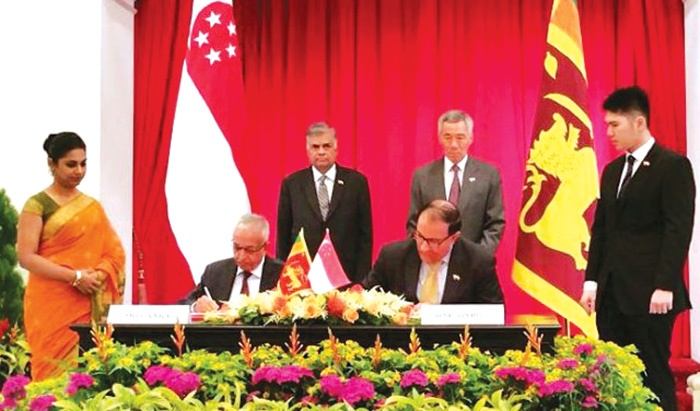
Any Sri Lankan would agree with the above words of President Wickremesinghe on the false promises our politicians and officials make and the fairy tales they narrate which bankrupted this country. So, to understand this, let’s look at one such fairy tale with lots of false promises; Ranil Wickremesinghe’s greatest achievement in the area of international trade and investment promotion during the Yahapalana period, Sri Lanka-Singapore Free Trade Agreement (SLSFTA).
It is appropriate and timely to do it now as Finance Minister Wickremesinghe has just presented to parliament a bill on the National Policy on Economic Transformation which includes the establishment of an Office for International Trade and the Sri Lanka Institute of Economics and International Trade.
Was SLSFTA a “Cleverly negotiated Free Trade Agreement” as stated by the (former) Minister of Development Strategies and International Trade Malik Samarawickrama during the Parliamentary Debate on the SLSFTA in July 2018, or a colossal blunder covered up with lies, false promises, and fairy tales? After SLSFTA was signed there were a number of fairy tales published on this agreement by the Ministry of Development Strategies and International, Institute of Policy Studies, and others.
However, for this article, I would like to limit my comments to the speech by Minister Samarawickrama during the Parliamentary Debate, and the two most important areas in the agreement which were covered up with lies, fairy tales, and false promises, namely: revenue loss for Sri Lanka and Investment from Singapore. On the other important area, “Waste products dumping” I do not want to comment here as I have written extensively on the issue.
1. The revenue loss
During the Parliamentary Debate in July 2018, Minister Samarawickrama stated “…. let me reiterate that this FTA with Singapore has been very cleverly negotiated by us…. The liberalisation programme under this FTA has been carefully designed to have the least impact on domestic industry and revenue collection. We have included all revenue sensitive items in the negative list of items which will not be subject to removal of tariff. Therefore, 97.8% revenue from Customs duty is protected. Our tariff liberalisation will take place over a period of 12-15 years! In fact, the revenue earned through tariffs on goods imported from Singapore last year was Rs. 35 billion.
The revenue loss for over the next 15 years due to the FTA is only Rs. 733 million– which when annualised, on average, is just Rs. 51 million. That is just 0.14% per year! So anyone who claims the Singapore FTA causes revenue loss to the Government cannot do basic arithmetic! Mr. Speaker, in conclusion, I call on my fellow members of this House – don’t mislead the public with baseless criticism that is not grounded in facts. Don’t look at petty politics and use these issues for your own political survival.”
I was surprised to read the minister’s speech because an article published in January 2018 in “The Straits Times“, based on information released by the Singaporean Negotiators stated, “…. With the FTA, tariff savings for Singapore exports are estimated to hit $10 million annually“.
As the annual tariff savings (that is the revenue loss for Sri Lanka) calculated by the Singaporean Negotiators, Singaporean $ 10 million (Sri Lankan rupees 1,200 million in 2018) was way above the rupees’ 733 million revenue loss for 15 years estimated by the Sri Lankan negotiators, it was clear to any observer that one of the parties to the agreement had not done the basic arithmetic!
Six years later, according to a report published by “The Morning” newspaper, speaking at the Committee on Public Finance (COPF) on 7th May 2024, Mr Samarawickrama’s chief trade negotiator K.J. Weerasinghehad had admitted “…. that forecasted revenue loss for the Government of Sri Lanka through the Singapore FTA is Rs. 450 million in 2023 and Rs. 1.3 billion in 2024.”
If these numbers are correct, as tariff liberalisation under the SLSFTA has just started, we will pass Rs 2 billion very soon. Then, the question is how Sri Lanka’s trade negotiators made such a colossal blunder. Didn’t they do their basic arithmetic? If they didn’t know how to do basic arithmetic they should have at least done their basic readings. For example, the headline of the article published in The Straits Times in January 2018 was “Singapore, Sri Lanka sign FTA, annual savings of $10m expected”.
Anyway, as Sri Lanka’s chief negotiator reiterated at the COPF meeting that “…. since 99% of the tariffs in Singapore have zero rates of duty, Sri Lanka has agreed on 80% tariff liberalisation over a period of 15 years while expecting Singapore investments to address the imbalance in trade,” let’s turn towards investment.
Investment from Singapore
In July 2018, speaking during the Parliamentary Debate on the FTA this is what Minister Malik Samarawickrama stated on investment from Singapore, “Already, thanks to this FTA, in just the past two-and-a-half months since the agreement came into effect we have received a proposal from Singapore for investment amounting to $ 14.8 billion in an oil refinery for export of petroleum products. In addition, we have proposals for a steel manufacturing plant for exports ($ 1 billion investment), flour milling plant ($ 50 million), sugar refinery ($ 200 million). This adds up to more than $ 16.05 billion in the pipeline on these projects alone.
And all of these projects will create thousands of more jobs for our people. In principle approval has already been granted by the BOI and the investors are awaiting the release of land the environmental approvals to commence the project.
I request the Opposition and those with vested interests to change their narrow-minded thinking and join us to develop our country. We must always look at what is best for the whole community, not just the few who may oppose. We owe it to our people to courageously take decisions that will change their lives for the better.”
According to the media report I quoted earlier, speaking at the Committee on Public Finance (COPF) Chief Negotiator Weerasinghe has admitted that Sri Lanka was not happy with overall Singapore investments that have come in the past few years in return for the trade liberalisation under the Singapore-Sri Lanka Free Trade Agreement. He has added that between 2021 and 2023 the total investment from Singapore had been around $162 million!
What happened to those projects worth $16 billion negotiated, thanks to the SLSFTA, in just the two-and-a-half months after the agreement came into effect and approved by the BOI? I do not know about the steel manufacturing plant for exports ($ 1 billion investment), flour milling plant ($ 50 million) and sugar refinery ($ 200 million).
However, story of the multibillion-dollar investment in the Petroleum Refinery unfolded in a manner that would qualify it as the best fairy tale with false promises presented by our politicians and the officials, prior to 2019 elections.
Though many Sri Lankans got to know, through the media which repeatedly highlighted a plethora of issues surrounding the project and the questionable credentials of the Singaporean investor, the construction work on the Mirrijiwela Oil Refinery along with the cement factory began on the24th of March 2019 with a bang and Minister Ranil Wickremesinghe and his ministers along with the foreign and local dignitaries laid the foundation stones.
That was few months before the 2019 Presidential elections. Inaugurating the construction work Prime Minister Ranil Wickremesinghe said the projects will create thousands of job opportunities in the area and surrounding districts.
The oil refinery, which was to be built over 200 acres of land, with the capacity to refine 200,000 barrels of crude oil per day, was to generate US$7 billion of exports and create 1,500 direct and 3,000 indirect jobs. The construction of the refinery was to be completed in 44 months. Four years later, in August 2023 the Cabinet of Ministers approved the proposal presented by President Ranil Wickremesinghe to cancel the agreement with the investors of the refinery as the project has not been implemented! Can they explain to the country how much money was wasted to produce that fairy tale?
It is obvious that the President, ministers, and officials had made huge blunders and had deliberately misled the public and the parliament on the revenue loss and potential investment from SLSFTA with fairy tales and false promises.
As the president himself said, a country cannot be developed by making false promises or with fairy tales and these false promises and fairy tales had bankrupted the country. “Unfortunately, many segments of the population have not come to realize this yet”.
(The writer, a specialist and an activist on trade and development issues . )