
Features
Right Thought (Samma Sankappa ) in Buddhism

by Dr. Justice Chandradasa Nanayakkara
Buddhism rests on the pivot of suffering. Lord Buddha declared ‘the world is established on suffering, it is founded on suffering’ (Duke loko patititthhito).
All problems in life bring about suffering (Dukka or unsatisfactoriness) and as we attempt to put an end to them, they give rise to another. Solution of one problem leads to another problem, in many other diverse ways. We are constantly confronted with fresh problems, in our daily life, and problems go on incessantly and interminably. Such is the nature of suffering, and it is the universal characteristic of sentient existence. Suffering can be either physical or psychological. Dukka is inescapable and ubiquitous and it constitutes the first of the four Noble Truths in Buddhism. The Four Noble Truths, which the Buddha himself discovered, and revealed to the world, are the chief characteristics and unshakable foundations of Buddhism.
In the first Noble truth, the Buddha defines the truth of dukka, thus. “What monks, is the Noble Truth of Dukka? Birth is dukka, decay is dukka, death is dukka, sorrow, lamentation, pain, displeasure and despair are dukka; union with the unpleasant dukka, separation from the pleasant dukka, not what one wants is dukka; in brief, the five aggregates of clinging are dukka. These monks, is the Noble Truth of Dukka”.
The solution for the aforesaid problems of dukka (unsatisfactoriness) of life is the Noble Eightfold Path, propounded by Lord Buddha more than 2600 years ago. This is the only way to the cessation of suffering and also a vital step in emancipating ourselves from an interminable cycle of rebirths.
It is said that the Noble Eightfold Path leads to the cessation of dukka. This path consists of a set of eight interconnected factors, or conditions, that when developed together, leads to the cessation of dukka.
The eight factors of the paths are 1. Right Understanding (sammaditthi) 2. Right Thought (sammasankappa) 3. Right Speech (sammavacca). 4. Right Action (sammakammanta) 5. Right Livelihood (sammaajiva) 6. Right Effort, (sammavayama). 7. Right Mindfulness (samma sati) 8. Right concentration (samma samadhi).
These eight factors aim at promoting and perfecting the three essentials of Buddhist training and discipline. For the purpose for coherent and better understanding of, the eight divisions of the path have been grouped according to the under-mentioned three headings.
The first two are classified as Wisdom (panna), the second three as Morality (sila) and the last three as Concentration (samadhi). These three stages in the Eightfold Path are encapsulated in a Buddhist stanza (sabba papassa akaranan – kusalassa upa sammapada – sacitta priyo dapanan – etan buddhanu sasanan). To cease from all evil to cultivate good, in order to purify one’s mind, that is the advice of all Buddhas.
The eight steps of the path are not expected to be realised in sequence, one after the other. Rather, they are considered a unity and an organic whole. They are interdependent and interrelated. All eight factors are preceded by the word “Right” classified as Right, which means perfect. It is a mode of transcendence that leads to sotapanna sakadagami, anâgâmi and arahant. No doubt, it is a difficult feat to be achieved. The Noble Eightfold path is in effect the path to Nibbana. It is a path which avoids the extreme of self-mortification that weakens the intellect and the extreme of self-indulgence that retards moral progress. Although it is generally spoken as a path to be treaded, in actual fact the eight steps signify mental factors to be practised. All eight factors should converge simultaneously, each supporting the other in order to reach a sufficient level of development to experience of sotapanna, sakadagame, anâgâmi or arahant. It is said that the path proceeds from a lower state of purity to higher state and factors of the path should coalesce at a certain level of perfection. Path is not meant to be practiced a little each day.
The Buddha taught the eightfold path in virtually all his discourses, and his directions are clear and practical to his followers, today, as they were when he first disclosed them.
According to Walpola Rahula, the divisions of the Noble Eightfold Path should be developed more or less simultaneously, as far as possible, according to the capacity of each individual. They are linked together and each helps the cultivation of the others.
The second factor of the noble Eight-fold Path, with which this article deals, is called in Pali; samma sankappa, (Right Thought) which is sometimes identified as “Right Intention” in Buddhist literature. In this instance, the word specifically refers to the purposive or conative aspect of mental activity, as the first factor in the Noble Eightfold path (samma ditthi or right understanding) encompasses cognitive aspect of the mental activity. Nevertheless, no clear demarcation can be made between these two divisions because, from the Buddhist perspective, the cognitive and purposive sides of the mind intertwine and interact in close correlation, inducing them into activity. Right Thought is important because it is one’s thoughts which either defile or purify a person. It is one’s thoughts and nature that control one’s destiny. Evil thoughts tend to debase one just as good thought tends to elevate one. Sometimes a single thought can either destroy or save a world. Right Thought serves the dual purpose of eliminating evil thoughts and developing pure thoughts.
Our thoughts are as important to us as our actions because they make up who we are, thus it becomes imperative that we keep thoughts pure.
Buddha, emphasising the value of Right Thought, declared “Your worst enemy cannot harm you as much as your own thoughts, unguarded. But once mastered, no one can help you as much, not even your father or your mother”.
Right Thought (right intention) is threefold. It is comprised of 1. Nekkamma: Renunciation of worldly pleasures, which is opposed to attachment, selfishness and self-possessiveness. 2. Avyapada: Loving Kindness, goodwill, or benevolence which is opposed to hatred, ill will or aversion and 3. Avihimsa: Harmlessness or compassion which is opposed to cruelty and callousness. In a moment of insight, the Buddha, at the time of his enlightment, saw that everything contains all these opposites. He saw the duality in nature and realised that everything can be replaced by the opposite. For instance, each kind of Right Thought counters the corresponding kind of wrong thought or intention, the thought of renunciation (Nekkama) counters the intention of desire, the thought of goodwill counters the intention of ill will and the thought of harmlessness counters the intention of harmfulness.
Buddha declared if one acts and speaks with a pure thought, happiness follows him like a shadow that never leaves him and if he acts or speaks with an impure mind then suffering follows as the hoof of the ox. Right thought means avoiding desire and ill will. The importance of wisdom is evident from this, as the cause of suffering is described in terms of desire, ill will and ignorance. Right understanding removes ignorance and Right thought removes desire and ill will.
Renunciation (Nekkama) is often a difficult task. Grappling with the power of desire and attachment may require a great deal of personal struggle, as the mind does not want to relinquish its hold on the objects to which it has become attached. But that struggle yields many benefits, as putting an end to dukkha depends on eliminating craving thereby directing the mind to renunciation. We develop the inner strength to overcome temptation and compulsion. Attachment coupled with ignorance are the chief causes of all evil prevalent in this deluded world. One can either be attached to desirable objects or is repulsed with aversion if the objects are found to be undesirable. The word “Nekkamma” generally conjures up the idea of leaving your household life for the monastic life by discarding all sensual pleasures completely. But it is not so, as renunciation can apply to lay practice as well. Real renunciation does not require you to give all things inwardly cherished but changing our perspective on them so that they no longer bind us. It is letting go of whatever that binds us to ignorance and suffering. It is only an abandonment of overly material comforts for spiritual enlightment. The degree to which a person renounces depends on his disposition and situation.
It is the attachment or desire that put us on an endless cycle of grasping and keeps us unsatisfied. Therefore, it is important that we maintain an attitude of detachment from worldly pleasures and realise the ephemeral nature of our possessions and to not be selfishly attached to them.
The Buddha says unfulfilled desire is the root cause of unhappiness and dissatisfaction, and the way to overcome such unhappiness is to eliminate the craving or desire by eradicating the root of unwholesome desire through renunciation. The Mind is in the habit of grasping. We have to break this habit and strive to let go of grasping.
When we look realistically at the desire and unhappiness that eventually follows in its wake, it is constantly shadowed by dukkha (unsatisfactoriness). When desire is not fulfilled there is always frustration, disappointment, sometimes despair. Even if the desire is fulfilled it does not a guarantee of happiness and it might not last long and sometimes we lose the object of desire. This is called grasping. When we hang on too hard this becomes a cause of unhappiness. It is important to realize the fulfillment of desire is impermanent, nothing lasts whether it be height of sensual delight, or the achievement of wealth or fame or power. The pursuit of such pleasures brings the pain of separation from the object of desire, which increases in intensity in proportion to the degree of attachment.
Our mental states such as happiness or sadness and consequent actions are determined by our thoughts. The cause for endless suffering, conflict, discontent and injustice does not lie outside the mind. They are all just manifestations of intentions, outcroppings of thoughts propelled by greed, driven by hatred and delusion.
Right thoughts can mean different things and it is essentially directed towards shunning away from the vicious cycle of craving and desire by committing to a life style of self improvement and ethical conduct. The Buddha identified two types of thought: wandering thought(vicara) and logical or directed thought. Normally our mind is filled with scattered, random and wandering thoughts. For instance, when we are asked to perform a task our thoughts are directed towards in a particular direction. Once that task is over our thoughts are directed towards another direction and begin their erratic wandering again. The Buddha making an important observation in this connection and declared “Whatever one thinks about and ponders on often the mind gets a leaning in that way” (M.I)
The Buddha broadly defines Right Thoughts as thoughts of detachment, of love and of helpfulness. Therefore, an important aspect of Buddhist training is to cultivate Right Thought, not to let negative thoughts persist in our mind and to encourage positive thoughts.
Right Thought basically refers to wholesome thoughts, which is closely linked to Right Understanding because it results eventually through the practice and attainment of wisdom.
The first two verses of the first chapter of the Dhammapada by the Buddha would also be relevant in this connection. “All we are is the result of what we have thought. It is founded on our thoughts, it is made up of our thoughts. If a man speaks or acts with a pure thought, happiness follows him like a shadow that never leaves him”.
Avyapada as the second constituent of Right thought literally means non-enmity and corresponds to the most important virtue of Metta. In Sanskrit Maittri is loving kindness or goodwill towards all without any distinction or discrimination. The Pali word Metta also connotes loving kindness, goodwill, benevolence friendliness. A person whose mind is full of loving kindness can harbor no hatred towards anybody just like a mother who makes no difference between herself and her only child and protects it even at the risk of her own life. Metta is the strong wish for the welfare and happiness of others and devoid of self interest. It is indeed a universal, unselfish and all-embracing love. Metta is opposed to hatred, ill will or aversion. A person who radiates metta refuses to be offensive and renounces bitterness, resentment and animosity of every kind. It is a love that has no ulterior motive. Metta does not make a distinction among beings. It embraces all and no one falls outside of its domain. Ill will is countered by Metta. The kind of love implied by Metta should be distinguished from sensual love and also from the love involved in personal affection.
The third and the last of the three constituents of Right Thought is Avihimsa or Karuna. It is guided by compassion (Karuna) which is opposed to cruelty, aggressiveness and violent thoughts. Like Buddhist Mettta, Karuna too is limitless and boundless. Karuna (compassion) is a virtue which makes the tender hearts of the noble quiver at the sufferings of others. The characteristics of Karuna are comparable to that of loving mother whose thoughts, words and deeds always tend to relieve the distress of her ailing son. (Narada). Karuna complements loving kindness (Metta). While loving kindness has the quality of wishing for the happiness and the wellbeing others, Karuna (compassion) has the quality of wishing that others be free from suffering. Bhikkhu Bodhi describing the thought of harmlessness (avihimsa) in the context of Right Thought states “The intention of harmlessness is thought guided by compassion (Karuna) aroused in opposition to cruel, aggressive, and violent Thoughts. Compassion supplies the complement to loving kindness. Whereas loving loving kindness as the characteristic of wishing for happiness and welfare of others, compassion has the characteristic of wishing that others be free from suffering, a wish to be extended without limits to all living beings. Like Metta, compassion arises by entering into the subjectivity of others, by sharing their interioty in a deep and total way. It springs up by considering that all beings, like ourselves, wish to be free from suffering, yet despite their wishes continue to be harassed by pain, fear sorrow and other forms dukkha.



by Dr Gotabhya Ranasinghe
Senior Consultant Cardiologist
National Hospital Sri Lanka
When we sought a meeting with Hon Dr. Ramesh Pathirana, Minister of Health, he graciously cleared his busy schedule to accommodate us. Renowned for his attentive listening and deep understanding, Minister Pathirana is dedicated to advancing the health sector. His openness and transparency exemplify the qualities of an exemplary politician and minister.
Dr. Palitha Mahipala, the current Health Secretary, demonstrates both commendable enthusiasm and unwavering support. This combination of attributes makes him a highly compatible colleague for the esteemed Minister of Health.
Our discussion centered on a project that has been in the works for the past 30 years, one that no other minister had managed to advance.
Minister Pathirana, however, recognized the project’s significance and its potential to revolutionize care for heart patients.
The project involves the construction of a state-of-the-art facility at the premises of the National Hospital Colombo. The project’s location within the premises of the National Hospital underscores its importance and relevance to the healthcare infrastructure of the nation.
This facility will include a cardiology building and a tertiary care center, equipped with the latest technology to handle and treat all types of heart-related conditions and surgeries.
Securing funding was a major milestone for this initiative. Minister Pathirana successfully obtained approval for a $40 billion loan from the Asian Development Bank. With the funding in place, the foundation stone is scheduled to be laid in September this year, and construction will begin in January 2025.
This project guarantees a consistent and uninterrupted supply of stents and related medications for heart patients. As a result, patients will have timely access to essential medical supplies during their treatment and recovery. By securing these critical resources, the project aims to enhance patient outcomes, minimize treatment delays, and maintain the highest standards of cardiac care.
Upon its fruition, this monumental building will serve as a beacon of hope and healing, symbolizing the unwavering dedication to improving patient outcomes and fostering a healthier society.We anticipate a future marked by significant progress and positive outcomes in Sri Lanka’s cardiovascular treatment landscape within the foreseeable timeframe.

by Fr. Emmanuel Fernando, OMI
Jesuit Fr. Aloysius Pieris (affectionately called Fr. Aloy) celebrated his 90th birthday on April 9, 2024 and I, as the editor of our Oblate Journal, THE MISSIONARY OBLATE had gone to press by that time. Immediately I decided to publish an article, appreciating the untiring selfless services he continues to offer for inter-Faith dialogue, the renewal of the Catholic Church, his concern for the poor and the suffering Sri Lankan masses and to me, the present writer.
It was in 1988, when I was appointed Director of the Oblate Scholastics at Ampitiya by the then Oblate Provincial Fr. Anselm Silva, that I came to know Fr. Aloy more closely. Knowing well his expertise in matters spiritual, theological, Indological and pastoral, and with the collaborative spirit of my companion-formators, our Oblate Scholastics were sent to Tulana, the Research and Encounter Centre, Kelaniya, of which he is the Founder-Director, for ‘exposure-programmes’ on matters spiritual, biblical, theological and pastoral. Some of these dimensions according to my view and that of my companion-formators, were not available at the National Seminary, Ampitiya.
Ever since that time, our Oblate formators/ accompaniers at the Oblate Scholasticate, Ampitiya , have continued to send our Oblate Scholastics to Tulana Centre for deepening their insights and convictions regarding matters needed to serve the people in today’s context. Fr. Aloy also had tried very enthusiastically with the Oblate team headed by Frs. Oswald Firth and Clement Waidyasekara to begin a Theologate, directed by the Religious Congregations in Sri Lanka, for the contextual formation/ accompaniment of their members. It should very well be a desired goal of the Leaders / Provincials of the Religious Congregations.
Besides being a formator/accompanier at the Oblate Scholasticate, I was entrusted also with the task of editing and publishing our Oblate journal, ‘The Missionary Oblate’. To maintain the quality of the journal I continue to depend on Fr. Aloy for his thought-provoking and stimulating articles on Biblical Spirituality, Biblical Theology and Ecclesiology. I am very grateful to him for his generous assistance. Of late, his writings on renewal of the Church, initiated by Pope St. John XX111 and continued by Pope Francis through the Synodal path, published in our Oblate journal, enable our readers to focus their attention also on the needed renewal in the Catholic Church in Sri Lanka. Fr. Aloy appreciated very much the Synodal path adopted by the Jesuit Pope Francis for the renewal of the Church, rooted very much on prayerful discernment. In my Religious and presbyteral life, Fr.Aloy continues to be my spiritual animator / guide and ongoing formator / acccompanier.
Fr. Aloysius Pieris, BA Hons (Lond), LPh (SHC, India), STL (PFT, Naples), PhD (SLU/VC), ThD (Tilburg), D.Ltt (KU), has been one of the eminent Asian theologians well recognized internationally and one who has lectured and held visiting chairs in many universities both in the West and in the East. Many members of Religious Congregations from Asian countries have benefited from his lectures and guidance in the East Asian Pastoral Institute (EAPI) in Manila, Philippines. He had been a Theologian consulted by the Federation of Asian Bishops’ Conferences for many years. During his professorship at the Gregorian University in Rome, he was called to be a member of a special group of advisers on other religions consulted by Pope Paul VI.
Fr. Aloy is the author of more than 30 books and well over 500 Research Papers. Some of his books and articles have been translated and published in several countries. Among those books, one can find the following: 1) The Genesis of an Asian Theology of Liberation (An Autobiographical Excursus on the Art of Theologising in Asia, 2) An Asian Theology of Liberation, 3) Providential Timeliness of Vatican 11 (a long-overdue halt to a scandalous millennium, 4) Give Vatican 11 a chance, 5) Leadership in the Church, 6) Relishing our faith in working for justice (Themes for study and discussion), 7) A Message meant mainly, not exclusively for Jesuits (Background information necessary for helping Francis renew the Church), 8) Lent in Lanka (Reflections and Resolutions, 9) Love meets wisdom (A Christian Experience of Buddhism, 10) Fire and Water 11) God’s Reign for God’s poor, 12) Our Unhiddden Agenda (How we Jesuits work, pray and form our men). He is also the Editor of two journals, Vagdevi, Journal of Religious Reflection and Dialogue, New Series.
Fr. Aloy has a BA in Pali and Sanskrit from the University of London and a Ph.D in Buddhist Philosophy from the University of Sri Lankan, Vidyodaya Campus. On Nov. 23, 2019, he was awarded the prestigious honorary Doctorate of Literature (D.Litt) by the Chancellor of the University of Kelaniya, the Most Venerable Welamitiyawe Dharmakirthi Sri Kusala Dhamma Thera.
Fr. Aloy continues to be a promoter of Gospel values and virtues. Justice as a constitutive dimension of love and social concern for the downtrodden masses are very much noted in his life and work. He had very much appreciated the commitment of the late Fr. Joseph (Joe) Fernando, the National Director of the Social and Economic Centre (SEDEC) for the poor.
In Sri Lanka, a few religious Congregations – the Good Shepherd Sisters, the Christian Brothers, the Marist Brothers and the Oblates – have invited him to animate their members especially during their Provincial Congresses, Chapters and International Conferences. The mainline Christian Churches also have sought his advice and followed his seminars. I, for one, regret very much, that the Sri Lankan authorities of the Catholic Church –today’s Hierarchy—- have not sought Fr.
Aloy’s expertise for the renewal of the Catholic Church in Sri Lanka and thus have not benefited from the immense store of wisdom and insight that he can offer to our local Church while the Sri Lankan bishops who governed the Catholic church in the immediate aftermath of the Second Vatican Council (Edmund Fernando OMI, Anthony de Saram, Leo Nanayakkara OSB, Frank Marcus Fernando, Paul Perera,) visited him and consulted him on many matters. Among the Tamil Bishops, Bishop Rayappu Joseph was keeping close contact with him and Bishop J. Deogupillai hosted him and his team visiting him after the horrible Black July massacre of Tamils.
Sri Lanka-Singapore Free Trade Agreement
By Gomi Senadhira
senadhiragomi@gmail.com
“You might tell fairy tales, but the progress of a country cannot be achieved through such narratives. A country cannot be developed by making false promises. The country moved backward because of the electoral promises made by political parties throughout time. We have witnessed that the ultimate result of this is the country becoming bankrupt. Unfortunately, many segments of the population have not come to realize this yet.” – President Ranil Wickremesinghe, 2024 Budget speech
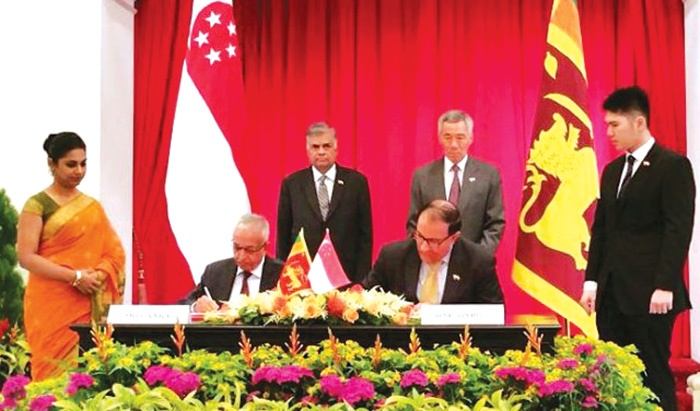
Any Sri Lankan would agree with the above words of President Wickremesinghe on the false promises our politicians and officials make and the fairy tales they narrate which bankrupted this country. So, to understand this, let’s look at one such fairy tale with lots of false promises; Ranil Wickremesinghe’s greatest achievement in the area of international trade and investment promotion during the Yahapalana period, Sri Lanka-Singapore Free Trade Agreement (SLSFTA).
It is appropriate and timely to do it now as Finance Minister Wickremesinghe has just presented to parliament a bill on the National Policy on Economic Transformation which includes the establishment of an Office for International Trade and the Sri Lanka Institute of Economics and International Trade.
Was SLSFTA a “Cleverly negotiated Free Trade Agreement” as stated by the (former) Minister of Development Strategies and International Trade Malik Samarawickrama during the Parliamentary Debate on the SLSFTA in July 2018, or a colossal blunder covered up with lies, false promises, and fairy tales? After SLSFTA was signed there were a number of fairy tales published on this agreement by the Ministry of Development Strategies and International, Institute of Policy Studies, and others.
However, for this article, I would like to limit my comments to the speech by Minister Samarawickrama during the Parliamentary Debate, and the two most important areas in the agreement which were covered up with lies, fairy tales, and false promises, namely: revenue loss for Sri Lanka and Investment from Singapore. On the other important area, “Waste products dumping” I do not want to comment here as I have written extensively on the issue.
1. The revenue loss
During the Parliamentary Debate in July 2018, Minister Samarawickrama stated “…. let me reiterate that this FTA with Singapore has been very cleverly negotiated by us…. The liberalisation programme under this FTA has been carefully designed to have the least impact on domestic industry and revenue collection. We have included all revenue sensitive items in the negative list of items which will not be subject to removal of tariff. Therefore, 97.8% revenue from Customs duty is protected. Our tariff liberalisation will take place over a period of 12-15 years! In fact, the revenue earned through tariffs on goods imported from Singapore last year was Rs. 35 billion.
The revenue loss for over the next 15 years due to the FTA is only Rs. 733 million– which when annualised, on average, is just Rs. 51 million. That is just 0.14% per year! So anyone who claims the Singapore FTA causes revenue loss to the Government cannot do basic arithmetic! Mr. Speaker, in conclusion, I call on my fellow members of this House – don’t mislead the public with baseless criticism that is not grounded in facts. Don’t look at petty politics and use these issues for your own political survival.”
I was surprised to read the minister’s speech because an article published in January 2018 in “The Straits Times“, based on information released by the Singaporean Negotiators stated, “…. With the FTA, tariff savings for Singapore exports are estimated to hit $10 million annually“.
As the annual tariff savings (that is the revenue loss for Sri Lanka) calculated by the Singaporean Negotiators, Singaporean $ 10 million (Sri Lankan rupees 1,200 million in 2018) was way above the rupees’ 733 million revenue loss for 15 years estimated by the Sri Lankan negotiators, it was clear to any observer that one of the parties to the agreement had not done the basic arithmetic!
Six years later, according to a report published by “The Morning” newspaper, speaking at the Committee on Public Finance (COPF) on 7th May 2024, Mr Samarawickrama’s chief trade negotiator K.J. Weerasinghehad had admitted “…. that forecasted revenue loss for the Government of Sri Lanka through the Singapore FTA is Rs. 450 million in 2023 and Rs. 1.3 billion in 2024.”
If these numbers are correct, as tariff liberalisation under the SLSFTA has just started, we will pass Rs 2 billion very soon. Then, the question is how Sri Lanka’s trade negotiators made such a colossal blunder. Didn’t they do their basic arithmetic? If they didn’t know how to do basic arithmetic they should have at least done their basic readings. For example, the headline of the article published in The Straits Times in January 2018 was “Singapore, Sri Lanka sign FTA, annual savings of $10m expected”.
Anyway, as Sri Lanka’s chief negotiator reiterated at the COPF meeting that “…. since 99% of the tariffs in Singapore have zero rates of duty, Sri Lanka has agreed on 80% tariff liberalisation over a period of 15 years while expecting Singapore investments to address the imbalance in trade,” let’s turn towards investment.
Investment from Singapore
In July 2018, speaking during the Parliamentary Debate on the FTA this is what Minister Malik Samarawickrama stated on investment from Singapore, “Already, thanks to this FTA, in just the past two-and-a-half months since the agreement came into effect we have received a proposal from Singapore for investment amounting to $ 14.8 billion in an oil refinery for export of petroleum products. In addition, we have proposals for a steel manufacturing plant for exports ($ 1 billion investment), flour milling plant ($ 50 million), sugar refinery ($ 200 million). This adds up to more than $ 16.05 billion in the pipeline on these projects alone.
And all of these projects will create thousands of more jobs for our people. In principle approval has already been granted by the BOI and the investors are awaiting the release of land the environmental approvals to commence the project.
I request the Opposition and those with vested interests to change their narrow-minded thinking and join us to develop our country. We must always look at what is best for the whole community, not just the few who may oppose. We owe it to our people to courageously take decisions that will change their lives for the better.”
According to the media report I quoted earlier, speaking at the Committee on Public Finance (COPF) Chief Negotiator Weerasinghe has admitted that Sri Lanka was not happy with overall Singapore investments that have come in the past few years in return for the trade liberalisation under the Singapore-Sri Lanka Free Trade Agreement. He has added that between 2021 and 2023 the total investment from Singapore had been around $162 million!
What happened to those projects worth $16 billion negotiated, thanks to the SLSFTA, in just the two-and-a-half months after the agreement came into effect and approved by the BOI? I do not know about the steel manufacturing plant for exports ($ 1 billion investment), flour milling plant ($ 50 million) and sugar refinery ($ 200 million).
However, story of the multibillion-dollar investment in the Petroleum Refinery unfolded in a manner that would qualify it as the best fairy tale with false promises presented by our politicians and the officials, prior to 2019 elections.
Though many Sri Lankans got to know, through the media which repeatedly highlighted a plethora of issues surrounding the project and the questionable credentials of the Singaporean investor, the construction work on the Mirrijiwela Oil Refinery along with the cement factory began on the24th of March 2019 with a bang and Minister Ranil Wickremesinghe and his ministers along with the foreign and local dignitaries laid the foundation stones.
That was few months before the 2019 Presidential elections. Inaugurating the construction work Prime Minister Ranil Wickremesinghe said the projects will create thousands of job opportunities in the area and surrounding districts.
The oil refinery, which was to be built over 200 acres of land, with the capacity to refine 200,000 barrels of crude oil per day, was to generate US$7 billion of exports and create 1,500 direct and 3,000 indirect jobs. The construction of the refinery was to be completed in 44 months. Four years later, in August 2023 the Cabinet of Ministers approved the proposal presented by President Ranil Wickremesinghe to cancel the agreement with the investors of the refinery as the project has not been implemented! Can they explain to the country how much money was wasted to produce that fairy tale?
It is obvious that the President, ministers, and officials had made huge blunders and had deliberately misled the public and the parliament on the revenue loss and potential investment from SLSFTA with fairy tales and false promises.
As the president himself said, a country cannot be developed by making false promises or with fairy tales and these false promises and fairy tales had bankrupted the country. “Unfortunately, many segments of the population have not come to realize this yet”.
(The writer, a specialist and an activist on trade and development issues . )



US sports envoys to Lanka to champion youth development

Rahuman questions sudden cancellation of leave of CEB employees


