Features
Reflecting on Swineetha Weerasinghe

By Uditha Devapriya
One of the clearest memories I have of Welikathara is Gamini Fonseka lavishing his love and later his anger on his wife. Welikathara is the closest to a Hollywood thriller (in the classic mould) ever made in Sri Lanka, and this aspect comes through even in its depiction of the romance between the two leads. By then Fonseka had established himself as more than just a primus inter pares of the Sinhalese cinema: he had become its king. Cast opposite him, the equally great Joe Abeywickrema, along with all other cast members, could only quail before Fonseka. That was why Abeywickrema’s Goring Mudalali had to go off like a dog at the end: because no other fate would have done for anyone playing Fonseka’s foil.
There is, however, one sequence where Fonseka’s supremacy is put into question. It comes towards the end, right after Goring Mudalali makes his big revelation about Fonseka’s past. Confronted with the fact of her husband’s infidelities, his wife taunts him, asking him why he is so afraid of Goring and why he doesn’t do anything about him. Ever gentle to his wife, he refuses to say anything. This only aggravates the situation, sparking off a fuse: in an ever rising crescendo, his wife goes on to ridicule him, reminding him of the difficulties of their marriage. She then questions his manhood. That hits him badly: getting up from his bed in a fit of anger, he slaps her harshly, then dons his police uniform to go after Goring.
Cutting between close-ups of Gamini Fonseka’s and the wife’s face, the sequence plays out beautifully: it reminds you of the café sequence in Juan Bardem’s Death of a Cyclist, where the characters’ faces betray unspoken and desperate dreams and desires. In Welikathara Nihalsinghe gives us the most Americanised film to hit Sri Lankan theatres; the dialogues, written by the great Tissa Abeysekara, take you back to the films of Billy Wilder. The first encounter between Goring and the wife, and the later confrontation with Fonseka, unveil with so much tension that we feel tense watching them ourselves. Much of that has to do with the acting of its three leads. And in her encounters with the two male leads, Swineetha Weerasinghe winds up with one of the finest performances in her career.


Swineetha Weerasinghe is an enigma, an ineffable mystery. She hasn’t been in too many films. By the standard which one may use on, say, a Malini Fonseka or a Sandya Kumari, her career hasn’t been prodigious. She herself has told me that she has been selective, that she has been careful about the scripts that came her way. Perhaps. But this is just half the story. Swineetha’s life, as with her career, has certainly been colourful. I doubt she’s failed to get the recognition she deserves. Yet seeing the plaudits lavished on her peers, that recognition came rather belatedly. It came around the time I first met her, in 2014, the year she opened her life and story to writers, just before she got featured in the only programme which could have done justice to someone like her, Rupavahini’s Alakamandawa.
Swineetha hailed from a middle-class Sinhala Buddhist family. Her father, a retired Army gunman, and her mother had both hailed from Dehiwela. She was raised there, educated initially at Buddhist Girls’ College in Mount Lavinia and later at the Dehiwela Madya Maha Vidyalaya. “I liked singing and dancing,” she told me, when I asked her whether she “took to the arts” at that age. She had also played netball and had been an avid athlete, managing to complete all three stages of Kandyan dancing while at school. Yet she refuses to believe that these had a large say in her career: “I never considered any of these seriously, certainly not as my career.” She felt her vocation lay elsewhere: in medicine.
With this in mind, she eventually enrolled for a four-year course at the Indigenous Medical College. Three years into that course, however, Swineetha came across an advertisement in a newspaper. “It was for an upcoming film, and it called for aspiring actresses. Acting never figured in my scheme of things, but I decided to take a shot at it.” In my interview she noted and emphasised that last point rather strongly: “Making it out at the movies may have been at the back of my mind, but I never considered it more than a passing interest.” Her parents, for their part, had mixed feelings: her mother objected to the idea, but her less conservative father managed to convince her that it was in their daughter’s best interests.
The interview was a success; she was selected. Thereafter she met her first figure of destiny. “Robin Tampoe cast me in three of his films: Sudu Sande Kalu Wala in 1963, Samajaye Api Okkoma Ekayi in 1964, and Sudo Sudu in 1965.” Emblematic of the popular middle cinema of their time, these three films hit it big at the box-office; Sudo Sudu in particular, based on the Sagara Palansuriya poem, in itself based on the Enoch Arden legend that the Jayamanne brothers and Rukmani Devi transposed in Kadawunu Poronduwa years before, revealed and brought out Swineetha’s talents to the world. She quickly set about proving her versatility: as she implied to me, her overarching desire was to show that she could play different types of characters and to show that she didn’t want to be pigeonholed and typecast.
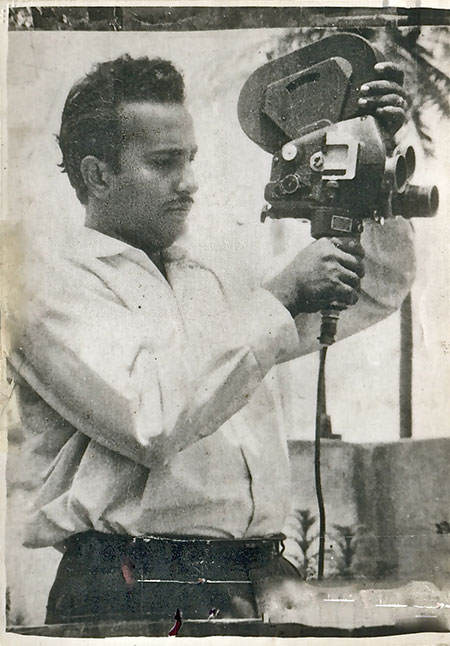

It was at this juncture that she met her second figure of destiny. “At the time I was working at RT Studios. Sudo Sudu was playing in every hall. At one screening I was approached by a gentle, unassuming man, who said he wanted me for his film. By then I had grown tired of playing damsels in distress. He told me that his film would be completely different, in mood and in tenor. There would be no boys chasing after girls, no good guy versus bad guy fights, and certainly no melodrama. It would be more intellectual and sophisticated. I realised that the opportunity was worth taking, and that I had to take it. So I took it.”
That gentle, unassuming man was Lester James Peries, and the film, of course, was Delovak Athara, the most exciting and least conventional Sinhala film to come out by that point. The critic Philip Cooray has called it Peries’s most intellectual work. This is an understatement. In the film’s two-hour duration there’s not a scene or a sequence where we involve ourselves in or identify ourselves with the characters, emotionally. True to Lester’s words, it was to be an intellectual and sophisticated work. And having cast an up-and-coming actress in the role of the protagonist’s university friend, he ensured a decent popular audience for the movie, while providing that actress an opportunity to diversify her career.
Delovak Athara got Swineetha to think more seriously about the cinema. “I read books. I watched films. My favourite actresses back then were people like Glenda Jackson, Geraldine Chaplin, and Rita Tushingham. They innovated on the kind of performances that had been associated with women for a long, long time. Needless to say, they inspired me to push my frontiers, to challenge myself, to take on more challenging roles.” Which is what eventually happened: from Lester Peries she would move on to D. B. Nihalsinghe (Welikathara), H. D. Premaratne (Sikuruliya), and W. A. B. de Silva (Hulavali).
These roles and films took her places, literally. “Welikathara took me to Tashkent. I met Simi Garewal, Sunil Dutt, Nargis, and Shabana Azmi there.” From Tashkent to the Krakow Film Festival in Poland, and from there to Germany and Czechoslovakia, Suwineetha felt awed at seeing Europe’s movie studios and industries. “We were obviously miles behind them, but that didn’t mean we couldn’t catch up with them.” Hulavali took her to a different kind of world: the 1976 Tehran Film Festival in Iran, where she met, among others, the Shah of Iran and Rita Tushingham, and on his last day before departure, Satyajit Ray.
When television arrived in the 1980s, Swineetha poured out her talents there also, from Dharmasena Pathiraja’s adaptation of Chekhov’s “The Lady with the Little Dog” to H. D. Premaratne’s Sandun Gira Gini Ganee. Her other film credits include Mille Soya. For a long time after Ira Handa Yata in 2010, some felt that she had retired. She put an end to such rumours with her comeback in Bandanaya, in 2017. Directed by Udayakantha Warnasuriya, Bandanaya is, essentially, The Exorcist set in some southern village in Sri Lanka. Casting has usually been one of Warnasuriya’s stronger points, and in Bandanaya he manages to secure convincing performances from Swineetha and her coplayers.
Glancing through her credits and her performances, I realise just how versatile Swineetha has been. After playing the gentle but morally grounded woman in Delovak Athara and the frustrated wife in Welikathara, Swineetha gave arguably the best performance in her life in Sikuruliya, where, as she told me very convincingly, she plays not one woman, but three. It’s a sad and sordid testament to such talents that they have not been accorded the place they deserve in the pantheon of our cinema. I remain optimistic, however: as we wrapped up our interview, she seemed optimistic too. One thing is certain, though: she’s always been one of our more avid actresses. She’s taken her job seriously. And profited by it, too.
The writer is an international relations analyst, researcher, and columnist who can be reached at udakdev1@gmail.com