Features
Realities of Taxation and Significance of Tax Planning in individual Wealth Creation

By Chandu Epitawala
There is much discussion in Sri Lanka since the last Budget about increases in taxation and its impact on individuals (especially the middle class). There’s even some suggestion of a brain drain of skilled professionals looking for greener pastures resulting from that. Since all my previous Notes explored ways of improving the individual financial situation through personal financial management, investments, retirement planning etc., I thought it opportune to explore (in this Note 6) the issue of taxation on long-term, individual Wealth creation.
As the income level of an individual increase over time, the issue of taxation and tax planning becomes critically important. In fact, it’s so important many relocate from one tax jurisdiction to another to avoid paying (not evading taxes which is illegal) excessive taxes or to simply reduce their tax liability (and increase their savings). As far as SL migrants to the West are concerned, people are migrating from a relatively low tax regime (admittedly with poor public infrastructure and services) to a high tax (high cost) environment!!! If one is migrating (maybe for a limited time period) to tax-free (or very low) Dubai or a similar country/jurisdiction or migrating for reasons other than economic (political, security etc.) reasons, however, a case or justification can be made.
To give some macro background and context to the discussion on Taxation, Taxes in any country is generally applied or imposed by governments mainly in three broad areas of economic activity.
Income – Corporate or Individual – is the fairest way to collect taxes but is often difficult for governments in the developing world as the institutions and systems are weak and inefficient Consumption – Sales taxes, VAT, Customs/Import Duty etc. – easier for governments to collect as there is little room for consumers to avoid but regressive in nature (unfair on the lower income groups) as it’s not linked to the income. Unfortunately, the bulk of GoSL revenue is derived from this tax category.
Wealth – Mainly Capital Gains Taxes (CGT), Inheritance Taxes, Property Taxes
At the Macro level, it’s also essential to keep in mind that, other than in oil-rich countries, all other governments rely on taxation to provide good/high-quality infrastructure and public services. Some countries like Denmark annually collect as high as 45% of its GDP in Taxes while SL collects only 8%!!! OECD average is 33%. Tax collection in most other middle-income countries is in the 20s. So unless a country has oil wealth/revenue, high-quality public infrastructure and services (seen in the West) come at a price often hidden or disguised (i.e. Consumption Taxation). As they say, there is no free lunch.
Also, if you examine the case in Sri Lanka vis-a- vis the rest of the World, 80% of government revenue is raised from easy to collect consumption related taxes and wealth related taxes are very low or non-existent. So many consumer items (especially the imported ones) ranging from F&B items to vehicles are expensive/out of reach for locals earning in rupees. Many individuals/businesses who should be paying income tax escape paying their fair share of taxes because the government is unable to capture them in the tax net. It’s a well-known fact that there are less than a million income tax payers in the country (of 21 Mn). It is also well known that many high-income earners in the country, from businessmen to professionals such as tuition masters, doctors, lawyers etc., pay no (not in the tax net at all) or very little income tax.
So I would strongly argue that the government should rationalize tax collection efforts by reducing consumption-related taxes and increasing the income-related tax net or tax base and take a serious re- look at wealth related taxes, especially property taxes and capital gains tax, to create a fairer society and bring SL on par or closer with other countries in Asia and the world. The natural question for the GoSL is to ask, ” if someone is not in the tax net, where would that person/entity park/invest those extra funds?” The answer is often in real estate (land, apartments etc.) and jewellery, stocks etc., to a lesser extent. So, it makes sense to tax property (worth over Rs. 30 Mn or so) at a higher rate.
Let us look at or compare some taxes or tax rates in SL with other countries around the world to put things in perspective from the taxpayers’ or Individual citizens’ perspective. Remember, the principle of taxation is generally based on the “Residence” of the individual. If an individual resides in a country for more than 182 days in a tax year/calendar year, that individual comes under the tax jurisdiction of that location (In the case of an entity or corporate body where it’s incorporated). Also, tax avoidance (using loopholes, exemptions etc.) is legal, and tax evasion (not declaring all your income to the tax authority) is illegal in many jurisdictions, even a criminal offence in some countries.
To do a meaningful comparison among various countries, one has to consider different cost structures or Purchasing Power Parity (PPP) among countries. Roughly speaking, earnings of $1000 a month in Colombo can be compared to earnings of $3000/month in Dubai and approximately $ 4000/month in Melbourne or London. Exceptions to the rule do exist; such as even with high taxes and other cost of living conditions, it would be easier or affordable to have a decent vehicle in most countries other than in SL due to high import taxes on vehicles (which is admittedly an aspiration of many middle-class Lankans). On the other hand, in SL, it would be more affordable to have domestic help (i.e. nanny, cook, gardner, cleaner, driver etc.) than in those countries. I doubt those eager to migrate from SL to greener pastures of the developed world/West (mostly English-speaking western countries) take taxes in those countries into account when they decide to migrate.
Also, in a digital world where many jobs can be done remotely or online, and incomes can be derived from multiple sources and in multiple currencies, it is advisable to be in a low-tax jurisdiction (not to mention a low-cost location) which in turn help build wealth in the long run. Despite the recent tax increases in SL, I would argue that income tax in SL is still not high ($1000/Rs.350,000 monthly income is effectively taxed at 15% or Rs.52,000) compared to many developed countries (destinations for most SL migrants) and things like Property Taxes (Municipality Rates in SL) are still extremely low as they are not calculated on the market price of property including land value (in SL only the house or building is considered) like in most other countries.
Let us now consider some differences in taxes and their impact on Individual incomes, expenses, lifestyles and wealth using real-life examples and figures given below.If one earns $100,000 in London or Dubai, the person who lives in Dubai is $38,000 better off every year (than in the UK due to taxes), and over 10 years, this can translate into $500,000 extra accumulated savings (without counting the returns from investments etc.).
About six months ago, at the height of oil prices ($120 a barrel in the global market), the UK was selling a 95 Octane Liter at Sterling 2/Liter, and SL was selling the same product at Sterling 1/Liter (Rs.450/-). What do you reckon the difference is? Largely due to consumption taxes in the UK. A similar result if one considered a pint of beer (or most other consumer items) at a pub/mall in the UK and SL.

I have a friend in LA who pays $3,000 a month ($36,000/year) in Property Taxes on his $ 2mn property (garbage collection is an additional fee!!). This roughly works out to 1.7% of Property Tax (in most countries, Property Tax ranges between 0.3% to 2.5%) on the market value of the property every year. Some countries have a lower rate for inherited property or the primary property one lives in and a higher rate for any additional or Investment properties. Many other examples from all over the world can be given. I challenge the reader (who happens to own Property) in SL to calculate his Municipality rates as a percentage of the current market value of his/her property (including the land) and compare it with the above % range. An apartment in Colombo City which is worth Rs.100 Mn today, is paying only about Rs. 40,000 a year or 0.04% in Municipality Rates. In my case (an old, renovated House), it is only about 0.002% annually!!!!
Elon Musk (of Tesla, Twitter etc.) made some $ 11 bn in Capital Gains last year from selling Tesla shares while still a resident of California. The CGT on that was 50%!!! (37% Federal CGT and 13% CA State CGT). In the Colombo Stock Market, a similar transaction generating even billions of Rupees in Capital Gains for an Investor will attract zero CGT from the GoSL!!! By the way Mr Musk has since moved to Texas, where the State CGT is zero.
NHS Consultant Doctor in the UK who earns Sterling 150K to 170K a year pays upwards of 40% in Income Taxes, not to mention the high indirect Consumption/Sales Taxes, Property Taxes etc., as demonstrated above. A similar situation exists in any other developed country like Australia or Canada. You can ask a doctor/lawyer friend of yours in SL who has a successful private practice how much (%) of the actual earnings they pay in taxes. Or simply look at their lifestyles, and you might get the answer.
In Japan, Inheritance Taxes can go as high as 60% of the Wealth transferred to the next generation. In UK, it can range from 20-40%. SL has no such thing as Inheritance Tax (it was abolished in the 80s).
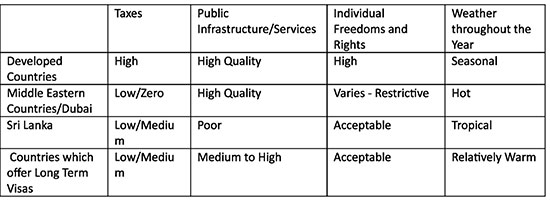
These are some of the real-life, actual examples that came to my mind. The big difference lies in income related taxes (poor/narrow tax base as well as lower rates), Capital Gains Tax and Property Taxes. Compare/contrast any number of jurisdictions or compare the SL situation with Dubai and a developed country such as the US, UK or Australia (favourite destinations for SL migrants) to highlight the impact of taxes on the standard of living as well as what one can potentially save/invest in building long term wealth. Artificial Intelligence-assisted ChatGPT will quickly do a better job in comparing these figures and rates. The following matrix will give a quick evaluation of the pros and cons of each location.
In conclusion/summary, the general thrust of my argument is as follows;
At a macro level (from the GoSL perspective) application of taxation principles and efficiency of Income Tax collection in SL needs a radical rethink and overhaul to increase the overall tax collection from the current 8% of GDP to at least 18% without hurting the lower and middle income/wealth groups. This should be done by shifting the tax focus from consumption based taxation to wealth based taxation and widening the Income Tax base so that no one (especially in the high-income groups) escapes the income tax net. Public trust in the government (with responsible handling/spending of tax money) must be restored.
Taxes in SL are significantly lower than in developed countries, but a place like Dubai, where there are few or no taxes but high-quality public infrastructure and services, offer the best of both worlds or takes the top spot.
There is a noticeable and growing global trend where many individuals (including many retirees) in high-cost/high taxes Countries seek to relocate to other low-cost, low taxes countries/locations such as Portugal, Indonesia, Thailand, Peurto Rico, Panama, Mexico etc. etc. (many of these countries now offer long term Visa schemes) precisely to enjoy a better quality of life/standard of living while enjoying warmer weather/beaches etc. The emerging Digital Economy and the opportunities it represents make such movements (for individuals with the right skills) and aspirations increasingly achievable (many countries now offer digital nomad visa schemes, even permanent residency visas etc.). For Sri Lanka as a country, this trend may be an opportunity to counter or somewhat reverse/mitigate the effects of the brain drain that is taking place.
Sri Lankans understandably migrating to the West (Australia, Canada, EU, UK, USA etc.) hoping for a better life or better standard of living may often be entertaining a misplaced dream. Working 10-20 years in the tax-free Middle East may be a far better option. If one pays attention to legally avoiding (not evading) high taxes/tax liability and opportunities they present to increase one’s savings over time and direct those savings to Investments with decent returns (i.e. create wealth), one can look forward to a comfortable and early retirement in any number of places (or in your home country/country of your birth where you are a first-class citizen) that offer residence to individuals with some accumulated wealth.