Life style
Rare Napier in Ceylon

1924 NAPIER 40/50 H.P. LIMOUSINE BY CUNARD, C-5579 – Ali Azeez –
My nephew Mr. Ali Azeez, who is a vintage car enthusiast, asked me to write what I know about the Napier car that my father (Mr. M.A.M. Hussein) owned from the mid-1920s until the end of World War II, in the mid-1940s.
My father had seen this car in a London motor car showroom. He told me that the agent had told him that the car had originally been built by the Napier Company for the King of Siam, and that it had been made specially for use in the tropics. It so happened that a French motor company which made the Delahaye car had successfully tempted the King to abandon the Napier for the Delahaye which they wanted him to buy. In the result, the Napier Company had to look for another buyer.
Those were days when royalty still retained some of the glamour that now surrounds famous pop stars and sportsmen. Further, the makers of luxury goods were vying with each other for the custom of a privileged few. Mass production was still to come.
When my father succumbed to the persuasion of the seller, he still had to find the money for the purchase. He had an indulgent father of means who solved that problem for him; in fact, my father in casual conversation told me that the cost was Rs. 48,000/-.
My memories are those of a child; the car looked old fashioned compared with the models that came in the thirties. When very occasionally my father took his children for a ride in it, we cringed inside as we felt like specimens in a museum piece. It did seven miles to the gallon. It looked a ‘white elephant’. Its luxury was lost on us.
Rich leather seats, a windscreen that was tinted to cut the tropical glare, a glass partition with a sort of speaker or telephone to speak to the chauffeur in front, two vases in vase holders fixed on either side of the rear mirror, two fans for the passengers at the back and a clock with the name “Napier” printed in italics on it fixed to the dashboard.
When the Second World War broke out in 1939, and petrol rationing was introduced, the car never got on the road. Towards the end of the War in 1945, my father gifted the car to S. Thomas’ College, Mt. Lavinia, his old school. I was not in Sri Lanka then, but I was told that it was for sometime used by the school to transport vegetables. That must have been the supreme humiliation. The Napier was rescued from there and is now in the collection of Mr. J.P. Obeyesekere.
Almost 60 years later, I happened to be in Las Vegas and came to know that on the fifth floor of the Imperial Hotel there was a fabulous motor car museum. I went there and saw some historic cars. The car used by Hitler when he came for the capitulation of Paris, the roadster from which Mussolini and his mistress were dragged to be hanged in a public square, the car which President Kennedy was riding when he was shot and killed, the car that Earl Mountbatten used when he was the Supremo of the South East Asian Command were all on display. Then unexpectedly, I saw a dark blue Delahaye with the notice attached before it “The car that was owned by the King of Siam in 1927”. I must say that it looked more modern though less imposing than the Napier. Had the King not been tempted by the French, it might have been the Napier that would be there.
On a purely sentimental note, I wish that Mr. Obeyesekere would sell or gift that Napier to my nephew, Mr. Ali Azeez. In a sense. It would mean that not only birds and misdeeds but also motor cars can come home to roost. (by Mahdi Hussein)
Technical Details of Napier 40/50
(Ali Azeez continues) After World War One, motor car production took second place to aero engines. The only Napier model made during this time was the luxurious 40/50 hp, designed to compete with the Rolls-Royce Silver Ghost. The design of its engine – a 6-cylinder 6,177 cc unit with detachable cylinder head, single overhead camshaft, seven-bearing crankshaft, and aluminium cylinders with steel liners – showed its aero ancestry. Modernity extended to the 4-speed gearbox which was in unit with the engine and had central control. It had a Napier-S.U. carburettor, and dual plugs with ignition by magneto and coil.
An unusual feature was the special piston with concave crown fitted to the number six (rearmost) cylinder. This modification was effected to reduce the compression ratio and lessen the load on the rear main bearing, so as to cure rough running experienced at low revs when the prototype 40/50 hp Napier was undergoing pre-production testing.
The chassis was also interesting in that the rear cantilever springs incorporated an anti-rolling device, while front springing was by normal semi-elliptics. Most Napier 40/50 hp cars, including C-5579, had their bodies coachbuilt by Cunard. Only 187 cars were built before production ceased in 1924.
Napier never built a car after 1924, but their famous Lion engine with 12 cylinders in a broad ‘W’ or arrow configuration, designed by A.J. Rowledge, powered many famous aircraft, as well as a succession of famous record breaking cars notably Sir Malcolm Campbell’s earlier “Bluebirds“, Sir Henry Segrave’s “Golden Arrow“, and John Cobb’s “Napier Railton“. The story of Napier cars is the saga of two men, Montague Napier, a brilliant engineer, and Selwyn Francis Edge, the famous racing driver who drove the Napier with success in the very early days of motor sport.
Fate of Napier C-5579
The car was gifted to S. Thomas’ College, Mt. Lavinia in 1945 by M.A.M. Hussein to his old school. At that time his elder son Mahdi was studying in England. The car was registered to Mr. Jan Prins, who was Secretary to the Warden of the College. Jan Prins also owned 1925 Rolls-Royce Phantom I, Barker tourer, Chassis No. 122HC registered X-4857. The car was previously owned by the Bawa brothers Geoffrey and Bevis. Jan Prins lived down St. Sylvester’s Road in Mt Lavinia and did not have space for these two large cars in his residential premises. They were parked on the road outside, exposed to the elements. In the early 1950s he decided to dispose of these valuable vehicles for Rs. 500/- each. Given the option J.P. Obeyesekere chose the Napier and Chitru Peiris acquired the Rolls-Royce. The latter took part in many rallies and exhibitions and in the 1953 movie “Elephant Walk” starring Peter Finch and Elizabeth Taylor. The Napier was never seen in public thereafter.
The Rolls-Royce is now with Chitru’s family and needs considerable restoration. The Napier had been allowed to deteriorate, sans many parts, at Racecourse Avenue. More recently, however, some attempts appear to have been made to restore it, although to what extent is unknown.
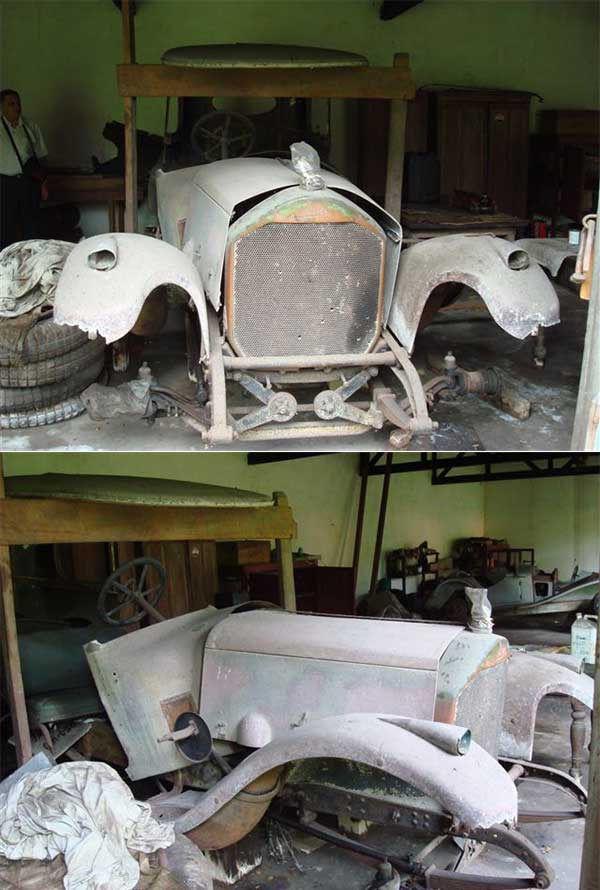
Present state of the majestic 1924 Napier, C-5579 at Obeyesekere walauwa in Racecourse Avenue
It may be asked why S. Thomas’ College did not appreciate and retain the valuable and rare Napier as a gesture of Hussein’s generosity and goodwill. However, the harsh reality is that restoration, preservation, and maintenance of an ancient motor car – especially such an unusual one as a Napier 40/50 hp, for which parts would have been almost impossible to obtain – would not have been a priority for the STC Board of Governors. Their primary concern, as always, is the efficient management of an educational institution and proper use of funds for that purpose alone.
However, if Hussein had gifted the car to an enthusiast, who appreciated the Napier’s rarity and had the desire and money to spend on its restoration and upkeep, the car may not have suffered the indignity of transporting vegetables and conveying pupils to/from sporting fixtures, as it did when in the custody of Prins and STC. Who knows, it might even be still running today in grand style…
(Tissa ‘Joy’ Yatawara, who was the popular Head Boy in 1950 and a hosteller at STC, vividly remembers the Napier being used to transport vegetables and other supplies to the hostel).
M.A.M. Hussein’s Family
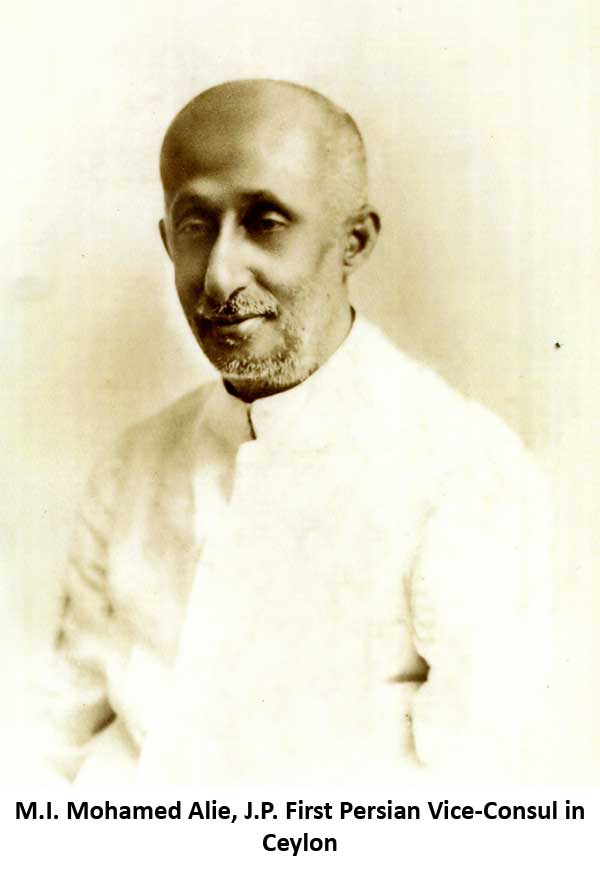
Hussein belonged to an affluent family and was the youngest of the children of M.I. Mohamed Alie, J.P., the first Persian Vice-Consul in Ceylon and the first Muslim Justice of the Peace, who also had a son Ismail and daughter Moomeen, in that order. Hussein was a modest person with fine taste and travelled often to England and France, and developed a special fondness for Paris and the Riviera. The family owned many expensive cars and Hussein owned a Minerva, Auburn, Piccard-Pictet and later models of Cadillac and Chrysler among others. M.A.M. Hussein built the beautiful mansion “Mumtaz Mahal” which was the Speaker’s official residence until a few years ago.

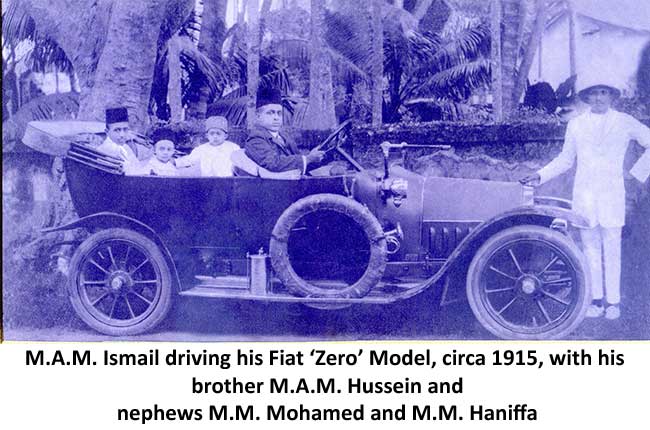
Ismail owned a 1915 Fiat ‘Zero’ model; in the photo his brother Hussein and sister’s sons Mohamed and Haniffa are seen. At the time of his death in 1945 he owned 1929 Morris Cowley Saloon X-2626, which was taken over by his daughter Ummu and her husband Azeez, who were the parents of Ali Azeez. Ali and his sister Marina travelled to Ladies’ College and Royal Primary School in this car, which for some reason or another was affectionately nicknamed ‘Matchbox’. It was painted with the body in maroon and mudguards in black. Ali remembers the day it came to collect him at RPS, when the cork clutch liner of the car had failed. So driver Ibrahim and another had to push the car all the way to Barnes Place while Ali enjoyed himself seated inside. The car was sold when his father bought Chevrolet ‘Fleetmaster’ saloon CY-4009 in late 1947.
Moomeen owned a 1937 Mercedes-Benz 230 7-seater Pullman limousine Z-5464, which she sold in 1967. It took part in the Times of Ceylon ‘Great Race’ of 1968 and 1969 and won prizes. The car is now in Germany.
Ismail’s eldest son Abdulla, and his cousins Mohamed and Haniffa, were very close and also owned many cars and motor cycles. Haniffa owned a red Riley Lynx X-8835 which was used often by Abdulla too. This interest led him to notice a Riley Lynx ‘Special Series’ 4-door tourer, Z-2776 on the Colombo-Piliyandala Road. He bought it from the owner, a bus magnate, in 1963. The car was later given to his nephew, Ali Azeez, in 1966, and it remains in beautiful, running condition to this day.