Features
Poetic Memories Of China I: The Waking Lion – Part 13

CONFESSIONS OF A GLOBAL GYPSY
By Dr. Chandana (Chandi) Jayawardena DPhil
President – Chandi J. Associates Inc. Consulting, Canada
Founder & Administrator – Global Hospitality Forum
chandij@sympatico.ca
Why China?
Today and next Sunday, instead of chronologically narrating episodes from my career, I will write something different here in my weekly column, i.e. about CHINA. Whether one likes Chinese Communism or not, fascination with the People’s Republic of China (PRC or China) in terms of the good, the bad and the ugly, is universal. My curiosity about China stems from my father’s personal connections with that country from 1958 and my own travels to China and Hong Kong, since 1981.
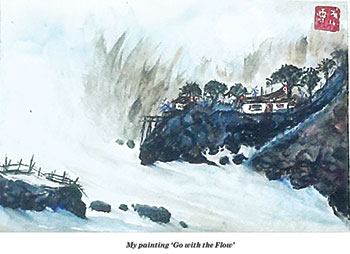
A country with a recorded history of 3,271 years, China has made rich contributions to human civilization. Myths, legends, history and the record of innovations of China never cease to amaze me. One of the greatest philosophers in the world, Confucius, a contemporary of Gautama Buddha and Socrates, lived in China between 551–479 BC. His ideas became central to the Chinese culture over time and endorsed by its government. Chinese philosophy and art had an influence on my paintings and poetry, for some time.


Napoleon Bonaparte is said to have once likened China to a sleeping lion, saying “when China wakes, the world will shake.” President Xi Jinping alluded to this in 2014, commenting that “Today, the lion has woken. But it is peaceful, pleasant and civilized.” That statement sums up what modern day China wants the rest of the world to see her, as the most populous nation in our planet – ACTIVE, POWERFUL, PEACEFUL, PLEASANT, CIVILIZED AND RESPECTED.
1958 – A Call from Tokyo
My father had many opportunities for official overseas tavel. When I was four years old, I remember him being away on a trip to Japan. About September 1958, my mother told me that he will be back home soon and I was impatiently awaiting the gifts he would bring me. An unexpected (and at that time, uncommon) international call from my father to my mother disappointed me. His trip had been extended by a month. At the time of that telephone call, my mother was seven months pregnant with my younger sister, and therefore eager to have our father by her side as soon as possible.
As one of the few countries friendly with the Communist China at that time, Mr. S. W. R. D. Banadaranaike’s democratic socialist government in Ceylon, had received an invitation to attend the ninth anniversary of PRC celebration on October 1, 1958 in Beijing. SWRD had requested the then first and only woman cabinet minister of the country, Mrs. Vimala Wijewardene, Minister of Health to attend the event. Owing to a previously engagement, she was not available and she delegated that duty to her Secretary (my father), who was in Japan on government business. Following instructions, he shortened his stay in Japan and immediately flew to Hong Kong for further directions.

A Foreign Delegate turned Tourist in China in 1958
The authorities of PRC in Hong Kong wanted father to fly to Beijing. His touristic inclinations prompted him to request a long train journey instead. There was no international tourism in the PRC at that time, and trains serviced only local travellers. Chinese officials, not wanting to disappoint a foreign delegate invited to attend the national day celebrations, arranged for him to travel to Beijing and elsewhere in China by train, accompanied by Chinese interpreters. He thus became became one of the earliest tourists to the PRC.
My father was also a published author, an award-winning dramatist, a journalist and a visual artist. These interests prompted him to record his travels from the time he left Japan to travel to Hong Kong. His intention was to write a book about his unique personal experience in the post-revolution China. On his arrival in Beijing, father was hosted by William Gopallawa, Ambassador for Ceylon in PRC (who later became the Governor General of Ceylon as well as the first and only ‘non-executive’ President of Sri Lanka). Father was fascinated to experience the innovations, culture, arts and long-term developmental strategies of China. The icing on the cake was having tea and a long conversation with the Head of the Government and the Prime Minister Zhou Enlai and sitting on stage with the President of PRC, Mao Zedong, during the national day celebrations.
An autographed ‘Long March’
presented by Zhou Enlai
is among my treasured mementos.
It was at a luncheon in Beijing
hosted by Ambassador Gopallawa
that I had a long conversation
with China’s charismatic helmsman.

“You will get a fuller picture
when you read this book” he added
and I was surprised that he showed
no reproach or rancour even about
deaths, hunger, and defeats
they had suffered during
years of the Long March
while about their exploits
and victories he spoke
with no excitement or a trace of pride
in a most self-effacing manner
with admirable equanimity.
(R.D.K. Jayawardena, 2008, p. 43, Fingerprint, Sarasavi Bookshop (pvt) Ltd, Nugegoda)
My father’s poetic expression of his experience meeting Chairman Mao:
The Man Called Mao
Bugles and drums!
The Red Militia marched
through Beijing’s Tiananmen
and a million cheers rent the air
hailing Mao Zedong
whose invincible spirit

made China a World Power.
Standing on the historic
“Gate of the Heavenly Peace”
Mao took the nation’s salute
and even we the foreign delegates
felt proud to be on the same rostrum
admiring the incomparable pageantry
of China’s Ninth National Day.
And when the dazzling feast of fireworks
set ablaze the night sky
there was Mao happily watching
the jubilant crowd
celebrating freedom.
(R. D. K. Jayawardena, 2008, p. 41, Fingerprint, Sarasavi Bookshop (pvt) Ltd, Nugegoda)
Rewarding Loyalty in the Chinese Way

After returning to Ceylon from PRC in 1958 father became extremely busy in his working life. Around that time, there had been a disagreement between the Prime Minister (PM) and Mrs. Wijewardene. As a result, they ceased to have direct communication with each other and father was told to interact with PM frequently on her behalf to get approvals on matters related to her portfolio. She had instructed, “RDK, deal with the old man directly, until further notice.”
Given the PM’s leadership qualities, eloquenc
e (in 1921, he had been the first non-white Secretary of the Oxford Union), intellectual capacity and quick wit, father enjoyed these opportunities to communicate directly with PM, and write parts of his speeches related to the work of Mrs. Wijewardene’s ministries. He used to occasionally visit Horagolla where Mr. Bandaranaike spent most weekends interacting with his voters.
It was a time the government was considering expanding Parliament by increasing its membership. Shrewdly, he wanted to split constituencies where his party had won large majorities and was looking for new blood for these seats. Impressed by my father, the PM shot the question, “Young man, do you like to get into politics and contest Divulapitiya?”
A year after my father’s trip to the PRC, we were on a family vacation at Mrs. Wijewardene’s holiday bungalow, Adisham Hall in Haputale. On September 26, 1959, during a relaxing walk to the town, we wondered why the whole town was decked in white and discovered the prime minister had been assassinated.
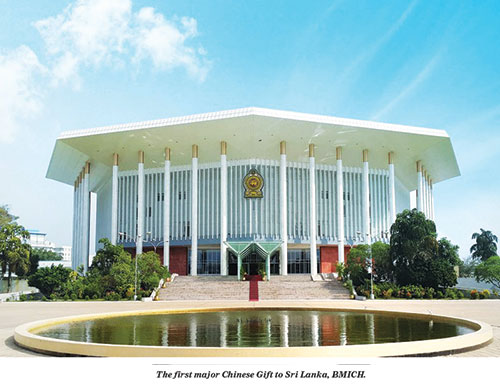
PRC was one of the first countries to express their sympathies to Ceylon and the Banadaranaike family. In addition, PRC made many generous gestures to commemorate the legacy of the late socialist leader and friend of China. The most significant of these was the BMICH, Bandaranaike Memorial International Conference Hall. A joint Sri Lankan and Chinese workforce built this magnificent structure with much of the needed building materials imported from China. More than 50 years later BMICH is still Sri Lanka’s largest convention center. It is South Asia’s very first purpose-built convention center with ultra-modern facilities.
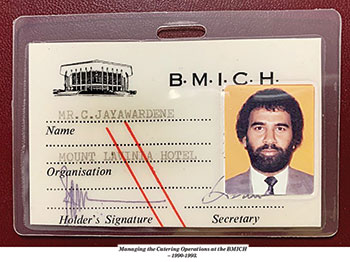
I was pleased to receive the opportunity to manage the entire catering operation at BMICH for three years as the General Manager of the Mount Lavinia Hotel Catering Services Limited. In that role I was involved with probably the largest wedding held in Sri Lanka, a dual wedding with a sit-down buriyani dinner for 2,400 guests. We even used the corridors of the banqueting areas of BMICH to accommodate that number. In 1992 and 1993 I handled the annual All Island Music Awards events at BMICH when with help of my team we filled all 1,506 seats in the main auditorium for this prestigious show, on both occasions.

1963 – The first Sinhala Book on China
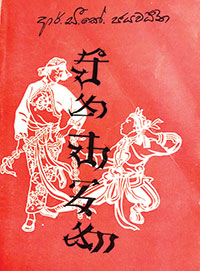
My father eventually published a ground-breaking book on China in 1963. Cheena Charika (Travels in China) was an instant best-seller. It was recognized by the Ministry of Education as a ‘Recommended Reading’ book for high schools. Decades later the Government of PRC, invited my father back to China on a fully-sponsored official trip, and honoured him for writing one of the earliest books on PRC, by a foreigner.
The next part of this article will appear next week on the theme ‘THE FLYING DRAGON’ capturing memories of two more trips to PRC by my father in the 1980s. It will also narrate some fun stories from my two trips to PRC in 1981 and 2010, as well as four trips I made to Hong Kong before its takeover over by the PRC.