Midweek Review
Platform perspective regaining next generation of archaeologists

Introduction:
Disenfranchising archaeologists in their sacred space
Thousands of visitors, both local and foreign, who arrive at the UNESCO declared World Heritage Sites, and other archaeological sites, marvel at the material cultural remains of the past and sing in praise of our ancestors who conceptualised, designed and executed such cultured expressions as gifts to humanity. Little does anyone realize the effort that has gone into the scientific retrieval and presentation of the past material culture in a recognizable form out of the vast mounds of soil and jungle tide that had hidden the monuments for several centuries! For three decades, scores of young archaeology graduates and conservator graduates, from national universities, toiled at the World Heritage sites, in the blazing heat, in an effort to unfold the historical panorama of this island. They are the unsung heroes of this great historic drama!
How has the Establishment treated and cared for them? These young men and women, who could have opted for greener pastures in banking, NGOs, and other private establishments, including the Government sector, decided against it and stayed with the science and sites they love. Having done so, they have dedicated their youthful lives to it. How have they been compensated for their dedication? Their specialization, as archaeologists, and their contribution, have never been properly appreciated and recognized by the Cultural Establishment. They have never been properly compensated for their commitment and passion for preserving the history of this land. Their young minds are never consulted and their acquired skills never maximised at their own work site. On the contrary, they are identified merely as wage labourers and treated accordingly at the World Heritage sites. The establishment has never respected the professional dignity of this wonderful human resource. They have been taken for granted as serfs bonded to fiefdoms.
The mediocre bureaucrats (some claim themselves to be professionals and one of them even announced that archaeological research is not necessary!) have only exploited the young graduates for their convenience. Hundreds and thousands of dollars earned through cultural tourism never reached these young professionals to be ploughed back for their long-term professional sustenance. Administrators, sitting in Colombo, perform the road show for the unsuspecting politicians by presenting the ‘cultural treasures’ and basking in the glory, unearthed by these toiling archaeologists. These moronic bureaucrats have enjoyed, for years, the perks squeezed out of the sweat and tears of these field researchers, and nurtured their own pathetic existence. The metropolitan-based dull-witted administrators have conveniently ignored the value-added service, provided by these young professionals to the national development grid. This is a classic case of disfranchising the archaeologists, the primary stakeholders, at their own worksite – the professional sacred space!
When you next visit the World Heritage sites and are awe-struck by the cultural and historical legacy of this island, please save a thought for the young professionals who are ‘hidden in history’.
This article is dedicated to all young professional archaeologists and conservators for their dedicated services, rendered to the heritage of Sri Lanka.
“Where the mind is without fear and the head is held high:
Where knowledge is free:
Where the world has not been broken-up into small fragments by narrow domestic walls:
Where words come out from the depth of truth
Where tireless striving stretches its arms towards perfection
Where the clear stream of reason has not lost its way into the dreary desert sand of dead habit
Where the mind is led forward by Thee into ever-widening thought and action:
Into that heaven of freedom, my Father, let my country awake.”
[Rabindranath Tagore. The Freedom of Heaven]
A literal English translation of a speech
delivered by
Sudharshan Seneviratne
Professor of Archaeology, University of Peradeniya, Director Archaeology, Jetavana Project
Co-Director, Anuradhapura Citadel Archaeology Project at Abhayagiriya, to the Archaeology Graduates Association of the Central Cultural Fund celebrating the launching of their research journal, WELIPILA.
I am most pleased to open my presentation with the poetic sentiments expressed on the beauty of knowledge, truth, perfection, clarity of mind and freedom by Rabindranath Tagore. This sage, along with Ananda Coomaraswamy, represents the once brilliant intellectual ethos of modern South Asia. I am equally happy that this discourse is carried out with a gathering of young archaeologists, the primary stakeholders of our heritage, within an archaeological site – which also happens to be your professional sacred space!
Space is central to the topic I selected for this discourse. This space is essentially identified with the present and its related past and future. Together, the past and the future are pivotal to the identity and sustenance of the archaeologist. I recognize the archaeologists of today and the future generations, investigating the past, as the lifeline of this profession. Considering the ongoing dynamics of professional archaeology – tomorrow is vital for the science of archaeology. It is my personal and professional view that my generation of archaeologists did not treat your generation with greater dignity and magnanimity. This is, indeed, a sorry state of affairs as your generation represents the primary stakeholders of our profession. It is important therefore that you recognize your professional platform, the way in which it must be structured and its futuristic vision regaining your professional status. If you do not grasp the essential gravity of this situation here and now, it may be fatal to the very professional status of archaeology.
One cannot divorce archaeology from the living reality of this country. That reality has reached a critical juncture. As things stand today, reading the past in Sri Lanka is situated between social fascism and anarchism, while liberal thinking, in this sphere, is dangling on a thin wire. The contemporary archaeologist has his or her task cut out and faces the enormous challenge of initiating a dialogue with the past, within the above context. How then do the archaeologists consolidate a professional platform to make that space for liberal thinking, devoid of biases and prejudices, so urgently needed in interpretative studies? How should the very future of the profession be contextualized? The decision rests in your hands and, as professional archaeologists, it is important that you situate this platform within a time and space context.
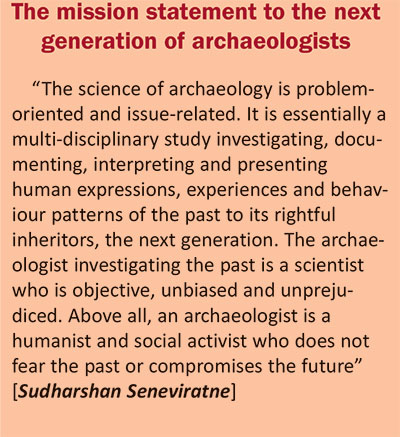

The responsibility and the role played by my generation, will end in a few years and we must accept this situation with humility. Unfortunately, some archaeologists, of my generation, are unable to accept this reality. Some of them actually believe that they will continue to remain at archaeological sites, even after their passage to the next life!! Some others in my generation also harboured the illusion that they held perpetual hegemonic power over archaeological sites and decision-making authority that guide the fortunes of Sri Lankan archaeology. A direct consequence of this thinking process was the subversion and the lumpanization of archaeological thought in Sri Lanka and the creation of subservient ‘archaeology-student surfs’ by particular schools of thought. The exploitation of the labour and ideas of the young archaeologists stand out as ugly and despicable feudal remnants of a bygone era in the post-Colonial period. You must not be deterred by this retarded behaviour of some among your predecessors. Such impediments must be corrected and the profession is thrust towards a progressive agenda with a new vision.
Time and space
Speaking of time, you must possess a vision and a plan. It could be identified as short, medium and long-term and, accordingly, your action plan could be situated. Then take up space in your agenda. It is critical that you contextualize space within your professional platform. As you are aware, context is pivotal to the science of archaeology. What is retrieved and studied in archaeology has no value devoid of context. I wish to situate space in multiple contexts. Taken together they comprise the platform of the archaeologist. These multiple contexts are organically interconnected to each other. If even one is disconnected, it then has a direct impact on the very survival of the genuine professional archaeologist.
Professional space
The archaeologists have two alternatives, with reference to their professional space:
1. Arrive at the work site in the morning, sign the register, dabble with some artefacts and return home at the end of the day
2. To conduct oneself as a professional archaeologist, in your body and mind, and consolidate one’s professional dignity. This means your professional thoughts and actions must be one.
The first of these two does not befit an archaeologist. In a bygone era, under Colonialism, some aspects of archaeological work overlapped with the Public Works Department (PWD). You have been appointed to these positions, endowed with a modern professional degree, not to think and behave like a desk clerk. Departments of Archaeology were established in the University system to produce professional archaeologists. Not schoolteachers and definitely not office clerks!
The second aspect is entwined with the very existence of the archaeologist. If we do not understand this, the demons waiting in the wings, to consume the archaeological sites ,could easily sever our roots. Consequently, this will lead to the cannibalisation of cultural sites. Sigiriya had a near miss in the recent past. If we do not protect our existence, it will only dilute our identity. When our identity is lost we cannot justify our existence. This is dialectics for you!!
Precisely, due to these reasons we must essentially protect our professional space. We project ourselves to the world as professional archaeologists. There is a fine line that demarcates the professional archaeologists from all other professionals who fiddle around with archaeology. There are those in the medical profession and administrators who are self-proclaimed archaeologists. They work within an antiquarian and Orientalist mental rubric. It is, therefore, imperative that you safeguard your professional status and identity. To consolidate this, one needs professional security. Security is found only when our professional status is recognized and announced. This status was legally established through an Act of Parliament, establishing the Sri Lanka Council of Archaeologists, our professional body. This act has enforced and secured the sacred space for our professional status. It will, indeed, be a tragedy if you lose what is rightfully yours. We reserve the right to carry out professional, work at heritage sites, because we maintain a conscious identity as archaeologists. The decision-making positions, in archaeology-related bodies, must be in the hands of professional archaeologists. This could be achieved by establishing an intellectual hegemony that sustains qualitative levels of professional priorities at such establishments.
In view of this, the conduct of the professional archaeologist becomes a critical factor. There must be a high level of the professional standard applied in the science of archaeology. We do not require sub-standards. As we are responsible for public funds, transparency and accountability must be displayed at the highest level. The international community of professionals are observing our conduct during this period of globalization. Our professional standards will directly come to play in our collaborative work with them. If we are unable to maintain standards, they will, as did the Orientalists and Colonials, scorn upon our inability to measure up to them. We must reach the highest standards, not for their sake, but for ourselves. It is incumbent upon the senior archaeologists to work out standards of quality assurance, and also to maintain them at all costs.
To be a sound professional, the archaeologist must necessarily adhere to a professional code of ethics. If one does not practice this code of ethics, we will be deprived of security and the law of the jungle will prevail. Senior archaeologists must act as role models, reach out to junior professionals and impart their knowledge, without reservations. The seniors must never fear the junior professionals, as the former must endeavour to be several strides ahead of the latter. If the senior archaeologists do not permit the juniors to advance, if their ideas are exploited, pirated and plagiarized, it will then pose an abysmal situation to the profession of archaeology and its professional pride. Each generation must be connected to the other and maintain professional standards. Links in the chain must remain unbroken. If and when the chain disconnects it will only dilute the expected level of professionalism. For our progress and sustenance, we must maintain and develop professional standards, skills, ethics and humanism. If and when any one of these cornerstones is dislodged, the structure will then collapse and disintegrate.
(TO BE CONTINUED)