
Features
Past, present and future

Addresss on the twin launch of books on father and son
by Prof. Savitri Goonesekere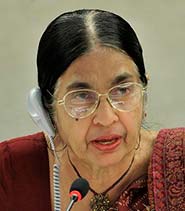
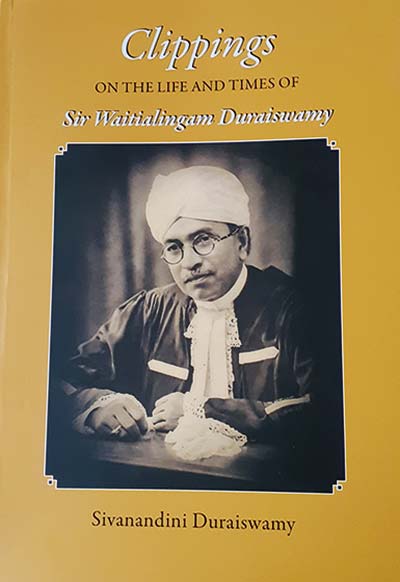
The first edition of the book “My Diplomat,”authored by Ms Sivanandini Duraiswamy, as a biography of her late husband Yogendra Duraiswamy was published in 2000.This was at the beginning of new Millennium, a year after his passing in 1999. I thank Ms Duraisawmy and her son Naresha for inviting me to speak to you this evening, at the launch of the second edition of this book. The family and I have had some connections.
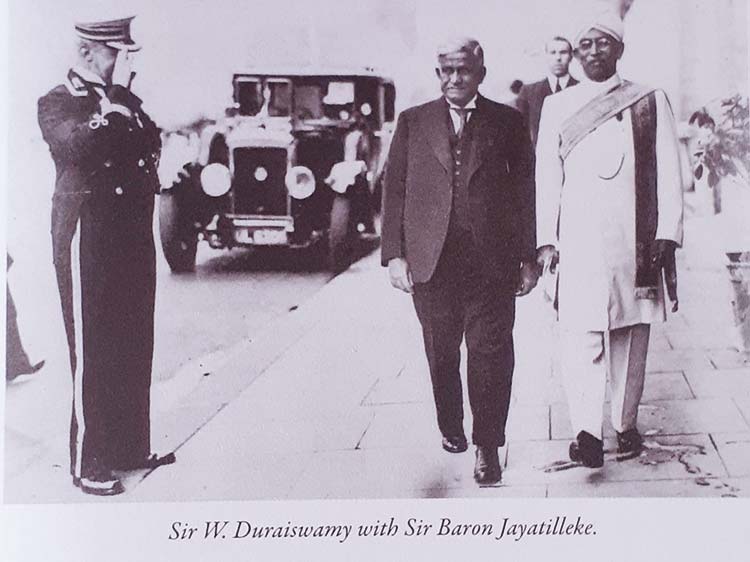
When Mr Duraiswamy’s father and Dr Naresha’s grandfather Sir Waitialingam Duraiswamy was a distinguished Speaker of the State Council, my maternal grandfather was a member of the Board of Ministers, as Minister of Health. Both became “Knights” of some obscure colonial “Order”, an honour conferred by Queen Victoria, British Empress of our island, then Ceylon.
Sir Waitialingam wore his traditional dress, as did my grandfather. Sir Waitialingam acquired the name of Porter from his colonial sponsor. My grandfather kept the first generation Kandyan name of Tikiri Banda, and named his son the third generation TB, Theodore Braybrooke ! So we have had colonial connections that we have happily shed in succeeding generations. as the publications launched this evening, clearly demonstrates for the Duraiswamys.
I had mixed feelings when I read this book. It was inspiring to read a testimony to a life well lived, with equanimity, integrity and courage in difficult times in our country. Mr. Yogendra Duraiswamy lived in the best of times at the dawn of independence, and the worst of times, of armed conflict. Mr. Duraiswamy, like those of his generation was a son of independent Sri Lanka at the dawn of freedom from centuries of colonial rule. There were anticipations and promises of a clear path to national progress and development.
Yet when Mr Duraiswamy passed away just at the end of that century, he had lived through a fratricidal and violent armed conflict, that impacted especially the North and East of the country, with which he had a deep sense of roots both in his personal and professional life. We meet this evening 25 years after Mr.Duraiswamy’s passing, 15 years after the end of the armed conflict in the North and East. We concluded an armed conflict of 30 years. Is not peace and development after conflict, still an unfulfilled dream?
Readers of this book will I think find that its record of past times, experiences and events, will provide some relevant insights and wisdom. The book comes as an expanded second edition, with documents that provide an opportunity for thought and reflection in Election Year 2024 for resolution to our National Question of power sharing. The book also provides insights on the leadership needed for accountable governance and public administration, based on a social contract that is not misunderstood by the rulers and their officials.
I hope the Book will receive the publicity that it deserves, and will be read by concerned citizens, despite the current focus on google searches WhatsApp messages and the internet, as a mode of communicating thoughts and ideas. The book comes in two parts. The first focuses on memories and events linked to Mr. Duraiswamy’s personal and professional life. This is usual in biographies.
I would like to share some thoughts on the first part which, is closely linked to the second part, that deals with substantive issues of public concern. This part also includes what I would describe as archival material of value. I would like to describe the former as the “He and Me” chapters of Ms. Duraiswamy’s book,”My Diplomat”. Crafted with an easy style and clarity, by someone who has received a national award for creative writing, this really is what is often described now as a “good read”.
Feminists tend to dismiss what is sometimes called “pativatha”or adulation of a husband. I think readers will appreciate a human story that speaks to a close relationship of love, and companionship, after a traditional arranged marriage, that was abundantly fulfilling and enriching for both partners. Indeed the idea of recording Mr Duraiswamy’s experiences in his “Jaffna Story” in a book, was a common project that interested both, and encouraged a shared approach to carrying this forward.
That relationship also extended to a strong bond of love and affection with their son Naresha. On one occasion when he actually sets their apartment on fire by lighting a match left by a careless maid, he is showered with affection. Modern mothers now understand that connectivity to the unborn in pregnancy is vital. Mrs Duraiswamy not only had stimulating conversations with her beloved spouse and companion. She began her conversation with her son before he was born and forged a bond that has helped her cope with the desolation of grief and loss and come through.
They have been fortunate to experience what is referred to as “the matchless blessing of a happy home and family”. These personal reflections to me are important, capturing a world of bonding and close familial relationships enriched by traditions of human communication and connectivity that seem to be disappearing in a brave new world of Internet connectivity. I recall Nelson Mandela once saying that all his core values were formed with his connectivity to his elders in the Transkei region of South Africa. Intergenerational connectivity is celebrated in this book.
Mrs. Duraiswamy’s introduction to life in Jaffna in colonial times also makes interesting reading, capturing as it does the impact of the American missionaries on education in the colonial period. The connection to conversion to Christianity in some ways contrasts with the British missionaries in other parts of the country, where secular school Principals in mission schools focused on giving a secular education to both Christians and Non Christians in an ethos of Christian values.
The impact of the religious revival linked to nationalism is reflected in the establishment of Hindu Secondary schools in Jaffna, rather like the establishment of schools like Visakha in Colombo and Mahamaya Girls School in Kandy. This trend was to have significant impact on educational policy in later years. Mrs Duraiswamys writing on their diplomatic postings also captures times past, in countries of the Middle East like Iraq Iran and Palestine – trapped today in violence generated by power politics.
Experiences in the “Forbidden City” of the times, Beijing, speak to the austerity and rigidity of an environment that has changed dramatically.
The second part of the book , beginning with the Chapter “Return to Jaffna”, has I think archival value in two important areas of continuing concern for our country. These chapters record various facets of Mr. Yogenndra Duraiswamy’s life, his experience of public office and governance, and what we would call today “civil society activism”. We now live in a country that has seen the collapse of public institutions, and adversarial or confrontational politics that has prevented us from winning the peace after 30 years of armed conflict.
Mr Duraiswamys experiences and his writings are carefully documented, with a sense of history, rather than personal emotions and bias, that can surface in writing on the national question or governance. Mr Duraiswamy articulated his vision of solutions to the National Question in terms of maximum devolution of power to the Tamil regions, and maximum and shared resource allocation for economic growth and development. He saw this as a necessary and possible path to peaceful coexistence of the majority and minority communities in our country. He was articulate in his rejection of separatism.
He celebrated his identity as a member of the Tamil community in his life and work but respected the diversity of Peoples and the shared religious and cultural connectivity of the Sinhala and Tamil communities. These ideas are reflected in his contribution in public life, and the speeches and writings published in this book. Articulating this position required courage at a time when a completely different and dominant political discourse prevailed in his community. Criticism and his rejection when he tried to enter active politics did not change his views in this regard. He was a role model of integrity and personal commitment to ideas and values he believed in.
Compare this with today’s politicians in public life. and public office. Mr Duraiswamy was a person who Tagore describes as “men and women whom the lust for office cannot buy.” Mr Duraiswamy perhaps like many others of his generation was active in Civil Society after retirement. A central area of his engagement was working towards peaceful coexistence in a plural society through interfaith religious and cultural connectivity.
He gave leadership in the Hindu Council and facilitated expression of a collective opinion on issues of public concern, not just for that community, but for Sri Lankans. The attack on the Temple of the Tooth was condemned by the Council in a public statement (p193). He helped to establish the Bauddha Hindu Maha Sabha in 1990, that brought both communities together to explore areas in which they could communicate and create awareness of common concerns.
He also connected with the Muslim community through a close personal friendship with a Minster at that time late Mr MHM Ashraff, the leader of the Muslim Congress. Mr Duraiswamy’s Civil Society activism also extended to the Education sector. Today with the controversies on IMF support in our economic crisis, there is a discourse that refers to an “entitlement culture”, where the public expect hand outs from government on health and education.
Mr Duraiswamy can be described perhaps correctly as “a famous son of a famous father”, born to wealth and privilege. But imbued with an ideal of service and social responsibility embedded in his religious beliefs as a Hindu, he could respond to economic deprivation and disadvantage. He helped grass roots organizations he worked with, to access international funding. He worked with the Alumni Association of my University of Colombo, to enable low income students from the outstations to access hostel facilities.
He understood the Kannagara vision that equal access to the public good of education was the right of all students and the State had a duty to provide that without ethnic or class discrimination. His writing on education policy critiquing affirmative action that benefited rural students in the Sinhala areas was because he believed passionately in the idea of equal access to education without discrimination.
He pointed to the disastrous impact of these policies in denying Tamil students equal access. That contribution expresses an interesting point of view . It is very relevant today where affirmative action or positive discrimination to address historical discrimination is being questioned, including in a controversial recent decision of the US Supreme Court.
It is important to make some remarks on Mr Duraiswamy’s contribution to public administration, as recorded in this book. The manner in which he held public office after retirement as a very senior official and, in our Foreign Service, demonstrates commitments that seem almost unreal today. The capacity of public servants to resist political pressures while holding public office was central to Mr Duraiswamy’s concept of fulfilling the public trust.
He himself had experienced disappointments because of politicised decision making while he served in the Foreign Ministry. But without bitterness and rancour he was committed to policy changes that would ensure non discrimination and appointments on merit, by the establishment of an independent Police Commission, Public Service Commission and Elections Commission.
The importance of that vision is seen today as we witness destructive politicization that has led to inertia in the prosecutors office. Loss of public confidence in the administration of justice, and law enforcement agencies has become a matter of concern when the Police Commission fails to take disciplinary action against officers who contravene the law. Assuming public office again by taking a controversial appointment as District Secretary and Government Agent Jaffna, Mr Duraswamy was witness to the political interference and violence associated with the District Development Council Election of 1981.
He had the satisfaction of using his office to engage in development work and programmes in the region, in the tradition of an early cadre of government officials who saw their mandate as public service for the benefit of the People in the region. Following a past tradition in public service, he preserved documents and papers in all his official work whether in the foreign office or in public administration and his personal life. This is remarkable in a country that is now familiar with a practice of destruction of records.
He received accolades for his development work. But the chapters in this book on this period in his life are testimony to the pressures he had to experience from many quarters. The situation culminated in violence by a police force seeking reprisals for police killings by militants, and the burning of the treasure that was the Jaffna Public Library. This was in a sense a portent of things to come in the appalling and tragic violence loss of lives and property of the Tamil community on 1983.
Yet Mr Duraswamy guided by the power of his spiritual beliefs seems to have coped with all this with equanimity. Despite criticism and pressure he made his decisions firmly and quietly and then resigned from the posts he held. How many public servants holding high posts can say that they have held office in this manner? How many would have witnessed the destruction of a much loved family home, in the armed conflict, and continued to live by his ideal of public service, contributing to public life and civil society in those traumatic years of armed conflict.
A few years before his passing Mr Duraiswamy had the satisfaction of serving on a Committee established by President Chanadrika Kumaranatunga and late Minister Mangala Samaraweera to reconstruct and resource the destroyed Jaffna Public Library. I interacted with him briefly when this initiative was in its final stages with leadership from late Minister Lakshman Kadirgamar.
Mr. Duraiswamy was able to witness in his lifetime a shift in national policy that led to the recognition of Sinhala and Tamil as “national languages” in public administration, administration of justice and education, through Constitutional Reforms of the 13th and 16th amendments. The failure to proactively implement the changes is documented in published research. However those changes have not been eliminated by the power politics that has impacted Constitutional Reform.
His vision of maximum devolution and power sharing remains embedded in controversy, with no efforts to implement the promise of the 13th Amendment. This book reveals that at the time of his passing Mr Duraswamy had great hopes of peaceful conflict resolution and Constitutional Reform, led by a Chandrika Bandaranaike government. He believed that these reforms would help realize his own passionate vision of a united country that gave sense of national identity and belonging, to all its diverse people.
When Constitutional Reform was proposed in 1989 as a way forward for resolving the armed conflict and the national question, Mr Duraiswamy stated publicly that there was collective responsibility in “acts of omission and commission by society in general and governments in particular.” (p228). He recommended an All Party National Government, as a preparatory step to a general election and a mandate of the People for Constitutional Reform including the continuation of the Executive presidency. These are ideas that seem pertinent to current discussions on Constitutional changes as the country moves into 2024.
In Mr Duraiswamy’s submissions on the draft Constitutional Reforms in 1996, as part of the Hindu National Council, he commended President Kumaranatunga’s leadership in agreeing to proposals on power sharing, and a political settlement on devolution of power on “specified subjects”.in a new Constitution (p322). Yet, one year after his passing the Constitution of 2000 with significant provisions on devolution and power sharing in important areas, and many other extremely important and relevant changes including the abolition of the Executive Presidency and return to a Parliamentary system of governance, was torn to shreds physically by the current President Ranil Wickremesinghe and his MPs.
This irresponsible and destructive behaviour was motivated by a petty concern in regard to who should succeed as Prime Minister in a government formed according to the new Constitution. We have witnessed over the years a lack of consistency in those who assume public office. Those who abuse power, transform into human rights experts and activists. Liberals tend to become autocrats in the seats of power, especially when they don the mantle of the Executive Presidency.
In our Dissolution of Parliament case 2018 our Supreme Court reminded that “Since 1972 (when we became a Republic) this country has known no monarch, and the President has not inherited that mantle”. A body of jurisprudence including the recent judgments on national bankruptcy and torture by the Police including the Acting IGP, focus on the doctrine of official duties and powers exercised for the well-being of the public, and held in “public trust”.This concept is considered embedded in democratic governance and the Rule of Law.
Yet the incorporation of a kingship concept into a powerful Executive Presidency, has permeated legislative and executive institutions and eroded any perception that public office is held in public trust. The Executive Presidency which Mr.Duraiswarny critiqued in his responses to Constitutional reform in 1998 remains the dominant institution in governance, in all its toxic manifestations. He recognized the dangers of concentrating executive power in one individual. He wanted it modified to incorporate checks and balances essential to prevent abuse of power and facilitate good governance.
The destructive impact of this model of governance on the national life of our country, would have amazed Mr. Yogendra Duraiswamy, as it has citizens who have lived with that experience. 2024, is a critical year for making important decisions on the progress and development of a country that we all love. The launch of the second edition of the book has given us an opportunity to recall Mr Duraiswamys vision, documented by Mrs Sivanandini and Dr Naresha Duraiswamy through the book “My Diplomat “.
At the inaugural meeting of the Jaffna Library Committee by President Chndarika Kumaranatunga Mr. Yogendra Duraiswamy said that “this was surely the forerunner of many efforts at nation building. The day has dawned when we as sons and daughters of Mother Lanka should work unitedly to create a new nation where peace equality freedom and justice shall prevail, and where every citizen shall live with honour and self respect, free from fear or want”.
Let us hope that we as citizens do not repeat our past follies, as rulers and citizens at Election time in 2024. I hope that we can collectively. recognize the relevance and importance of a new commitment to give life and meaning to that vision of peace and harmony, and accountable governance to the People of Sri Lanka.


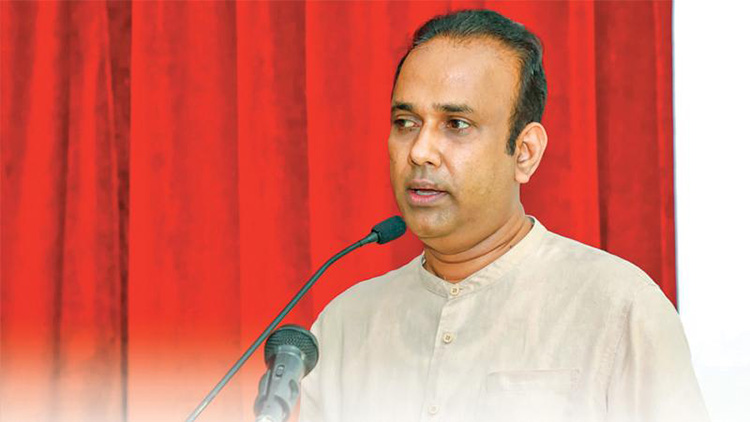
by Dr Gotabhya Ranasinghe
Senior Consultant Cardiologist
National Hospital Sri Lanka
When we sought a meeting with Hon Dr. Ramesh Pathirana, Minister of Health, he graciously cleared his busy schedule to accommodate us. Renowned for his attentive listening and deep understanding, Minister Pathirana is dedicated to advancing the health sector. His openness and transparency exemplify the qualities of an exemplary politician and minister.
Dr. Palitha Mahipala, the current Health Secretary, demonstrates both commendable enthusiasm and unwavering support. This combination of attributes makes him a highly compatible colleague for the esteemed Minister of Health.
Our discussion centered on a project that has been in the works for the past 30 years, one that no other minister had managed to advance.
Minister Pathirana, however, recognized the project’s significance and its potential to revolutionize care for heart patients.
The project involves the construction of a state-of-the-art facility at the premises of the National Hospital Colombo. The project’s location within the premises of the National Hospital underscores its importance and relevance to the healthcare infrastructure of the nation.
This facility will include a cardiology building and a tertiary care center, equipped with the latest technology to handle and treat all types of heart-related conditions and surgeries.
Securing funding was a major milestone for this initiative. Minister Pathirana successfully obtained approval for a $40 billion loan from the Asian Development Bank. With the funding in place, the foundation stone is scheduled to be laid in September this year, and construction will begin in January 2025.
This project guarantees a consistent and uninterrupted supply of stents and related medications for heart patients. As a result, patients will have timely access to essential medical supplies during their treatment and recovery. By securing these critical resources, the project aims to enhance patient outcomes, minimize treatment delays, and maintain the highest standards of cardiac care.
Upon its fruition, this monumental building will serve as a beacon of hope and healing, symbolizing the unwavering dedication to improving patient outcomes and fostering a healthier society.We anticipate a future marked by significant progress and positive outcomes in Sri Lanka’s cardiovascular treatment landscape within the foreseeable timeframe.

by Fr. Emmanuel Fernando, OMI
Jesuit Fr. Aloysius Pieris (affectionately called Fr. Aloy) celebrated his 90th birthday on April 9, 2024 and I, as the editor of our Oblate Journal, THE MISSIONARY OBLATE had gone to press by that time. Immediately I decided to publish an article, appreciating the untiring selfless services he continues to offer for inter-Faith dialogue, the renewal of the Catholic Church, his concern for the poor and the suffering Sri Lankan masses and to me, the present writer.
It was in 1988, when I was appointed Director of the Oblate Scholastics at Ampitiya by the then Oblate Provincial Fr. Anselm Silva, that I came to know Fr. Aloy more closely. Knowing well his expertise in matters spiritual, theological, Indological and pastoral, and with the collaborative spirit of my companion-formators, our Oblate Scholastics were sent to Tulana, the Research and Encounter Centre, Kelaniya, of which he is the Founder-Director, for ‘exposure-programmes’ on matters spiritual, biblical, theological and pastoral. Some of these dimensions according to my view and that of my companion-formators, were not available at the National Seminary, Ampitiya.
Ever since that time, our Oblate formators/ accompaniers at the Oblate Scholasticate, Ampitiya , have continued to send our Oblate Scholastics to Tulana Centre for deepening their insights and convictions regarding matters needed to serve the people in today’s context. Fr. Aloy also had tried very enthusiastically with the Oblate team headed by Frs. Oswald Firth and Clement Waidyasekara to begin a Theologate, directed by the Religious Congregations in Sri Lanka, for the contextual formation/ accompaniment of their members. It should very well be a desired goal of the Leaders / Provincials of the Religious Congregations.
Besides being a formator/accompanier at the Oblate Scholasticate, I was entrusted also with the task of editing and publishing our Oblate journal, ‘The Missionary Oblate’. To maintain the quality of the journal I continue to depend on Fr. Aloy for his thought-provoking and stimulating articles on Biblical Spirituality, Biblical Theology and Ecclesiology. I am very grateful to him for his generous assistance. Of late, his writings on renewal of the Church, initiated by Pope St. John XX111 and continued by Pope Francis through the Synodal path, published in our Oblate journal, enable our readers to focus their attention also on the needed renewal in the Catholic Church in Sri Lanka. Fr. Aloy appreciated very much the Synodal path adopted by the Jesuit Pope Francis for the renewal of the Church, rooted very much on prayerful discernment. In my Religious and presbyteral life, Fr.Aloy continues to be my spiritual animator / guide and ongoing formator / acccompanier.
Fr. Aloysius Pieris, BA Hons (Lond), LPh (SHC, India), STL (PFT, Naples), PhD (SLU/VC), ThD (Tilburg), D.Ltt (KU), has been one of the eminent Asian theologians well recognized internationally and one who has lectured and held visiting chairs in many universities both in the West and in the East. Many members of Religious Congregations from Asian countries have benefited from his lectures and guidance in the East Asian Pastoral Institute (EAPI) in Manila, Philippines. He had been a Theologian consulted by the Federation of Asian Bishops’ Conferences for many years. During his professorship at the Gregorian University in Rome, he was called to be a member of a special group of advisers on other religions consulted by Pope Paul VI.
Fr. Aloy is the author of more than 30 books and well over 500 Research Papers. Some of his books and articles have been translated and published in several countries. Among those books, one can find the following: 1) The Genesis of an Asian Theology of Liberation (An Autobiographical Excursus on the Art of Theologising in Asia, 2) An Asian Theology of Liberation, 3) Providential Timeliness of Vatican 11 (a long-overdue halt to a scandalous millennium, 4) Give Vatican 11 a chance, 5) Leadership in the Church, 6) Relishing our faith in working for justice (Themes for study and discussion), 7) A Message meant mainly, not exclusively for Jesuits (Background information necessary for helping Francis renew the Church), 8) Lent in Lanka (Reflections and Resolutions, 9) Love meets wisdom (A Christian Experience of Buddhism, 10) Fire and Water 11) God’s Reign for God’s poor, 12) Our Unhiddden Agenda (How we Jesuits work, pray and form our men). He is also the Editor of two journals, Vagdevi, Journal of Religious Reflection and Dialogue, New Series.
Fr. Aloy has a BA in Pali and Sanskrit from the University of London and a Ph.D in Buddhist Philosophy from the University of Sri Lankan, Vidyodaya Campus. On Nov. 23, 2019, he was awarded the prestigious honorary Doctorate of Literature (D.Litt) by the Chancellor of the University of Kelaniya, the Most Venerable Welamitiyawe Dharmakirthi Sri Kusala Dhamma Thera.
Fr. Aloy continues to be a promoter of Gospel values and virtues. Justice as a constitutive dimension of love and social concern for the downtrodden masses are very much noted in his life and work. He had very much appreciated the commitment of the late Fr. Joseph (Joe) Fernando, the National Director of the Social and Economic Centre (SEDEC) for the poor.
In Sri Lanka, a few religious Congregations – the Good Shepherd Sisters, the Christian Brothers, the Marist Brothers and the Oblates – have invited him to animate their members especially during their Provincial Congresses, Chapters and International Conferences. The mainline Christian Churches also have sought his advice and followed his seminars. I, for one, regret very much, that the Sri Lankan authorities of the Catholic Church –today’s Hierarchy—- have not sought Fr.
Aloy’s expertise for the renewal of the Catholic Church in Sri Lanka and thus have not benefited from the immense store of wisdom and insight that he can offer to our local Church while the Sri Lankan bishops who governed the Catholic church in the immediate aftermath of the Second Vatican Council (Edmund Fernando OMI, Anthony de Saram, Leo Nanayakkara OSB, Frank Marcus Fernando, Paul Perera,) visited him and consulted him on many matters. Among the Tamil Bishops, Bishop Rayappu Joseph was keeping close contact with him and Bishop J. Deogupillai hosted him and his team visiting him after the horrible Black July massacre of Tamils.
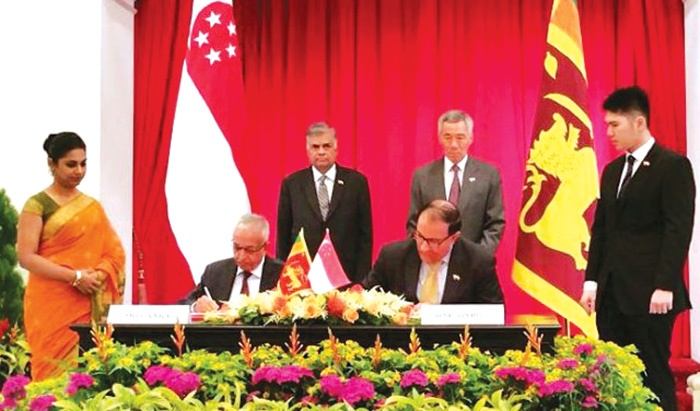
Sri Lanka-Singapore Free Trade Agreement
By Gomi Senadhira
senadhiragomi@gmail.com
“You might tell fairy tales, but the progress of a country cannot be achieved through such narratives. A country cannot be developed by making false promises. The country moved backward because of the electoral promises made by political parties throughout time. We have witnessed that the ultimate result of this is the country becoming bankrupt. Unfortunately, many segments of the population have not come to realize this yet.” – President Ranil Wickremesinghe, 2024 Budget speech
Any Sri Lankan would agree with the above words of President Wickremesinghe on the false promises our politicians and officials make and the fairy tales they narrate which bankrupted this country. So, to understand this, let’s look at one such fairy tale with lots of false promises; Ranil Wickremesinghe’s greatest achievement in the area of international trade and investment promotion during the Yahapalana period, Sri Lanka-Singapore Free Trade Agreement (SLSFTA).
It is appropriate and timely to do it now as Finance Minister Wickremesinghe has just presented to parliament a bill on the National Policy on Economic Transformation which includes the establishment of an Office for International Trade and the Sri Lanka Institute of Economics and International Trade.
Was SLSFTA a “Cleverly negotiated Free Trade Agreement” as stated by the (former) Minister of Development Strategies and International Trade Malik Samarawickrama during the Parliamentary Debate on the SLSFTA in July 2018, or a colossal blunder covered up with lies, false promises, and fairy tales? After SLSFTA was signed there were a number of fairy tales published on this agreement by the Ministry of Development Strategies and International, Institute of Policy Studies, and others.
However, for this article, I would like to limit my comments to the speech by Minister Samarawickrama during the Parliamentary Debate, and the two most important areas in the agreement which were covered up with lies, fairy tales, and false promises, namely: revenue loss for Sri Lanka and Investment from Singapore. On the other important area, “Waste products dumping” I do not want to comment here as I have written extensively on the issue.
1. The revenue loss
During the Parliamentary Debate in July 2018, Minister Samarawickrama stated “…. let me reiterate that this FTA with Singapore has been very cleverly negotiated by us…. The liberalisation programme under this FTA has been carefully designed to have the least impact on domestic industry and revenue collection. We have included all revenue sensitive items in the negative list of items which will not be subject to removal of tariff. Therefore, 97.8% revenue from Customs duty is protected. Our tariff liberalisation will take place over a period of 12-15 years! In fact, the revenue earned through tariffs on goods imported from Singapore last year was Rs. 35 billion.
The revenue loss for over the next 15 years due to the FTA is only Rs. 733 million– which when annualised, on average, is just Rs. 51 million. That is just 0.14% per year! So anyone who claims the Singapore FTA causes revenue loss to the Government cannot do basic arithmetic! Mr. Speaker, in conclusion, I call on my fellow members of this House – don’t mislead the public with baseless criticism that is not grounded in facts. Don’t look at petty politics and use these issues for your own political survival.”
I was surprised to read the minister’s speech because an article published in January 2018 in “The Straits Times“, based on information released by the Singaporean Negotiators stated, “…. With the FTA, tariff savings for Singapore exports are estimated to hit $10 million annually“.
As the annual tariff savings (that is the revenue loss for Sri Lanka) calculated by the Singaporean Negotiators, Singaporean $ 10 million (Sri Lankan rupees 1,200 million in 2018) was way above the rupees’ 733 million revenue loss for 15 years estimated by the Sri Lankan negotiators, it was clear to any observer that one of the parties to the agreement had not done the basic arithmetic!
Six years later, according to a report published by “The Morning” newspaper, speaking at the Committee on Public Finance (COPF) on 7th May 2024, Mr Samarawickrama’s chief trade negotiator K.J. Weerasinghehad had admitted “…. that forecasted revenue loss for the Government of Sri Lanka through the Singapore FTA is Rs. 450 million in 2023 and Rs. 1.3 billion in 2024.”
If these numbers are correct, as tariff liberalisation under the SLSFTA has just started, we will pass Rs 2 billion very soon. Then, the question is how Sri Lanka’s trade negotiators made such a colossal blunder. Didn’t they do their basic arithmetic? If they didn’t know how to do basic arithmetic they should have at least done their basic readings. For example, the headline of the article published in The Straits Times in January 2018 was “Singapore, Sri Lanka sign FTA, annual savings of $10m expected”.
Anyway, as Sri Lanka’s chief negotiator reiterated at the COPF meeting that “…. since 99% of the tariffs in Singapore have zero rates of duty, Sri Lanka has agreed on 80% tariff liberalisation over a period of 15 years while expecting Singapore investments to address the imbalance in trade,” let’s turn towards investment.
Investment from Singapore
In July 2018, speaking during the Parliamentary Debate on the FTA this is what Minister Malik Samarawickrama stated on investment from Singapore, “Already, thanks to this FTA, in just the past two-and-a-half months since the agreement came into effect we have received a proposal from Singapore for investment amounting to $ 14.8 billion in an oil refinery for export of petroleum products. In addition, we have proposals for a steel manufacturing plant for exports ($ 1 billion investment), flour milling plant ($ 50 million), sugar refinery ($ 200 million). This adds up to more than $ 16.05 billion in the pipeline on these projects alone.
And all of these projects will create thousands of more jobs for our people. In principle approval has already been granted by the BOI and the investors are awaiting the release of land the environmental approvals to commence the project.
I request the Opposition and those with vested interests to change their narrow-minded thinking and join us to develop our country. We must always look at what is best for the whole community, not just the few who may oppose. We owe it to our people to courageously take decisions that will change their lives for the better.”
According to the media report I quoted earlier, speaking at the Committee on Public Finance (COPF) Chief Negotiator Weerasinghe has admitted that Sri Lanka was not happy with overall Singapore investments that have come in the past few years in return for the trade liberalisation under the Singapore-Sri Lanka Free Trade Agreement. He has added that between 2021 and 2023 the total investment from Singapore had been around $162 million!
What happened to those projects worth $16 billion negotiated, thanks to the SLSFTA, in just the two-and-a-half months after the agreement came into effect and approved by the BOI? I do not know about the steel manufacturing plant for exports ($ 1 billion investment), flour milling plant ($ 50 million) and sugar refinery ($ 200 million).
However, story of the multibillion-dollar investment in the Petroleum Refinery unfolded in a manner that would qualify it as the best fairy tale with false promises presented by our politicians and the officials, prior to 2019 elections.
Though many Sri Lankans got to know, through the media which repeatedly highlighted a plethora of issues surrounding the project and the questionable credentials of the Singaporean investor, the construction work on the Mirrijiwela Oil Refinery along with the cement factory began on the24th of March 2019 with a bang and Minister Ranil Wickremesinghe and his ministers along with the foreign and local dignitaries laid the foundation stones.
That was few months before the 2019 Presidential elections. Inaugurating the construction work Prime Minister Ranil Wickremesinghe said the projects will create thousands of job opportunities in the area and surrounding districts.
The oil refinery, which was to be built over 200 acres of land, with the capacity to refine 200,000 barrels of crude oil per day, was to generate US$7 billion of exports and create 1,500 direct and 3,000 indirect jobs. The construction of the refinery was to be completed in 44 months. Four years later, in August 2023 the Cabinet of Ministers approved the proposal presented by President Ranil Wickremesinghe to cancel the agreement with the investors of the refinery as the project has not been implemented! Can they explain to the country how much money was wasted to produce that fairy tale?
It is obvious that the President, ministers, and officials had made huge blunders and had deliberately misled the public and the parliament on the revenue loss and potential investment from SLSFTA with fairy tales and false promises.
As the president himself said, a country cannot be developed by making false promises or with fairy tales and these false promises and fairy tales had bankrupted the country. “Unfortunately, many segments of the population have not come to realize this yet”.
(The writer, a specialist and an activist on trade and development issues . )



US sports envoys to Lanka to champion youth development

Rahuman questions sudden cancellation of leave of CEB employees


