
Life style
Parliament revisited: creation of a magnificent edifice on the Duwa marsh in Kotte Parliament revisited: creation of a magnificent edifice on the Duwa marsh in Kotte


The structure has a definite Eastern flavour. Bawa commented, “I just wanted the building to fit into the site. You must run with the site, after all, you don’t want to push nature out of the building.”
by Nihal Seneviratne
Wending my way along the old road to what was then known as Kotte, many nostalgic memories keep crowding my mind. This road has now been replaced by a four-lane highway, which leads to the new Sri Jayewardenepura Kotte as the area is now known, along which I commuted for over 33 years.
Most of all I recall the request madeto me by Anandatissa de Alwis, MP for Kotte, to accompany him to view the site for the proposed new Parliament. President Jayewardene had asked the then Speaker to inspect this marshland called Duwa where my friends used to shoot duck a long time ago and assess the suitability of the site.
We had to shed our shoes for gumboots to wade into the marsh. Anandatissa de Alwis was able to report to the president, already totally enamoured by the model of the new Parliament given to him by master architect Geoffrey Bawa, that here was an ideal place for the construction. All credit to Bawa for his enlightened thinking that he could build a Parliament on this marshy site.
On a bright April morning in 1982 at the auspicious hour of 10.13 am, Sri Lanka inaugurated its new capital, Sri Jaywardenepura Kotte to the triumphant sounds of conch shells and reverberating drums. When a third of the construction the new Parliament was done the president followed tradition and deposited nine different gems and other ritual items to invoke the blessings of the deities on the project-
The site popularly known as Kotte would eventually become the sumptuous home of Sri Lankan politicians. The historic Diyawanna Oya, a substantial body of water, was reclaimed from what was once a marshy wasteland. A 300-acre lake was created on which now stands the Parliament of Sri Lanka.
The building was designed by Geoffrey Bawa, Sri Lanka’s best known architect, and it stands as an elegant embodiment of the rich cultural and aesthetic heritage of this land. The silver plated chandelier, weighing one tonne, in the main chamber and skillfully carved mahogany wall outside the Members’ special entrance stand testimony to his work.
Kotte was a capital of Ceylon in the 15th Century, and taking Parliament there as the centerpiece of a new capital was regarded as a return to the past and a methodical strategy for easing congestion of Colombo.
Today, the city of Colombo is still growing from its relatively small size now hosting a yet growing 1.5 million population. What was intended was to make Sri Jayewardenepura the administrative capital of the country and it was so gazetted. It was to house the diplomatic community, government ministries and offices, hospitals and schools; but this has not happened as originally planned. Anandatissa de Alwis suggested the site to President Jayewardene after being told by Geoffrey Bawa that it was eminently suitable. He said, “if we are going to build a new capital, why not return to the capital of the Kings?”
When the Portuguese arrived in 1505, the shrewd Sinhalese tried to keep Kotte’s proximity to the Colombo port a secret. They led the foreigners through a winding excursion on horseback that stretched over seven miles. But the Portuguese saw through the ploy as they could hear their ship guns boom in the harbour. Hence the popular saying “Parangiya Kotte giya” (How the Portuguese went to Kotte).
The building has a huge copper pitch Kandyan roof to disguise its height. In the main pavilion conclave, layers of space on every level are articulated by rectangles of dark wood and glass. Even the stucco columns on the ground floor are unadorned and fuse easily with the simple wooden beams above.
The structure has a definite Eastern flavour. Bawa commented, “We have a marvellous tradition of building in this country which has got lost. It got lost because the people followed outside influences over their own good instincts. I just wanted the building to fit int the site so I opened it into blocks. You must run with the site, after all, you don’t want to push nature out of the building.”
Rupert Scott writing in a Architectural Review states, “most important, the building appears to be in tune with the climate, topography and culture”.
To stand at the entrance to the complex, besides the reflecting pools and Lei race slopes of cascading water, it has to be kept in mind that for centuries the site was a marsh. Constructing the building fell to a consortium of two Mitsui companies. An international team from Japan, Philippines, Malaysia and Singapore along with the skilled labour of masons and carpenters from Sri Lanka all completed the project in very impressive period of 26 months.
Its real heroes are the artisans of Sr Lanka – most of them unacknowledged craftsmen who helped create the magnificent work of art and culture. The opulent chamber, the focal point of the complex, is covered with a shimmering tented ceiling made of thousands of small pressed aluminium pieces linked by a tiny brass sequence. Suspended from the centre of the atrium is the enormous silver plated chandelier with over 500 bulbs in the double pain motif designed by Lankan artist and sculptor Laki Senanayake. He was given only six months to create this and say that he could never have succeeded without the brilliant master craftsman Edwin Perera and his skilled team of craftsmen.
Eighteen silver flags, beams and standards of kings, temples and korales displayed prominently from tall steel posts were crafted by D Wimal Surendra. He was responsible for this work as well as the massive silver door leading to the chamber. The intricately carved square copper door is silver plated and decorated with an elaborate inscription with the words of the preamble of the 1978 Constitution in all three languages -English, Sinhala and Tamil inscribed on it.The walls flanking this ornate door are covered with beautiful line drawings of murals by the late artist LTP Manjusri, a Magsaysay Award winner. The story depicted here is the Selalihini Sandesaya – an eloquent legend of King Parakrama Bahu VI by a famous Sinhala scholar monk of the 15th Century. The Selalihiniya was the bird chosen as the courier to convey to the deity Vibushna in the nearby city of Kelaniya the supplication of the Kotte King for a male heir. The understated elegance of the mural juxtaposes with the lobby walls of the entrance for MPs.
The special entrance, usually off limits to the public, is surrounded by wall space covered with multi-dimensional jungle scenes carved in mahogany by Mahinda Abeysekera. The interior of the main Chamber – the centrepiece or the entire complex – exudes luxury. The plush red carpet, the billowing ceiling, together with black leather chairs for the Members are bathed in indirect lighting.
At the Parliament’s opening ceremony, Dr Anandatissa de Alwis defended such seeming extravagance by rhetorically asking: “Is this unworthy of such a nation that can look towards the world and say we are not made by treaty, we were not created by the United Nations Conference, we were not created by Potsdam, Zurich or Washington. We have a history of over 2,500 years of writing, of poetry, of sculpture, of learning, second to nobody – except the most ancient civilization of my Dravidian friends across the floor of this House.”
These were truly historic and memorable words uttered by the Member of Parliament for Kotte whose valuable contribution must be recorded and not forgotten.
(The writer is a former Secretary General of Parliament)



Institute of Hospitality Sri Lanka
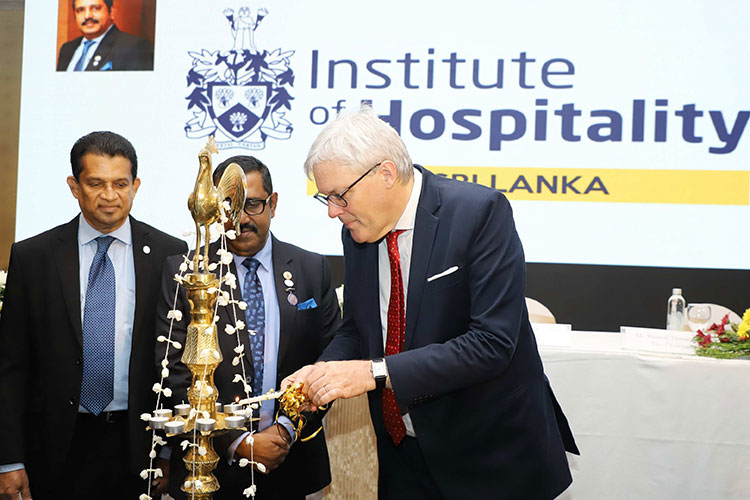
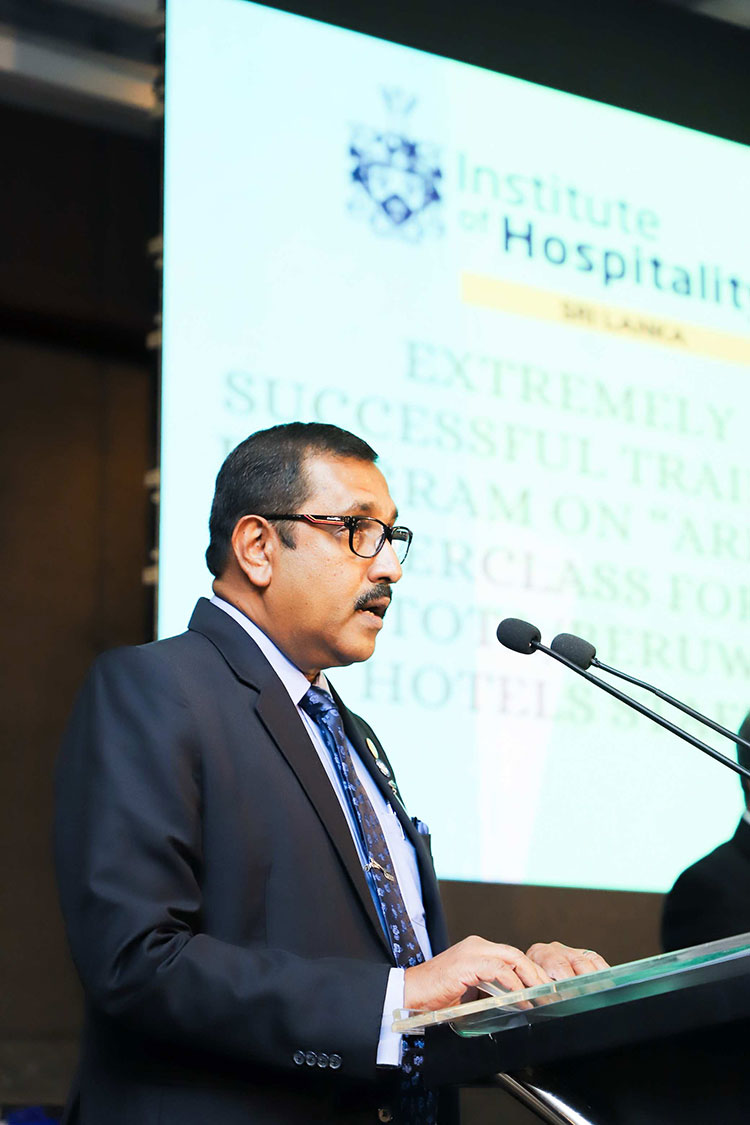
 The 32nd Annual General Meeting (AGM) of the UK-based Institute of Hospitality’s Sri Lanka Chapter was held recently at the Ramada Hotel Colombo,.The event provided an evening of camaraderie , reflection of the past and present achievements,setting new benchmarks for the future
The AGM had the presence of two distinguished guests, the Chief Guest Opposition Leader Sajith Premadasa, and the Guest of Honour British High Commissioner to Sri Lanka, Andrew Patrick. Their inspiring speeches were lauded by all hoteliers who were present at the occasion
A special thanks was extended to Robert Richardson, CEO of the Institute of Hospitality UK, along with his team, sponsors, committee members, and all attendees for making the event memorable.
Dr. Harsha Jayasingh, Past President of the Institute of Hospitality (UK) Sri Lanka Chapter, emphasised the Institute’s longstanding history and the strength of its Sri Lankan branch. “The Institute of Hospitality (IH) UK has a history of 86 years, and we are proud to be the Sri Lanka Branch. IH Sri Lanka is much stronger now with many members from all areas of the hospitality industry,” he stated.
Dr. Jayasingh highlighted the significant role of tourism in Sri Lanka’s economy,. He said tourism it is the third-largest source of revenue for the country. “Tourism accounts for about 13.3% of total foreign exchange earnings and employs 450,000 people directly and indirectly. The hospitality industry in this island of pearl holds tremendous potential for economic growth, job creations, and cultural exchange,” he added.
He also pointed out more women should be attracted to the industry and advocated for the use of technology in hospitality sector to attract the younger generation.
The newly appointed Chairman Ramesh Dassanayake spoke about the challenges faced by the industry, including the reluctance of youth to join the sector. . Dassanayake expressed concerns over the migration of staff between hotels and the overall ‘brain drain’ in the sector. ” We must maintain high standards in the hotel We must try to attract tourists to Sri Lanka, we must have with many facilities Hence, hotel schools and other professional institutions involved in skills development mustincrease their intakes,” he pointed out.
Chief Guest Sajith Premadasa emphasised the importance of eco tourism and said “We need to have an environmental policy related to tourism in place,” . .
The 32nd AGM of the Institute of Hospitality UK, Sri Lanka Chapter, was a testament to the strength and potential of Sri Lanka’s hospitality industry. The insights and commitments shared during the event set a new benchmark for the future.(ZC)



Pix by Thushara Attapathu
Life style
He recognizes human identity beyond boundaries of gender, race, nationality and religion.

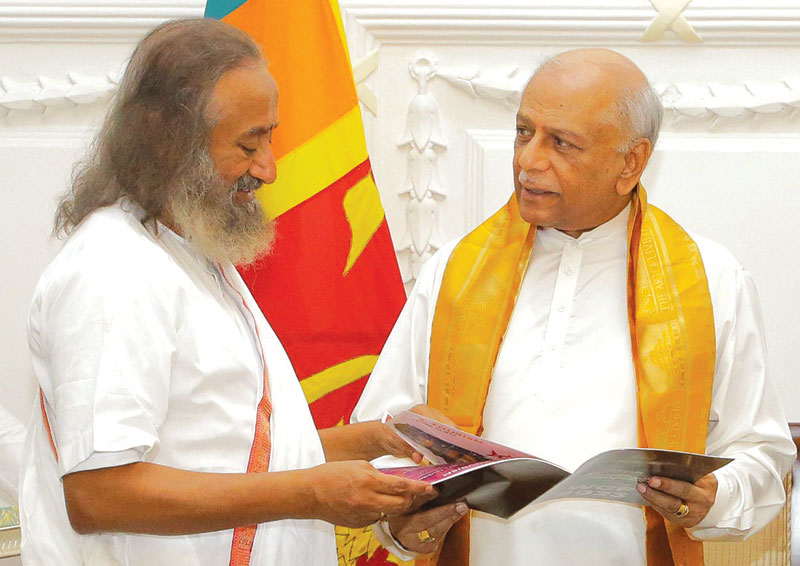
Visit of Sri Gurudev to Sri Lanka
Humanitarian, spiritual leader and Global Ambassador of Peace Gurudev Sri Sri Ravi Shankar (Sri Gurudev) was in Sri Lanka on a three day tour on the invitation of the Prime Minister of Sri Lanka Dinesh Gunewardene. Gurudev who inspired a wave of volunteerism and service to moot one of the largest volunteer-based organisations in the world – The Art of Living – visited the various projects under the aegis of the foundation and launched twelve vocational and technical centers around the island. He was accompanied by thousands of followers from Sri Lanka and around the world.
Gurudev who visited Sri Lanka for the sixth time also had a first day cover launched in honour of his visit. He is a strong proponent of spreading happiness, using the unique Sudarshan Kriya, yoga, meditation and practical wisdom to unite people, empower individuals and transform communities. His programmes provide techniques and tools to live a deeper, more joyous life, while his non-profit organisations recognize the human identity beyond the boundaries of gender, race, nationality and religion.
The Art of Living which has more than 30,000 teachers and over one million volunteers across 180 countries has touched in excess of five hundred million people around the world. CNN called it “Life Changing” and The Washington Post headlined it, “Fresh air to millions”.
In Trincomalee, Gurudev met with war victims and had a heartwarming engagement with the children from the children’s homes run by the Foundation. He also visited the Koneswara Temple in Trincomalee and graced the Kumbhabhishekam at Seetha ecogPnize the human identity beyond the boundaries of gender, race, nationality and religion. Amman temple at Nuwara Eliya. He held discussions with the trustees on the progress of the foundation’s social service projects, while also holding a special event – Ekamuthuwa – attended by a large number of dignitaries and his devotees from around the world.
His time with the Prime Minister was spent discussing the prospects of unity in diversity and uniting Sri Lanka by adding happiness into the formula of living. In addition he had discussions with the Speaker of the Parliament of Sri Lanka Mahinda Yapa Abeywardena, prominent business stewards and civil society leaders.
by Zanita Careem
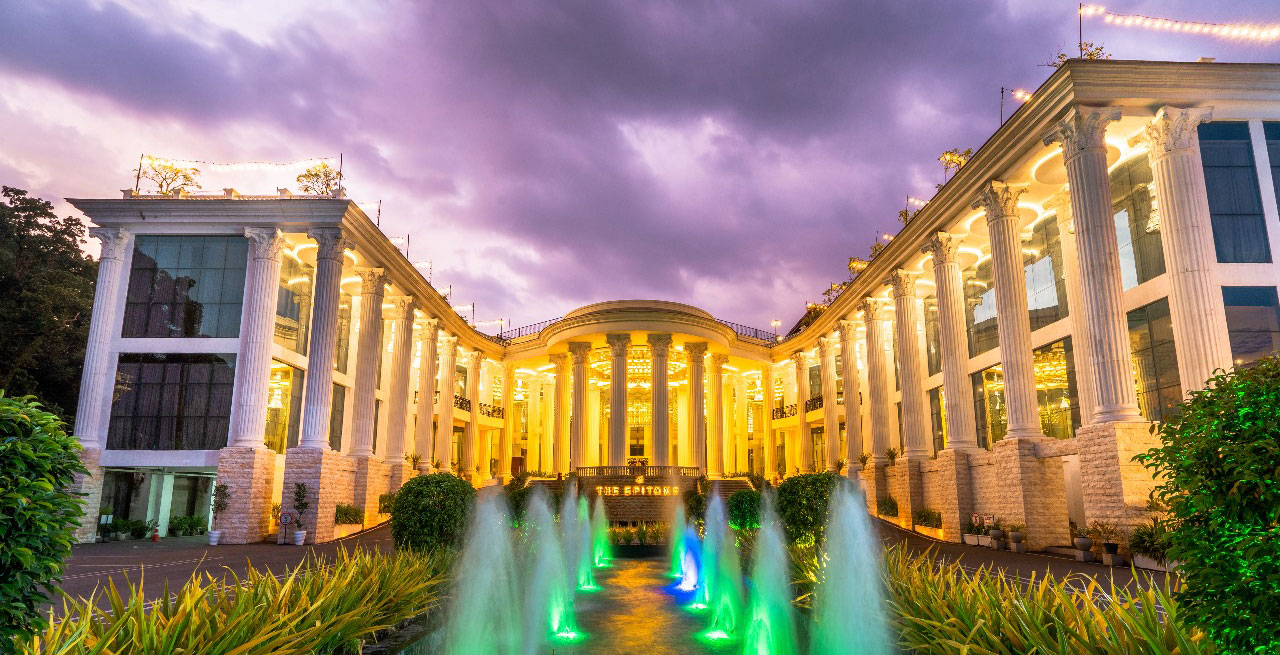
Envison your dream wedding day come to life at the Epitome Hotel, a prestigious city hotel in Kurunegala offering an unrivalled luxury rendors experience for weddings.
The venue is designed to embody opulence and luxury from all quarters for a spectacular wedding in kurunegala,Thier ballroom is the largest banquet facility in Sri Lanka It can be divided into six luxurious pillarless wedding halls on the ground floor and 25pax smaller banquet halls.
It can be easily named as a five star heaven in the heart of the city contributing to a myriad of immense experiences tailored to inspire and delight wedding experiences.
From opulent décor set up to exquisite table decor, lavish food, every detail is meticulously curated to spark your imagination and ignite creativity for a perfect wedding. The previous prestigious wedding shows season one and season two attracted large crowds
were unique events which gave the wedding vendors and potential clients had an opportunity to connect and interact with each other. Beyond being a showcase it was a chance for the wedding vendors to unite and contribute to the vibrancy of the wedding industry. The wedding show covered all area of the bridal industry providing a comprehensive variety of bridal supplies from Sri lanka and became the most popular bridal exhibitions in Kurunegala.This bridal exhibitions allowed brides and grooms to experience first hand the products and services available from suppliers in Sri Lanka
These wedding shows held at The Epitome created a benchmark and gave an opportunity for vendors to create connections to the utmost satisfaction said Harshan Lakshita Executive Director. of the magnificent Hotel
Our wedding shows featured experts and professionals in every field‘ It covered all areas of the bridal industry provided a comprehensive variety of bridal supplies from Sri lanka and became most popular bridal exhibition in this region.We are always open to everyone to join us at our wedding shows in the future. It is an opportunity to discover the incredible talent within our local wedding and bridal vendors to make meaningful relationships and plan thier special day at our breathtaking hotel The Epitome said General Manager Kavinda Caldera
The Epitome Hotel’s bridal show which will be held end of June will buzz with great ideas,advice and inspiration for all those who plan thier dream wedding
…….
The Hotel Epitome’s Wedding Season 3 will marked excellence, celebration and inspiration for those in the wedding industry. The exhibition halls will resonate with ideas on exquisite bridal wear to decor, florists , photography etc and showshowcase the rich tapestry of talent within the local wedding industry. .





US sports envoys to Lanka to champion youth development

Rahuman questions sudden cancellation of leave of CEB employees


