Midweek Review
Painters in Lakdasa’s poetry

by Gamini de Alwis
I had long forgotten the few poems we read in English at school, when I happened upon a book of poetry by Yasmine Gooneratne in the main library. I was initially attracted to the book because of its cover and the illustrations within by Stanley Kirinde. The poems were a revelation to me. It was refreshing to enjoy for the very first time, poetry of Sri Lanka and of Peradeniya in particular in English. In one of her poems for instance, I found the image of purple Jacaranda flowers strewn on freshly cut green grass. An image I would often encounter near Jayathilaka hall. Since then, I have sought other works of Sri Lankan poets who wrote in English.
Somehow, Lakdasa Wikkramasinha had escaped my attention until a few weeks ago. The first poem of his, I read, featured painters, perhaps this attracted me to his poetry, much like the illustrated cover. After reading him and going beyond my initial fascination, I am in awe of his creative energy, his social consciousness, his sensitivity and his anger particularly towards violence of the Portuguese period. Lakdasa is not only a Sri Lankan poet who writes in English, but a poet who writes Sri Lankan poetry in English.
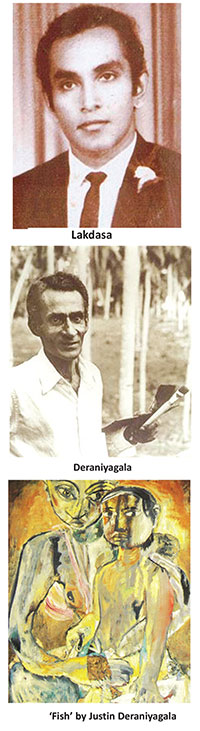
Lakdasa had achieved in less than 20 years an impressive body of work. In addition to the varied direction of his poetry, his knowledge and appreciation of the world of artists in a medium different to his, is impressive. One of his poems, The Cockerel, is written to Justin Daraniyagala. Lakdasa finds a kindred spirit in Daraniyagala, who like Lakdasa himself, treats his subjects without prejudice. He does not apply to them the narrow limits of a stratified society outside. He does not portray them in relegated tasks. Instead, he treats them with respect, just as he finds them, as lovers, mothers and others. He also finds Daraniyagala heaped with ridicule orchestrated by his established predecessors. Perhaps, he is also attracted to the gentleness with which Daraniyagala treats his subjects, even if it is at odds with his own internal conflicts at times even violent. He would have been touched as well by Daraniyagala’s return to his roots in the village of Pasyala turning his back on Cambridge, London and Paris. I am yet to read his edited publication in which he presents 12 poems in tribute to Daraniyagala. His works are extremely difficult to find and hence our eager wait for his planned anthology.
The Cockerel To Justin Daraniyagala, d. 1967
It was
the venality
of fathers
& no nine-farrow
that could wreak
such love: Women:
a brass spittoon. Women,
no longer beating
the washing on the stone, peeling
manioc-tubers & boilt mush
gone purple
(such a woman axed once; she was
‘with child’). The days abominable. Seeing
the dreaming cockerel at dawn – ‘He’s Mad’! they say – –
combing his hair with the cockerel’s comb.
The rice froths in the pot – –
the kitchen-woman unloosening her cloth,
standing naked among chatty-pots,
straddling a coconut scraper …… He
lives in sanity.
His eyes – two jak-stones – –
turn to cinder in the fireplace.
“He’s blind”, they say.
“He’s now dead” they say.
Dead, the cattle
trample across his hands
of old jasper,
ancient grass,
as all art, deep &
imperishable.

Lakdasa’s enjoyment of paintings and painters is apparent in this poem and in others, where artists sometimes emerge unexpectedly and in unusual context.
One would relax perhaps with a cucumber sandwich and a pint of ale, to enjoy his playful poem To My Friend Aldred.
To my friend Aldred
My dear chap,
In this Kandyan weather there is
no shame in having in your bed
a servant maid –
The same passion moved others too, famous in time –
When there were servant maids about.
Achilles for one – who gave his heart to
Breseis, a milky slave,
& Tecmessa: enemy blood, as Horace has it;
and Agamemnon fired Troy and burnt his heart to a
cinder, hot for a virgin there;
and though we do not get so Greek here
we are not to such titillations immune
– being classical in our traditions.
And so it is
with you and your Jose
with such long lashes
to whom you have lost your heart,
………
While he carries on along this theme out of the blue appears Keyt.
……….
straight out of the old poetry books:
Breasts like gourds, and ripe and Oh
nodding like geese, thighs
like plantain trunks, and
haunches as a king could ride
on or Keyt.
……..

Admittedly, Keyt is included in this poem for his life style rather than for his Art. Yet, it is not an accident that he features the best two from the 43 group of artists with their disparate styles.
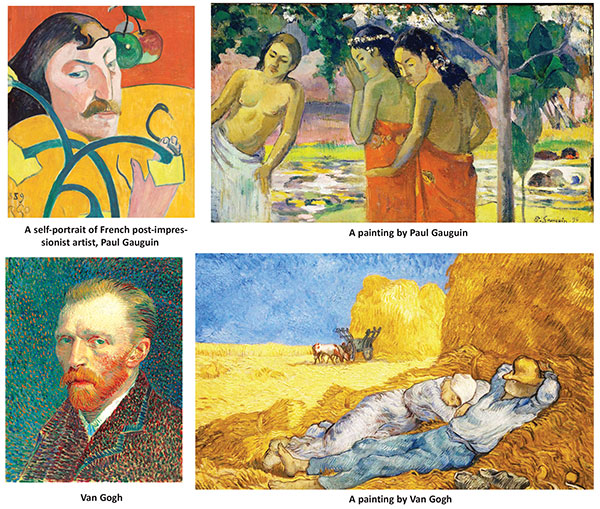
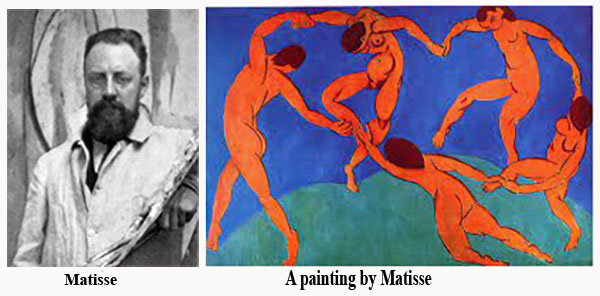
In his celebrated poem Don’t talk to me about Matisse, he picks Matisse, Gauguin and Van Gogh to shock the reader and destroy the exalted position in which the European Style of 1900 is presented to English speakers of Sri Lanka. He achieves his end with a ruthless, unfair and single-minded commentary, seemingly disparaging of the three artists. Yet he picks the three artists who took impressionism beyond its confines with their own individualistic styles. It shows his critical awareness and appreciation of their work. His use of yellowed obesity demonstrates his knowledge of Gauguin’s Yellow Christ and with obesity speaks to the use of contrasting and vivid colour palette, which Gauguin employs in gay abandon in his paintings without losing the integrity of the whole painting. Yet, he employs a term Yellowed Obesity as a put-down, to achieve the main thrust of his piece. His ability to free the people from the hegemonic grip in which they meekly accept a superiority of western culture and obscure the worth of the native culture, would resonate in any country where the people have long been hoodwinked by the colonisers. His virulent attack on the three artists makes his point but it does not diminish his or our interest and enjoyment of these artists. He could well have used Beethoven, Mozart and Bach of a different era to make his point and continued to enjoy their music.
Don’t talk to me about Matisse
Don’t talk to me about Matisse,
don’t talk to me about Gauguin, or even
the earless painter van Gogh …
and the woman reclining on a blood-spread …
the aboriginal shot by the great white hunter Matisse
with a gun with two nostrils, the aboriginal
crucified by Gauguin- the syphilis-spreader, the yellowed obesity
Don’t talk to me about Matisse…
the European style of 1900, the tradition of the studio
where the nude woman reclines forever
on a sheet of blood

Talk to me instead of the culture generally-
how the murderers were sustained
by the beauty robbed of savages: to our remote
villages the painters came, and our white-washed
mud-huts were splattered with gunfire.
I have presented three of his poems with admittedly a tenuous strand connecting the painters in them in the hope that interest in his work will be rekindled. Lakdasa’s poetry is well represented in the English academia yet not among those who savour poetry in the general public.