Features
Padma Rao Sunderji in Sri Lanka

By Uditha Devapriya
Review of Padma Rao Sunderji’s Sri Lanka:
The New Country
HarperCollins India, 2015, INR 499, 322 pages
What does it mean to be Sri Lankan? Am I Sri Lankan? I’d like to think and say that I am. Yet, to be Sri Lankan is to be many things, often at the same time. In my case, it can also mean being Sinhalese and Buddhist. Similarly, another person can claim another identity. Though helpful in one sense, however, such terms tend to divide. We can debate endlessly about the meaning of these words, but do they add up to an all-embracing identity? Sri Lanka is a land of much potential and promise, a distinct geographic entity that has claimed for itself a place under the sun. How can we all be a part of this entity?
Being Sri Lankan is obviously a matter for thought and speculation. We can debate and discuss. The arguments will probably never end. Yet, deep down inside, there’s no doubt that we are, at the end of the day, one family. Dayan Jayatilleka called it “smart patriotism”: an all-encompassing national identity that could account for exigencies of race and religion. Mervyn de Silva spoke of an “age of identity” in which “ethnicity walks on water.” He could have been writing of any country, from any part of the world. But here he was talking about the land of his birth. Whatever it may be, and however you describe it, it’s inescapable that this country is full of complex identities, and complex people.
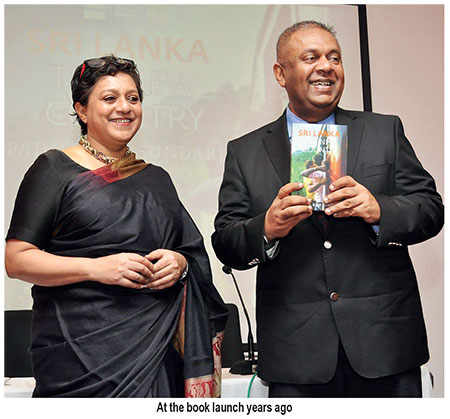
Some books are hard to put down. This one certainly is. Published in 2015, a pivotal year if ever there was one for Sri Lanka’s post-independence and post-war history, Sri Lanka: The New Country reflects on the country and its people. It’s not slim, but it’s lucid, and it dwells at considerable length on what Sri Lankans think about being Sri Lankan. Packed with sharp insights and observations, it’s at once travelogue and political narrative. Sunderji does her best to cut to the chase, getting to the heart of the matter wherever she is. That reflects her deeply sincere love for the country, a love she underscores frequently before explaining her connection to an island that seems like her surrogate motherland.
I felt intrigued by the title of the book. For many foreign commentators, post-2009 was an era of much transformation in Sri Lanka, politically and economically. Yet, in the minds of those among them who had dismissed Sri Lanka as a failed state, a nation arising from the ashes of war but incapable of making peace with itself, this new era did not merit a definite article: for them, Sri Lanka after 2009 was just another new country, no different to others that had won wars but lost the peace. Sunderji, however, inserts a definite article: Sri Lanka, for her, is THE new country: unique, hopeful, free of the burdens of the past.
In her preface, Suderji admits that she aims “at affording readers interested in Sri Lanka an opportunity to hear the other side.” What is this other side? “Sri Lanka’s army generals, its president, its new chief minister of the Northern Province, and more importantly, ordinary Sinhalese and Tamil citizens rebuilding their lives.” A not so modest goal, though she herself downplays the scope of her work by calling it “a collection of stories.” The conviction comes through no matter who she’s interviewing and talking to. Not surprisingly perhaps, the best parts of the book are those where she engages with ordinary people and soldiers, instead of the usually motley crew of politicians, governors, and bureaucrats.
The importance of Sunderji’s contribution cannot be understated. Until the publication of this book, most narratives about Sri Lanka and its post-war phase revolved around its failure to clinch peace, its obsession with infrastructural growth, and its consolidation of an ethno- nationalist political consciousness. Sunderji does not, to her credit, downplay or deny these realities. Yet, she points out that Sri Lanka after the war is much, much more than what most commentators prefer to see. Along the way, she criticises foreign correspondents, especially those who report from the confines of a hotel or another country, for propounding false and mischievously erroneous stereotypes about what’s happening in Sri Lanka.
“I knew from previous experiences that many Western journalists – and NGOs – had repeatedly arrived in Sri Lanka as ‘tourists’ and then proceeded to write damning, unsubstantiated reports on the country. Most did so from the veranda of the Galle Face Hotel in balmy Colombo, of course, for setting foot in the north and north-east would have been too conspicuous, given the widespread presence of the army.”
It’s because of these transgressions that Sunderji does everything she can to ensure her independence as an observer in Sri Lanka. Though cautioned against visiting the island, she finds her transit and her travels here a relatively peaceful affair, barring an altercation at a military checkpoint. Elsewhere, be it an interview with the President, a conversation with a Tamil Buddhist evangelist figure in the north, or a Skype chat with someone calling himself the heir to an ancient Jaffna dynasty, the Aryacakravartis, she blends into the world around her. These embolden her to reflect anecdotally on otherwise trivial matters, like the quality of service at military run hotels in the north and north-east.

Even here, the critique is fair: Sunderji does not vilifying an otherwise heavily vilified outfit, the Sri Lankan army, the way it has been and continues to be by other commentators. It is for this reason that her interviews with soldiers and majors resonate so well: she does not judge or editorialise their replies, but lets them have their say. Offering them the benefit of the doubt, she draws a more complex picture of the relationship between the military, the political system, and the people on the ground in the north and north-east.
Consequently, the conclusions she draws are not only fresh but also unbiased. For instance, she points out clearly that the Channel 4 documentary, Sri Lanka’s Killing Fields, despite how its narrative was accepted everywhere, never substantiated its claim of 40,000 civilians killed by the military towards the end of the war: “it surprised me that the allegations by a solitary television channel were unquestioningly picked up and reproduced.”
The Sri Lanka that emerges from such reports, naturally, are both colourful and colourless: they reduce the island to a bloody teardrop (the teardrop association, not surprisingly, exasperates her: it simplifies an otherwise complicated country and terrain) with the same old, overused, hackneyed, much hyped dichotomies: Sinhala versus Tamil, Buddhist versus Hindu. As Janaka Perera put it in a response to an article by Robert Kaplan in The Atlantic (“Buddha’s Savage Peace”), violence in Sri Lanka was never linked to a religious crisis, since there was much syncretism between Buddhism and Hinduism.
Given the prevalence of such barely concealed simplifications and falsifications, then, is it any wonder that we still come across lies propagated by media reports in globally renowned publications? Such falsifications are not the preserve of foreigners only, since publications have local correspondents based in “balmy Colombo”, who still cave in to the exigencies of Western editors. That is why Sunderji, who willingly describes herself as an “outsider” at several points in her book, attempts to keep up a narrative that neither plays to the gallery nor subsumes the Sri Lankan experience within her own narrow encounters.
What keeps her book alive is her interest in reconciling, rather than differentiating between, the many polarities which have magnified and telescoped in Sri Lanka. Given the country’s size, it comes to little or no surprise that an ethnic crisis should turn into an ethnic conflict within the space of a few years. But perhaps the biggest factor which helped turn that crisis into a conflict were the many mis-comparisons made by foreign observers.
Not even John Pilger, that most prolific of commentators, who has frequently exposed the underside of Western media, can desist from comparing the Sri Lankan separatist conflict to Israel’s occupation of Palestine, forgetting that while Israel and Palestine have significant and sizeable populations in the region and elsewhere, in Sri Lanka the ethnic majority, the Sinhalese, happen to be a global minority, while the “occupied” minority, the Tamil, make up a global majority: a point Dayan Jayatilleka has made in Long War, Cold Peace.
At present, then, what we need is a book that brings together, not keeps apart, differences. As of now, Padma Rao Sunderji’s book fulfils that task beautifully. It is richly detailed, lucid, and not a little evocative: written from the head, as well as the heart.
The writer can be reached at udakdev1@gmail.com