Features
Origin story that provides closure

Black Widow
By Tharish Hewavithanagamage
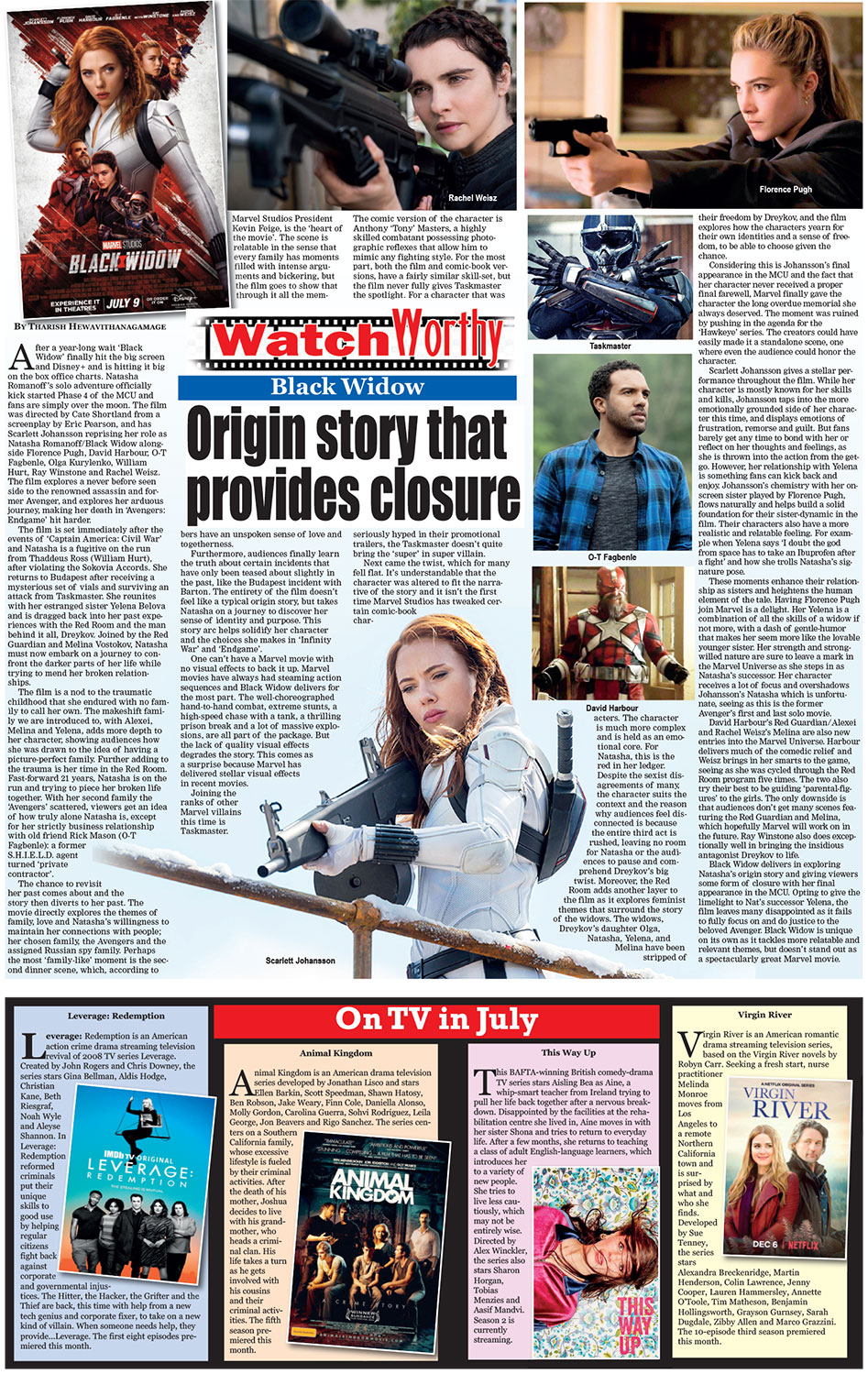
After a year-long wait ‘Black Widow’ finally hit the big screen and Disney+ and is hitting it big on the box office charts. Natasha Romanoff’s solo adventure officially kick started Phase 4 of the MCU and fans are simply over the moon. The film was directed by Cate Shortland from a screenplay by Eric Pearson, and has Scarlett Johansson reprising her role as Natasha Romanoff/Black Widow alongside Florence Pugh, David Harbour, O-T Fagbenle, Olga Kurylenko, William Hurt, Ray Winstone and Rachel Weisz. The film explores a never before seen side to the renowned assassin and former Avenger, and explores her arduous journey, making her death in ‘Avengers: Endgame’ hit harder.
The film is set immediately after the events of ‘Captain America: Civil War’ and Natasha is a fugitive on the run from Thaddeus Ross (William Hurt), after violating the Sokovia Accords. She returns to Budapest after receiving a mysterious set of vials and surviving an attack from Taskmaster. She reunites with her estranged sister Yelena Belova and is dragged back into her past experiences with the Red Room and the man behind it all, Dreykov. Joined by the Red Guardian and Melina Vostokov, Natasha must now embark on a journey to confront the darker parts of her life while trying to mend her broken relationships.
The film is a nod to the traumatic childhood that she endured with no family to call her own. The makeshift family we are introduced to, with Alexei, Melina and Yelena, adds more depth to her character, showing audiences how she was drawn to the idea of having a picture-perfect family. Further adding to the trauma is her time in the Red Room. Fast-forward 21 years, Natasha is on the run and trying to piece her broken life together. With her second family the ‘Avengers’ scattered, viewers get an idea of how truly alone Natasha is, except for her strictly business relationship with old friend Rick Mason (O-T Fagbenle): a former S.H.I.E.L.D. agent turned ‘private contractor’.
The chance to revisit her past comes about and the story then diverts to her past. The movie directly explores the themes of family, love and Natasha’s willingness to maintain her connections with people; her chosen family, the Avengers and the assigned Russian spy family. Perhaps the most ‘family-like’ moment is the second dinner scene, which, according to Marvel Studios President Kevin Feige, is the ‘heart of the movie’. The scene is relatable in the sense that every family has moments filled with intense arguments and bickering, but the film goes to show that through it all the members have an unspoken sense of love and togetherness.
Furthermore, audiences finally learn the truth about certain incidents that have only been teased about slightly in the past, like the Budapest incident with Barton. The entirety of the film doesn’t feel like a typical origin story, but takes Natasha on a journey to discover her sense of identity and purpose. This story arc helps solidify her character and the choices she makes in ‘Infinity War’ and ‘Endgame’.
One can’t have a Marvel movie with no visual effects to back it up. Marvel movies have always had steaming action sequences and Black Widow delivers for the most part. The well-choreographed hand-to-hand combat, extreme stunts, a high-speed chase with a tank, a thrilling prison break and a lot of massive explosions, are all part of the package. But the lack of quality visual effects degrades the story. This comes as a surprise because Marvel has delivered stellar visual effects in recent movies.
Joining the ranks of other Marvel villains this time is Taskmaster. The comic version of the character is Anthony ‘Tony’ Masters, a highly skilled combatant possessing photographic reflexes that allow him to mimic any fighting style. For the most part, both the film and comic-book versions, have a fairly similar skill-set, but the film never fully gives Taskmaster the spotlight. For a character that was seriously hyped in their promotional trailers, the Taskmaster doesn’t quite bring the ‘super’ in super villain.
Next came the twist, which for many fell flat. It’s understandable that the character was altered to fit the narrative of the story and it isn’t the first time Marvel Studios has tweaked certain comic-book characters. The character is much more complex and is held as an emotional core. For Natasha, this is the red in her ledger. Despite the sexist disagreements of many, the character suits the context and the reason why audiences feel disconnected is because the entire third act is rushed, leaving no room for Natasha or the audiences to pause and comprehend Dreykov’s big twist. Moreover, the Red Room adds another layer to the film as it explores feminist themes that surround the story of the widows. The widows, Dreykov’s daughter Olga, Natasha, Yelena, and Melina have been stripped of their freedom by Dreykov, and the film explores how the characters yearn for their own identities and a sense of freedom, to be able to choose given the chance.
Considering this is Johansson’s final appearance in the MCU and the fact that her character never received a proper final farewell, Marvel finally gave the character the long overdue memorial she always deserved. The moment was ruined by pushing in the agenda for the ‘Hawkeye’ series. The creators could have easily made it a standalone scene, one where even the audience could honor the character.
Scarlett Johansson gives a stellar performance throughout the film. While her character is mostly known for her skills and kills, Johansson taps into the more emotionally grounded side of her character this time, and displays emotions of frustration, remorse and guilt. But fans barely get any time to bond with her or reflect on her thoughts and feelings, as she is thrown into the action from the get-go. However, her relationship with Yelena is something fans can kick back and enjoy. Johansson’s chemistry with her on-screen sister played by Florence Pugh, flows naturally and helps build a solid foundation for their sister-dynamic in the film. Their characters also have a more realistic and relatable feeling. For example when Yelena says ‘I doubt the god from space has to take an Ibuprofen after a fight’ and how she trolls Natasha’s signature pose.
These moments enhance their relationship as sisters and heightens the human element of the tale. Having Florence Pugh join Marvel is a delight. Her Yelena is a combination of all the skills of a widow if not more, with a dash of gentle-humor that makes her seem more like the lovable younger sister. Her strength and strong-willed nature are sure to leave a mark in the Marvel Universe as she steps in as Natasha’s successor. Her character receives a lot of focus and overshadows Johansson’s Natasha which is unfortunate, seeing as this is the former Avenger’s first and last solo movie.
David Harbour’s Red Guardian/Alexei and Rachel Weisz’s Melina are also new entries into the Marvel Universe. Harbour delivers much of the comedic relief and Weisz brings in her smarts to the game, seeing as she was cycled through the Red Room program five times. The two also try their best to be guiding ‘parental-figures’ to the girls. The only downside is that audiences don’t get many scenes featuring the Red Guardian and Melina, which hopefully Marvel will work on in the future. Ray Winstone also does exceptionally well in bringing the insidious antagonist Dreykov to life.
Black Widow delivers in exploring Natasha’s origin story and giving viewers some form of closure with her final appearance in the MCU. Opting to give the limelight to Nat’s successor Yelena, the film leaves many disappointed as it fails to fully focus on and do justice to the beloved Avenger. Black Widow is unique on its own as it tackles more relatable and relevant themes, but doesn’t stand out as a spectacularly great Marvel movie.