
Features
On a day like this 35 years ago INTAKE 20 was Commissioned

by Nilakshan Perera
On a day like this on Jan 18, 1985, some 35 years ago, there was a call for brave patriotic youth to come forward to lead soldiers to safeguard the Nation. A total of 1,039 applicants responded. After six interviews, young blood from leading schools who excelled in sports and extracurricular activities among others both at school and national level were selected. It was a unique achievement and indeed a tremendous honour for the selected 35 to gather at Army Headquarters.
After saying goodbye to our families, and knowing we had taken our first steps to embark on our chosen career, we knew that the future was not going to be a bed of roses but we were ready to take on this challenge. All 35 selected were turning their backs on cushy, white collar jobs in air-conditioned offices. They had answered the call from their hearts.
These cadets, promising future officers, were seated in an Army bus while their baggage in trunks was loaded into an Army 1210 Tata truck. We left Army HQ by 1730 hrs heading for Diyatalawa. It was around 0110 hrs next day when our journey came to an end near the Polo Grounds at Diyatalawa. This is the only natural playground in Sri Lanka used for rugby, soccer, and athletics with an adjoining golf course. It is also used as a small airfield for light aircraft. We were told the engine of the bus had overheated and the radiator was boiling and ordered by Staff Sgt Dharmasena of the Artillery Regiment and Sgt Piyasdasa of Gemunu Watch to debus as it would go no further.
To our surprise neither the bus nor the truck could be started. We assumed that this may have been due to continuous driving without a break for over six hours. Even though we were dressed in suits as we got off the bus, the temperature of 6-7o C virtually froze us in our tracks. No sooner we alighted from the bus we were asked to run to a place called Pandama, (Torch) which was the unique symbol of the Military Academy – a burning torch fixed atop a lamp-post. This eternal flame symbolizes life, dedication, and regenerative power.
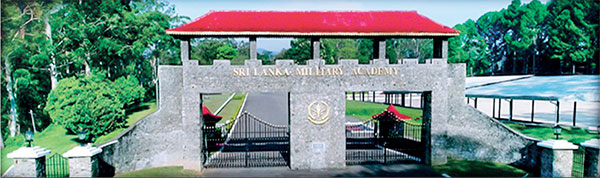
By this time all of us were shivering as we doubled past the main gate of the Sri Lanka Military Academy. We had fleeting glimpses of the parade ground that was shining with frosty dew. Beyond the ground we saw a huge Makara Thorana (Dragon Arch) past which newly commissioned young officers would march. Just as we reached the ‘Pandama’, the bus and the truck which were supposedly stalled, arrived miraculously! It was only when we were asked to unload our baggage that we realized that there was nothing wrong with the vehicles. They had only wanted us to enter the Military Academy on the double – a long-established tradition.
The full moon was shining brightly in a clear sky as it was a Poya day. We could see the surrounding area more clearly now. We were taken to a place called Beast Billet, which was to be our new “home” where our sleeping accommodation was located. There was a smart Warrant Officer (WO) who showed us the green bush and grass covered area adjoining the billet. He ordered us in a commanding tone to clean and have it neat and tidy next day (a Poya holiday) as he didn’t want to see any reptiles on the ground. He then asked us to go to sleep.
The next morning after breakfast we were asked to get into our PT kit. Sgt Piyadasa took us to Q (Quartermaster’s) stores and drew us tools such as mammoties, knives, grass cutters etc. to tidy the green area. Later in the evening the same Warrant Officer ordered us to be ready in full suit next morning as he was going to take us on our ‘camp tour’ .
This Warrant Officer 1 was Chandra Abeykoon, who had just returned from a Drill Instructor’s Training course at the Guards Depot at Pirbright in UK. His boots were polished to a mirror shine and his uniform was impeccable.
Next morning, we were dressed in full suit again and taken to Army QM stores. We were issued various items, such as mess tin, water bottle, cup and plate, ground sheet, boots, canvas shoes, blankets, beret, etc. We were asked to pack all these items into a duffle bag called ‘Ali Kakula’, as it resembled the leg of an elephant. We were then taken on the double on our ‘camp tour’ by WO1 Abeykoon, Staff Sgt Dharmasena, Sgt Piyadasa, Sgt Wijeratne and PTI Cpl Mendis. We were shown the boundaries of the Military Academy and the out of bounds areas, recreational grounds, cinema hall, polo grounds, Halangoda Lake, White Gate (a small white gate leading to the officers’ mess of the Gemunu Watch at the top of a hill above the polo grounds. The whole tour was done on the double, and that was how we moved for the next six months – no walking. We had to be alert and keen. Everywhere we went we had to go on the double, sometimes doing forward rolls (a rolling mode of moving) too.
Our Chief Instructor was Maj Nihal Marambe of the Armoured Corps and our first Course Commander was Major Gamini Balasuriya, also of the Armoured Corps, and later Capt Rohan Induruwa from Sinha Regiment,
Our billet was called Beast Billet. As the name implies, we were fondly taken for beasts. There was no relaxing and we were always on the move from one task to another. Our only consolation was to receive an occasional letter from home. From the Beast Billet we could clearly see three railway stations on mist free nights. These were Idalgasshinna, Haputale and Diyatalawa. We often imagined that we were seated in the train and going home on vacation and a few of us sometimes became emotional. We waited to hear the train approaching through the hills of Idalgasshinna. Early in the morning when we getting ready for PT, we could see it moving slowly like several boxes of matches coupled together and we knew that letters for us would be by delivered by afternoon. The same way our letters home would be carried in the night mail train leaving Diyatalawa every evening at 1940 hrs.
It was a part of the Duty Orderly Cadet’s tasks to collect the daily mail from the office and to hand over any mail that was to be posted. All of us were delighted to receive a letter or two from home. While those of us who got mail were rejuvenated, the few who didn’t were dejected. Getting letters was one of the few joys of life we enjoyed at that time.
We were taken for physical training, drill and weapon training, map reading, field craft, and tactics during morning sessions. In the afternoon we were taught leadership, military law, current affairs and English. We were taught Tamil by a civilian teacher from Bandarawela, our only civilian teacher, and we were very relaxed and enjoyed his lessons. We had plenty of recreational facilities and games in the evening.
During the next few weeks, we were transformed from raw young men into tough military personnel and made ready to face the future. We never dreamed of a good, cozy night’s sleep in the cool of Diyatalawa because we never knew what would come next. No two nights were the same. Soon we were well prepared for whatever came, sometimes even being mocked at or ostracized.
At the end of six months we had passed our Drill and PT tests. These included several changing parades in front of Senior Intake 18A and later Intake 19, before we could go out. They checked our attire – blazer, slacks, shirt, tie, belt, shoes, and socks to ensure they matched. We were properly shaved and generally well groomed. We flocked to Bandarawela Town like homing pigeons. Some of us were at restaurants, some went to tailor shops and few went to Cyril Studio to have their photos taken. And then all of us made a beeline to the Bandarawela Post Office to make telephone calls home and to friends. There were no pay phones then in the Academy, Mobile phones, WhatsApp, Viber, Facebook, Twitter, Instagram etc. were not even in the lexicon. Wherever we went we had to walk in step and in pairs. We never knew who would report wrongdoings to SLMA. The whole town knew we were cadets from the Academy.
To our great delight we soon got to share rooms with a batch mate. We had our first seven-day vacation after passing the drill and PT test. However, during this vacation each of us had to research material for our Leadership Presentations of famous political, military, and historical figures. We were expected to be ready with view files, photographs, scripts, slides, and booklets. We had to soldier through endless pages to gather the necessary information. There was no Google those days and it was a nightmare to prepare and make presentations to the instructor officers in a series of repeated sessions lasting till midnight. But the knowledge gained and efforts made were invaluable later in our lives.
Intake 19 passed out in November 1985 and we now became the Senior Intake. We were assigned individual rooms. There was Lady Intake 3, SSC (Short Service Commission) Intake 5,6,7,8 with Intake 22 & 23. There were seven Service Cadets from KDA who after completing their three and half year University degree cum military training joined us for their final term.
By this time Intake 20 was under the watchful eyes of new Course Commander Capt Jayavi Fernando from Gajaba Regiment, an amazing military man who had achieved many firsts in his career. History records he always placed his boundless talents at the service of the Army whenever duty called. He never dodged a responsibility, never refused to take on a hard task if it had to be done. What he believed, he believed with heart and soul. In brief, he was a patriotic and distinguished military officer, a natural leader, and an affectionate brother to all servicemen. He was loved and admired by all his superiors, colleagues and subordinates. His premature retirement as Colonel on Oct 31, 1998 was a great blow to the Army.
We were taken for firing practice including night firing to the Firing Range on various occasions as it was a part and parcel of our training. During our moves by truck to the firing range and at the Cadets’ Mess after dinner we used to sing popular Sinhala songs songs like Ae NeelaWara Peerala by Dhanapala Udawatte & ThilineLesin by Three Sisters and Asoka Mal by MS Fernando.
We went on field exercises to the landmark Foxhill area for Exercises Seetha Sulang and Grave Digger at Gurutalawa and to Ambewela for Frozen Trout living in trenches on the last exercise for six days with leeches for company and misty continuous drizzling and unpredictably cold weather. We then had Exercise Wanabambara in the dense jungles off Wellawaya for 14 days. Then Exercise God King in Kataragama. During Exercise Scorpion we practiced enforcing curfews in Welimada/Keppettipola area and searching for and detecting mock insurgents.
Our parents were invited on Parents’ Day in February for a full day program to observe their sons’ progress and development in their budding military careers.
With lot of endurance and enthusiasm we ran nine miles three times with our rifle, full water bottle (from which we could not take even a sip) and 20 kgs kit in our battle order packs along the Bandarawela/Welimada Road crossing the bridge and passing Bandarawela town, Kahagolla, and the Ceylon Volunteer Force camp to the Academy Gym.
The Intake 20 boxing meet was held on April 11, 1986, at the gymnasium. We were matched according to our weights and boxed each other with gusto. It is no friendly Charlie Charlie game; we were told to draw blood from our opponent. All Officer Instructors of SLMA, Capt Rohan Jayasinghe, Capt Jagath Rambukpotha, Capt Aruna Wijenayake, and Lt Mahesh Senanayake acted as judges. Commandant Col Rohan de S Daluwatte was the Chief Guest.
On Vesak Poya night, after dinner some trainee teachers from Bandarawela performed Bhakthi Gee for us at the Cadets’ Mess. Soon after they left a few of us sought permission from the Course Officer to go out to see the Vesak decorations. We didn’t get that permission but the whole Intake was made to circle the Cadet’s Mess singing Bhakthi Gee, This went on non-stop for three or four hours. No one ever after requested permission to go out to see Vesak illuminations!
In May we were taken on Unit visits. We were all stationed at Kotelawala Defence Academy for eight days during which we visited all unit HQs in Colombo and Panagoda. On our return, we were given motorcycle riding lessons at Polo grounds in the mornings as we prepared for the Commissioning Parade on May 31.
Four years after Intake 16 we were greatly honoured to have an Under Officer appointed from our batch. That was Wipula Seneviratne, as he came first in the order of merit. For our Commissioning Parade Gen Denis Perera, the first Commandant of Army Training Center and former Army Commander, took the salute.
After Commissioning as 2nd Lieutenants, we were taken to Maduru Oya for further Infantry training and then went on to our respective Units.
2/Lt Wipula Seneviratne and 2/Lt Prasanna Perera, the first two in our intake were selected to go to the Royal Military Academy, Sandhurst, in UK for further training. It was another unique achievement for Intake 20 as these two were the first to go to Sandhurst after a lapse of several years.
During this time, all our batch mates were in the thick of military operations in the North or the East. With deep sorrow and highest gratitude, we recall the names of our beloved batch mates who made the supreme sacrifice in defending Mother Lanka for future generations.
They were Lt Sanath Samarakoon GW (27/08/1986 Nillaweli), Lt Ananda De Silva SLA (07/10/1987-Mannar), Capt Wipula Seneviratne SLA (15/04/1988 Athurugiriya), Maj Prasanna Liyanagoda VIR (30/07/1990 – Mannar), Maj Devamiththa Dissanayake GW (01/05/1991 -Trincomalee), Lt Col B C K L Silva SLLI (13/09/1995 – Plane Crash/Kandana), Lt Col Shantha Jayaweera SLLI (17/11/1995 Jaffna) Maj Srinath Wickramasinghe SLLI (26/12/2007 Tsunami/Thelwatte), — Maj Ravi Dissanayake SLASC (20/07/2018 – Military Hospital.
When we look back, we could say with humility and pride that we served as soldiers and fought for our country with utmost dedication and commitment, in the jungles, plains, hills and valleys. We had seen our comrades lay down their lives, suffered setbacks and finally achieved victory under extremely challenging conditions.
As Intake 20 celebrated their 35th anniversary on 31 May as Commissioned Officers, let me salute all our dear batchmates who have laid down their lives for our future generations. May your journey in Samsara be short, May you all finally attain Supreme bliss of Nibbana and Rest in Peace eternal.
And best wishes to all my batch mates in their future endeavors






by Dr Gotabhya Ranasinghe
Senior Consultant Cardiologist
National Hospital Sri Lanka
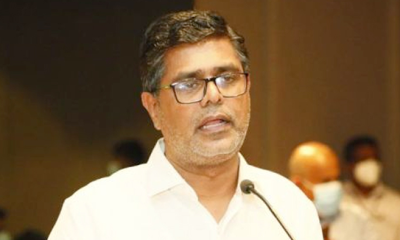
When we sought a meeting with Hon Dr. Ramesh Pathirana, Minister of Health, he graciously cleared his busy schedule to accommodate us. Renowned for his attentive listening and deep understanding, Minister Pathirana is dedicated to advancing the health sector. His openness and transparency exemplify the qualities of an exemplary politician and minister.
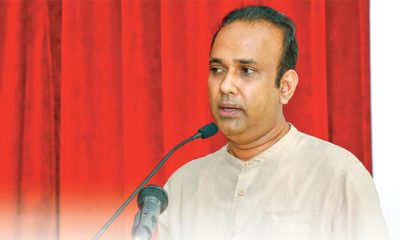
Dr. Palitha Mahipala, the current Health Secretary, demonstrates both commendable enthusiasm and unwavering support. This combination of attributes makes him a highly compatible colleague for the esteemed Minister of Health.
Our discussion centered on a project that has been in the works for the past 30 years, one that no other minister had managed to advance.
Minister Pathirana, however, recognized the project’s significance and its potential to revolutionize care for heart patients.
The project involves the construction of a state-of-the-art facility at the premises of the National Hospital Colombo. The project’s location within the premises of the National Hospital underscores its importance and relevance to the healthcare infrastructure of the nation.
This facility will include a cardiology building and a tertiary care center, equipped with the latest technology to handle and treat all types of heart-related conditions and surgeries.
Securing funding was a major milestone for this initiative. Minister Pathirana successfully obtained approval for a $40 billion loan from the Asian Development Bank. With the funding in place, the foundation stone is scheduled to be laid in September this year, and construction will begin in January 2025.
This project guarantees a consistent and uninterrupted supply of stents and related medications for heart patients. As a result, patients will have timely access to essential medical supplies during their treatment and recovery. By securing these critical resources, the project aims to enhance patient outcomes, minimize treatment delays, and maintain the highest standards of cardiac care.
Upon its fruition, this monumental building will serve as a beacon of hope and healing, symbolizing the unwavering dedication to improving patient outcomes and fostering a healthier society.We anticipate a future marked by significant progress and positive outcomes in Sri Lanka’s cardiovascular treatment landscape within the foreseeable timeframe.

by Fr. Emmanuel Fernando, OMI
Jesuit Fr. Aloysius Pieris (affectionately called Fr. Aloy) celebrated his 90th birthday on April 9, 2024 and I, as the editor of our Oblate Journal, THE MISSIONARY OBLATE had gone to press by that time. Immediately I decided to publish an article, appreciating the untiring selfless services he continues to offer for inter-Faith dialogue, the renewal of the Catholic Church, his concern for the poor and the suffering Sri Lankan masses and to me, the present writer.
It was in 1988, when I was appointed Director of the Oblate Scholastics at Ampitiya by the then Oblate Provincial Fr. Anselm Silva, that I came to know Fr. Aloy more closely. Knowing well his expertise in matters spiritual, theological, Indological and pastoral, and with the collaborative spirit of my companion-formators, our Oblate Scholastics were sent to Tulana, the Research and Encounter Centre, Kelaniya, of which he is the Founder-Director, for ‘exposure-programmes’ on matters spiritual, biblical, theological and pastoral. Some of these dimensions according to my view and that of my companion-formators, were not available at the National Seminary, Ampitiya.
Ever since that time, our Oblate formators/ accompaniers at the Oblate Scholasticate, Ampitiya , have continued to send our Oblate Scholastics to Tulana Centre for deepening their insights and convictions regarding matters needed to serve the people in today’s context. Fr. Aloy also had tried very enthusiastically with the Oblate team headed by Frs. Oswald Firth and Clement Waidyasekara to begin a Theologate, directed by the Religious Congregations in Sri Lanka, for the contextual formation/ accompaniment of their members. It should very well be a desired goal of the Leaders / Provincials of the Religious Congregations.
Besides being a formator/accompanier at the Oblate Scholasticate, I was entrusted also with the task of editing and publishing our Oblate journal, ‘The Missionary Oblate’. To maintain the quality of the journal I continue to depend on Fr. Aloy for his thought-provoking and stimulating articles on Biblical Spirituality, Biblical Theology and Ecclesiology. I am very grateful to him for his generous assistance. Of late, his writings on renewal of the Church, initiated by Pope St. John XX111 and continued by Pope Francis through the Synodal path, published in our Oblate journal, enable our readers to focus their attention also on the needed renewal in the Catholic Church in Sri Lanka. Fr. Aloy appreciated very much the Synodal path adopted by the Jesuit Pope Francis for the renewal of the Church, rooted very much on prayerful discernment. In my Religious and presbyteral life, Fr.Aloy continues to be my spiritual animator / guide and ongoing formator / acccompanier.
Fr. Aloysius Pieris, BA Hons (Lond), LPh (SHC, India), STL (PFT, Naples), PhD (SLU/VC), ThD (Tilburg), D.Ltt (KU), has been one of the eminent Asian theologians well recognized internationally and one who has lectured and held visiting chairs in many universities both in the West and in the East. Many members of Religious Congregations from Asian countries have benefited from his lectures and guidance in the East Asian Pastoral Institute (EAPI) in Manila, Philippines. He had been a Theologian consulted by the Federation of Asian Bishops’ Conferences for many years. During his professorship at the Gregorian University in Rome, he was called to be a member of a special group of advisers on other religions consulted by Pope Paul VI.
Fr. Aloy is the author of more than 30 books and well over 500 Research Papers. Some of his books and articles have been translated and published in several countries. Among those books, one can find the following: 1) The Genesis of an Asian Theology of Liberation (An Autobiographical Excursus on the Art of Theologising in Asia, 2) An Asian Theology of Liberation, 3) Providential Timeliness of Vatican 11 (a long-overdue halt to a scandalous millennium, 4) Give Vatican 11 a chance, 5) Leadership in the Church, 6) Relishing our faith in working for justice (Themes for study and discussion), 7) A Message meant mainly, not exclusively for Jesuits (Background information necessary for helping Francis renew the Church), 8) Lent in Lanka (Reflections and Resolutions, 9) Love meets wisdom (A Christian Experience of Buddhism, 10) Fire and Water 11) God’s Reign for God’s poor, 12) Our Unhiddden Agenda (How we Jesuits work, pray and form our men). He is also the Editor of two journals, Vagdevi, Journal of Religious Reflection and Dialogue, New Series.
Fr. Aloy has a BA in Pali and Sanskrit from the University of London and a Ph.D in Buddhist Philosophy from the University of Sri Lankan, Vidyodaya Campus. On Nov. 23, 2019, he was awarded the prestigious honorary Doctorate of Literature (D.Litt) by the Chancellor of the University of Kelaniya, the Most Venerable Welamitiyawe Dharmakirthi Sri Kusala Dhamma Thera.
Fr. Aloy continues to be a promoter of Gospel values and virtues. Justice as a constitutive dimension of love and social concern for the downtrodden masses are very much noted in his life and work. He had very much appreciated the commitment of the late Fr. Joseph (Joe) Fernando, the National Director of the Social and Economic Centre (SEDEC) for the poor.
In Sri Lanka, a few religious Congregations – the Good Shepherd Sisters, the Christian Brothers, the Marist Brothers and the Oblates – have invited him to animate their members especially during their Provincial Congresses, Chapters and International Conferences. The mainline Christian Churches also have sought his advice and followed his seminars. I, for one, regret very much, that the Sri Lankan authorities of the Catholic Church –today’s Hierarchy—- have not sought Fr.
Aloy’s expertise for the renewal of the Catholic Church in Sri Lanka and thus have not benefited from the immense store of wisdom and insight that he can offer to our local Church while the Sri Lankan bishops who governed the Catholic church in the immediate aftermath of the Second Vatican Council (Edmund Fernando OMI, Anthony de Saram, Leo Nanayakkara OSB, Frank Marcus Fernando, Paul Perera,) visited him and consulted him on many matters. Among the Tamil Bishops, Bishop Rayappu Joseph was keeping close contact with him and Bishop J. Deogupillai hosted him and his team visiting him after the horrible Black July massacre of Tamils.
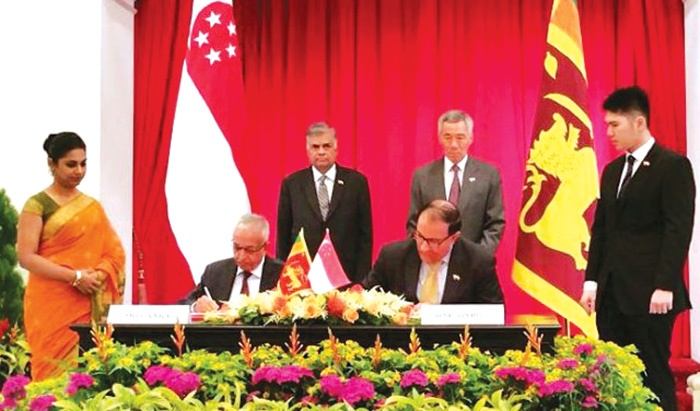
Sri Lanka-Singapore Free Trade Agreement
By Gomi Senadhira
senadhiragomi@gmail.com
“You might tell fairy tales, but the progress of a country cannot be achieved through such narratives. A country cannot be developed by making false promises. The country moved backward because of the electoral promises made by political parties throughout time. We have witnessed that the ultimate result of this is the country becoming bankrupt. Unfortunately, many segments of the population have not come to realize this yet.” – President Ranil Wickremesinghe, 2024 Budget speech
Any Sri Lankan would agree with the above words of President Wickremesinghe on the false promises our politicians and officials make and the fairy tales they narrate which bankrupted this country. So, to understand this, let’s look at one such fairy tale with lots of false promises; Ranil Wickremesinghe’s greatest achievement in the area of international trade and investment promotion during the Yahapalana period, Sri Lanka-Singapore Free Trade Agreement (SLSFTA).
It is appropriate and timely to do it now as Finance Minister Wickremesinghe has just presented to parliament a bill on the National Policy on Economic Transformation which includes the establishment of an Office for International Trade and the Sri Lanka Institute of Economics and International Trade.
Was SLSFTA a “Cleverly negotiated Free Trade Agreement” as stated by the (former) Minister of Development Strategies and International Trade Malik Samarawickrama during the Parliamentary Debate on the SLSFTA in July 2018, or a colossal blunder covered up with lies, false promises, and fairy tales? After SLSFTA was signed there were a number of fairy tales published on this agreement by the Ministry of Development Strategies and International, Institute of Policy Studies, and others.
However, for this article, I would like to limit my comments to the speech by Minister Samarawickrama during the Parliamentary Debate, and the two most important areas in the agreement which were covered up with lies, fairy tales, and false promises, namely: revenue loss for Sri Lanka and Investment from Singapore. On the other important area, “Waste products dumping” I do not want to comment here as I have written extensively on the issue.
1. The revenue loss
During the Parliamentary Debate in July 2018, Minister Samarawickrama stated “…. let me reiterate that this FTA with Singapore has been very cleverly negotiated by us…. The liberalisation programme under this FTA has been carefully designed to have the least impact on domestic industry and revenue collection. We have included all revenue sensitive items in the negative list of items which will not be subject to removal of tariff. Therefore, 97.8% revenue from Customs duty is protected. Our tariff liberalisation will take place over a period of 12-15 years! In fact, the revenue earned through tariffs on goods imported from Singapore last year was Rs. 35 billion.
The revenue loss for over the next 15 years due to the FTA is only Rs. 733 million– which when annualised, on average, is just Rs. 51 million. That is just 0.14% per year! So anyone who claims the Singapore FTA causes revenue loss to the Government cannot do basic arithmetic! Mr. Speaker, in conclusion, I call on my fellow members of this House – don’t mislead the public with baseless criticism that is not grounded in facts. Don’t look at petty politics and use these issues for your own political survival.”
I was surprised to read the minister’s speech because an article published in January 2018 in “The Straits Times“, based on information released by the Singaporean Negotiators stated, “…. With the FTA, tariff savings for Singapore exports are estimated to hit $10 million annually“.
As the annual tariff savings (that is the revenue loss for Sri Lanka) calculated by the Singaporean Negotiators, Singaporean $ 10 million (Sri Lankan rupees 1,200 million in 2018) was way above the rupees’ 733 million revenue loss for 15 years estimated by the Sri Lankan negotiators, it was clear to any observer that one of the parties to the agreement had not done the basic arithmetic!
Six years later, according to a report published by “The Morning” newspaper, speaking at the Committee on Public Finance (COPF) on 7th May 2024, Mr Samarawickrama’s chief trade negotiator K.J. Weerasinghehad had admitted “…. that forecasted revenue loss for the Government of Sri Lanka through the Singapore FTA is Rs. 450 million in 2023 and Rs. 1.3 billion in 2024.”
If these numbers are correct, as tariff liberalisation under the SLSFTA has just started, we will pass Rs 2 billion very soon. Then, the question is how Sri Lanka’s trade negotiators made such a colossal blunder. Didn’t they do their basic arithmetic? If they didn’t know how to do basic arithmetic they should have at least done their basic readings. For example, the headline of the article published in The Straits Times in January 2018 was “Singapore, Sri Lanka sign FTA, annual savings of $10m expected”.
Anyway, as Sri Lanka’s chief negotiator reiterated at the COPF meeting that “…. since 99% of the tariffs in Singapore have zero rates of duty, Sri Lanka has agreed on 80% tariff liberalisation over a period of 15 years while expecting Singapore investments to address the imbalance in trade,” let’s turn towards investment.
Investment from Singapore
In July 2018, speaking during the Parliamentary Debate on the FTA this is what Minister Malik Samarawickrama stated on investment from Singapore, “Already, thanks to this FTA, in just the past two-and-a-half months since the agreement came into effect we have received a proposal from Singapore for investment amounting to $ 14.8 billion in an oil refinery for export of petroleum products. In addition, we have proposals for a steel manufacturing plant for exports ($ 1 billion investment), flour milling plant ($ 50 million), sugar refinery ($ 200 million). This adds up to more than $ 16.05 billion in the pipeline on these projects alone.
And all of these projects will create thousands of more jobs for our people. In principle approval has already been granted by the BOI and the investors are awaiting the release of land the environmental approvals to commence the project.
I request the Opposition and those with vested interests to change their narrow-minded thinking and join us to develop our country. We must always look at what is best for the whole community, not just the few who may oppose. We owe it to our people to courageously take decisions that will change their lives for the better.”
According to the media report I quoted earlier, speaking at the Committee on Public Finance (COPF) Chief Negotiator Weerasinghe has admitted that Sri Lanka was not happy with overall Singapore investments that have come in the past few years in return for the trade liberalisation under the Singapore-Sri Lanka Free Trade Agreement. He has added that between 2021 and 2023 the total investment from Singapore had been around $162 million!
What happened to those projects worth $16 billion negotiated, thanks to the SLSFTA, in just the two-and-a-half months after the agreement came into effect and approved by the BOI? I do not know about the steel manufacturing plant for exports ($ 1 billion investment), flour milling plant ($ 50 million) and sugar refinery ($ 200 million).
However, story of the multibillion-dollar investment in the Petroleum Refinery unfolded in a manner that would qualify it as the best fairy tale with false promises presented by our politicians and the officials, prior to 2019 elections.
Though many Sri Lankans got to know, through the media which repeatedly highlighted a plethora of issues surrounding the project and the questionable credentials of the Singaporean investor, the construction work on the Mirrijiwela Oil Refinery along with the cement factory began on the24th of March 2019 with a bang and Minister Ranil Wickremesinghe and his ministers along with the foreign and local dignitaries laid the foundation stones.
That was few months before the 2019 Presidential elections. Inaugurating the construction work Prime Minister Ranil Wickremesinghe said the projects will create thousands of job opportunities in the area and surrounding districts.
The oil refinery, which was to be built over 200 acres of land, with the capacity to refine 200,000 barrels of crude oil per day, was to generate US$7 billion of exports and create 1,500 direct and 3,000 indirect jobs. The construction of the refinery was to be completed in 44 months. Four years later, in August 2023 the Cabinet of Ministers approved the proposal presented by President Ranil Wickremesinghe to cancel the agreement with the investors of the refinery as the project has not been implemented! Can they explain to the country how much money was wasted to produce that fairy tale?
It is obvious that the President, ministers, and officials had made huge blunders and had deliberately misled the public and the parliament on the revenue loss and potential investment from SLSFTA with fairy tales and false promises.
As the president himself said, a country cannot be developed by making false promises or with fairy tales and these false promises and fairy tales had bankrupted the country. “Unfortunately, many segments of the population have not come to realize this yet”.
(The writer, a specialist and an activist on trade and development issues . )



US sports envoys to Lanka to champion youth development

Rahuman questions sudden cancellation of leave of CEB employees


