
Features
Notes towards a politics and aesthetics of film:


‘Face Cover’ by Ashfaque Mohamed
“Black cat, at the tip of my
fingers pulsates poetry,
Desiring hands, yours, nudgingly pluck those roses of mine
In the soft light of the moon
The dreams we picked from the foaming edges of waves of the sea.”
Jusla/Salani (in Face Cover)
PART II
First part of this article appeared yesterday (01)
by Laleen Jayamanne
I personally loved wearing a veil to church, especially my Spanish-mantilla. And then I remembered how most of the paintings of the Virgin-Mother Mary in the European tradition have presented her with her head covered as was the custom of Middle Eastern peoples of the Book (Jews, Christians and Muslims), who lived in desert lands. It is/was a cultural practice of peoples of the desert, first and foremost, before the three Middle Eastern religions of ‘The Book’ took it up in their own creative ways. And now it strikes me as strange that we thought it quite normal and proper that our dear Roman Catholic nuns at school wore white layered ‘habits’ and covered their head and hair completely with a long black cotton veil. The forehead was also covered with a white band of cloth. Cultural habits need so much contextualisation to comprehend in our globalised world with instant manufacture of opinion.
But the Persian theosophical idea of the ‘veil’ as a subtilisation of matter is a rich source for imagining the film image/sound, beyond its capitalist market value as a commodity that controls and extracts our sensations for profit. Henry Corbin, the celebrated Professor of Islam at the Sorbonne University in Paris and Teheran University, spent much of his life translating and editing the work of the Iranian theosophist/mystic Suhrawardi (1154-1191). Suhrawardi’s work offer glimpses of such a cosmoscentric-image, suspended, he says, as in a mirror, between the purely empirical sense perception and the purely intellectually abstract domain. Great filmmakers like Sergei Paradyanov reached towards such a vision of film in his last film Ashik Kerib, about a Sufi Minstrel’s wanderings across the deeply multi-cultural, war-torn, Caucasus where Christians and Muslims were killing each other in the name of their own religions. The scholarly literature on Henri Corbin refers to him as a mystic, while his guru Suhrawardi the Sufi mystic, was executed as a heretic. In recent times the shrines of popular Sufi saints have been desecrated in Pakistan and the followers subjected to violence by Islamic Fundamentalist who believe in the letter of the law rather than in its spirit.
One might then ask, towards what does Ashfaque’s film lure us, through an oblique use of the vernacular title? It takes us to the heart of a relationship between a young Muslim woman and her older and rather weary, but utterly devoted mother, played (as one Indian film distributor put it), ‘soulfully’, by Professor Sumathy Sivamohan, a Tamil. I thought this is worth mentioning, given the themes of the film. And through the intimacy of the mother-daughter relationship in their home, we who are Sinhala outsiders, are also made more receptive to look, listen and understand the recent micro-histories of the densely populated Muslim township of Kattankudy. We learn that it is a township of a majority of Muslim people who have suffered a great deal of violence during the civil war (caught between, the LTTE, IPKF and the Lankan army), and in its difficult aftermath, in the context of the 2019 Easter Sunday Bombings of churches and hotel across the country, by the ISIS influenced group, one of whom, Zaharan Hashim, was from this very place. In this film we experience the intricacies of ethnic relations from below, from where the suffering and violence are remembered and brought into speech, largely, but not only by women. Intra-ethnic sectarian and class conflicts among the Muslim populations are also brought into the discourse, not covered up. But the focus on the lives of several girls and that of the maternal figure anchors the film so that it can inter-weave their stories and cut-through laterally into the blood-soaked memories, without actually showing the violence enacted. This is an important political decision that several South Asian debut films at the festival have made. They testify to historical and current ongoing violence while refusing to represent it, show it. This is part of their politics.
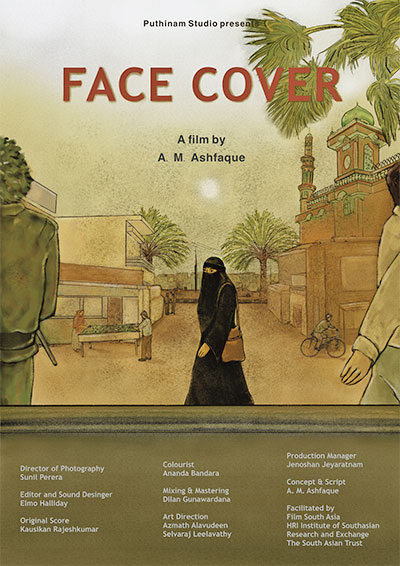 In the Lankan cinema, between 1947 to 1979, that I have studied, there has never been a feature film where the main protagonists are Muslim and set in a predominantly Muslim area. When a Muslim man occasionally appeared in a Sinhala film as a trader, it was more often than not as comic relief, making fun of the person’s accented Sinhala or his fez hat. Whereas, in Face Cover we have an entire Muslim community brought into focus through its young and older women and the elderly mother. This is a productive strategy because it allows Ashfaque to go right into the domestic sphere of women, the bedroom and kitchen as well, which he does with great tact as a Muslim ‘man with a movie-camera’. A surprising scene happens in the kitchen when the mother and a relative are preparing food packets for sale, it would appear, and gossiping about a potential suitor for Asifa. Hearing what is being said she comes in quietly and firmly tells her mother that she is not interested in a marriage to the man in question who drives the blue tuk tuk. The aunt, instead of addressing Asifa, tells the mother that it would be sensible to take up the offer because she has no help from a husband, as he is dead. Surprisingly, the mother sides with Asifa in saying, ‘he is short, I don’t think it will work’. This is delightfully modern dialogue, I think, assuming that the girl’s likes and dislikes do matter in the choice of a husband, in what we (Sinhala folk), tend to of think of as an ultra-traditional community. This strong point is made quietly, in understated humour, without any drama. And Asifa does get to marry the man of her choice (of a suitable height one imagines), despite initial objections from the boy’s more prosperous family.
The tact of Ashfaque’s camera is seen in the use of long to medium shots, in many scenes, even in emotional ones when a woman gives her personal testimony of the wrongful arrest of her husband for instance. The maintaining of a distance has an ethical force, though it is an actor who delivers the moving testimony, I learn later. Asifa who is seen wearing a head scarf at home is often filmed from either behind or from the side, sometimes her shadow, obliquely, in mid-to-close-shots and because of how she wears the head scarf her profile is not visible. At first, I was irritated by this but when it was repeated, while other young faces were quite visible, I came to realise that there were other values, rather than taboos, expressed in this oblique angle of the camera. As Jean Marie Straub, the great Marxist filmmaker, who recently died, said, where one places the camera is a political decision. Over the years, his films, made with his wife, the late Daniel Huillet, showed us how to understand this profound idea about the power built into the gaze of the camera. Ashfaque is from East Coast and has dedicated the film to his own mother, Ummu Rahuma. At times one feels that he might be filming his own mother in the way he collaborates with Sivamohan’s maternal figure. It is so very rare to see an older woman, who is a ‘house wife’, given so much screen time in the Lankan cinema and indeed in many other cinemas as well. Chantal Akerman’s classic feminist film Jean Dielman, 23 quai du Commerce, 1080 Bruxells (1975), comes to mind as a rare film centred on a house wife and her daily routines. Akerman said that it was made as a tribute to her mother and women like her. When the mother hears from Asifa that several bombs have gone off all over the island, she turns round and sits on the floor saying, ‘Those LTTE boys… More trouble for us!’, not remembering that the LTTE were defeated by the Lankan armed forces in 2009. Similarly, when Asifa shows her a Face Book video of the Supermarket scene where a Muslim girl is abused in Sinhala for wearing a mask, she looks at the cell phone for a while and returns it saying ‘I don’t understand…’ Despite this lack of connection with aspects of what’s going on politically around her, she tells her cousin regretfully that Asifa doesn’t have a Tamil friend, that she studied in a different school, a Muslim school. Then she says that they have lived there in Katankudy from very early times and for generations, when there was ‘no Muslim and Tamil, then’. These are communities where people of different ethnicities and religions have lived together for generations, peaceably, we learn.
So, I am wondering what sort of politics this film explores and brings forth within a blood- soaked history and memory of a town, (Kattankudy), a region (Batticoloa), and a country (Lanka). There is no militant gesture linked to big ‘P’ politics in the film but the effects of the civil war have marked people and they offer their thoughts and memories to the camera as witnesses to past crime whose effects are still felt. The attentive camera is a witness here, a part of its politics. An Imam of a large mosque speaks of the massacre that occurred there by LTTE gunmen, while the devotees were at prayer, on August 3, 1990, which he considers an event of world historical significance, as we are shown black & white photographs of dead bodies splattered in blood. The bullet holes on the walls of the mosque still remain as testimony to that crime.
*****
There is nearly a hundred-year history to the idea of ‘political cinema,’ linked to the State in the former Soviet Union. The first generation of Soviet filmmakers were all supporters of the Bolshevik revolution and tried in their own unique ways to both theorise their practice and also develop political films with vitality and imagination, perceptible even now. They also taught at the Soviet film school, the first of its kind in the world. Lenin famously said, ‘Of all the Arts, film is the most important one for us’, because of the large illiterate peasantry in Russia who he thought could be educated by filmed history of the revolution and its hopes for the future. Eisenstein, Pudovkin, Vertov, Dovzenko are among the most illustrious of Soviet filmmakers of the silent era, who made films to promote the revolution and its ideals in its several facets. More often than not their political sympathies are clearly stated in their films but they had very different, competing ideas, of how to make them, as is evident in their theories of Montage which has created a theoretical lineage with a deep history still alive.
The great Latin American film manifestoes from Argentina, Brazil and Cuba also promoted an explicit political activist cinema in the 1960s. Each of these countries issued Cine-Manifestoes (Towards a 3rd Cinema, Aesthetics of Hunger, Towards a Poor Cinema) declaring programmatically the kind of political cinema they wished to create, sometimes against great odds, fighting military rule. We don’t have such well formulated traditions of political cinema. In India Ritwick Ghatak was the key figure in developing ideas of political cinema by using Bengali traditions in tune with Brechtian Marxist ideas as well. He taught film making at the Pune film school and wrote about it as well. But Lankan cinema has evolved to engage critically with the social and political life of the country at least since the pioneering work of Dharmasena Pathiraja in the early 1970s, with Ahas Gaua (1971) and Ponmani (1987, Tamil).
What appears to be special in the digital era of filmmaking in South Asia, especially, is the relatively easy access to the technology and technical knowledge now and the evolution of film cultures and festivals across South Asia and elsewhere which have created a new cinematic public sphere, more democratically global than before. I hope there is also well thought out theoretical-critical writing that can feed into filmmaking practices so they can improve and imagine what is impossible. Also, studying film histories is essential and now so easily accessible as well. Cultural memory is sustained through writing because film festivals are intense events, but in their ephemerality, fade away.
******
Ashfaque’s Tracking-Shots:
Walking and Driving
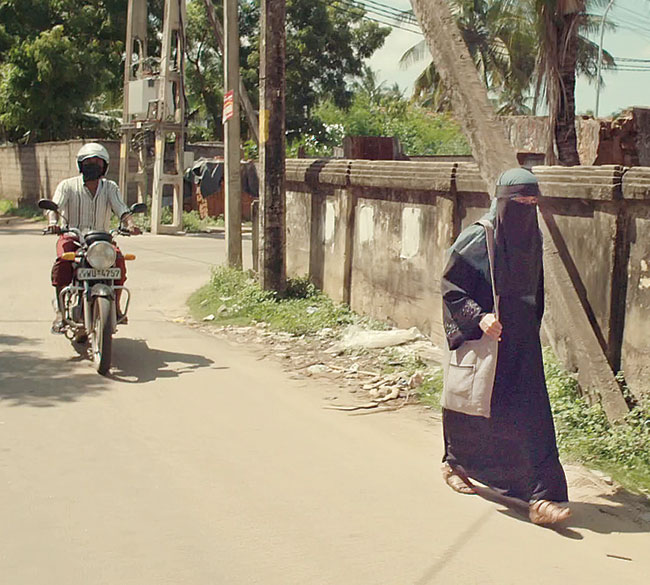
asifa
There is a sense of freedom of movement in Face Cover, in the way it’s filmed, which is surprising because of the immediate connotations of the title which conjures up a restriction on movement of girls. This is so also because of the cliches we have imbibed through the media, especially in the West, about what a Muslim woman is or what she can do in traditional Islamic cultures. Since 9/11 this hostile discourse on Islam has never ceased in the West. In Face Cover, at the end when the actress playing Asifa speaks as herself, unmasked, addressing us directly, about her character and her approach to the role, it is very surprising indeed. She introduces herself as a University student who has never acted and says that she didn’t think about her character much because she was told that the girl she played was an ordinary girl, not someone special. She also tells us that there are many cliches prevalent about what a Muslim girl or woman is. This self-reflexive discourse reconfigures the film in one’s mind. We then wonder which interviews were staged with actors and which are real people speaking of their personal experience. In luring us to do this the film gathers a density and richness such that the cliches we might have thought with, are dispelled or at the very least seen for what they are.
Women and girls are seen walking comfortably all over the town with relaxed ease, on beaches and on empty land with tall palm trees, and on streets, either by themselves or in twos. A small protest group of feminists carry lanterns and walk cross a bridge demanding an end to violence against women. We see a woman on a motor bicycle. Asifa’s mother is seen doing her daily routine to the shops, chatting with other women in passing. These movements form an integral part of the rhythm of the film. The other smooth, fast paced tracking-movement on main roads and in the suburbs are shot from a moving vehicle, while voice-overs narrate the numerous incidents of violence, internal displacement of Muslims by the LTTE for example and the difficulties of resettlement among Muslims who suspect them of Tiger sympathies. These broadly descriptive tracking shots give the film an elan, creating different rhythms from that of the tracking shots of walking and orient us spacially in the township. Sivamohan who was also a consultant on the film, uses the tracking shot stylistically, in her own films such as One Single Tumbler.
Cell Phones – Poetry – Bicycle Rides
The multiplicity of uses the cell phone is put to in the film is refreshing in its ability to shift our focus and sense of scale, casually. Asifa meets a boy on line and he proposes to her online and she has agreed to marry him and says so to the mother candidly, firmly and sweetly. She carries out a small business on line and of course chats with friends. The cell phone screen is shown in extreme close-up, of images of a girl wearing a head scarf but her face is cut in half by the framing and another of a full-face cover in black, which because of its enlarged scale, is quite a powerful image with only the eyes visible. They discuss the shaming of girls on Face Book and how it affects their reputations. But it is also shown as a portal, to by pass the patriarchal adult world of injunctions and restrictions that have proliferated since the remittance of wages and Wahabi Islamic ideas from Saudi Arabia began to arrive in the community and different Islamic associations are formed with varying ideologies. The cell phone’s use creates a sense of light humour too when the mother, standing outside her window, eavesdrops on a long girly chat between Asifa and a friend, about how she met her boyfriend.
A young woman poet introduces herself as Jusla and says she writes under the pen name of Salari. She recites a poem, seated near a man and a little girl. The young man who shyly listens to it is in fact her husband and the smiling little girl, her daughter. In one shot we see the husband seated near a vase of red flowers, listening pensively to his wife reading her poem and then there is an exchange between them. This intricate sequence of multiple shots of the poet and her young husband, is full of surprises about gender relations within a Muslim marriage and female creativity. I cite fragments from a poem Jusla recites, interspersed with bits of conversation with her husband, about her desire to write.
“All these poems were written before marriage…I had had dealings with some man before marriage. I want to talk about this poem in that connection;
Snakes Made of Glass!”
You speak slowly of who I am
(Jusla stands and then walks out of house as her voice-over continues the poem)
On the clothes hanger hangs a beautiful golden coloured pouch
I remember an intimacy swinging on that hanger.
(Husband seated at a table with a red vase of flowers, listening to the poem in VO)
It is the colour of the blue sea.
It was given to me for keeping small change and the phone card
(Jusla is now seated on a veranda in long shot, alone)
Overflowing with dreams
In the shape of an orange
And other sundry stuff
It is full of mysteries
It carries the memory of the man who struck me from behind
When he passed by
The beggar who caressed my hand when he received his coins”
(The two seated side by side)
“What have you written about me? Interesting stuff?” asks the husband smiling shyly, playfully.
Jusla laughs.
“It’s all good, People say they are good poems. I need to reengage with writing, only then will my mind be at peace. I need your permission. I have been waiting all this while for it.”
I have quoted from Jusla’s poem as a way of also remembering that Islam has given rise to so much love poetry in Urdu, in the Indian subcontinent alone. When artists in Delhi decided to create a response to anti-Muslim Hindutva violence in Gujarat, singers of Hindustani music and Muslim Ghazal singers sang together to a mass audience in Delhi.
Asifa’s Father
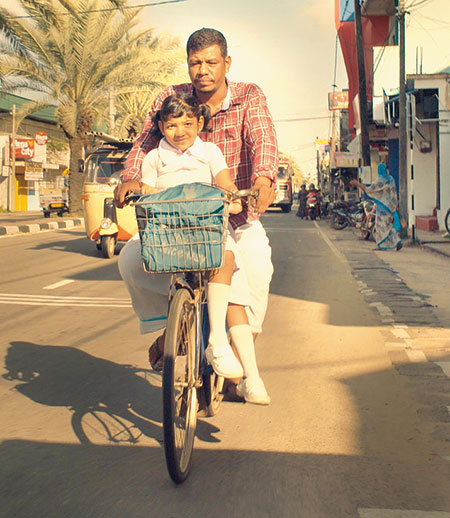
asifa and Father
I will conclude with, what for me, is the most poignant image in the film. It is seen at the beginning and at the end of the film, accompanied with the sound of a violin or sita. It’s that of the little Asifa in her white uniform, knee high socks and white shoes, riding on the bar of her father’s bicycle to school. A fluid frontal tracking shot on a busy road, shows the well-built man (now dead), protectively cycling his little girl to school. In its repetition, it appears as a singular poetic refrain resonating across the film we have just watched. Asifa’s mother should, however, have the last words. She tells her cousin who acts as the marriage broker, that Asifa will inherit the house as her dowery and when this appears insufficient, she says, quietly and poignently, ‘but she likes him’. At another time she says that, unlike herself, she wanted Asifa to become ‘somebody’ through education. And she discusses her employment prospects with care and the pragmatism of a worldly woman.



by Dr Gotabhya Ranasinghe
Senior Consultant Cardiologist
National Hospital Sri Lanka
When we sought a meeting with Hon Dr. Ramesh Pathirana, Minister of Health, he graciously cleared his busy schedule to accommodate us. Renowned for his attentive listening and deep understanding, Minister Pathirana is dedicated to advancing the health sector. His openness and transparency exemplify the qualities of an exemplary politician and minister.
Dr. Palitha Mahipala, the current Health Secretary, demonstrates both commendable enthusiasm and unwavering support. This combination of attributes makes him a highly compatible colleague for the esteemed Minister of Health.
Our discussion centered on a project that has been in the works for the past 30 years, one that no other minister had managed to advance.
Minister Pathirana, however, recognized the project’s significance and its potential to revolutionize care for heart patients.
The project involves the construction of a state-of-the-art facility at the premises of the National Hospital Colombo. The project’s location within the premises of the National Hospital underscores its importance and relevance to the healthcare infrastructure of the nation.
This facility will include a cardiology building and a tertiary care center, equipped with the latest technology to handle and treat all types of heart-related conditions and surgeries.
Securing funding was a major milestone for this initiative. Minister Pathirana successfully obtained approval for a $40 billion loan from the Asian Development Bank. With the funding in place, the foundation stone is scheduled to be laid in September this year, and construction will begin in January 2025.
This project guarantees a consistent and uninterrupted supply of stents and related medications for heart patients. As a result, patients will have timely access to essential medical supplies during their treatment and recovery. By securing these critical resources, the project aims to enhance patient outcomes, minimize treatment delays, and maintain the highest standards of cardiac care.
Upon its fruition, this monumental building will serve as a beacon of hope and healing, symbolizing the unwavering dedication to improving patient outcomes and fostering a healthier society.We anticipate a future marked by significant progress and positive outcomes in Sri Lanka’s cardiovascular treatment landscape within the foreseeable timeframe.

by Fr. Emmanuel Fernando, OMI
Jesuit Fr. Aloysius Pieris (affectionately called Fr. Aloy) celebrated his 90th birthday on April 9, 2024 and I, as the editor of our Oblate Journal, THE MISSIONARY OBLATE had gone to press by that time. Immediately I decided to publish an article, appreciating the untiring selfless services he continues to offer for inter-Faith dialogue, the renewal of the Catholic Church, his concern for the poor and the suffering Sri Lankan masses and to me, the present writer.
It was in 1988, when I was appointed Director of the Oblate Scholastics at Ampitiya by the then Oblate Provincial Fr. Anselm Silva, that I came to know Fr. Aloy more closely. Knowing well his expertise in matters spiritual, theological, Indological and pastoral, and with the collaborative spirit of my companion-formators, our Oblate Scholastics were sent to Tulana, the Research and Encounter Centre, Kelaniya, of which he is the Founder-Director, for ‘exposure-programmes’ on matters spiritual, biblical, theological and pastoral. Some of these dimensions according to my view and that of my companion-formators, were not available at the National Seminary, Ampitiya.
Ever since that time, our Oblate formators/ accompaniers at the Oblate Scholasticate, Ampitiya , have continued to send our Oblate Scholastics to Tulana Centre for deepening their insights and convictions regarding matters needed to serve the people in today’s context. Fr. Aloy also had tried very enthusiastically with the Oblate team headed by Frs. Oswald Firth and Clement Waidyasekara to begin a Theologate, directed by the Religious Congregations in Sri Lanka, for the contextual formation/ accompaniment of their members. It should very well be a desired goal of the Leaders / Provincials of the Religious Congregations.
Besides being a formator/accompanier at the Oblate Scholasticate, I was entrusted also with the task of editing and publishing our Oblate journal, ‘The Missionary Oblate’. To maintain the quality of the journal I continue to depend on Fr. Aloy for his thought-provoking and stimulating articles on Biblical Spirituality, Biblical Theology and Ecclesiology. I am very grateful to him for his generous assistance. Of late, his writings on renewal of the Church, initiated by Pope St. John XX111 and continued by Pope Francis through the Synodal path, published in our Oblate journal, enable our readers to focus their attention also on the needed renewal in the Catholic Church in Sri Lanka. Fr. Aloy appreciated very much the Synodal path adopted by the Jesuit Pope Francis for the renewal of the Church, rooted very much on prayerful discernment. In my Religious and presbyteral life, Fr.Aloy continues to be my spiritual animator / guide and ongoing formator / acccompanier.
Fr. Aloysius Pieris, BA Hons (Lond), LPh (SHC, India), STL (PFT, Naples), PhD (SLU/VC), ThD (Tilburg), D.Ltt (KU), has been one of the eminent Asian theologians well recognized internationally and one who has lectured and held visiting chairs in many universities both in the West and in the East. Many members of Religious Congregations from Asian countries have benefited from his lectures and guidance in the East Asian Pastoral Institute (EAPI) in Manila, Philippines. He had been a Theologian consulted by the Federation of Asian Bishops’ Conferences for many years. During his professorship at the Gregorian University in Rome, he was called to be a member of a special group of advisers on other religions consulted by Pope Paul VI.
Fr. Aloy is the author of more than 30 books and well over 500 Research Papers. Some of his books and articles have been translated and published in several countries. Among those books, one can find the following: 1) The Genesis of an Asian Theology of Liberation (An Autobiographical Excursus on the Art of Theologising in Asia, 2) An Asian Theology of Liberation, 3) Providential Timeliness of Vatican 11 (a long-overdue halt to a scandalous millennium, 4) Give Vatican 11 a chance, 5) Leadership in the Church, 6) Relishing our faith in working for justice (Themes for study and discussion), 7) A Message meant mainly, not exclusively for Jesuits (Background information necessary for helping Francis renew the Church), 8) Lent in Lanka (Reflections and Resolutions, 9) Love meets wisdom (A Christian Experience of Buddhism, 10) Fire and Water 11) God’s Reign for God’s poor, 12) Our Unhiddden Agenda (How we Jesuits work, pray and form our men). He is also the Editor of two journals, Vagdevi, Journal of Religious Reflection and Dialogue, New Series.
Fr. Aloy has a BA in Pali and Sanskrit from the University of London and a Ph.D in Buddhist Philosophy from the University of Sri Lankan, Vidyodaya Campus. On Nov. 23, 2019, he was awarded the prestigious honorary Doctorate of Literature (D.Litt) by the Chancellor of the University of Kelaniya, the Most Venerable Welamitiyawe Dharmakirthi Sri Kusala Dhamma Thera.
Fr. Aloy continues to be a promoter of Gospel values and virtues. Justice as a constitutive dimension of love and social concern for the downtrodden masses are very much noted in his life and work. He had very much appreciated the commitment of the late Fr. Joseph (Joe) Fernando, the National Director of the Social and Economic Centre (SEDEC) for the poor.
In Sri Lanka, a few religious Congregations – the Good Shepherd Sisters, the Christian Brothers, the Marist Brothers and the Oblates – have invited him to animate their members especially during their Provincial Congresses, Chapters and International Conferences. The mainline Christian Churches also have sought his advice and followed his seminars. I, for one, regret very much, that the Sri Lankan authorities of the Catholic Church –today’s Hierarchy—- have not sought Fr.
Aloy’s expertise for the renewal of the Catholic Church in Sri Lanka and thus have not benefited from the immense store of wisdom and insight that he can offer to our local Church while the Sri Lankan bishops who governed the Catholic church in the immediate aftermath of the Second Vatican Council (Edmund Fernando OMI, Anthony de Saram, Leo Nanayakkara OSB, Frank Marcus Fernando, Paul Perera,) visited him and consulted him on many matters. Among the Tamil Bishops, Bishop Rayappu Joseph was keeping close contact with him and Bishop J. Deogupillai hosted him and his team visiting him after the horrible Black July massacre of Tamils.
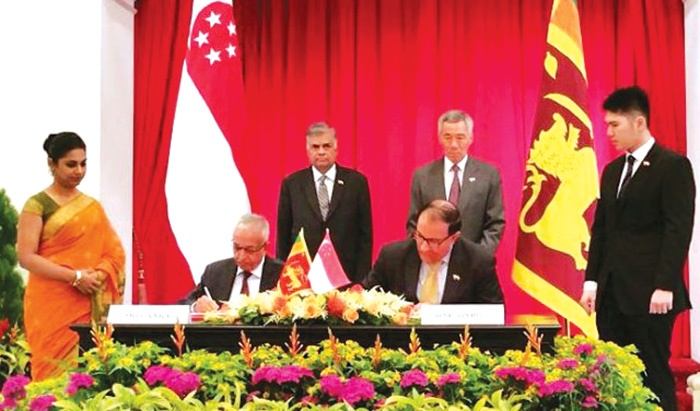
Sri Lanka-Singapore Free Trade Agreement
By Gomi Senadhira
senadhiragomi@gmail.com
“You might tell fairy tales, but the progress of a country cannot be achieved through such narratives. A country cannot be developed by making false promises. The country moved backward because of the electoral promises made by political parties throughout time. We have witnessed that the ultimate result of this is the country becoming bankrupt. Unfortunately, many segments of the population have not come to realize this yet.” – President Ranil Wickremesinghe, 2024 Budget speech
Any Sri Lankan would agree with the above words of President Wickremesinghe on the false promises our politicians and officials make and the fairy tales they narrate which bankrupted this country. So, to understand this, let’s look at one such fairy tale with lots of false promises; Ranil Wickremesinghe’s greatest achievement in the area of international trade and investment promotion during the Yahapalana period, Sri Lanka-Singapore Free Trade Agreement (SLSFTA).
It is appropriate and timely to do it now as Finance Minister Wickremesinghe has just presented to parliament a bill on the National Policy on Economic Transformation which includes the establishment of an Office for International Trade and the Sri Lanka Institute of Economics and International Trade.
Was SLSFTA a “Cleverly negotiated Free Trade Agreement” as stated by the (former) Minister of Development Strategies and International Trade Malik Samarawickrama during the Parliamentary Debate on the SLSFTA in July 2018, or a colossal blunder covered up with lies, false promises, and fairy tales? After SLSFTA was signed there were a number of fairy tales published on this agreement by the Ministry of Development Strategies and International, Institute of Policy Studies, and others.
However, for this article, I would like to limit my comments to the speech by Minister Samarawickrama during the Parliamentary Debate, and the two most important areas in the agreement which were covered up with lies, fairy tales, and false promises, namely: revenue loss for Sri Lanka and Investment from Singapore. On the other important area, “Waste products dumping” I do not want to comment here as I have written extensively on the issue.
1. The revenue loss
During the Parliamentary Debate in July 2018, Minister Samarawickrama stated “…. let me reiterate that this FTA with Singapore has been very cleverly negotiated by us…. The liberalisation programme under this FTA has been carefully designed to have the least impact on domestic industry and revenue collection. We have included all revenue sensitive items in the negative list of items which will not be subject to removal of tariff. Therefore, 97.8% revenue from Customs duty is protected. Our tariff liberalisation will take place over a period of 12-15 years! In fact, the revenue earned through tariffs on goods imported from Singapore last year was Rs. 35 billion.
The revenue loss for over the next 15 years due to the FTA is only Rs. 733 million– which when annualised, on average, is just Rs. 51 million. That is just 0.14% per year! So anyone who claims the Singapore FTA causes revenue loss to the Government cannot do basic arithmetic! Mr. Speaker, in conclusion, I call on my fellow members of this House – don’t mislead the public with baseless criticism that is not grounded in facts. Don’t look at petty politics and use these issues for your own political survival.”
I was surprised to read the minister’s speech because an article published in January 2018 in “The Straits Times“, based on information released by the Singaporean Negotiators stated, “…. With the FTA, tariff savings for Singapore exports are estimated to hit $10 million annually“.
As the annual tariff savings (that is the revenue loss for Sri Lanka) calculated by the Singaporean Negotiators, Singaporean $ 10 million (Sri Lankan rupees 1,200 million in 2018) was way above the rupees’ 733 million revenue loss for 15 years estimated by the Sri Lankan negotiators, it was clear to any observer that one of the parties to the agreement had not done the basic arithmetic!
Six years later, according to a report published by “The Morning” newspaper, speaking at the Committee on Public Finance (COPF) on 7th May 2024, Mr Samarawickrama’s chief trade negotiator K.J. Weerasinghehad had admitted “…. that forecasted revenue loss for the Government of Sri Lanka through the Singapore FTA is Rs. 450 million in 2023 and Rs. 1.3 billion in 2024.”
If these numbers are correct, as tariff liberalisation under the SLSFTA has just started, we will pass Rs 2 billion very soon. Then, the question is how Sri Lanka’s trade negotiators made such a colossal blunder. Didn’t they do their basic arithmetic? If they didn’t know how to do basic arithmetic they should have at least done their basic readings. For example, the headline of the article published in The Straits Times in January 2018 was “Singapore, Sri Lanka sign FTA, annual savings of $10m expected”.
Anyway, as Sri Lanka’s chief negotiator reiterated at the COPF meeting that “…. since 99% of the tariffs in Singapore have zero rates of duty, Sri Lanka has agreed on 80% tariff liberalisation over a period of 15 years while expecting Singapore investments to address the imbalance in trade,” let’s turn towards investment.
Investment from Singapore
In July 2018, speaking during the Parliamentary Debate on the FTA this is what Minister Malik Samarawickrama stated on investment from Singapore, “Already, thanks to this FTA, in just the past two-and-a-half months since the agreement came into effect we have received a proposal from Singapore for investment amounting to $ 14.8 billion in an oil refinery for export of petroleum products. In addition, we have proposals for a steel manufacturing plant for exports ($ 1 billion investment), flour milling plant ($ 50 million), sugar refinery ($ 200 million). This adds up to more than $ 16.05 billion in the pipeline on these projects alone.
And all of these projects will create thousands of more jobs for our people. In principle approval has already been granted by the BOI and the investors are awaiting the release of land the environmental approvals to commence the project.
I request the Opposition and those with vested interests to change their narrow-minded thinking and join us to develop our country. We must always look at what is best for the whole community, not just the few who may oppose. We owe it to our people to courageously take decisions that will change their lives for the better.”
According to the media report I quoted earlier, speaking at the Committee on Public Finance (COPF) Chief Negotiator Weerasinghe has admitted that Sri Lanka was not happy with overall Singapore investments that have come in the past few years in return for the trade liberalisation under the Singapore-Sri Lanka Free Trade Agreement. He has added that between 2021 and 2023 the total investment from Singapore had been around $162 million!
What happened to those projects worth $16 billion negotiated, thanks to the SLSFTA, in just the two-and-a-half months after the agreement came into effect and approved by the BOI? I do not know about the steel manufacturing plant for exports ($ 1 billion investment), flour milling plant ($ 50 million) and sugar refinery ($ 200 million).
However, story of the multibillion-dollar investment in the Petroleum Refinery unfolded in a manner that would qualify it as the best fairy tale with false promises presented by our politicians and the officials, prior to 2019 elections.
Though many Sri Lankans got to know, through the media which repeatedly highlighted a plethora of issues surrounding the project and the questionable credentials of the Singaporean investor, the construction work on the Mirrijiwela Oil Refinery along with the cement factory began on the24th of March 2019 with a bang and Minister Ranil Wickremesinghe and his ministers along with the foreign and local dignitaries laid the foundation stones.
That was few months before the 2019 Presidential elections. Inaugurating the construction work Prime Minister Ranil Wickremesinghe said the projects will create thousands of job opportunities in the area and surrounding districts.
The oil refinery, which was to be built over 200 acres of land, with the capacity to refine 200,000 barrels of crude oil per day, was to generate US$7 billion of exports and create 1,500 direct and 3,000 indirect jobs. The construction of the refinery was to be completed in 44 months. Four years later, in August 2023 the Cabinet of Ministers approved the proposal presented by President Ranil Wickremesinghe to cancel the agreement with the investors of the refinery as the project has not been implemented! Can they explain to the country how much money was wasted to produce that fairy tale?
It is obvious that the President, ministers, and officials had made huge blunders and had deliberately misled the public and the parliament on the revenue loss and potential investment from SLSFTA with fairy tales and false promises.
As the president himself said, a country cannot be developed by making false promises or with fairy tales and these false promises and fairy tales had bankrupted the country. “Unfortunately, many segments of the population have not come to realize this yet”.
(The writer, a specialist and an activist on trade and development issues . )



US sports envoys to Lanka to champion youth development

Rahuman questions sudden cancellation of leave of CEB employees


