Sat Mag
Notes on an Opposition: Champika and Harsha

By Uditha Devapriya
Champika Ranawaka
Ignazio Silone is reported to have told Palmiro Togliatti, the Italian Communist Party leader, that “the final struggle will be between the communists and the ex-communists.” It’s not too much to claim that in Sri Lanka the final struggle will be between the nationalists and the ex-nationalists. The Communists claim the ex-Communist has betrayed his conscience. The ex-Communist claims the Communists have betrayed his ideals. In the end the ex-Communist, branded a heretic, turns into a renegade. It happens with nationalists also.
Our ex-nationalist seeks for himself the comfort of the two major parties, and like the ex-Communist who finds himself branded a traitor if he joins the Party of the Right, he finds his credentials questioned if he joins our Party of the Right, the UNP. Tilak Karunaratne did that in 2004. Now the UNP, the Party of the Propertied, has split into two wings, an old and a new. Tilak Karunaratne’s successor is Champika Ranawaka. Two weeks ago he left the party of the ex-nationalists, the Jathika Hela Urumaya, to join Sajith Premadasa’s Samagi Jana Balavegaya. The Hela Urumaya is history, for now.
Before getting to Champika, it is imperative to shed a few myths about the JHU. For a decade and a half, from 2000 to 2015, the rallying call of the left-liberal intelligentsia was that the JHU was tribalistic. Left-liberals adduced JHU opposition to fundamentalist Islam and Christian evangelism, in that order, as evidence for their view. Thus long before the Bodu Bala Sena, the JHU became known as the party of chauvinists. When it fielded monks in parliament in 2004, the left-liberals argued the legislature was not a proper place for monks. Omalpe Sobitha Thera’s protest fast against the P-TOMS in 2005 and Athuraliaye Rathana Thera’s march to Mavil Aru in 2006 merely heightened their opposition to it.
Yet their characterisation of the JHU as tribalistic belied two facts. One, support for the JHU cut across party lines. Two, membership of the JHU also cut across party lines.
The JHU’s origins can be traced to the Sinhala middle-class’s ambivalent run-ins with the Jayewardene, Premadasa, and Kumaratunga regimes. While the open economy enriched a Sinhala middle bourgeoisie, it fuelled antipathy towards minorities wielding economic power. Jayewardene’s policies did little to address this antipathy, and even Premadasa, despite the wide support he enjoyed among even the clergy, could not assuage it.
Yet neither of them went as far as Kumaratunga in dismantling the state, historically seen as the official patron of Buddhism. From 1977 to 1990, W. D. Lakshman observed in 2010, “the role of the state sector remained significant and powerful.” The first Kumaratunga presidency rolled back not only the economy but also that “significant and powerful” sector, contributing to if not enhancing a cultural critique of neoliberalism among ranks of a disgruntled Sinhala middle-class who hailed from the SLFP and the UNP; they would later find their home in the Sihala Urumaya and the Hela Urumaya. Their attitude to the role of the government is rather interesting, because in a very big way it explains the contradiction at the heart of the Sinhala nationalist movement: it offered resistance to neoliberalism and the internationalisation of the war from a cultural angle, but it failed to do so from an economistic angle.
This largely explains the Sihala Urumaya’s bizarre economic ideology. In its 2000 Manifesto, the SU rejected a closed economy while rejecting neoliberalism, acknowledging that while “going back to a closed economy” was “unthinkable”, it would nevertheless avail itself “of the opportunities thrown up by globalisation.” Viewed this way, even Nalin de Silva’s campaigns against Coca-Cola at the Kelaniya University in the 1990s seems to me more a cultural than a political attack on globalisation. Not surprisingly, it shows how Sinhala nationalists can oppose free markets while criticising the Sirimavo Bandaranaike reforms on the grounds that those reforms destroyed the “Sinhala businessman.” Indeed, the SU explicitly opposed that kind of reform: Tilak Karunaratne once told Aratuwa that they were “not of the opinion that the public sector must control industry and business.” This confirms my thesis that as far as their stance on the economy is concerned, Sinhala nationalism differs very little if at all from the dominant UNP and post-Chandrika SLFP paradigm. Today it seems to have made the transition from a petty bourgeois to a more bourgeois framework. The credit for this transition must certainly go to the Sihala Urumaya, and the Hela Urumaya.
All this, however, is secondary to my point.
My point is that Patali Champika Ranawaka’s departure from the Jathika Hela Urumaya had to happen; it really transpired five years ago, when he joined the UNFGG. In a context where Sinhala nationalism has become a product of the very parties it ends up opposing on cultural grounds, it should come to no surprise when its most fervent stalwarts return to those parties as renegades. Champika’s departure in that sense was an acknowledgement of the fact that as far as this kind of nationalism is concerned, he has no future.
Champika’s departure also reveals his political acuity. As Uvindu Kurukulasuriya pointed out four months ago, he is the last of the old aspirants to the presidential throne. As Nalin de Silva pointed out last week, when compared with him even Sajith Premadasa seems trivial. The latter remark should be taken as a tribute by Champika’s most implacable ideological foe to his potential, no matter how begrudgingly it has been made.
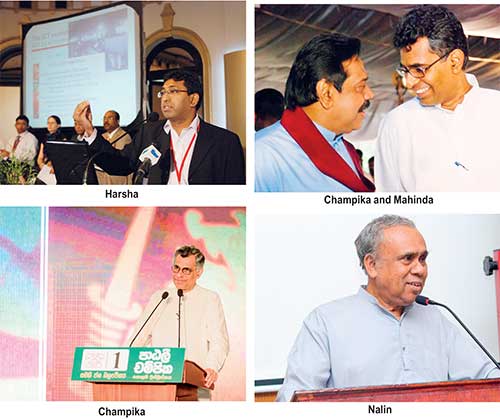

It is true that Champika’s journey has taken him from the path of Sanwardanaye Thunveni Yamaya to that of expedient political practice. And yet, I find myself wishing him well. I do so because while Mahinda Rajapaksa’s rise remains the most groundbreaking political act in recent times, Champika’s resurgence within the SJB smacks of a possible sequel to it. Will he have Sajith Premadasa at his side? Will he be content being at Sajith Premadasa’s side? More importantly, will he nationalise (i.e. Sinhalise) the Opposition?
EconomyNext headlines its report on his departure from the JHU thus: “Champika seeks to shed his Sinhala-Buddhist cloak.” Of course he has to, if he is to expand vertically (to gain non-Sinhala non-Buddhist voters within Colombo) and horizontally (to gain Sinhala voters outside Colombo). Yet he doesn’t crave for the SJB: he wants to see whether it will become “a truly democratic institution.” Is he throwing down a gauntlet there? Perhaps. In any case, now is not the time to get into Champika’s project; I leave that for a later essay.
Ignazio Silone died in 1978. By then a new generation of leftists and liberals disillusioned by the Communist dream had turned to the Right, reneging on their radical roots and forging new alliances with conservatives. They would later be called neoconservatives; their icon would be Henry Jackson. Michael Harrington used the term for the first time to denigrate his friends on the Left who had abandoned the Communist ship. Now the thing with Champika Ranawaka is that while he has “neo-conned” the Sinhala Buddhist nationalists, he has done so without, as of yet, abandoning the Sinhala Buddhist nationalist ship.
Harsha de Silva
The point of an Opposition is to hold the government to account. It is to engage government representatives and lawmakers and make sure they adhere to their manifestos and pledges. Sajith Premadasa said as much last January when assuming duties as Opposition Leader. It is not the easiest thing to do, but it must be done, because a government elected by the people cannot be left to its own devices. The Opposition should make the government lead, and it should make the government govern.
Does that mean the Opposition has to live up to the standards it demands from the state? That is debatable, but personally I would say yes. There’s no point demanding transparency, accountability, and honesty from those in power if you have never been transparent, accountable, and honest when you held power. But then power overrides values. Power is the antithesis of values. Power, as international relations theorists would point out in the 20th century, is the ultimate expression of interest. So it is natural that those who demand adherence to values fail to adhere to them when they run the show. It is easier, after all, to direct a circus than it is to run it. It is not easy to lead. It is not easy to govern.
Should there be limits to such expedience? I personally think so. But where do we draw the line? When Mervyn Silva committed all those antics during the second Mahinda Rajapaksa administration, did the Opposition criticise him setting as the limit to their criticism of him the possibility that one day he would join them, as he did? When Sarath Fonseka emerged from the war, did the UNP and the left-liberal intelligentsia critique and in some cases ridicule him setting as the limit to that criticism the possibility that he would one day become their chosen anti-Rajapaksa candidate, as he did?
This, I think, is the great reformist illusion: that the imperative of the moment is to get rid of the governing party and replace it with another. In itself, there’s really nothing wrong with this principle; that is, if you can call it a principle. But like all moral principles and tenets, it exists to be pursued, and pursued for its sake. When pursued for its sake, of course, it loses its moral character, and even the semblance of a value.
What that ends up achieving, if what it leads to can be called an achievement, is a veritable transgression of the same norms the Opposition, no matter what the party or who the MP and civil society representative, wants the government to adhere to. Be it transparency, accountability, or a fact-checked tweet, it’s the same: in its campaigns to get a regime out the Opposition can step out of its moral high ground. This is as much a pursuit of power as what the state engages in, and ethically, it should not be condoned.
In 2015 after the new government came into power, Harsha de Silva, then Deputy Minister of National Policies and Economic Affairs and UNP Electoral Organiser for Kotte, alleged that the Kotte Municipal Council had gone bankrupt under its Chairman Janaka Ranawaka. I will let de Silva’s words speak for themselves: “The Chairman and his Deputy awarded contracts and took bribes, but none of the projects ever took off. Ranawaka had authorised the illegal construction of a number of buildings, and now they cannot be completed as they are not in line with regulations… we found out that 12 floors was the maximum height of a building allowed down such a narrow road.” Then came his pledge: “If I find a UNP in the Kotte MC is corrupt, I will not hesitate to show him the door and sack him.”
It’s a tribute to Harsha’s honesty, decency, and efficiency that despite the constraints under which he had to work, he got the job done. As a “citizen” of Kotte myself – at least until 2004 – I realise that successive governments have sacrificed the historical, archaeological, and cultural value of the area to haphazard development initiatives. That is something I hope the SLPP’s man, Madhura Vithanage, will try to avoid. But I digress. This is not about Harsha, really. It is about Ranawaka, against whom indictments were filed by the Attorney-General at a time when Harsha was serving as a Non Cabinet Minister.
In 2018 a Presidential Commission of Inquiry recommended that criminal charges be filed against Ranakawa (for “massive corruption”) and that he should not hold public office any longer. Harsha was particularly emphatic on the latter point. His concern was legitimate and it remains so now. But that was two years ago. Janaka Ranawaka later joined the SLPP. He did not secure enough votes last August. He then got out of the SLPP.
Today Ranawaka has crossed over to Sajith Premadasa and the Samagi Jana Balavegaya. A man accused of “massive” corruption, who as his critics implied ran his electorate to the ground, is now on the side of the people who tried to run him down. De Silva cannot forget what he said five years ago. Obviously, neither can we. Janaka Ranawaka may or may not be innocent of the crimes for which he has been charged, but the UNP didn’t give him the benefit of the doubt then. Why should the SJB give him that benefit now?
I say this for two reasons. One, Harsha is an honest man, and I note that without the irony of an Antony pondering Caesar’s grave. He is one of the few MPs whom I’ll call genuine any day; after all he is the author of the most effective project that got done by his administration, Suwa Seriya. Two, and more importantly, selectivity will not remain a vice of a government if the Opposition indulges in it too. This is to be avoided at all costs.
The great reformist illusion has always been that the Opposition must not be criticised, that it must be allowed to criticise. I am not a reformist. I am a realist. And as a realist, I believe that if the Opposition is to mount a campaign of honesty, decency, and candour, it must get over its selectivity. This message is not only for Harsha or Champika. It is for the Opposition and it is for the government. It is for everyone. It must be heeded. At once.
The writer can be reached at udakdev1@gmail.com