Sat Mag
Not just your cup of tea

By Uditha Devapriya
In his travelogue Following the Equator, Mark Twain makes the following intriguing claim: “Tea-tasting is the great business in Ceylon, now. A passenger says it often pays 40 percent on the investment.” Considering that the observation was made and the book published in 1897, a mere 30 years after the first clearing was opened in Ramboda, it seems clear tea had become more than a mere export commodity; it had become the symbol of an economy, a country, and a way of life. It’s as Sri Lankan as American pie is American.
Tea became to the British what coffee almost became to the Dutch. The latter, introduced as a garden crop in 1772, became part of the Dutch East India’s monopoly in the region, to the extent that its supply outstripped demand and its production was halted by officials in 1738. By 1870, under the British, coffee had become king, but what could have become a profitable industry was destroyed by a virulent disease: Hæmileia vastatrix.
The tea plant (Camellia thea or Thea sinensis) was not indigenous to Sri Lanka. There were two broad varieties: the Chinese (Bohea), imported in 1824 and planted at the Royal Botanical Garden, the first non-commercial tea plant in the country; and the Indian (Viridis), imported from the Calcutta Botanical Garden in 1839, about 30 seedlings of which found their way to a property in Nuwara Eliya owned by Sir Anthony Oliphant, then Chief Justice, later tended by the tutor of the Chief Justice’s son, Reverend E. F. Gepp.
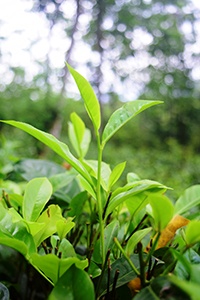

Seeds were also planted at around the same time at the Penylan Estate in Dolosbage and the Loolecondera Estate in Hewaheta, Kandy. Loolecondera was where James Taylor cultivated the first commercial tea plantation in the country. Teas from this estate were sold in 1872, the first consignment reaching Britain a year later; so much in demand did tea from here become that in 1886, the first local brokering firm, John Brothers & Co., was established, followed in 1883 by the first public auction in Colombo, held under the guidance of the Ceylon Chamber of Commerce which had been formed in 1839.
Production picked up. From 10 acres (4 hectares) in 1867, it expanded to 4,700 acres (1,900 ha) in 1878, 32,000 acres (13,000 ha) in 1883, and 364,000 acres (146,000 ha) in 1898. By the turn of the 19th century, more than 384,000 acres (154,000 ha) had been cultivated, mostly by individual proprietors. Once these proprietors retired, they sold their estates to limited liability companies; by 1924, these companies – with more than 67 percent of them registered in Great Britain – owned more than 71 percent of the total acreage of 418,135 acres (167,254 ha). Tea had, in other words, turned into a booming industry, though by 1995 the area of cultivation had reduced to 228,630 acres (192,524 ha).
To be sure, expansion was not unhindered by external constraints. The industry had to face a glut in the world market, due to heavy supplies from other tea producing countries, in the early part of the 20th century. Though Ceylon tea enjoyed an unassailable position, prices fell rapidly. That led to a rise in consumption in the West, spurred by a marketing campaign carried on by a group of merchants who called itself the Thirty Committee. Owing to their campaign, consumption overtook demand and tea prices began to pick up.
10 years later another problem arose. Stocks of tea accumulated in the UK during the war years were released in 1920, exerting a downward pressure on prices and threatening to bring down profit margins. Ceylon’s tea growers responded by restricting production. By 1921, due to a drought and an improvement in plantation methods, a rise in the quality of the tea restored the industry to what it had been before the slump.
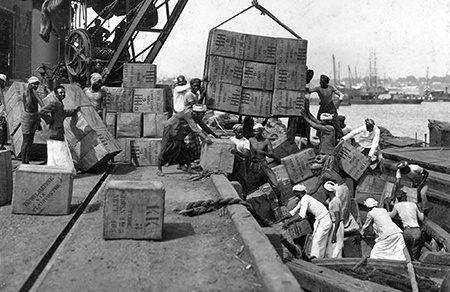

Facilitating that was the Tea Traders’ Association, established in 1894, and the Tea Research Institute, established in 1925. Moreover, 13 years before the first tea clearings and 30 years before the first auction, the planters formed the Tea Planters’ Association. This bolstered the market. Headquartered in Kandy, it became an incorporated body in 1920 and grew to encompass other District Associations; today it operates on promoting the interests of its members, who happen to be the shapers and makers of the industry.
Other organisations came up also: the Tea Traders’ Association in 1894, the Tea Research Institute in 1925, the Ceylon Estate Employers’ Federation in 1944, and the State Plantations Corporation in 1958. These boosted the position of Ceylon tea, and in 1965 the country became the world’s largest exporter; in 1961 it had become the world’s second largest tea producing nation. Yet hidden underneath was a looming threat: Ceylon’s growers, since the 1950s, had been cultivating vegetatively propagated (clonal) tea instead of seedlings, shortening the maturity period from five to three years.
A period of intense political shifts followed, which had a say in the evolution of the industry: takeovers of local and foreign enterprises by the government in the 1970s (which limited land ownership to 50 acres), and, partly under a government headed by the daughter of the prime minister who sanctioned those takeovers, the restoration of estates to private hands in the 1990s. The takeovers of the estates in the 1970s had been buttressed by a 25 year replanting program.
Once estates reverted to private hands during Ranasinghe Premadasa’s and Chandrika Kumaratunga’s presidencies, that programme lost its tenor.
The challenges facing the tea industry today are, to put it mildly, many. This shouldn’t be the case: tea, after all, is the most consumed beverage in the world, after water. While Kenya and other countries have produced their own varieties, Sri Lankan tea remains strong: one hardly hears of other varieties being spoken of in the same tones.
The problem might have something to do with how the Tea Board is (not) promoting the product, but then that’s not the real issue; high labour costs (tea pluckers in Sri Lanka are paid a relatively high rate, accounting for almost 65 percent of the cost of production) might also be to blame, though as writers have pointed out high costs have not discouraged other countries, including Kenya, from increasing their productivity and yields. More likely the latter is to blame; in a context where our tea has turned into a brand, we have succeeded in marketing it at the exorbitant cost of long term productivity.
This decline in productivity can be traced to one factor: the abandonment of replanting. Consider that from 1983 to 1998, while output rose from 179.3 to 280 million kilograms and export earnings rose from Rs. 8,296 to Rs. 50,280 million, value added as a percentage of GDP fell from 6.0 to 1.5 percent. Low agricultural standards and old vegetative stock have been identified as two reasons for this steep decline: a worrying issue, especially since Sri Lanka’s tea yield was considered to be the highest in the world in the 1950s.
The solution is to resume replanting. However, due to its abandonment for over 20 years, resuming it will necessarily entail a higher cost. Meanwhile soil erosion continues to be a problem in the hill country, even as old seedling teas continue to be cultivated again and again, cutting down on productivity and leaving open the possibility for further soil erosion. It’s a vicious circle, which is why, unless it’s sorted, it will affect the image and the touristic value of Sri Lanka – both of which have been bolstered over the centuries by the quality and the taste of probably the most loved tea in the world.
The writing is thus on the wall. Will we heed it? Will they? That remains to be seen.
The writer can be reached at udakdev1@gmail.com