Features
NM and Abe Lincoln Pragmatists or Opportunists?

by Kumar David
Leave aside the difference in measure – gigantic versus small country – or the nature of the endeavours and try if you can to bridge in your mind the century between the 1850s and the 1960s. I think I can’t ask you to forget that Lincoln succeeded in the Civil War and in proclaiming Emancipation while on both the National Question and the so-called Coalition Tactic to take half a step to socialism, NM and the left suffered setbacks. However both men had a characteristic in common; they made crucial tactical compromises on the way. A pragmatist is one who makes needed compromises but does not lose sight of his principles, an opportunist sells out for narrow gain, and a realist throws up his hands in despair and lives with reduced moral commitments.
Did you know that until the last years of his life Lincoln wasn’t an abolitionist? He considered slavery immoral and economically retrogressive but he conceded that it was lawful and constitutional. Technically he was right till the 13th Amendment of 1865 after the Civil War. The American Constitution, up to then, did not explicitly endorse slavery but it did include clauses protecting the institution and Lincoln bowed. It is not possible to justify the ‘lapse’ in terms of values of the times because there existed at the time an Abolitionist Movement led by people like William Lloyd Garrison who demanded that slavery be immediately abolished and that freed slaves be incorporated as equal members of society. Abolitionists called the Constitution “a covenant with death and an agreement with Hell.” Though Lincoln worked with the abolitionists he was not one of them. Lincoln’s deepest commitment was not to the abolition of slavery but to the preservation of the Union. This is all well-known and you will find what I have said at many sources, for example:
Great Emancipator and Smart Pragmatist
Though Lincoln opposed slavery morally, he did not believe until much later that blacks should have the same social and political rights as whites. During the 1858 debates with Stephen Douglas who alleged he supported “negro equality” (like Sinhalese politicians flaying the left: “Rata Demalunta Vikka“) Lincoln defensively declared: “I am not, nor ever have been, 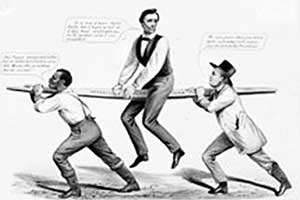

There is no doubt that all his life Lincoln abhorred slavery and considered it morally repugnant. But he judged till the late the 1850s that the white population would not accept abolition and adopted a pragmatic approach that could yield practical results. This is fascinating; similar but a time-reversed sequence to NM’s retreat on Sinhala Only later in life. In his personal convictions confirmed by my own familiarity (I was a young Samasamajist in the 1950s), NM was firmly committed to the language rights of the Tamils. He was an intransigent advocate of Parity of Status to an extent that many in the LSSP and CP (Philip had sold out by then) – Jack Kotalawela, Robert Gunewardena, Mahanama Samaraweera, Somaweeera Chandrasiri and others who we at the time called turncoats – simply could not comprehend. I know that NM was the clearest advocate of an equitable status for the minorities in the 1950s and he took his stand boldly to the trade unions and the working class. Maybe his training as a constitutionalist helped. Nor was he enamoured of the shilly-shally drivel of Tamil politicians and lawyers; he stood out much bigger than them. Alas the Sinhala electorate was to teach him a bitter lesson. It was not 1952 or 1956, the LSSP and CP did well in both, but the crushing defeats of the March and July 1960 elections that smothered the left. Lincoln won the final lap; NM started out strong but narrow nationalism finally defeated him.
Parity of Status
The lesson was painful but abundantly clear and NM, pragmatist per excellence compared to other LSSP leaders, drew it first. No party that fails to advocate the cultural primacy and political hegemony of Sinhala-Buddhism can win political power in Lanka. This has been true for 70 years; the intervention of a civil war hardened it. Lincoln never in his soul accepted slavery, but for the main part of his political life he did not place abolition on his programme. NM despised Sinhala-Buddhist chauvinism but in the mid-1960s he gave up leading the charge against it. There is no way the Left could have turned back the tide of ethno-religious nationalism; history was being written by deep social and historical forces. Hence NM’s decision in the final decades of life to partner with the ‘progressive petty-bourgeoisie; our day has yet to come’. Inability of left ideology to defeat nationalism is best illustrated by the fate of the movement that displaced the LSSP-CP as the left-mainstream in subsequent decades. The JVP could not break from Sinhala nationalism for the first half-century of its existence. Worldwide, class receded to make way for ethnicity (linguistic, racial, cultural or fealty to an extravaganza of gods) as the primary driver of social conflict. Marx forgot to add ethno-national hubris to religion as the world’s bestselling opium.
This essay must not be misunderstood as an apology for the Lankan left’s accommodation of nationalism (quintessentially leftists are internationalists whatever national pragmatism compels in day to day matters) but I do insist that the ‘old-left’ was pragmatic not opportunist while today’s ‘Dead-Left’ is concerned with what leaders get for themselves; programmes don’t matter. I therefore firmly underline that neither Lincoln nor NM were opportunists in this pejorative sense. There has been scholarship enough to fill libraries about Lincoln and slavery and no judgement that I can add will be useful. I would however ask that my intervention today be read as an honest attempt at the evaluation of two persons in relation to the prevailing conflicts of their times.
I will conclude with a few personal comments about pragmatism that I trust a few of you will find interesting. Those who do me the honour of reading my column and those who have had the misfortune of personal acquaintance, have some idea of my views. I am an unrepentant Marxist, an internationalist who despises all nationalisms (Sinhala, Tamil, Timbuctoan), who draws strength from materialism, sees culture as a social product, and has trust in dialectics and science. Sometimes I confront the challenge “Marxism is dead and buried; it has no future; see what happened to the Soviet Union?” This is daft; the stuff of superficial minds. Imagine if the crimes of the Burmese Buddhist Army or Narayana Modi’s Hindutva were adduced as evidence that Buddha was a no-good dreamer or Hinduism is a load of crap! My Christian education equips me to play this game even better with the Church. I have no time for imbeciles with no inclination to philosophy or methodology.
But there is a pragmatic point. Socialism will not dawn tomorrow, nor is a classless utopia just over the horizon. Lenin’s brilliant strategy of a party of professional revolutionaries is of zero relevance one hundred years on. Guevara’s thesis is a one-of exception for Cuba. Modern Marxists must be pragmatic in dealing with the actually existing world while retaining their vision. “If you can trust yourself when all men doubt you: If you can dream and not make dreams your master: If you can wait and not be tired by waiting”, then dear boy or girl you will make a splendid pragmatist who can strive for decent objectives with good sense. People who are in a hurry to discard ideals actually never had any. Sell-outs are opportunists, simple scoundrels. Marxists must learn to navigate complicated currents between actually existing liberal-democracy and aspirations of equity, between decaying finance-capital and desired social democracy, and seek allies to defeat extremists whether the American Trump-hooligan variety, Asian ethno-religious mobs, or other neo-fascisms elsewhere. When the Lankan regime’s best friends at the UNHRC include Belarus, the Philippines, Egypt, Russia and Venezuela it confounds my dutiful countrymen who venerate patriotism as a sacred obligation.