News
New study finds 33 species of butterflies at Maduru Oya National Park

It could be a butterfly destination as well in the long-term
by Ifham Nizam
(Pics courtesy Praneeth Silva)
An ongoing new study has discovered 33 species of butterflies at the Maduru Oya National Park, which is better known for its wildlife and aquatic birds.
The new discovery could lead to the national park being identified also as a bird location in the long-term.
The research team comprising Prof. Dharshani Mahaulpatha, Praneeth Silva, Tharanga Dassanayake, Dulan Jayasekara, Chamara Prabhath, Wathmini De Silva and Hiranthi Dilrangi Praneeth Silva, a graduate research assistant of the University of Sri Jayewardenepura, expressed optimism that with further research the number of species could increase.
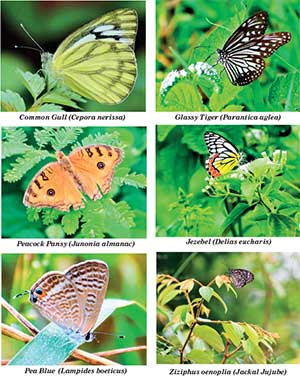

Though elephants and aquatic birds are popular in the park, it could also be made a popular destination for butterflies, which are fascinating flying insects among lepidopterans and essential bio indicators of ecology and evolutionary studies, the researchers said.
“There are about 19,000 species of butterflies distributed around the world. The Western Ghats and Sri Lanka are a global biodiversity hotspot characterized by a large number of endemic species. With respect to butterfly fauna which harbors 331 species, Sri Lanka has 248 species, including 26 endemics.
Of the total butterfly species in the island, 21 are categorized as critically endangered, while 38 are endangered, 40 vulnerable and 21 near threatened. Furthermore, the conservation status of 29 species of butterflies has not been evaluated due to the lack of adequate data, Praneeth Silva said.
The Maduru Oya National Park extends to the Eastern, Uva and North Central provinces. The national park provides habitats for displaced wildlife and provides refuge to many other native fauna and flora particularly elephants. It is also home to thousands of aquatic birds.
The new study discovered 33 species of butterfly fauna representing five families. The commonest butterfly species is the Common Mormon (Papilio polytes). The butterfly count is high during the wet season (October-February) and low in the dry season (March-September).
Distinct differences in butterfly individual and species counts may be governed by climatic conditions of the area. As butterflies are poikilothermic organism, their biological cycle, activity, distribution and abundance are influenced by monthly temperature and rainfall patterns of the locality.
As the park is situated in the dry zone, the climax community of the area is tropical dry mixed evergreen forests characterized by large trees. However, high butterfly diversity can be observed in shrubs and bushes in the Maduru Oya National Park other than roads, water banks and extensive grassland habitat types. Availability of diverse shrubs and bushes in the park is the main reason for occurring high numbers of butterflies.
They act as host plants for butterflies by fulfilling the main living functions of butterflies to sustain their survival in the environment: facilitate laying of eggs, ensure nourishment and shelter for caterpillars, act as nectar sources for adults.
Praneeth de Silva said a higher number of ‘road kills’ of butterflies was observed due to the impact of vehicular traffic. High speed driving, lack of awareness of foreign and local visitors and poor law restrictions of wildlife authorities are the major governing factors for this critical issue.
The research team appreciated the cooperation of the Maduru Oya National Park staff, especially former park warden M. R. Mohamed and the incumbent warden J. Rathnayake and the Department of Wildlife Conservation for granting permission for the research.
The team also thanked the “Wildlife Circle” Association (Department of Zoology, University of Sri Jayewardenepura) for helping with their field work.