Features
New century, old story: War ends as social tragedy, continues as political farce

(Fifty years after 1971: Concluding Part)
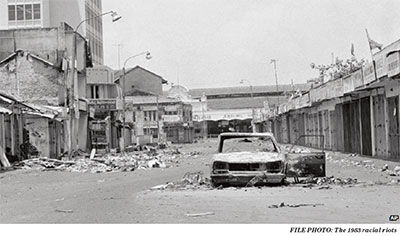
The violence of 1983 impacted the Tamils indiscriminately and directly led to the emergence of the Tamil diaspora. On the other hand, the backlash to 1983 from outside Sri Lanka, especially the West and human rights organizations, may have been a factor in the energization of the JC school after 1983. The UNP government of the day wholly owned the 1983 disaster and deserved a great deal more than whatever blame it got and wherever it came from. JC was opposed to the UNP government’s open economy swindle and its cultural sellout, and it resented the government’s cunning approach to the Tamil national question. That was to parley with Tamil politicians in secret, and organize violence against Tamil civilians in the open. When 1983 went out of control, the backlash was not only against the government, but besmirched the entire Sinhalese society, including those who were revolted by the violence and others who were intractably opposed to the government. And there were backlash echoes from different fragments in the Sri Lankan social formation.
by Rajan Philips
Sri Lanka didn’t need a Y2K (year 2000) problem at the dawn of the 21st century, indeed, the third millennium. The island of millenniums had enough baggage from the old century to carry over into the new century, or from the old millennium to the new. Old problems were carried with new mutations and whole new other ones were added. The war that was muddled through the nineties consumed almost the entire first decade of the new century, before ending in 2009. The end of the war did end much of the social tragedy that it created, but it did not end the farcical continuation of war by political means. Mercifully, the killings ended but the agony of the living has persisted with no certainty about the dead and the missing. Not to mention the endless spat over how many died, with nary a thought or hand for the survivors of war and their livelihood struggles.
The war added new mutations to the old national question. The emergence of the Tamil diaspora and with it the phenomenon of diasporic nationalism, are developments that no one could have foreseen even as late as 1982. Equally, at both the state and societal levels, Sri Lanka has not fully come to terms with the rise of new strands of Sinhala Buddhist nationalism outside the ambits of mainstream political parties among the Sinhalese. Add to these, the coming of age of Muslim nationalism after having long been in the shadows of Sinhala and Tamil politics. These developments have defined the 21st century course of Sri Lanka’s never ending constitutional odyssey, especially involving the fate or the future of the Thirteenth Amendment, the Provincial Councils, and even the Executive Presidency.
A new dimension to the course of politics was provided by the end of the war itself, rather by the debate over how the war ended and whether or not war crimes were committed. Twelve years after the war ended, there are no answers in sight to any of these questions. There are no permanently correct answers in politics, but the task of every generation is to keep the balance on the side of more correct than incorrect answers. As things are in 2021, and thanks to an untoward juncture of a global pandemic and government incompetence, there are mostly only incorrect answers and hardly any correct answers to the many questions that Sri Lankans are facing. The current juncture will pass one way or another, but the questions that have been raised in the aftermath of the war are not likely to be answered satisfactorily any time soon.
A Dysfunctional Family
If Sri Lanka is a family of nationalisms, it has been for the most part a dysfunctional one. This is because Sri Lanka’s nationalisms have grown into being more conflictual and competitive than being complementary. The war and its aftermaths would appear to have exacerbated these tendencies and the unfolding of diasporic and Jathika Chinthanya phenomena would certainly attest to this. At the same time, their emergence also provide insights into the social and cultural roots of the nationalist stirrings among the Sinhalese, Tamils and the Muslims. Identifying and sharing these insights is needed to get rid of the always simplistic, and very often offensive, stereotypes which for far too long informed each community’s understanding of the other.

It might not be widely known outside the JC universe that the political roots of the two intellectual prime movers (Dr. Gunadasa Amarasekara and Prof. Nalin de Silva) behind JC are traceable more to Marxism and left politics than to any Mahavamsa mindset. In fact, one of them (Prof. de Silva) is known to have been a defender of the right of self-determination of the Tamil people before 1983. The open economy politics that began in 1977 and its social eruption in 1983 have more to do with the emergence of the Tamil diaspora and the Jathika Chinthanya soul searching among the Sinhalese intelligentsia, than anything that stereotypical explanations can provide.
The violence of 1983 impacted the Tamils indiscriminately and directly led to the emergence of the Tamil diaspora. On the other hand, the backlash to 1983 from outside Sri Lanka, especially the West and human rights organizations, may have been a factor in the energization of the JC school after 1983. The UNP government of the day wholly owned the 1983 disaster and deserved a great deal more than whatever blame it got and wherever it came from. JC was opposed to the UNP government’s open economy swindle and its cultural sellout, and it resented the government’s cunning approach to the Tamil national question. That was to parley with Tamil politicians in secret, and organize violence against Tamil civilians in the open. When 1983 went out of control, the backlash was not only against the government, but besmirched the entire Sinhalese society, including those who were revolted by the violence and others who were intractably opposed to the government. And there were backlash echoes from different fragments in the Sri Lankan social formation.
The fragmentation of the social formation and the creation of multiple political spaces was another outcome of the open economy and the political makeover under the UNP government. Thus, there was a new sociopolitical space for the off springs of the old, westernized Ceylonese middle class. It is not unfair to characterize the NGOs as being among the occupants of this space. And the children of 1956 were not neglected, at least from the economic standpoint. The more mobile among them easily filled up the economic spaces that the open economy created.
And for their social reproduction outside the vernacular, with a western accent, President Jayewardene gave them international schools. If that was JRJ’s belated rejoinder to the schools’ takeover of the 1960s, and it certainly was, he was not particularly looking to provide reparation to the Churches who lost their schools then. Worse, JRJ snobbishly abandoned the entire national school system, which he had the absolute power to retool anyway he wanted – to provide international education with a national accent to the children of 1977.
There was another aspect to the open economy that the UNP, and every government thereafter, neither recognized nor addressed. It was the orphaning of the state sector at the altar of the open economy. The salaries and compensation levels in the state sector were instantly and massively devalued by the opening of the economy and the aligning of market prices and private sector remunerations to global rates. I do not think this anomaly has been satisfactorily addressed to date. If Singapore is the vaunted model, you cannot have a competitive public sector without matching compensation with the private sector. It is no secret that some of the best and the brightest in a whole generation opted not to join the Central Bank, the universities or government institutions.
Political Limitations
The upshot of these changes was the emergence of two contending formations. One of the two, the NGO-formation (to call it loosely with no disparagement intended), wanted to use 1983 as a platform to recast Sri Lanka’s political society fundamentally different from what had led to the catastrophe of 1983. The new society would be plural and secular, would celebrate its diversity and welcome devolution. Intellectually, ethno-nationalism would be called out for what it is not – not an essential human condition.
The other, the JC-formation (so called, for convenience), has diametrically been opposed to any and all of the above. The JC thinking is also indicative of the unique exceptionalism that Sinhala Buddhist nationalism is uniquely constrained to project unlike Tamil nationalism or Muslim nationalism, both of which have external cultural validations to fall back on by virtue of language (in South India) and religion (Islam), respectively. The JC response in effect might be seen as a response to a sense of besiegement of the Sinhalese by forces from within (NGOs) and without (the West).
At the political level, the NGO formation found its spearheads alternatingly in Chandrika Kumaratunga and Ranil Wickremesinghe. Their accomplishments fell far below expectations. The JC formation waited patiently for the most authentic Sinhala Buddhist leader in Mahinda Rajapaksa, and had its golden decade from 2005 to 2015. The rest of the Sri Lankan political field, both individuals and organizations and of all ethnic groups, have been scurrying between the two main political polarities at regular intervals. The JVP and the JHU, both beneficiaries of JC affiliations at some point, have been in both political alliances and have also splintered over which side they should be permanently aligned with. The Tamil and the Muslim political parties have had their cracks of affiliations with the two main alliances and have little to show as results for their efforts.
Mahinda Rajapaksa had his setback when the people rejected his attempt to extend his presidency to a third term. Gotabaya Rajapaksa was elected promising vistas of prosperity and splendour. But the country is living through a rather dismal record of incompetence quite different from what was handsomely promised. The ‘young’ SLPP that was seen by some as a permanent incubator of future presidents. Instead, the limitations of the executive presidency have been exposed like never before. The JVP is now making a mark as a sharp opposition party in parliament. JHU’s Champika Ranawaka, perhaps the only politician with credible presidential ambition but without a political vehicle of his own, is now a member of convenience in Sajith Premadasa’s Samagi Jana Balawegaya (SJB).
Fifty years ago, the JVP launched its first abortive insurrection ostensibly to liberate the rural poor through the agency of its youth. Within twenty years, the JVP staged its second coming and the Tamil militants launched their violent struggle. They have all run their course which came to an end in 2009. Political violence used to be justified as the last resort after all other avenues have been exhausted. The violent struggles in Sri Lanka from 1971 to the Easter bombings in 2019 were not launched after all other avenues were exhausted. The question to ask fifty years after 1971 is – what happens after the ultimatums of political violence have all been tried and exhausted as well? Should politics be reduced to a farce as the continuation of war by other means?