Midweek Review
Neruda Alborada and Brumpy’ Daughter

By Maximus Jayantha Anandappa (Sydney)
anandappaj@yahoo.com.au
Prof. Carmen Wickramagamage’s multifaceted review of Handagama’s latest feature film Alborada (The Island 9 March 2022) and her comments on Neruda and reference to Tissa Devendra’s recollections prompted me to post this note.
Though a film buff, myself, I have not had the opportunity to watch Handagama’s movie yet and as such I would not venture into commenting on Prof W’s critique of the film. As I gather, the central theme of the film is drawn from a segment of Pablo Neruda’s autobiographical account- his infamous act of virtually raping an innocent defenceless young girl way back around 1930. Neruda was then serving in Sri Lanka (Ceylon) as a young diplomat and living in Wellawatta, in 1929-1931. The girl – a Tamil of the pariah caste (quoting Neruda) doing the meanest of all jobs – a latrine cleaner, belonging to the so called sakkili clan, as commonly and derogatively referred to in the era of bucket lavatories, was a visitor to Neruda’s residence at Wellawatta early in the morning to perform that unholiest of all daily rituals- collecting and disposing the domestic excreta which she had been doing without been visibly indiscreet, as noted by Neruda.
Enticed and bewitched by her unusual beauty, the young Chilean poet who was possibly 26 years at the time, unable to contain his impulses, drags her forcibly to bed one early morning to have sex with the poor girl. I would not attempt to recap Neruda’s own account of this act, as Prof W had summarised Neruda’s account from his Memoirs quite well. The elitist status that Neruda achieved later in life as a celebrated poet, a Nobel Prize laureate (1971) and political activist, who in 1970 was even nominated as a candidate for the Chilean presidency, surely is the reason why the iconoclastic filmmaker chose to create a movie, based on Neruda’s Memoirs on his sojourn in Ceylon.
Without digressing any further, I like to present two related issues which I believe is worthy of further discourse.
For those who are inclined to know more about the background of Neruda’s Memoirs it will be a point of interest to note that both its original Spanish version and the English translation were published posthumously – the Spanish original in 1974 and the English translation in 1977. Neruda diagnosed with prostate cancer died of a heart failure in 1973 but forty years later, around 2013 it was rumoured that he was murdered due to political reasons. On exhumation, scientific tests conducted on the remains of the poet suggested that that he was possibly poisoned when he entered hospital in 1973.
It is on record that the final editing of his memoirs was interrupted by his death and his wife Matilde Neruda (nee Urrutia) and the writer Miguel Otero Silva prepared the manuscript for publication.
Was Neruda repentant of his act of virtually raping a hapless girl? Why did he lay bare this ugly secret without taking it to his grave? Its lyrical and richly evocative literary style or the tone or the subtext of his narration –belies any form or inkling of a confession – on its first reading to me it sounded anything but a confession. Or was the celebrated poet of rare literary gift, savouring his youthful moment of bliss? Or is it a mixture of both? Or did he try to illustrate that he broke all the caste and elitist barriers by having sex with a girl from pariah caste? I suppose we will never find the answer. The reader of Neruda’s Memoirs in the Spanish original may be in a better position to comment.
Writing more than four decades after the incident, Neruda always had the choice of “expunging” this Wellawatta, incident from his memoirs. His sojourn in Ceylon would have been squeaky clean then. Had he opted to do this, the whole incident would have gone unrecorded, with no trace, and we would not be even having this discussion. One can argue that the sole redeeming aspect of Neruda’s act therefore, is that without compulsion he was at least honest to admit to this incident even belatedly. But this argument, too, can be somewhat flimsy- four decades is a long span of time and Neruda would have even safely assumed that the victim of that social background would never come back to confront him again or torment him. In late 60s or early seventies presumably when the Memoirs were written an admission of this sort would not have caused a ripple even in the West. The feminist protests, quoted by Prof W in Chile against Neruda, emerged only as late as 2018. When writing this segment of his Memoirs, Neruda possibly would have never anticipated a backlash of this nature.
With that decisive concluding remark – “The experience was never repeated” the young nameless Tamil girl, the victim of Neruda’s violent act vanishes from his Memoirs altogether and the inquisitive reader is not told anything about her fate after the incident. The poet who banished her from his script would have never dreamt that she could reappear decades later to torment him. She does come back as Thangamma in one of Tissa Devendra’s recollections “Brumpy’s Daughter” contained in his, part fictional, part real stories titled “The Horseshoe Street”.
Tissa Devendra, the distinguished public servant had served for more than 40 years in government service as District Land Officer and Government Agent. Devendra published several books including “‘On Horseshoe Street” (2005) a highly readable collection of several short stories based on his own recollections mostly from his wanderings as a public servant when Sri Lanka was known as Ceylon.
Elegantly written, the book is a window to a bygone era- it is in more than many ways a nostalgic portrait of the leisurely lifestyle in remote outskirts of the country now transformed beyond recognition. In one of his stories “Brumpy’s Daughter” Devendra had narrated how in a male dominated government office, he came across, the trilingual Imelda Rathnayaka – a fair skinned beauty- the cynosure of all eyes in that male sanctuary which the government offices were in those good old days. Devendra later discovers fortuitously and through extraordinary coincidences that this Imelda is none other than the biological daughter of Neruda, born to that Tamil girl with whom the poet had sex as described in the poet’s Memoirs.
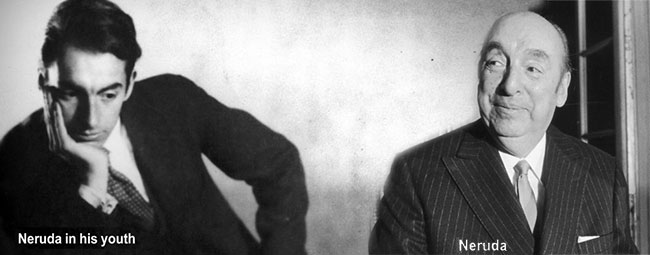

Someone has, in an article in The Island, presented a detailed synopsis of the story believing that what Devendra had written in “Brumpy’s Daughter” is nothing but the truth and that Devendra’s Imelda Rathnayake is certainly Neruda’s biological daughter. Devendra’s account is so convincing I must confess that I too thought so when I read this story which I first read when it was published in The Island as a feature article.
In 2013 or early 2014, I was able to get a copy of “The Horseshoe Street”. I was instantly captivated by most of the stories which sounded so real and authentic.
But something was troubling me as the author also had hinted that he had fictionalised some of his stories or at least some elements. Quoting a secondary source Tissa has added that “all the characters in these stories are based on real happenings – but then roam into the realms of imagination” Some stories were replete with extraordinary co-incidents and melodramatic endings and sounded inconceivable to be taken as true events. I was curious to find out more.
Failing to elicit further information from people of his vintage, I thought the best would be to pose the question to the writer himself. Having obtained his phone number from his publisher Vijitha Yapa Associates, I spoke to him one mid-morning Sydney time. Devendra was very accommodating and during conversation when I wanted to know more about Brumpy’s Daughter or Imelda Rathnayake’s story I was shocked and disappointed when he responded that he contrived the whole story except the reference to the Japanwatta. It was not uncommon to have fair skinned to be born out of wedlock fathered by white men in that era and his Imelda Rathnayake had fitted the bill. Devendra chose to make Pablo Neruda the father of his fictional beauty Imelda and in the process had to resurrect the seduced girl as Thangamma. Discerning Neruda’s Memoirs, I later realised how cleverly he had twisted Neruda’s account to suit his storyline and to make it so convincing. When I told him that I enjoyed reading his memoirs as memoirs but fictionalised insertions could diminish its value, he mentioned that “I did that in order to make the stories a bit juicy” or something to that effect.
Any creative artiste has some entitlement to poetic licence- but this is not such a case. In this case it has made the author’s recollections even somewhat toxic. “Brumpy’s Daughter” is not the only story that had suffered this fate in Devendra’s otherwise remarkable book of memoirs.
To my great relief, in fairness to Devendra recently I came across a statement made by him in one of the English newspapers or a forum making a clarification on this issue. (I cannot now find or quote the source). Referring to the Neruda incident Devendra admitted that he had indulged in a dangerous practice when someone from England possibly a Neruda fan, after reading Devendra’s story, had contacted him requesting him to help to trace Neruda’s lost daughter Imelda.
I am also compelled to send this rejoinder in view of a perception or belief amongst certain circles that Pablo Neruda had an illegitimate daughter born in Sri Lanka by the name of Imelda Rathnayanake. Recently, in a Facebook forum this subject was discussed with passion and Devendra’s “Brumpy’s Daugher” was presented as objective evidence. Devendra’s belated clarification has not disseminated to all levels yet.
The only thing that we know for certain about Neruda’s act of seducing or raping a defenceless girl is what is contained in the few pages of his Memoir. That, too, is Neruda’s own version. The girl never came back to tell her tale. “Brumpy’s Daughter” -though evocative of a bygone era and written in the author’s flowing easy language is mostly fiction, Imelda is a figment of imagination of Devendra who had cleverly constructed a readable story with a happy and melodramatic ending.
(The writer is a Chartered Civil Engineer)