
Features
Natural Reserve over 40 years ago

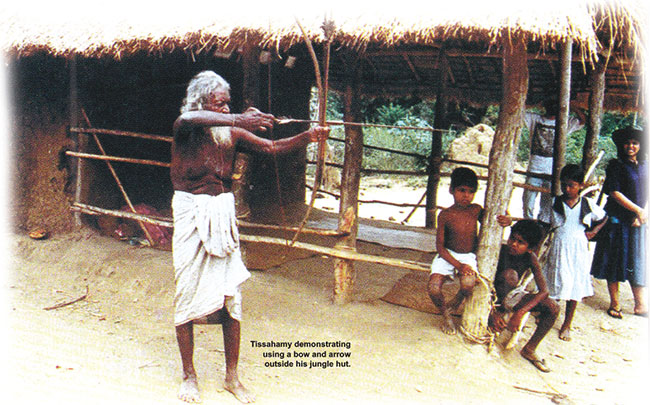
by Lyn de Alwis
And at last we arrived at Rugamtota! We were on the threshold of Yala’s wonderland beyond the Menik Ganga, with its vast plains from which rose the rock massifs of Banawelkema, Mayagala and Muduntalawa. There had been many a time when I sat on a fallen kumbuk log in front of our Kosgasmankada camp and gazed at the thick jungle across the river, roadless, impenetrable except on foot and with only rock caves to shelter in. I would go there one day! I thought.
Here I was, with the cream of Yala’s fearless men: K. David, W.L.A. Piyadasa and Kirineris led by the most senior Game Ranger and tough leader, G.N.Q. de Silva. We forded the river with much difficulty, our groaning jeep protesting loudly as we revved up the steep bank of Menik Ganga, there being no easy bridges in those days.
Strict Natural Reserve
We had spent many exciting days planning our route march, in collecting our meagre provisions and cutting out any item we thought was a luxury. Yet when the desiderata were assembled at Banawelkema, where the jeeps deposited us, each of us had loads which caused much pain to arms and backs, and tended to fix our necks immovably in one direction.
From Rugantota to Banawelkema is eight and a half miles, with the Strict Natural Reserve on the right and Yala Block 3 on the left. This boundary also separates the Uva and Southern Provinces. At 2.00 pm we began walking, or wading would be a better word, for almost immediately we struck a matted growth of nelu which we had to overcome by doing what in swimming is called the breast-stroke. We could not possibly see through this eight-foot tangle, and lest we patted an elephant on the back, we spoke loudly to each other now and again.
At the first glade, Kottapudaina, we saw our first animals, which were two sambhurs, mother and son. They stopped in their tracks and looked at us unconcerned, or perhaps terribly confused, for clumsily harnessed as we were, we must have looked bizarre. Five adjutant storks took themselves heavily into the air and a lone, aging wild boar with twisted tusks, sauntered across our path. There was something very elemental about this scene, for we felt accepted.
We trundled on through more nelu, now laced with karamba and kukurumang whose vicious thorns tore into our clothes or deftly picked off our hats. I remember turning left at a stream-crossing and continuing our torrid journey. Then quite suddenly, through the forest curtain, there loomed to our right the towering black rock, Lunuatugalge which was our destination. Gone were the fatigue and the anxiety on seeing this fabulous rock, rising 400 feet in a gentle arc sheltering one of the most beautiful caves in Sri Lanka. It is approximately 200 feet long and as much as 30 feet broad in places, and had evidently housed many families in ancient times, for it had been partitioned with brick walls to form about a dozen rooms. The carving of the drip ledge of the cave must have been a stupendous feat, for it is at the upper end of the arc at a height of some 100 feet above ground.
It was a pity the cave was not habitable, for dust lay thickly about, wasps and bambara bees were everywhere and bears appeared to occupy some of the rooms. Going through the cave and climbing its roof, we came upon two reasonably flat rocks where we decided to stay put. While Pat Decker and Ranger de Silva enthused about the view, I looked around with some trepidation. I observed that the rock assigned to the three of us, was not flat but was gently sloping and, at its bottom it just fell away more than I00 feet, with only the branches of a palu tree to hold us if we accidentally fell over. The wind velocity was also not in our favour, making our perch rather precarious.
However, by the time we had unloaded and unpacked and the first round of hot tea came up, I felt I had accomplished something. The view was indeed enchanting. It looked more like a wilderness of rock with a sprinkling of forest. There was Dematagala 1,008 feet high, the highest rockscape in the whole of Yala, and Thalaguruhela on whose summit (800 feet) are the remains of a stupa; and in its shadow the skull-like Pettigala, Mayagala (Wadambuwa) in Block 3 and so on. Our minds were taken back to pre-Christian times when in this belt of jungle between the rivers Menik and Kumbukkan was a flourishing civilisation, going hand in hand with the rise of Kataragama and Mahagama (Tissamaharama).
The shrill trumpet of an elephant close by broadcast our intrusion and the immediate belling of an agitated sambhur told us that beneath the green carpet it was already dusk. We descended to prepare for the night. Almost immediately the full moon appeared, unusually large and clear, behind Dematagala. It was the night of the Poson Poya.
Rathu-walaha
I looked around at my staff and realized they all belonged to Yala. Piyadasa was a nephew of the famous Andiris, the grand old man of Yala, while David was a Kumana stalwart and the son of Karolis, a Range Assistant. Kirineris happened to be the jolly, irrepressible son-in-law of the legendary Menika, ‘chieftain’ of the Kumana village. These then were the ‘jungle graduates’ schooled in the wild and where knowledge, experience and dedication will forever remain unsurpassed.
Among other subjects we hoped to study on this expedition, was the occurrence of rathu-walaha, a species of brown bear recorded only from this part of Sri Lanka. The late Mr. C.W. Nicholas, the first Warden of the Department of Wildlife had alluded to this animal in his Administration Report for 1952. The existence of a brown bear in this Reserve, first reported by Mr. H. Neville in The Taprobanian in 1885 is still believed in and there are men who claim to have seen it in recent years. It is said to be smaller in size than the (normal) sloth bear, dark brown and not black in colour, more gregarious, aggressive and fierce. Its former range is said to have extended as far as Panama.
Neville’s passage and the legends concerning it related round our dying campfire the previous night, haunted me as we plunged through the unrelenting thorny scrub next morning. Every grunt of an unseen pig relayed through the nelu was magnified into the frenzied cough of a charging bear; and every squeal of an infant langur came down from the lofty canopy as the death yells of fleeing Nittaevo. Ahead of me Ranger de Silva had stopped and was showing his men the fresh claw marks of a bear, which had clambered up a neralu tree. Kirineris and David came up with some leaves and flowers which had defied identification even in their experienced hands. The younger watchers asked for water, which was doled out in thimble-like mugs by Piyadasa. When an Oliver Twist among them craved for more, he had only to be sternly reminded by the ranger ‘Nothing more till you find your own water at the next pool, wherever that is’.
The compass, on which we were pinning our faith, showed that we were heading south-east, slightly wide of Dematagala. ‘I remember some interesting plains around here’, said Ranger de Silva grabbing his battle-axe and disappearing through the trees. It was a signal to follow although I would have preferred to sit under a tree and let the jungle talk to me.
The plains were indeed attractive and refreshing after the dense vegetation of the high forest, but what caught my eye was a magnificent sambhur standing at the far end of a glade, dripping mud. We had not seen water for hours now and this was a surprise. ‘Boys’ said Kirineris ‘there’s water in that unawe’. An unawe, if I may explain, is a set-up by which water oozes through the soil from a spring. This is a heaven-sent gift to the animals during the dry season and these are fairly well spaced out in Yala block 3 and the Strict Natural Reserve. The sambhur left, grumbling. The water in the wallow was, of course, undrinkable but a little further up a puddle was dug out and left to settle for 10 minutes. We drank our fill and collected some more for the rest of the day.
Bin-kohomba
At this point we had another surprise, a rather unpleasant one, for there on a shrub close by was the unmistakable jungle sign to show that a person or persons had gone groping before us. The Ranger and Kirineris examined the three distinct slashes one under the other, on a weera tree and declared that they were not more than a week old. Poachers? We began tracking. It was easy following the broken twigs, and we heaved a sigh of relief when we came upon a rambling rock on which the intruders had halted. The signs were those of villagers who stole into this area to collect bin-kohomba, a plant which fetches a high price in Kataragama, from where it is marketed to other parts of the country. Its juice, which is intensely bitter, is said to be a tonic and also a cure for ‘mild’ leprosy.
Wild beasts and bees
The search for new archaeological remains and inscriptions led us to a sizeable water-hole, unnamed and not marked on the map. We approached it cautiously, testing the wind. Piyadasa got there first and beckoned to us excitedly. He showed a buffalo, which as we approached rose suspiciously, swirling round on his own axis till he located our clicking cameras. In the few seconds before he identified us and prepared to charge I saw in him a fearful frown and wildness. Kirineris stepped out with gun in hand, a movement which changed the buffalo’s mind. To Kirineris, a Kumana villager, buffalo is the most unpleasant and feared of all Yala’s inhabitants.
This water-hole was apparently well patronized and having built a ‘hide’ of rock boulders we sat down. It was a hot day with a gusty wind and the time was just after 12 noon. Conditions were ideal to bring animals out for a noonday drink.
They did not disappoint us. A group of unsuspecting, carefree sambhur came first. They virtually frolicked on the edge before plunging happily into the water. The base of the buck’s antlers was as thick as my knee. There they lay until a wild boar spoilt the serenity of the place by coming up behind us, getting our scent and crashing headlong into the bush. Up and out went the sambhur as though they were shot. Throughout the hour spent at this lonely pool several such scenes with different players held us enthralled.
To me, being carefree and undisturbed was the spirit of the Strict Natural Reserve. We wandered several miles scouting round for water-holes and kemas (rock pools) and marking them on a map; collecting samples of unidentified plants, geological specimens, and other items, and all the while trying to return by a circuitous route. This became the pattern of our meandering over the next few days after which all that was new was sifted, weighed and recorded.
Our presence on the rock was attracting undue attention. The night before, too, we heard a leopard sawing close to the kema at which we bathed. And today after we returned from the gruelling trek I felt an uneasiness. The bambara bees, too, resented our intrusion and had sent down a few soldiers to warn us. Fortunately we immediately realized why. The smoke from our camp-fire was eddying up to their hives and causing them distress. We had to reduce our camp-fires to one. The wind was also building up to add to our discomfort, and once it blew the hurricane lamp right off its crude tripod.
Skirmish with a bear
I was disappointed that we had not encountered a normal bear, let alone a rathu-valaha. Pat agreed, between scowls as he scraped off columns of ticks from his shins. The men sensed our disappointment, too, and came round the fire to console us with some delightful folk lore. David was nearest the fire and was relating a particularly complicated story even for a folk tale, when for a moment we thought he had lost the theme, for he said ‘Don’t move or get excited, but I think it’s a bear.’ Someone groaned. But Ranger de Silva was quick on the uptake and peering round rasped to me ‘Sir, it’s a bear, a large one’. Pat and I saw it together not more than four feet from David, behind the red embers. He looked enormous and stood there swinging his head and shoulders as bears usually do.
The situation was an impossible one. I looked anxiously at the 100 foot drop. It was no place to have a serious misunderstanding with a ferocious animal equipped with dreadful claws and teeth. Besides, he could not be seen in the darkness if it came to a showdown. In the meantime he waddled closer. The best thing to do was to keep talking, until we got out the three-celled flashlights. Having the lights on him we all stood up together and swore at him. With a muffled roar, which sounded to us like a deafening charge, he shuffled backwards. We advanced. That shook him a bit and he scurried down to one of the rooms in the cave. By now we were once more calm and sat there watching him many minutes until he got up and faded away into the night.
During the rest of our stay we had more incidents but none to equal this and I made sure of one thing. I cut a stout pole from a wewarana tree and kept it very close to me at all times. On the last night before we were to leave we braved the bambara bees and lit two fires once more, for some jungle message was conveyed to us that we would be visited again.
I wanted to keep awake but not with the kind of fatigue one has after 11 hours of walking. Sleep must have come swiftly and deeply, for when I awoke to some hoarse whispers about me, it was already dawn. David came up, and prodding with the club showed me what the excitement was about. Not two yards from where we all slept and near the hurricane lamp was unmistakable evidence left by ‘our bear’ as he padded down to claim his rightful drink from the rock pool.
Thank God, we had all slept so well!
(The writer, now deceased, was both Director of the National Zoological Gardens and Director of Wildlife Conservation – excerpted from ??????? compiled by CG Uragoda)



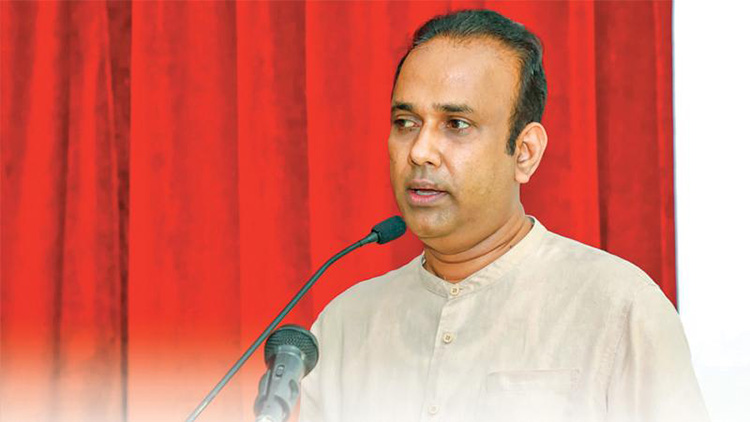
by Dr Gotabhya Ranasinghe
Senior Consultant Cardiologist
National Hospital Sri Lanka
When we sought a meeting with Hon Dr. Ramesh Pathirana, Minister of Health, he graciously cleared his busy schedule to accommodate us. Renowned for his attentive listening and deep understanding, Minister Pathirana is dedicated to advancing the health sector. His openness and transparency exemplify the qualities of an exemplary politician and minister.
Dr. Palitha Mahipala, the current Health Secretary, demonstrates both commendable enthusiasm and unwavering support. This combination of attributes makes him a highly compatible colleague for the esteemed Minister of Health.
Our discussion centered on a project that has been in the works for the past 30 years, one that no other minister had managed to advance.
Minister Pathirana, however, recognized the project’s significance and its potential to revolutionize care for heart patients.
The project involves the construction of a state-of-the-art facility at the premises of the National Hospital Colombo. The project’s location within the premises of the National Hospital underscores its importance and relevance to the healthcare infrastructure of the nation.
This facility will include a cardiology building and a tertiary care center, equipped with the latest technology to handle and treat all types of heart-related conditions and surgeries.
Securing funding was a major milestone for this initiative. Minister Pathirana successfully obtained approval for a $40 billion loan from the Asian Development Bank. With the funding in place, the foundation stone is scheduled to be laid in September this year, and construction will begin in January 2025.
This project guarantees a consistent and uninterrupted supply of stents and related medications for heart patients. As a result, patients will have timely access to essential medical supplies during their treatment and recovery. By securing these critical resources, the project aims to enhance patient outcomes, minimize treatment delays, and maintain the highest standards of cardiac care.
Upon its fruition, this monumental building will serve as a beacon of hope and healing, symbolizing the unwavering dedication to improving patient outcomes and fostering a healthier society.We anticipate a future marked by significant progress and positive outcomes in Sri Lanka’s cardiovascular treatment landscape within the foreseeable timeframe.

by Fr. Emmanuel Fernando, OMI
Jesuit Fr. Aloysius Pieris (affectionately called Fr. Aloy) celebrated his 90th birthday on April 9, 2024 and I, as the editor of our Oblate Journal, THE MISSIONARY OBLATE had gone to press by that time. Immediately I decided to publish an article, appreciating the untiring selfless services he continues to offer for inter-Faith dialogue, the renewal of the Catholic Church, his concern for the poor and the suffering Sri Lankan masses and to me, the present writer.
It was in 1988, when I was appointed Director of the Oblate Scholastics at Ampitiya by the then Oblate Provincial Fr. Anselm Silva, that I came to know Fr. Aloy more closely. Knowing well his expertise in matters spiritual, theological, Indological and pastoral, and with the collaborative spirit of my companion-formators, our Oblate Scholastics were sent to Tulana, the Research and Encounter Centre, Kelaniya, of which he is the Founder-Director, for ‘exposure-programmes’ on matters spiritual, biblical, theological and pastoral. Some of these dimensions according to my view and that of my companion-formators, were not available at the National Seminary, Ampitiya.
Ever since that time, our Oblate formators/ accompaniers at the Oblate Scholasticate, Ampitiya , have continued to send our Oblate Scholastics to Tulana Centre for deepening their insights and convictions regarding matters needed to serve the people in today’s context. Fr. Aloy also had tried very enthusiastically with the Oblate team headed by Frs. Oswald Firth and Clement Waidyasekara to begin a Theologate, directed by the Religious Congregations in Sri Lanka, for the contextual formation/ accompaniment of their members. It should very well be a desired goal of the Leaders / Provincials of the Religious Congregations.
Besides being a formator/accompanier at the Oblate Scholasticate, I was entrusted also with the task of editing and publishing our Oblate journal, ‘The Missionary Oblate’. To maintain the quality of the journal I continue to depend on Fr. Aloy for his thought-provoking and stimulating articles on Biblical Spirituality, Biblical Theology and Ecclesiology. I am very grateful to him for his generous assistance. Of late, his writings on renewal of the Church, initiated by Pope St. John XX111 and continued by Pope Francis through the Synodal path, published in our Oblate journal, enable our readers to focus their attention also on the needed renewal in the Catholic Church in Sri Lanka. Fr. Aloy appreciated very much the Synodal path adopted by the Jesuit Pope Francis for the renewal of the Church, rooted very much on prayerful discernment. In my Religious and presbyteral life, Fr.Aloy continues to be my spiritual animator / guide and ongoing formator / acccompanier.
Fr. Aloysius Pieris, BA Hons (Lond), LPh (SHC, India), STL (PFT, Naples), PhD (SLU/VC), ThD (Tilburg), D.Ltt (KU), has been one of the eminent Asian theologians well recognized internationally and one who has lectured and held visiting chairs in many universities both in the West and in the East. Many members of Religious Congregations from Asian countries have benefited from his lectures and guidance in the East Asian Pastoral Institute (EAPI) in Manila, Philippines. He had been a Theologian consulted by the Federation of Asian Bishops’ Conferences for many years. During his professorship at the Gregorian University in Rome, he was called to be a member of a special group of advisers on other religions consulted by Pope Paul VI.
Fr. Aloy is the author of more than 30 books and well over 500 Research Papers. Some of his books and articles have been translated and published in several countries. Among those books, one can find the following: 1) The Genesis of an Asian Theology of Liberation (An Autobiographical Excursus on the Art of Theologising in Asia, 2) An Asian Theology of Liberation, 3) Providential Timeliness of Vatican 11 (a long-overdue halt to a scandalous millennium, 4) Give Vatican 11 a chance, 5) Leadership in the Church, 6) Relishing our faith in working for justice (Themes for study and discussion), 7) A Message meant mainly, not exclusively for Jesuits (Background information necessary for helping Francis renew the Church), 8) Lent in Lanka (Reflections and Resolutions, 9) Love meets wisdom (A Christian Experience of Buddhism, 10) Fire and Water 11) God’s Reign for God’s poor, 12) Our Unhiddden Agenda (How we Jesuits work, pray and form our men). He is also the Editor of two journals, Vagdevi, Journal of Religious Reflection and Dialogue, New Series.
Fr. Aloy has a BA in Pali and Sanskrit from the University of London and a Ph.D in Buddhist Philosophy from the University of Sri Lankan, Vidyodaya Campus. On Nov. 23, 2019, he was awarded the prestigious honorary Doctorate of Literature (D.Litt) by the Chancellor of the University of Kelaniya, the Most Venerable Welamitiyawe Dharmakirthi Sri Kusala Dhamma Thera.
Fr. Aloy continues to be a promoter of Gospel values and virtues. Justice as a constitutive dimension of love and social concern for the downtrodden masses are very much noted in his life and work. He had very much appreciated the commitment of the late Fr. Joseph (Joe) Fernando, the National Director of the Social and Economic Centre (SEDEC) for the poor.
In Sri Lanka, a few religious Congregations – the Good Shepherd Sisters, the Christian Brothers, the Marist Brothers and the Oblates – have invited him to animate their members especially during their Provincial Congresses, Chapters and International Conferences. The mainline Christian Churches also have sought his advice and followed his seminars. I, for one, regret very much, that the Sri Lankan authorities of the Catholic Church –today’s Hierarchy—- have not sought Fr.
Aloy’s expertise for the renewal of the Catholic Church in Sri Lanka and thus have not benefited from the immense store of wisdom and insight that he can offer to our local Church while the Sri Lankan bishops who governed the Catholic church in the immediate aftermath of the Second Vatican Council (Edmund Fernando OMI, Anthony de Saram, Leo Nanayakkara OSB, Frank Marcus Fernando, Paul Perera,) visited him and consulted him on many matters. Among the Tamil Bishops, Bishop Rayappu Joseph was keeping close contact with him and Bishop J. Deogupillai hosted him and his team visiting him after the horrible Black July massacre of Tamils.
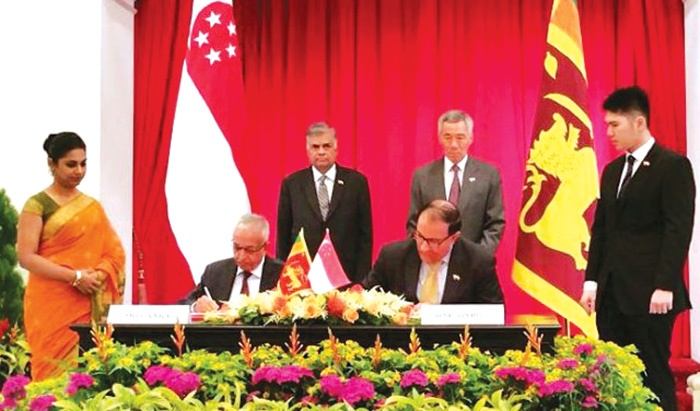
Sri Lanka-Singapore Free Trade Agreement
By Gomi Senadhira
senadhiragomi@gmail.com
“You might tell fairy tales, but the progress of a country cannot be achieved through such narratives. A country cannot be developed by making false promises. The country moved backward because of the electoral promises made by political parties throughout time. We have witnessed that the ultimate result of this is the country becoming bankrupt. Unfortunately, many segments of the population have not come to realize this yet.” – President Ranil Wickremesinghe, 2024 Budget speech
Any Sri Lankan would agree with the above words of President Wickremesinghe on the false promises our politicians and officials make and the fairy tales they narrate which bankrupted this country. So, to understand this, let’s look at one such fairy tale with lots of false promises; Ranil Wickremesinghe’s greatest achievement in the area of international trade and investment promotion during the Yahapalana period, Sri Lanka-Singapore Free Trade Agreement (SLSFTA).
It is appropriate and timely to do it now as Finance Minister Wickremesinghe has just presented to parliament a bill on the National Policy on Economic Transformation which includes the establishment of an Office for International Trade and the Sri Lanka Institute of Economics and International Trade.
Was SLSFTA a “Cleverly negotiated Free Trade Agreement” as stated by the (former) Minister of Development Strategies and International Trade Malik Samarawickrama during the Parliamentary Debate on the SLSFTA in July 2018, or a colossal blunder covered up with lies, false promises, and fairy tales? After SLSFTA was signed there were a number of fairy tales published on this agreement by the Ministry of Development Strategies and International, Institute of Policy Studies, and others.
However, for this article, I would like to limit my comments to the speech by Minister Samarawickrama during the Parliamentary Debate, and the two most important areas in the agreement which were covered up with lies, fairy tales, and false promises, namely: revenue loss for Sri Lanka and Investment from Singapore. On the other important area, “Waste products dumping” I do not want to comment here as I have written extensively on the issue.
1. The revenue loss
During the Parliamentary Debate in July 2018, Minister Samarawickrama stated “…. let me reiterate that this FTA with Singapore has been very cleverly negotiated by us…. The liberalisation programme under this FTA has been carefully designed to have the least impact on domestic industry and revenue collection. We have included all revenue sensitive items in the negative list of items which will not be subject to removal of tariff. Therefore, 97.8% revenue from Customs duty is protected. Our tariff liberalisation will take place over a period of 12-15 years! In fact, the revenue earned through tariffs on goods imported from Singapore last year was Rs. 35 billion.
The revenue loss for over the next 15 years due to the FTA is only Rs. 733 million– which when annualised, on average, is just Rs. 51 million. That is just 0.14% per year! So anyone who claims the Singapore FTA causes revenue loss to the Government cannot do basic arithmetic! Mr. Speaker, in conclusion, I call on my fellow members of this House – don’t mislead the public with baseless criticism that is not grounded in facts. Don’t look at petty politics and use these issues for your own political survival.”
I was surprised to read the minister’s speech because an article published in January 2018 in “The Straits Times“, based on information released by the Singaporean Negotiators stated, “…. With the FTA, tariff savings for Singapore exports are estimated to hit $10 million annually“.
As the annual tariff savings (that is the revenue loss for Sri Lanka) calculated by the Singaporean Negotiators, Singaporean $ 10 million (Sri Lankan rupees 1,200 million in 2018) was way above the rupees’ 733 million revenue loss for 15 years estimated by the Sri Lankan negotiators, it was clear to any observer that one of the parties to the agreement had not done the basic arithmetic!
Six years later, according to a report published by “The Morning” newspaper, speaking at the Committee on Public Finance (COPF) on 7th May 2024, Mr Samarawickrama’s chief trade negotiator K.J. Weerasinghehad had admitted “…. that forecasted revenue loss for the Government of Sri Lanka through the Singapore FTA is Rs. 450 million in 2023 and Rs. 1.3 billion in 2024.”
If these numbers are correct, as tariff liberalisation under the SLSFTA has just started, we will pass Rs 2 billion very soon. Then, the question is how Sri Lanka’s trade negotiators made such a colossal blunder. Didn’t they do their basic arithmetic? If they didn’t know how to do basic arithmetic they should have at least done their basic readings. For example, the headline of the article published in The Straits Times in January 2018 was “Singapore, Sri Lanka sign FTA, annual savings of $10m expected”.
Anyway, as Sri Lanka’s chief negotiator reiterated at the COPF meeting that “…. since 99% of the tariffs in Singapore have zero rates of duty, Sri Lanka has agreed on 80% tariff liberalisation over a period of 15 years while expecting Singapore investments to address the imbalance in trade,” let’s turn towards investment.
Investment from Singapore
In July 2018, speaking during the Parliamentary Debate on the FTA this is what Minister Malik Samarawickrama stated on investment from Singapore, “Already, thanks to this FTA, in just the past two-and-a-half months since the agreement came into effect we have received a proposal from Singapore for investment amounting to $ 14.8 billion in an oil refinery for export of petroleum products. In addition, we have proposals for a steel manufacturing plant for exports ($ 1 billion investment), flour milling plant ($ 50 million), sugar refinery ($ 200 million). This adds up to more than $ 16.05 billion in the pipeline on these projects alone.
And all of these projects will create thousands of more jobs for our people. In principle approval has already been granted by the BOI and the investors are awaiting the release of land the environmental approvals to commence the project.
I request the Opposition and those with vested interests to change their narrow-minded thinking and join us to develop our country. We must always look at what is best for the whole community, not just the few who may oppose. We owe it to our people to courageously take decisions that will change their lives for the better.”
According to the media report I quoted earlier, speaking at the Committee on Public Finance (COPF) Chief Negotiator Weerasinghe has admitted that Sri Lanka was not happy with overall Singapore investments that have come in the past few years in return for the trade liberalisation under the Singapore-Sri Lanka Free Trade Agreement. He has added that between 2021 and 2023 the total investment from Singapore had been around $162 million!
What happened to those projects worth $16 billion negotiated, thanks to the SLSFTA, in just the two-and-a-half months after the agreement came into effect and approved by the BOI? I do not know about the steel manufacturing plant for exports ($ 1 billion investment), flour milling plant ($ 50 million) and sugar refinery ($ 200 million).
However, story of the multibillion-dollar investment in the Petroleum Refinery unfolded in a manner that would qualify it as the best fairy tale with false promises presented by our politicians and the officials, prior to 2019 elections.
Though many Sri Lankans got to know, through the media which repeatedly highlighted a plethora of issues surrounding the project and the questionable credentials of the Singaporean investor, the construction work on the Mirrijiwela Oil Refinery along with the cement factory began on the24th of March 2019 with a bang and Minister Ranil Wickremesinghe and his ministers along with the foreign and local dignitaries laid the foundation stones.
That was few months before the 2019 Presidential elections. Inaugurating the construction work Prime Minister Ranil Wickremesinghe said the projects will create thousands of job opportunities in the area and surrounding districts.
The oil refinery, which was to be built over 200 acres of land, with the capacity to refine 200,000 barrels of crude oil per day, was to generate US$7 billion of exports and create 1,500 direct and 3,000 indirect jobs. The construction of the refinery was to be completed in 44 months. Four years later, in August 2023 the Cabinet of Ministers approved the proposal presented by President Ranil Wickremesinghe to cancel the agreement with the investors of the refinery as the project has not been implemented! Can they explain to the country how much money was wasted to produce that fairy tale?
It is obvious that the President, ministers, and officials had made huge blunders and had deliberately misled the public and the parliament on the revenue loss and potential investment from SLSFTA with fairy tales and false promises.
As the president himself said, a country cannot be developed by making false promises or with fairy tales and these false promises and fairy tales had bankrupted the country. “Unfortunately, many segments of the population have not come to realize this yet”.
(The writer, a specialist and an activist on trade and development issues . )



US sports envoys to Lanka to champion youth development

Rahuman questions sudden cancellation of leave of CEB employees


