Features
My time at Hindu Ladies College

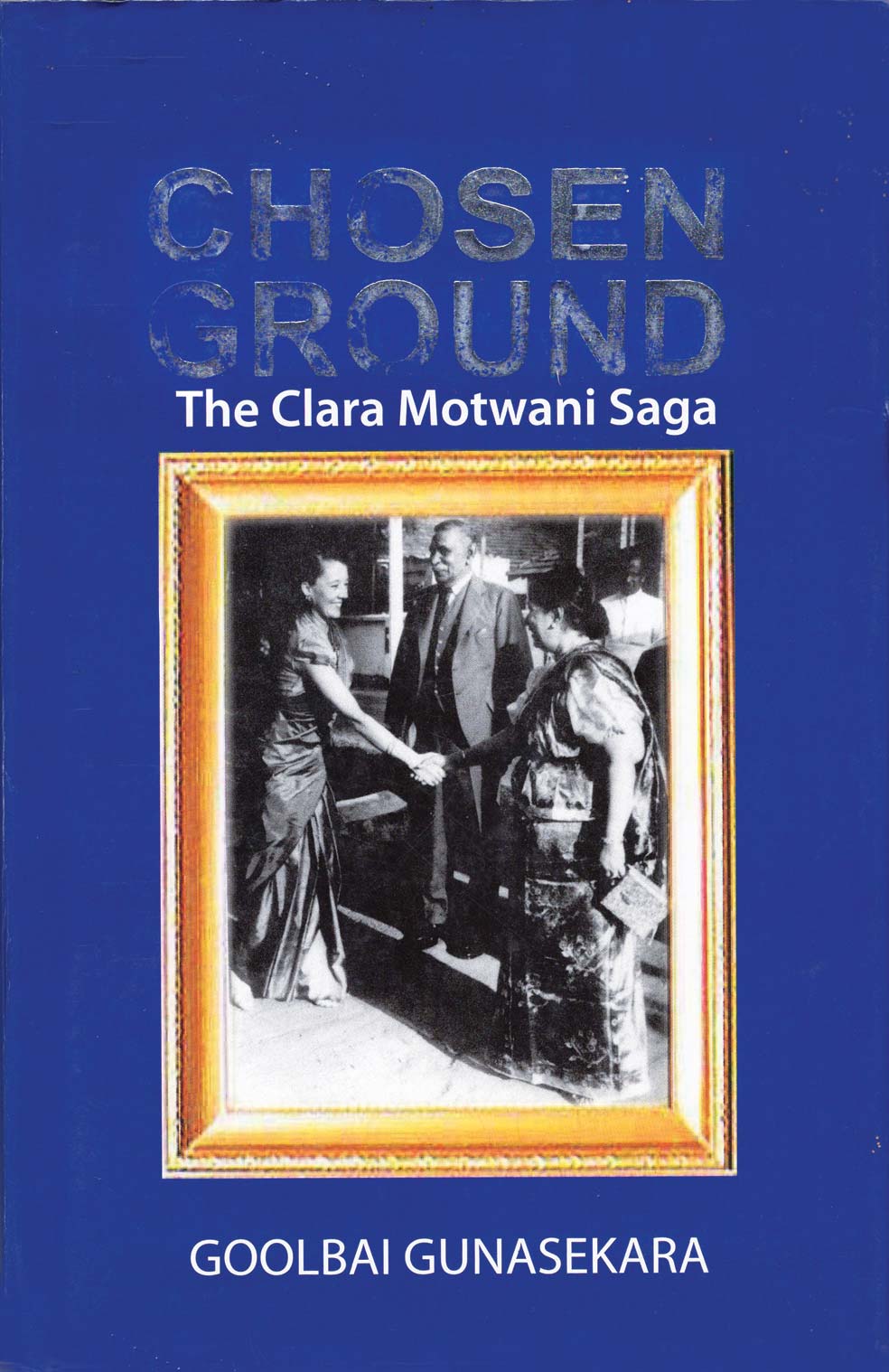
(This chapter on Goolbai Gunasekera’s Jaffna experience is excerpted from her book on her mother, Clara Motwani, Chosen Ground. The first chapter published last week was a response to ACB Pethiyagoda’s memoir of his time at Jaffna College.)
Mrs. Visaladhy Sivagurunathan, a philanthropic Hindu lady, had gifted the property of Hindu Ladies’ College to the school in 1943. Mother was the school’s fifth Principal. Under her, the first Past Pupils’ Association was formed, with Mrs. Jeevaratnam Rasiah as its first President. Miss Thambu (Mother’s long suffering Tamil tutor) was its Secretary. Just recently, I was invited to speak to the Colombo branch of the HLC alumni.
I met a former HLC teacher there — Mrs Navaratna, formerly Leela Ponniah — along with many old friends. The reverence in which Mother was held was very heart- warming, and it was a moving experience to hear the stories they related of instances in which Mother had touched — and sometimes directed — their lives.
A glamour figure on the HLC campus was a Miss Shantha from India. She wore the most gorgeous saris and influenced my love of cotton saris in years to come. It is strange indeed that one’s perceptions can be so acutely honed when one is still so young. To this day I can recall most of Miss Shantha’s wardrobe. Another fantastically good teacher was Vijayalakshmi Pathy. She was also one of the most attractive. She absorbed all Mother’s teaching methods; and her family in Britain, where she now lives, is a testimony to her fine guidance as a mother and grandmother, and not only as a teacher.
Picnics in Jaffna were given top priority. Mother liked to combine education with pleasure, so every picnic had some place of interest on the day’s agenda. We visited the Rosarian monks’ vineyards and place of retreat. We went to Keerimalai, which is a fresh water tank lying a few yards away from the sea. Bathing suits were not a part of our school wardrobes, but even in sarongs and bathing cloths we essayed a swimming stroke or two.
Visits to other schools were another distraction. Mother arranged netball matches with many Jaffna schools and colleges, and I particularly remember one with Vembadi Girls’ School, for I made a friend, Kiruba Moses, whom I remember to this day.
Mother was quickly drawn into the educational world of Jaffna. Miss Barker of Vembadi was a close friend and Principals’ meetings were many. Being somewhat young at the time, many illustrious names have now escaped me. I do recall having tea with Lady Ramanathan, the British wife of the founder of Ramanathan College. Her daughter, Mrs. Nadesan, was the nominal Head of that school but it was the senior Lady Ramanathan who pretty much ran things. Transport was occasionally in cars – often in buggy carts.
Athough Mother did not keep diaries that recorded her personal experiences, she was a great one to keep detailed notes of the educational aspects of her life. That she would keep notes on my progress was to be expected, but they were not the sort of notes one expects of a mother: they were the notes of an educationist. In years to come I was not enchanted to read: ‘Goolbai would do better in Mathematics if she were not so over confident. This carries over into other subjects too, I find’.
Whatever Mother thought of my shortcomings as a student, she positively glowed at my accomplishments in Jaffna. Her notes took on a lyrical quality. She rhapsodized: ‘My experiments seemed to have worked at last, and Goolbai is really doing so well I can hardly credit it’. Never could it be said that dilly-dallying was one of Mother’s failings. Taking the tide at its flood she arranged for all the new academic interest I was showing to be further enhanced by a little advanced private tuition in Science. My classmate Thilaka Karunanandan had a brother who had just finished his degree and was reputedly a brilliant scholar. Mother asked him if he would kindly tutor me in his spare time. He did.
When I was not studying on my own I was being tutored regularly. Along with my classmates, I played netball, studied, sang Tamil songs (which I quickly picked up) in the evenings, studied, had long icily refreshing well baths, studied, saw a movie once a month, studied and then studied some more. My mind was soon becoming as razor-sharp as those of the brilliant Tamil girls with whom I was now competing although, truth to tell, I was never in their league. The students of HLC had the tenacity of Bruce’s spider. They were always on an upward track.
“But what did you do in Jaffna?” Colombo friends would ask Mother later.
“We were always doing something,” Mother would answer, and we were.
Socially, a lot went on behind those cadjan walls that screened the houses and gardens of Jaffna residences from the road. Right opposite our home and almost next to the school lived Dr. and Mrs.
Canagasabai and their family. Dr. Canagasabai — a Malaya doctor, whose youngest daughter Dharma, had just left school —quickly struck up a friendship with us. Dr. Canagasabai had a very large garden with a badminton court and every evening we would play strenuous matches with the Canagasabai nieces, nephews and friends.
It was a sort of informal club. On moonlit nights picnics would be arranged to beaches and similar places, with no thought of danger in anyone’s mind. It was a time of peace. It was a time of friendship. These were the last few years before politics and politicians divided the island as surely as if they had taken a metaphorical knife and cut this lovely land and its people in half.
Sincerity, simplicity and affection were what Mother found in Jaffna. She had expected immovable bastions of conservatism. She found instead pliable minds and flexible brains. Jaffna has always remained a special place to the Motwanis. Before the 1983 tragedy stopped travel to the North, I took my husband and daughter to revisit my old school. It was a nostalgic time.
The school was on vacation but I had the permission of the Principal to wander through it. Buildings had quadrupled in size but the familiar classrooms still stood. I recalled with a shudder the time I opened my desk and found that a little snake had got in through the inkwell. Could this have been the very desk perhaps? There was still an inkwell in it.
Mother had begun the study of Tamil a week after she got to Jaffna. Our brand-new house had a broad veranda running right around it. An enormous desk occupied the shady side of it, and it was here that Mother had her lessons. She could never rid herself of that very American trait which had every waking moment gainfully utilized. Despite a heavy work schedule, Mother seriously tried to learn the language.
“Did she ever pick it up?” I asked her teacher, Thailnayagi Thambu (now Karunanandan) recently. “She was not in Jaffna long enough to really get into it,” was the tactful reply. Mother’s flair for languages did not translate well into the Oriental variety. She was considered the class wizard in Latin, French and Spanish but somehow her ear was not attuned to Sinhala and Tamil. Neither was it vital to learn either language when she first came to this island as the British still ruled and everything was in English. Father, on the other hand, picked up Sinhala in three months and was soon well able to berate our long suffering cook in an understandable lingo.
I drifted into Mother’s old office. It was still the same office but very modernized. It was here Mother had drilled her teachers in the requirements of the Dalton Plan.
This plan was a system she had greatly admired when visiting the Dalton School in New York. It required that teachers made detailed plans of their subject, and students were given these plans in the form of six-weekly advance schedules. A gifted student could then even proceed on her own, while a weak one could get help before the subject was taken up in class. At the Dalton School in New York, which I attended for a short time, I never got beyond History and English — but I did complete those syllabuses to Mother’s satisfaction.
“Your Mother motivated us instantly,” said Miss Leela Navaratne (nee Ponniah). “We understood the Plan, and it was brilliant from the start.”
Of course it worked well. The teachers of Jaffna were born with that same workaholic gene that Mother was finding in her pupils.
As I left the familiar grounds I took one long last look around. I somehow knew I would never see HLC again. Visits to Jaffna take a long time, and were not planned too easily even at that time. The memory of the picture my tall, lovely and gracious Mother made as she said her goodbye to the girls and Staff at Assembly that last day, is still fresh in my heart. And in my own heart the remembrance of Jaffna will always be green.
Our lovely days of quietness and harmony in Jaffna had drawn to a close and Mother returned to Colombo to head Musaeus College. One footnote that bears telling is that thanks to Mother’s recommendation, Dharma Canagasabai became an air hostess on the newly fledged Air Ceylon soon after Mother returned to Colombo.