
Features
More memoirs of escapades at KDU

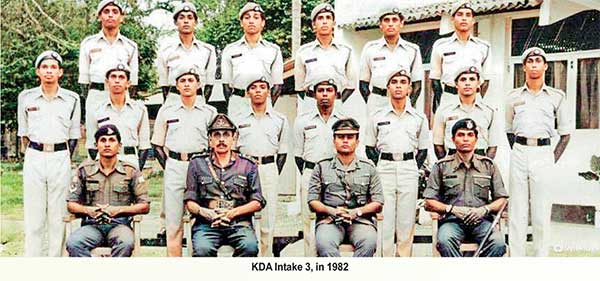
by Nilakshan Perera
(continued from last week)
On July 23, 1983, when the LTTE ambushed 14 Army personnel including Lt Waas Gunawardena, we were at Ratmalana Air Force hangar to receive and assist Security Forces personnel. We will never forget the tragic scene of the special Y-8 plane carrying 14 dead bodies wrapped in polythene landing at Ratmalana. The next day onwards we were deployed for Internal Security duties. That was a somber period that opened our eyes to the stark realities of military life. However, no sooner the situation in the country became somewhat normal we too reverted to our usual routine.
Though we could move around with other students at University we were strictly instructed not to engage in any form of ragging as it will lead to the suspension of our studentships as well as being discharged from KDA. Among the next batch of university students, a few happened to be the daughters of some senior officers. For ragging, we asked them to bring us packets of home-cooked lunches wrapped in “kehel kola” with dhal, pol sambol & fried dried fish and asked one of them to get us a good machete so that our midnight operation (plucking kurumbas) could continue after the machetes used earlier had been confiscated. We also asked themto take us to Hotel Rahima (biryani), Venice Ice cream Parlor, or Shanthi Vihar for dosa. They were all good sports and readily obliged.
After one of the dinner nights, we were tasked the next day to rearrange the tables and chairs (we were the juniors throughout our cadetship at KDA as no new cadets were admitted due to protests over KDA entry by various student movements), and the job was going to be quite a task as long distances had to be covered with the tables and chairs. Fortunately, the Duty Officer of the day told us to use the Army 1210 TATA truck provided there was a volunteer driver. Only two of us could drive during our cadet days, but we grabbed the chance and did the unloading and rearranging and then drove back via Airport Road, Borupone Rd, Ratmalana Station Rd – a journery of about two hours. The truck was perfectly parked at the vehicle yard with all 14 of us seated comfortably inside at the end of the assignment.
Lt Dushantha Chelliah of Sri Lanka Navy (he retired as Commander in 1995 and migrated to Canada) took over as our Troop Commander. He came directly from Naval Maritime Academy where he was the Asst Division Commander (the Course Officer of Admiral Ravi Wijegoonawardane, former Chief of Defence Staff). He was a great cricketer who played for Royal College, Sri Lanka Navy, and Defence Services as an opening batsman. He was a strict disciplinarian and didn’t tolerate any nonsense. We were fortunate to have played either football, cricket or rugby matches with teams of several foreign naval ships visiting Sri Lanka. These games were played either at Welisara Navy grounds or S. Thomas’ College grounds, Mt. Lavinia, thanks to Lt Chelliah.
In addition to sports, he also helped us with our studies and with his
contacts. We had our very first sea experience of a voyage from Galle to Colombo onboard SLNS SAGARAWARDANA. (Sadly now it’s at the
bottom of the sea). We were given on-board training of most naval operations We all loved the food that was served on board the vessel with all kinds of fresh seafood on offer. Lt Chelliah had also introduced us to maintaining a Journal. We had to write details of events that took place daily and submit our records to the troop commander by Monday morning at 0700hrs before leaving for campus. He returned the journals marked and corrected the same evening when we returned. Before doing anything else, we read and redid the corrections knowing the consequences if we did not do so. It was a great lesson we learned and we still maintain historic information and important dates.
Few of the most undisciplined cadets were made to measure the depth of Sir John’s lake near the summer hut as punishment. The water was not that salty but the smell of muddy water and different types of rotting vegetation and small fish lingered in our overalls. That was all part and parcel of our training and we still cherish the experiences.
Changing uniforms for parades had to be done to split second precision. We had to get ready in 30- 40 seconds and report to Sir John’s bungalow in a couple of minutes – a maximum of two to three minutes for running back to billets which were 750 meters away and returning to stand at attention in a place where a spotlight was focused. Cadets couldn’t move beyond that point. Lt Chelliah would come to the balcony and see/instruct us on the next kit change and timing. This will go on for about 20-30 minutes. Some tried shortcuts by placing all kits – civil, white PT, battle order uniform and recreational kit – under a coconut tree on the grounds and changing there rather than running back to billets.
Our profound gratitude to you Sir, for who we are today – dedicated disciplined gentlemen officers. Though he was a strict disciplinarian he always respected us cadets and trained us to be the best. He punished us when we did wrong with the good intention of making us better officers so that we too will train our subordinates in the same way in the future.
Normally on Poya Days, we had bana for about an hour, preached by one of the Buddhist monks from Bellanwila Raja Maha Viharaya. Having this in mind, on the day before Poya, we took our civil clothes and left them at a friend’s place on the other side of runway of the Ratmalana Airport.
This particular Poya day in Dec 1983 also happened to be a Saturday which suited us fine for our escapade. While the rest of the cadets were plucking araliya flowers for the bana, five of the worst rascals crossed the runaway to our friend’s place for a quick change into the civilian clothes left there and then scooted off on trip to Sri Pada. We caught the 9.40 am Udarata Menike express train and got to our destination.
We didn’t have any plans for meals but for our good luck, while climbing the mountain we made friends with a very nice family with four pretty daughters. They looked after us very well with food and soft drinks and all we did accompanying them to the summit. We returned their hospitality by carrying all their belongings down the mountain as we had nothing to carry ourselves. This was easy as we had carried heavy backpacks and weapons as punishments and for training and compared to those what we carried for our friends was nothing.
Two of the daughters of that family became popular pediatricians and one a well-known banker. We were fortunate to have met them and still are in touch. We managed to return to KDA secretly by 4.55 am on Monday to be mustered for PT at 5.30 am. All went well but the Air Traffic Controller at the Airport had spotted five cadets wearing PT kits crossing the tarmac. But he had not reported it to KDA as he was a good friend of one of the cadets. We owe him for not reporting his observation to our superiors; and also the rest of our batch-mates, who who covered for us by putting down our mosquito nets and pretending that all of us were asleep in our billet. The duty sergeant on his night round saw all nets down and thought 14 cadets, including us absconders, were sleeping soundly.
We were the very first Intake to decline the leave given for Sinhala/Tamil New Yearone year. We were given four days off but it was hardly enough time for Saliya Weerakkody, whose home was at Diyatalawa, to travel to and fro with the travel time alone two days. We requested more days of leave on behalf of Saliya but when this was refused, all of us said we’d stay back at KDA. Because of us many others from the training staff, naval catering, medical, and transport also had to sacrifice their leave. We were very well served for our ‘solidarity’ with pack-drills, in the morning, afternoon, and evening continuously on all five days. As a result of this became fitter and tougher and also well united and bonded.
Mess Assistants from the Navy and two waiters were dead scared of us as we used to complain about the quantity and quality of food etc. to duty officers who had to either instruct the catering staff to cook separately for us or reach the proper standard. Because there was only the 14 of us in the camp at that time, our unity and comradeship was very high. Only two of us had girlfriends when joining KDA and whenever a love letter was delivered by post, the recipient had to read it aloud for everyone to hear. Others hardly received any letters even from parents but on our own we posted letters to ourselves, just to pretend that we too were getting mail. Few of us were so well known at the Ratmalana Post Office that letters addressed with only a name and Ratmalana reached us. With no WhatsApp, Viber, FB, Twitter and Instagram then, we used to have many singsongs. Preethi would sing Amaradeva’s Minidada Heesara, and Upul Wijesinghe, Mal Warusawe. Just Walking in the Rain was Damian’s favourite while Thiru contributed Maha Re Yame. There were a lot of M.S. Fernando’s songs and baila sung too.
Shantha Liyanage used to do ‘bat drills’ as he played cricket for University and Lal Padmakumara, being a jack of all trades, advised even carpenters and masonry workers at construction sites at KDA. Manoj was glued to James Hadley Chase’s books, one after the other, but Dimuthu had other plans. He used to take us fishing at Bolgoda lake and Panadura bund. Whether we like it or not, we too went with him. He knew all the culverts in the Borupone area, where guppies breed. Only later did we learn that he had fished the best Mermaid of the Kanangara family consisting of three daughters who lived down Borupone Road. That was Nalika (Dr. Nalika Gunawardena, former Senior Lecturer at Medical Faculty Colombo and presently at WHO as National Professional Officer) Catholics among us were allowed to attend Sunday Mass at nearby St Mary’s Church in Ratmalana and Buddhists went to Bellanwila Temple. While returning to KDA we used to check if Dimuthu’s Dad’s EN 2876 black Morris Minor was parked under the portico of the Principal’s bungalow(highly respected Mr.
Cyril Gunawardane was the Principal of the Deaf & Blind school) and if the car was there we were sure of a good dinner and a free ride to KDA with Dimuthu. We’ll never forget Uncle Cyril and Aunt Dolly’s wonderful hospitality and unconditional affection for all of us.
Whenever we were invited for a birthday party (especially girls’ 21st birthday parties) or any other social gathering we got permission but had to return before the 10.00 pm roll call so that the Duty Cadet could report that all 14 of us were there and no one was sick. In case the Duty Cadet wanted to check, he would call them personally by 2200 hrs but not later. Whoever had gone out had to walk along the Kandawala Road would look at our top floor bathroom window. If a green towel was hung there, he could go back to the party and come for the next day’s PT by 5.30 am. A red towel signaled “return immediately.” Coming back we had to navigate a 12 ft. high barbed wire fence.
We were fortunate to have our first ever CADET BALL in December 1984. We were asked to bring our dancing partners and most of the pretty girls of Moratuwa and Colombo Universities were there on the floor. It was all organized by Cadets of Intakes one, two and three and we were well trained in all aspects of hosting these functions very well by our Officer Instructors.
We had the privilege of associating with Military Academy Intake 16, 17, 18 & 19 Cadets on their Unit visits, and having a football match played at railway grounds and also several Cadet Intakes of Naval Maritime Academy Intakes 11 & 12 and China Bay Air Force Academy. Among these cadets, there were two future Army Commanders, Three Navy Commanders, and two Air Force Commanders.
We were also fortunate to have the remarkable company of a few great Air Force flyers like Jayanthalal Thibbotumunuwe, TTK Seneviratne, and Ruwan Punchihetti as they were attached to KDA while doing their flying training at Ratmalana. Sadly all three of them died in action later, (Wing Cmdr. Thibbotumunuwe in Nov 1996 at KKS and Pilot Officer TTK Seneviratne & Officer Cdt Ruwan Punchihetti in May 1995 during a Sia Marchetti training flight accident at Beruwala)
In our last year, five of our batchmates captained University teams.
Dhammika (rugby), Saliya (football), Damian (basketball), Dimuthu (rowing) and Ruwan Upul (athletics). After completing the University final exams in Nov 1985, four joined the Navy, another three joined Air Force and seven others joined the Army for their advanced and further training, saying goodbye to KDA, where we had spent almost three years and three months. Our passing out parade held in Aug 1986, with Mr. Lalith Athulathmudali, Minister of National Security, as the Chief Guest.
Thanks to General John Kotelawela five of our batch-mates found their life partners from Colombo University and two got married to two
doctors from the Medical Faculty while two others wed lawyers from
the Faculty of Law. One found his bride in the Faculty of Science.
After joining the respective services our cadets excelled in their duties to the country at the highest level, especially at sea. Manoaj Jayasooriya, Preethi Vidnapathirana, and Dimuthu Goonawardena played aleading role in defeating Sea Tiger craft and engaging with Sea Tiger cadres face to face many times. For bravery and selfless acts, Manoj was promoted to the rank of Commander while at sea (Field/Sea promotion) by the Commander of the Navy in Feb 1999.
November 19, 1997 was perhaps the saddest day for the officers of Intake three when news was received that Lt Preethi Vidanapathirana, one of the most disciplined and adorable of our batch mates and a dear friend, has made the supreme sacrifice during one of the fierce sea battles in Mullaitivu.
The evening before, three batch mates Manoaj, Dimuthu and Preethi sailed from Trincomalee harbor as directed by the Commander Eastern Naval Area along with a flotilla of ships and crafts on an offensive patrol to disrupt an enemy movement that was due to take place between Thiriyaya and Mullaitivu.
Manoj who commanded the prestigious Fast Attack Craft Flotilla (FAF4) twice in his career after perfecting the art of naval battle, joined this important operation displaying his tactical leadership taking quick and vital decisions in battle. His presence in the theatre was undoubtedly a morale booster to all. Preethi was in Command of another FAC, P452 and Dimuthuin Command of a Chinese Gunboat SLNS Ranawickrama tasked to neutralize enemy launching pads along with SLNS Ranarisi. The two gunboats and eight Dovras engaged targets both at sea and on land to prevent a Tiger logistic move. The battle which is considered one of the bloodiest at sea lasted from approximately 2100 hrs on Oct. 18, to 0330 hrs on October 19, 1997. In the ensuing battle, Preethi having successfully attacked one of the enemy clusters was hit by a high caliber gun mounted on the bows of an enemy boat which immediately immobilized him, paving the way for two enemy suicide boats to ram his vessel sinking it within seconds approximately 3.5 nautical miles off Kokilai.
By this time, the enemy was forced to abandon its logistic move and return to base and what remained at sea were their two offensive clusters. Preethi was one of the best swimmers of his time and shone both in Ananda College, KDA and at the University of Colombo. As the incident occurred quite close to the shore, Manoaj and Dimuthu scoured the area for the next 24 hrs hoping to find and recover Preethi and his crew. But there was no sign of them.
Preethi was posthumously promoted to the rank of Lt Commander having been killed in action. We never forget to leave out Preethi’s beloved wife, Dr. Dayani Panagoda (Senior Technical Specialist Global Communities at USAID/SCORE) at our gatherings for she too is a part of our Intake family.
Manoj retired from the Navy as Commander in 2002. For his gallant and meritorious conduct in battle, he had been decorated fourteen (14) times by the President of Sri Lanka and he remains the most decorated officer in the Navy with this record has not been broken to date. He is a proud recipient of Rana Wickrama Paddakkama (RWP) seven times and Rana Sura Padakkama (RSP) seven more times. He is presently Executive Director of a well known Motor Company and Director/General Manager of a famous Engineering Company.
Dimuthu retired as Rear Admiral in April 2018, and presently functions as Director Communications and Publications at the Institute of National Security Studies having served in several senior positions in the naval hierarchy with his distinguished naval career recognized with awards on several occasions. Shantha Liyanage retired as Major General in Feb 2018 and held the prestigious appointments as Colonel Commandant Army Service Corps and former Commandant Army School of Logistics. He is recipient of PSC, and LSC.
Lal Padmakumara retired as Major General in Sept 2017 and was the former Director Budget & Finance Management of the Army, also the recipient of PSC and HDMC Damian Fernando retired as Rear Admiral and was the former Director-General Budget and Finance of the Sri Lanka Navy, proud recipient of USP, VSV, Purna Bhumi Medal too. Major General Dhammika Pananwela retired in Nov 2018, functioned as Commander Security Forces East, also a proud recipient several times of RSP for bravery, NDU for academics and was trained to bring death to the enemy from the sky. A qualified combat parachutist. Palitha Sirimal retired as Lt Col in 2002 and is at present he is a Director of a semi-governmental organization.
Ruwan Upul Perera retired as Wing Commander in Aug 2005 and is looking after his coconut plantations and other properties in Marawila.
Upul Wijesinghe is the Deputy Chief Executive of one of the largest Life Insurance Companies in Sri Lanka and also former President of the Sri Lanka Insurance Association. Others are well settled abroad like Thiru Amaran (Sydney) Shantha Edirisinghe ( London) Saliya Weerakkody (Melbourne) and yours truly in Singapore.
We salute all our senior officers of Intake one and two for their insightful guidance and patience, tolerating all our acts of misbehavior.
I take this opportunity to thank from the bottom of my heart my fellow batch mates of Intake three for the wonderful memories and camaraderie and humbly salute my brother officers who made the supreme sacrifice. During these past 38 years, we were united not just in friendships but in brotherhood and comradeship.
You guys truly are The Best



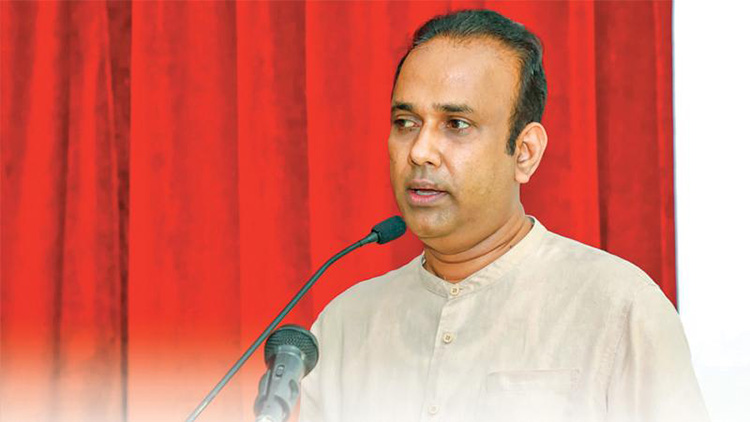
by Dr Gotabhya Ranasinghe
Senior Consultant Cardiologist
National Hospital Sri Lanka
When we sought a meeting with Hon Dr. Ramesh Pathirana, Minister of Health, he graciously cleared his busy schedule to accommodate us. Renowned for his attentive listening and deep understanding, Minister Pathirana is dedicated to advancing the health sector. His openness and transparency exemplify the qualities of an exemplary politician and minister.
Dr. Palitha Mahipala, the current Health Secretary, demonstrates both commendable enthusiasm and unwavering support. This combination of attributes makes him a highly compatible colleague for the esteemed Minister of Health.
Our discussion centered on a project that has been in the works for the past 30 years, one that no other minister had managed to advance.
Minister Pathirana, however, recognized the project’s significance and its potential to revolutionize care for heart patients.
The project involves the construction of a state-of-the-art facility at the premises of the National Hospital Colombo. The project’s location within the premises of the National Hospital underscores its importance and relevance to the healthcare infrastructure of the nation.
This facility will include a cardiology building and a tertiary care center, equipped with the latest technology to handle and treat all types of heart-related conditions and surgeries.
Securing funding was a major milestone for this initiative. Minister Pathirana successfully obtained approval for a $40 billion loan from the Asian Development Bank. With the funding in place, the foundation stone is scheduled to be laid in September this year, and construction will begin in January 2025.
This project guarantees a consistent and uninterrupted supply of stents and related medications for heart patients. As a result, patients will have timely access to essential medical supplies during their treatment and recovery. By securing these critical resources, the project aims to enhance patient outcomes, minimize treatment delays, and maintain the highest standards of cardiac care.
Upon its fruition, this monumental building will serve as a beacon of hope and healing, symbolizing the unwavering dedication to improving patient outcomes and fostering a healthier society.We anticipate a future marked by significant progress and positive outcomes in Sri Lanka’s cardiovascular treatment landscape within the foreseeable timeframe.

by Fr. Emmanuel Fernando, OMI
Jesuit Fr. Aloysius Pieris (affectionately called Fr. Aloy) celebrated his 90th birthday on April 9, 2024 and I, as the editor of our Oblate Journal, THE MISSIONARY OBLATE had gone to press by that time. Immediately I decided to publish an article, appreciating the untiring selfless services he continues to offer for inter-Faith dialogue, the renewal of the Catholic Church, his concern for the poor and the suffering Sri Lankan masses and to me, the present writer.
It was in 1988, when I was appointed Director of the Oblate Scholastics at Ampitiya by the then Oblate Provincial Fr. Anselm Silva, that I came to know Fr. Aloy more closely. Knowing well his expertise in matters spiritual, theological, Indological and pastoral, and with the collaborative spirit of my companion-formators, our Oblate Scholastics were sent to Tulana, the Research and Encounter Centre, Kelaniya, of which he is the Founder-Director, for ‘exposure-programmes’ on matters spiritual, biblical, theological and pastoral. Some of these dimensions according to my view and that of my companion-formators, were not available at the National Seminary, Ampitiya.
Ever since that time, our Oblate formators/ accompaniers at the Oblate Scholasticate, Ampitiya , have continued to send our Oblate Scholastics to Tulana Centre for deepening their insights and convictions regarding matters needed to serve the people in today’s context. Fr. Aloy also had tried very enthusiastically with the Oblate team headed by Frs. Oswald Firth and Clement Waidyasekara to begin a Theologate, directed by the Religious Congregations in Sri Lanka, for the contextual formation/ accompaniment of their members. It should very well be a desired goal of the Leaders / Provincials of the Religious Congregations.
Besides being a formator/accompanier at the Oblate Scholasticate, I was entrusted also with the task of editing and publishing our Oblate journal, ‘The Missionary Oblate’. To maintain the quality of the journal I continue to depend on Fr. Aloy for his thought-provoking and stimulating articles on Biblical Spirituality, Biblical Theology and Ecclesiology. I am very grateful to him for his generous assistance. Of late, his writings on renewal of the Church, initiated by Pope St. John XX111 and continued by Pope Francis through the Synodal path, published in our Oblate journal, enable our readers to focus their attention also on the needed renewal in the Catholic Church in Sri Lanka. Fr. Aloy appreciated very much the Synodal path adopted by the Jesuit Pope Francis for the renewal of the Church, rooted very much on prayerful discernment. In my Religious and presbyteral life, Fr.Aloy continues to be my spiritual animator / guide and ongoing formator / acccompanier.
Fr. Aloysius Pieris, BA Hons (Lond), LPh (SHC, India), STL (PFT, Naples), PhD (SLU/VC), ThD (Tilburg), D.Ltt (KU), has been one of the eminent Asian theologians well recognized internationally and one who has lectured and held visiting chairs in many universities both in the West and in the East. Many members of Religious Congregations from Asian countries have benefited from his lectures and guidance in the East Asian Pastoral Institute (EAPI) in Manila, Philippines. He had been a Theologian consulted by the Federation of Asian Bishops’ Conferences for many years. During his professorship at the Gregorian University in Rome, he was called to be a member of a special group of advisers on other religions consulted by Pope Paul VI.
Fr. Aloy is the author of more than 30 books and well over 500 Research Papers. Some of his books and articles have been translated and published in several countries. Among those books, one can find the following: 1) The Genesis of an Asian Theology of Liberation (An Autobiographical Excursus on the Art of Theologising in Asia, 2) An Asian Theology of Liberation, 3) Providential Timeliness of Vatican 11 (a long-overdue halt to a scandalous millennium, 4) Give Vatican 11 a chance, 5) Leadership in the Church, 6) Relishing our faith in working for justice (Themes for study and discussion), 7) A Message meant mainly, not exclusively for Jesuits (Background information necessary for helping Francis renew the Church), 8) Lent in Lanka (Reflections and Resolutions, 9) Love meets wisdom (A Christian Experience of Buddhism, 10) Fire and Water 11) God’s Reign for God’s poor, 12) Our Unhiddden Agenda (How we Jesuits work, pray and form our men). He is also the Editor of two journals, Vagdevi, Journal of Religious Reflection and Dialogue, New Series.
Fr. Aloy has a BA in Pali and Sanskrit from the University of London and a Ph.D in Buddhist Philosophy from the University of Sri Lankan, Vidyodaya Campus. On Nov. 23, 2019, he was awarded the prestigious honorary Doctorate of Literature (D.Litt) by the Chancellor of the University of Kelaniya, the Most Venerable Welamitiyawe Dharmakirthi Sri Kusala Dhamma Thera.
Fr. Aloy continues to be a promoter of Gospel values and virtues. Justice as a constitutive dimension of love and social concern for the downtrodden masses are very much noted in his life and work. He had very much appreciated the commitment of the late Fr. Joseph (Joe) Fernando, the National Director of the Social and Economic Centre (SEDEC) for the poor.
In Sri Lanka, a few religious Congregations – the Good Shepherd Sisters, the Christian Brothers, the Marist Brothers and the Oblates – have invited him to animate their members especially during their Provincial Congresses, Chapters and International Conferences. The mainline Christian Churches also have sought his advice and followed his seminars. I, for one, regret very much, that the Sri Lankan authorities of the Catholic Church –today’s Hierarchy—- have not sought Fr.
Aloy’s expertise for the renewal of the Catholic Church in Sri Lanka and thus have not benefited from the immense store of wisdom and insight that he can offer to our local Church while the Sri Lankan bishops who governed the Catholic church in the immediate aftermath of the Second Vatican Council (Edmund Fernando OMI, Anthony de Saram, Leo Nanayakkara OSB, Frank Marcus Fernando, Paul Perera,) visited him and consulted him on many matters. Among the Tamil Bishops, Bishop Rayappu Joseph was keeping close contact with him and Bishop J. Deogupillai hosted him and his team visiting him after the horrible Black July massacre of Tamils.
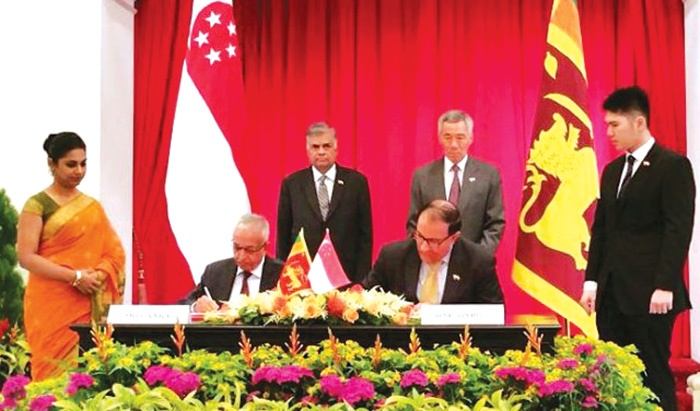
Sri Lanka-Singapore Free Trade Agreement
By Gomi Senadhira
senadhiragomi@gmail.com
“You might tell fairy tales, but the progress of a country cannot be achieved through such narratives. A country cannot be developed by making false promises. The country moved backward because of the electoral promises made by political parties throughout time. We have witnessed that the ultimate result of this is the country becoming bankrupt. Unfortunately, many segments of the population have not come to realize this yet.” – President Ranil Wickremesinghe, 2024 Budget speech
Any Sri Lankan would agree with the above words of President Wickremesinghe on the false promises our politicians and officials make and the fairy tales they narrate which bankrupted this country. So, to understand this, let’s look at one such fairy tale with lots of false promises; Ranil Wickremesinghe’s greatest achievement in the area of international trade and investment promotion during the Yahapalana period, Sri Lanka-Singapore Free Trade Agreement (SLSFTA).
It is appropriate and timely to do it now as Finance Minister Wickremesinghe has just presented to parliament a bill on the National Policy on Economic Transformation which includes the establishment of an Office for International Trade and the Sri Lanka Institute of Economics and International Trade.
Was SLSFTA a “Cleverly negotiated Free Trade Agreement” as stated by the (former) Minister of Development Strategies and International Trade Malik Samarawickrama during the Parliamentary Debate on the SLSFTA in July 2018, or a colossal blunder covered up with lies, false promises, and fairy tales? After SLSFTA was signed there were a number of fairy tales published on this agreement by the Ministry of Development Strategies and International, Institute of Policy Studies, and others.
However, for this article, I would like to limit my comments to the speech by Minister Samarawickrama during the Parliamentary Debate, and the two most important areas in the agreement which were covered up with lies, fairy tales, and false promises, namely: revenue loss for Sri Lanka and Investment from Singapore. On the other important area, “Waste products dumping” I do not want to comment here as I have written extensively on the issue.
1. The revenue loss
During the Parliamentary Debate in July 2018, Minister Samarawickrama stated “…. let me reiterate that this FTA with Singapore has been very cleverly negotiated by us…. The liberalisation programme under this FTA has been carefully designed to have the least impact on domestic industry and revenue collection. We have included all revenue sensitive items in the negative list of items which will not be subject to removal of tariff. Therefore, 97.8% revenue from Customs duty is protected. Our tariff liberalisation will take place over a period of 12-15 years! In fact, the revenue earned through tariffs on goods imported from Singapore last year was Rs. 35 billion.
The revenue loss for over the next 15 years due to the FTA is only Rs. 733 million– which when annualised, on average, is just Rs. 51 million. That is just 0.14% per year! So anyone who claims the Singapore FTA causes revenue loss to the Government cannot do basic arithmetic! Mr. Speaker, in conclusion, I call on my fellow members of this House – don’t mislead the public with baseless criticism that is not grounded in facts. Don’t look at petty politics and use these issues for your own political survival.”
I was surprised to read the minister’s speech because an article published in January 2018 in “The Straits Times“, based on information released by the Singaporean Negotiators stated, “…. With the FTA, tariff savings for Singapore exports are estimated to hit $10 million annually“.
As the annual tariff savings (that is the revenue loss for Sri Lanka) calculated by the Singaporean Negotiators, Singaporean $ 10 million (Sri Lankan rupees 1,200 million in 2018) was way above the rupees’ 733 million revenue loss for 15 years estimated by the Sri Lankan negotiators, it was clear to any observer that one of the parties to the agreement had not done the basic arithmetic!
Six years later, according to a report published by “The Morning” newspaper, speaking at the Committee on Public Finance (COPF) on 7th May 2024, Mr Samarawickrama’s chief trade negotiator K.J. Weerasinghehad had admitted “…. that forecasted revenue loss for the Government of Sri Lanka through the Singapore FTA is Rs. 450 million in 2023 and Rs. 1.3 billion in 2024.”
If these numbers are correct, as tariff liberalisation under the SLSFTA has just started, we will pass Rs 2 billion very soon. Then, the question is how Sri Lanka’s trade negotiators made such a colossal blunder. Didn’t they do their basic arithmetic? If they didn’t know how to do basic arithmetic they should have at least done their basic readings. For example, the headline of the article published in The Straits Times in January 2018 was “Singapore, Sri Lanka sign FTA, annual savings of $10m expected”.
Anyway, as Sri Lanka’s chief negotiator reiterated at the COPF meeting that “…. since 99% of the tariffs in Singapore have zero rates of duty, Sri Lanka has agreed on 80% tariff liberalisation over a period of 15 years while expecting Singapore investments to address the imbalance in trade,” let’s turn towards investment.
Investment from Singapore
In July 2018, speaking during the Parliamentary Debate on the FTA this is what Minister Malik Samarawickrama stated on investment from Singapore, “Already, thanks to this FTA, in just the past two-and-a-half months since the agreement came into effect we have received a proposal from Singapore for investment amounting to $ 14.8 billion in an oil refinery for export of petroleum products. In addition, we have proposals for a steel manufacturing plant for exports ($ 1 billion investment), flour milling plant ($ 50 million), sugar refinery ($ 200 million). This adds up to more than $ 16.05 billion in the pipeline on these projects alone.
And all of these projects will create thousands of more jobs for our people. In principle approval has already been granted by the BOI and the investors are awaiting the release of land the environmental approvals to commence the project.
I request the Opposition and those with vested interests to change their narrow-minded thinking and join us to develop our country. We must always look at what is best for the whole community, not just the few who may oppose. We owe it to our people to courageously take decisions that will change their lives for the better.”
According to the media report I quoted earlier, speaking at the Committee on Public Finance (COPF) Chief Negotiator Weerasinghe has admitted that Sri Lanka was not happy with overall Singapore investments that have come in the past few years in return for the trade liberalisation under the Singapore-Sri Lanka Free Trade Agreement. He has added that between 2021 and 2023 the total investment from Singapore had been around $162 million!
What happened to those projects worth $16 billion negotiated, thanks to the SLSFTA, in just the two-and-a-half months after the agreement came into effect and approved by the BOI? I do not know about the steel manufacturing plant for exports ($ 1 billion investment), flour milling plant ($ 50 million) and sugar refinery ($ 200 million).
However, story of the multibillion-dollar investment in the Petroleum Refinery unfolded in a manner that would qualify it as the best fairy tale with false promises presented by our politicians and the officials, prior to 2019 elections.
Though many Sri Lankans got to know, through the media which repeatedly highlighted a plethora of issues surrounding the project and the questionable credentials of the Singaporean investor, the construction work on the Mirrijiwela Oil Refinery along with the cement factory began on the24th of March 2019 with a bang and Minister Ranil Wickremesinghe and his ministers along with the foreign and local dignitaries laid the foundation stones.
That was few months before the 2019 Presidential elections. Inaugurating the construction work Prime Minister Ranil Wickremesinghe said the projects will create thousands of job opportunities in the area and surrounding districts.
The oil refinery, which was to be built over 200 acres of land, with the capacity to refine 200,000 barrels of crude oil per day, was to generate US$7 billion of exports and create 1,500 direct and 3,000 indirect jobs. The construction of the refinery was to be completed in 44 months. Four years later, in August 2023 the Cabinet of Ministers approved the proposal presented by President Ranil Wickremesinghe to cancel the agreement with the investors of the refinery as the project has not been implemented! Can they explain to the country how much money was wasted to produce that fairy tale?
It is obvious that the President, ministers, and officials had made huge blunders and had deliberately misled the public and the parliament on the revenue loss and potential investment from SLSFTA with fairy tales and false promises.
As the president himself said, a country cannot be developed by making false promises or with fairy tales and these false promises and fairy tales had bankrupted the country. “Unfortunately, many segments of the population have not come to realize this yet”.
(The writer, a specialist and an activist on trade and development issues . )



US sports envoys to Lanka to champion youth development

Rahuman questions sudden cancellation of leave of CEB employees


