Features
Memories of life in Russia in 1971

by Sanjeewa Jayaweera
It is precisely half a century ago that our family arrived in Moscow, the capital of the then Soviet Union (USSR). Since the collapse of the USSR in 1991 it is Russia’s capital city. In 1971, the “Cold War” was at its peak. According to Wikipedia, The Cold War was the tense relationship between the United States (and its allies), and the Soviet Union (the USSR and its allies) between the end of World War II and the fall of the Soviet Union. It was referred to as the “Cold” War because the US and the USSR never directly fought each other.
In July 1970, my father at his request was transferred to the Sri Lankan Embassy in Moscow. We never understood his reasons for selecting Moscow. Maybe it might have been because in 1957 or 1958 he had been chosen to be the diplomatic officer to set up the embassy. According to my father, he had conveyed to the Permanent Secretary (PS) of the the Ministry of Defence and External Affairs that he was not in favour of accepting the transfer. He felt he would not be able to work with the designated Ambassador (Dr. G.P. Malalasekera), a political appointee! The PS conveyed this to the Prime Minister (PM) SWRD Bandaranaike. The PM had sent for my father and asked him why he felt unable to work with the Dr. Malasekera. My father had hesitantly divulged his reason/s at which point SWRD had laughed loudly and told the PS “Send Jayaweera to Singapore where he can be his own boss!” Quite a contrast from what might befall a government servant in the last few decades who refuses to work with a person appointed by the Head of State or even a Minister. How times have changed!
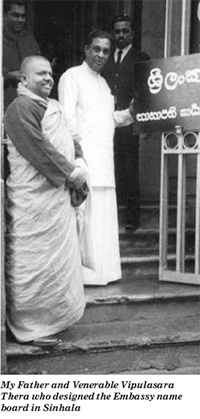

My father was not keen to leave his family behind. Therefore, the government decided to transfer out the junior diplomat at the embassy. Our family was to occupy his apartment, comprising just two bedrooms. It was patently too small for us. However, we were told to bear the inconvenience for six months until the larger apartment was ready.
We ultimately left Sri Lanka towards the end of December 1970. We took a flight to Madras (now Chennai) where we stayed for a few days and then took a flight to Bombay (now Mumbai) and stayed the night. Next morning, we took an Air India flight to Moscow. I still remember my father getting us to look out of the window to get a glimpse of the Himalayas.
We arrived in Moscow on January 2, 1971, and it was freezing cold. The temperature would have been around minus 35 degrees centigrade. Fortunately, some of the Embassy staff who had come to the airport to welcome us had brought some heavy overcoats and headwear to protect us. To our great relief, our apartment was as hot as Colombo!
For a couple of weeks other than our father who went to work, none of us was brave enough to venture outside in the freezing cold! It took some time to get us all kitted out in warm clothing. Once dressed, the only thing visible were our eyes and the nose! Despite being bundled up, once outside for more than 10 minutes, your toes and fingers were more or less frozen.
Everything outside was white; the scenery looked like something from the movie Dr Zhivago. Other than the main road and the sidewalk, all else was covered in three feet of snow; beneath it was solid ice. We would slither around and at times take a tumble as we got to grips with the art of walking in the snow. The Moscow river, a ten-minute walk from our apartment, was rock-solid ice. We were told that even a lorry could drive across the river as the ice was so solid.
As the academic year had started in September, we were told that we would not be attending school for another nine months, which delighted my siblings! The question was how to while away the time inside a small apartment. We quickly realized that the best way was to stand by a large window in the living room and watch and count the number of people who got arrested for “jaywalking”! The law in Russia was extremely strict, and anyone caught crossing the road other than at a designated zebra crossing was breaking the law. Those caught were bundled into a police cruiser and taken away; I assume they were charged and fined. Despite that, every day, there were a few who were brave enough to jaywalk. About 75 per cent of those who attempted to were caught.
The security service monitored the movement of foreign diplomats. The apartment complexes housing diplomats and their families were segregated. No Russian was either allowed to live or even visit unless accompanied by a diplomat. A police post manned 24 hours at the centre of the compound observed who was entering and leaving. They also recorded when a particular vehicle left the apartment complex. It was generally believed that the police post at the embassy where the person worked was informed. In case the person’s arrival at the embassy was delayed, the police would through its network try to trace the vehicle. The same happened in the evening in the reverse order.
I remember an incident that took place after my father got his personal vehicle. We went for a drive and got totally lost. There being no Google maps at the time and our Russian language skills being minimal, we were in a quandary. Fortunately, within a few minutes, a couple of police vehicles arrived, and my father was questioned. When he explained that we were lost the police escorted us back to our apartment complex.
There was also a rule that foreign embassy staff could not travel beyond 40 km from Moscow without informing the Russian Foreign Ministry. Details such as the location, number of people traveling, and vehicle details had to be shared. The summer months in Russia were gorgeous with trees blooming, and generally, it was quite warm. So, most weekends in the summer the embassy staff would organize a day trip for sightseeing and go in a convoy of several cars. We would then try to find a nice spot to enjoy a picnic lunch. On one occasion, the convoy went beyond the informed location, searching for a suitable place for the picnic. I recall our convoy was quickly surrounded and questioned. We were escorted back to a suitable place for us to enjoy our picnic. One of the drawbacks of this restriction was that you could not suddenly get up on Sunday morning and decide that you would like to travel beyond the 40 KM radius despite the day being perfect for an outing.
Another incident that I vividly recall even after 50 years took place in the summer. An Indian diplomat’s son and I were playing badminton by the roadside. It was by a sharp bend near the entrance to the compound. I still remember a blonde girl running towards us. When she reached the spot where we were playing, she slowed down. I think she thought that she had given the policeman at the post the slip. Unfortunately for her, a policeman had seen her and came quietly behind her. He grabbed her by her long hair and dragged her screaming in Russian to the police post. Within a few minutes, a police van came and took her away. My friend and I were astounded but being only 11-years could not do anything to help her. Perhaps she was engaged in the oldest profession who took her chances!
One summer day, my father’s first cousin, living in London, arrived at the embassy unannounced. He had studied in Russia from 1958 until 1964 before returning to Ceylon with a degree in Engineering. Unfortunately, back home, his Russian degree did not get due recognition. He soon found employment in London where both his Russian engineering degree as well language skills were better appreciated. He visited us to seek my father’s assistance to marry his longstanding Russian girlfriend and obtain an exit permit for his wife to accompany him back to London. At that time Russian citizens were not allowed to travel overseas without government sanction. My father arranged the exit permit through his contacts at the Russian Foreign Ministry and the cousin, a true gentleman, was able to honour a promise he made to his girlfriend several years before to come back for her. However, I think my father earned his Aunt’s wrath for helping her son marry a non-Sri Lankan!
Some of the incidents that I have related are not intended to criticize the governance system that prevailed in the Soviet Union. I firmly believe that it was up to the people of the Soviet Union to accept or reject those rules. We were guests in the country, and we needed to abide by their rules. Russia has always stood by Sri Lanka and supported the principle that our country should resolve our problems without foreign interference.
Our stay in Russia was limited to just one year as our education was at a standstill. Our command of the Russian language was wholly inadequate to study in Russian. The government’s education allowance was paltry, and my father could not afford to educate four of his children at the International school. At my father’s request, the government transferred him to our embassy in Pakistan, and we bade goodbye to Russia just after completing one year there. Since then, none of us has been to Moscow, although the destination is undoubtedly in my bucket list of countries to visit.