Features
Manouri Muttetuwegama: a woman unapologetically herself

Her privileged family background did not deter Manouri from working in overcrowded prisons, making a case for thousands of women and appearing for rural farmers who were arrested for not paying their water tax. She would often represent these victims pro bono. Credited to have published one of the earliest reports on missing persons following the ‘Muttetuwegama Commission’, Manouri would once recollect in an interview that forcible disappearance of loved ones is the ‘most inhuman and heinous crime’ where even the right to pay last respects was taken away from relatives. She charged that it could not be dismissed as a mere ethnic issue.
by Randima Attygalle
“War is very much a man’s thing… widows were marginalized by their communities, orphaned girls were deprived of basic education and thousands of female-headed families struggling to survive are still waiting to be counted in official statistics…” Manouri Muttetuwegama, the Chairperson of the Disappearance Commission (1994) would recollect. A woman who had to brave many battles of life, Manouri Kokila Muttetuwegama, the human rights activist and one of the earliest Lankan women to take up criminal law, could relate easily to the heartbreaks of fellow women. She would not hesitate to remind the world that ‘women’s rights are human rights’ too.
One time President of the Women Lawyers’ Association, her privileged family background did not deter Manouri from working in overcrowded prisons, making a case for thousands of women and appearing for rural farmers who were arrested for not paying their water tax. She would often represent these victims pro bono. Credited to have published one of the earliest reports on missing persons following the ‘Muttetuwegama Commission’, Manouri would once recollect in an interview that forcible disappearance of loved ones is the ‘most inhuman and heinous crime’ where even the right to pay last respects was taken away from relatives. She charged that it could not be dismissed as a mere ethnic issue.
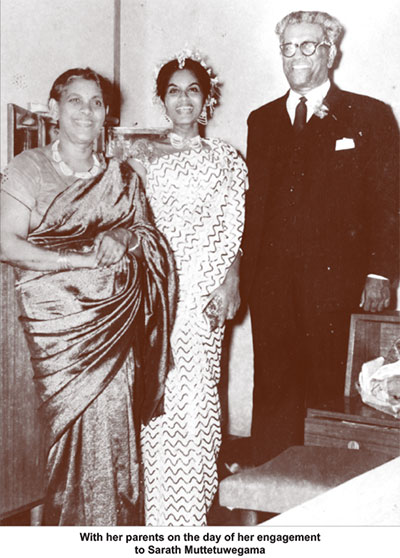

Manouri was only two-years old when her father, Dr. Colvin R de Silva was taken to custody by the British and put behind the bars at Bogambara. Her mother, a devout Buddhist would sing softly to herself, siduhath kumaruge hitha nam boho dediya.. matawath nokiya thaniyama thapasata wediya…
Born to a mother whose family had an uncle or a brother taking robes in every generation, it was only natural for Manouri to be admitted to her mother’s school, Visakha Vidyalaya. “She came from a family of temple builders and found the temple to be an outlet of solace, especially at time when things were tough at home with daddy’s political involvement. And daddy far from the temple-goer his wife was, stood by my mother, encouraging her to pursue her spiritual pursuits. He was very liberal-minded,” she once recollected.
When the young Barrister-daughter returned from England, her father as Manouri would say, was convinced that she had made the best of both worlds. “While London exposed me to more than law books, my Buddhist upbringing enabled me to sit on the ground with my legs to one side and my skirts covering my knees,” she would reminisce.
Very much her father’s daughter, Manouri took to student activism like duck to water at the University of London, where her father had also studied. The first woman to have held the chair of the of the Ceylon Students’ Union, Manouri earned the title ‘street lady’ for her vociferous activism. At a time when the natives were still aping the imperialists and growing up in local public schools which were “copies of British education”, young lawyer Manouri did not feel “planted and alienated” in her own country, after a 10-year sojourn in England from 1953 to 1963.
The “liberating experience” of London, only shaped her to experience the socio-political fabric prevailing at home with “no trappings” as she called it. “My father further fuelled my spirit by exposing me to the top brass and the most remote folk of his electorates,” she once said. Be it metropolitan hubs as Wellawatte-Galkissa (her father’s first parliamentary seat) or at Agalawatta (where he was later MP) and Balapitiya, Manouri would feel at home in her father’s election campaigns. Several years later, she would re-write history in the rural Kalawana where her late lawyer-husband Sarath Muttetuwegama, a man who lived in the hearts of people, reigned.
To our generation of lawyers who could not be privy to the life and times of her legendary father who could ‘swing a jury,’ Mrs. Muttetuwegama became a priceless window. More than the drama of her father’s legal feats, what moved her most was his ability to go straight to the ‘essentials of the Law’ and his treatment of the Law as a social instrument. “He was never tied down to precedent, instead he had a sharp appreciation of the legal concepts. He treated the courts with reverence and drilled into us that one is never to treat the courtroom as a political platform. For him, it was not just a matter of mastering the technical aspects of the Law; integrity and decorum mattered most to him. He set the example of never humiliating or bullying a witness, never misleading the judges neither on the law nor on evidence and most importantly to be relevant in courts.” She herself lived up to this.
An inspiration to a young lawyer, Mrs. Muttetuwegama was always one of the most coveted subject of interview for a journalist. I was once intrigued to know what her unforgettable memories of her father’s sensational trials were. Sathasivam murder case, Kularatne arsenic poisoning case and the attempted coup of 1971 were among the most unforgettable. It was 12-year-old Manouri who received the famous forensic expert Sir Sydney Smith who heeded her father’s call and arrived here to give expert evidence in the Sathasivam case. Dr. Smith, a family friend by then, whom she had the privilege of visiting in Edinburgh with her father was a ‘Scotsman with a heavy accent’ as Mrs. Muttetuwegama would recall. “I remember how he used to pick carnations for me from his garden and I pinning them on the button hole of my overcoat,” she once shared a fond memory with me.
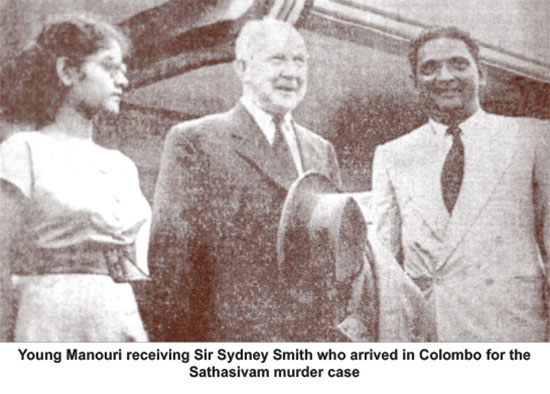

Inheriting her father’s universality of thinking, Mrs. Muttetuwegama would encourage young professionals- lawyers or otherwise, applaud anyone for a job well done. Women empowerment being close to her heart, the avant-garde activist would admire those who would challenge the status quo. On one occasion when I was accompanied by my colleague photographer Sujatha Jayaratna, Mrs. Muttetuwegama remarked that she was both delighted and proud to be posing for one of the few professional women photojournalists in the country. A woman who had the highest regard for women breadwinners, I remember Mrs. Muttetuwegama applauding Sujatha who looks after her sick and ageing mother while juggling a full time career.
Despite her commanding and charismatic personality, Mrs. Muttetuwegama remained truly feminine, a trait I often admired in her. Her simple yet sophisticated dress sense made a statement wherever she went. A few years ago when I launched a publication at the Colombo International Book Fair, she was among my earliest guests, adding stature to the occasion. Despite her challenging health, she was kind and humble enough to remain until the end of the event, taking time to speak to several who had been mentored by her, occupying some of the top legal ranks today.
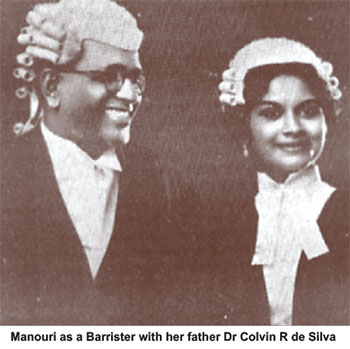

A qualified lawyer at the time her father drafted the first Republican Constitution, Mrs. Muttetuwegama used to recap walking as a ‘proud daughter’ beside him into the Constituent Assembly. “The exercise of the 1972 Constitution is a matter of regret to me today. My father’s objective was to champion individual rights of liberty and equality and make a chance for everybody to make a place for himself,”. It was she who headed the Consultation Task Force on Reconciliation Mechanisms (CTFRM) appointed in 2016. Reflecting on her father’s foresight: ‘One language two nations; two languages one nation’, she would often lament that the country was not only divided on ethnic grounds but also on lines of education. She was disheartened that the educational disparity was getting worse.
Calling the LSSP her ‘elder sister’, only a few years older than she was, Mrs. Muttetuwegama was often critical of the present day so-called leftists. The activist lawyer would say that they were on an “impossible see-saw.” While trying to hold onto old leftist concepts of egalitarianism, non-racism and at the same time labouring to stay in the public eye, they were making the “inevitable compromise,” she often said.
A woman of great attainment, she remained unassuming until the end. Apart from being her father’s daughter, she would say, “I’m also my husband’s wife and my daughter Ramani’s (an accomplished lawyer in her own right) mother, but I’m only humbled.” Above all of it, she was Manouri Muttetuwegama, a role model who was an embodiment of my favourite poet Maya Angelou’s words: ‘a woman in harmony with her spirit is like a river flowing. She goes where she will without pretense and arrives at her destination prepared to be herself and only herself.’