Features
Lowland rice culture since Green Revolution in Sri Lanka

By Dr. N. Senanayake
Retired Rice Scientist
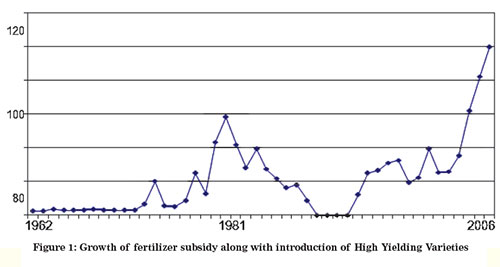
Rice cultivation in lowlands of Sri Lanka also resulted in a kind of revolution locally along with the global Green Revolution. Following the invention of new varieties IR 8, IR 62, with fertiliser response and high yields at International Rice Research Institute (IRRI), the Philippines and their spread globally, the Department of Agriculture (DOA) also produced rice hybrids such as H4, H8 series in early 1970s by using our traditional varieties as parents. However, in a bid to defend the sudden imposition of organic agriculture in Sri Lanka, inorganic fertilizer use has been imposed suddenly on our farmers.
(See Figure 1)
It is only those who were in the DOA who know how difficult it was for our farmers to use locally bred hybrid rice varieties and the corresponding use of inorganic fertiliser. In fact, in spite of tireless efforts by the extension officers of DOA, it took nearly two to three decades for us to cultivate 70 percent (in 1980, IRRI report) of the arable area with high yielding varieties.

However, today, farmers are much more educated and their attitudes may be different, but some of them are still backward in thinking.
Use of Nitrogen fixing flora
In 1980s or 1990s, the DOA scientists and their international counterparts worked on nitrogen fixing plants like Azolla pinnata and Sesbania rostrata in rice fields as a Nitrogen supplement for rice growth. A considerable amount of money was spent on research and development of this technology but popularising its use faced several constraints and farmers did not adopt it unless they were forced to do so or provided with some sort of compensation. One of the main constraints was that the contribution from these plants could not sustain rice yields without addition of inorganic fertiliser. Today, these practices are haphazardly adopted by global rice farmers and none of the countries depend solely on them.
The constraints with regard to using the Azolla fern are several. It can be grown in wet soil and then ploughed under, generating a good amount of nitrogen-rich fertiliser (N 2-5%, P 0.1-1.6%, K 0.3-6% and many micro elements). Therefore, inoculation is necessary every season. In order to maintain the fern throughout the year, special multiplication nurseries are necessary to produce sufficient quantities of planting material as inoculant for further propagation. These nurseries require shade, an ample supply of water, plant nutrients, disease and pest control and some measures to protect the fern from extreme weather conditions. Super phosphate should be applied to the field for the fern nursery thrice—four days apart.
Azolla pinnata in Rice Field
Research work done globally also showed that in an open field under tropical conditions, a full cover of Azolla as monoculture could yield about 20 t/ha fresh weight. When intercropped with rice the growth rate decreases with the development of the rice canopy, but repeated inoculation and harvest of the fern can give an annual yield of up to 40-50 t/ha fresh weight. However, rice yields may increase only by 0.4-1.5 t/ ha when thus fertilised. Therefore, Azolla can only supplement N requirement of rice in the next cultivation season.
EM (Effective Microorganisms)
technology
In another attempt, some tried to use the global EM technology in our country and requested the support of DOA. But the scientists of the calibre of Vidyajothi C. R. Panabokke, who was the Director of Agriculture of DOA, refused to use it on our soils, but some other institutes supported the move. Finally, EM technology was introduced here and private sector organisation, with its extension staff took up the challenge. It was used in some parts 

This writer once attended an international biofertiliser conference, where scientists discussed such adverse effects of microbial fertiliser use in some other countries.
The writer personally believes that CKDu in our country could have been caused by such an unfavourable microbe inadvertently entering our soils with EM solutions. The basis for this hypothesis is that CKDu was first reported from areas where EM technology became popular in rice cultivation. Moreover, heavy metal problems in many countries are due to solubilisation of these minerals, present in the soil, by microbial degradation. For example, high arsenic level in the paddy soils of Bangladesh due to variations indigenous soil properties as well as the microbially mediated biogeochemical interactions that control the biogeochemical cycling of arsenic in soil, has been reported by many scientists.
Therefore, as scientists we foresee problems that crop up when alien microbes are introduced into our soils because of the size of microbes and huge populations per unit weight of soil, and in such instances human error cannot be ruled out. Moreover, this technology was not practised by southern farmers and there are few or no CKDU patients in the area and if at all it may be due to migration of people.
(To be continued)