
Latest News
Lost power, a mayday call and the crash that brought down a Baltimore bridge

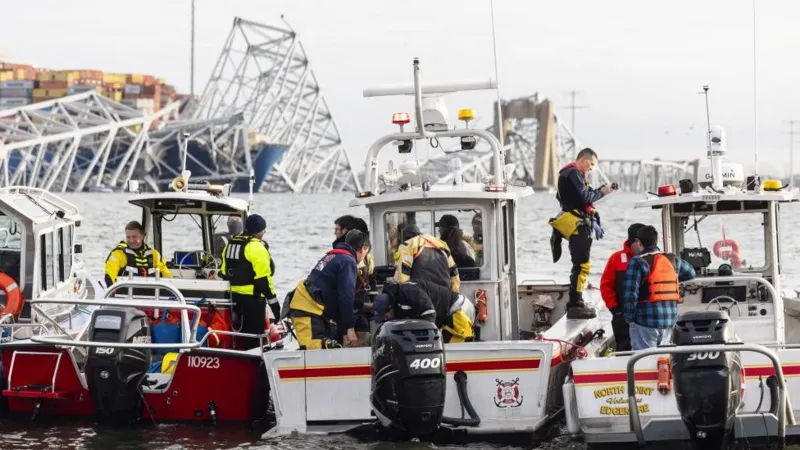
By the time the crew of the Dali, a massive 948ft (289m) container ship, realised what was happening, it was already far too late.
The vessel – at the very start of a 27-day journey from the port of Baltimore to Sri Lanka – completely lost power after leaving the port and was hurtling towards the city’s iconic Francis Scott Key Bridge.
It was the middle of the night and the crew onboard were pitched into further darkness when the ship’s lights suddenly went out.
The vessel was dead: there were no electronics and – crucially – no engine power. They were adrift but powerless to stop what was happening.
Multiple alarms rang out as the crew ran unsuccessful tests in a desperate attempt to fix the issue and regain power. A local pilot onboard the vessel frantically gave orders, telling the crew to steer the rudder hard to port and drop anchor to keep it from drifting starboard. While an emergency generator is believed to have kicked in, the ship never regained the use of its engines.
The pilots were left with no choice. Shortly before 01:30 (05:30 GMT), they issued a mayday call warning authorities that a collision was imminent.
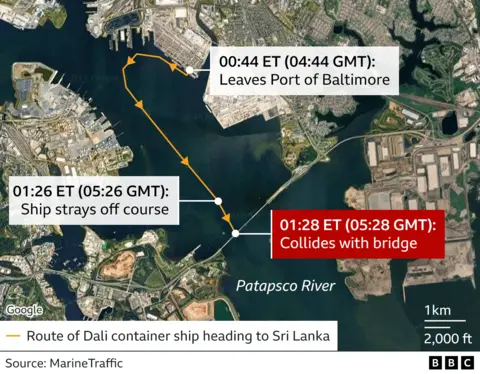
“There’s a ship approaching that has lost their steering,” an official with the Maryland Transportation Authority can be heard saying in radio traffic recorded not long after. “Until you’ve got that under control, we’ve got to stop all traffic.”
Maryland Governor Wes Moore later hailed the crew as “heroes” and said that their quick response had “saved lives” because authorities were able to stop the flow of vehicle traffic on to the bridge in the two minutes between the call and the collision.
It did not, however, stop what happened when the Dali slammed into a concrete column on the 1.5-mile (2.4km) bridge, which quickly collapsed, piece by piece, into the dark, cold waters of the state’s Patapsco River.
Six people – all believed to be members of a road crew working on the bridge – are presumed dead due to the water temperature and time that has passed. The US Coast Guard said in the late evening on Tuesday that it had concluded the men had died and intended to suspend its massive search and rescue effort, which had been complicated by cold and cloudy weather.
Local media had reported that the six workers were citizens of Mexico, Guatemala, Honduras and El Salvador. The BBC has not independently confirmed this and has contacted consular authorities for comment. All 22 crew on the ship were Indian – the country is a major player in the global seafaring industry.
The ship’s crew were all accounted for and none appeared to suffer significant harm.
The dramatic destruction of the bridge – which opened 47 years ago – left many in the city, including Governor Moore, shaken.
“This is a place that is a normal commute route for 30,000 Marylanders every single day. To hear the words ‘the Key Bridge has collapsed’ is shocking. It’s heartbreaking,” Mr Moore said at a news conference on Tuesday.
“For over 47 years, it is all that we’ve known.”
“I felt it… The whole house shook,” John Flansburg, who lives near the water, told the BBC. “Today’s not going to be a good day. A lot of tragedy.”
Another area resident, Darlene Irwin, said that she first knew there was a problem when she heard a “rumbling sound”.
Hours later, the scale of the destruction became apparent when she looked out her window at the Patapsco River. The massive cargo ship, carrying at least 3,000 containers, was wedged between the debris of the collapsed bridge.
By then, the entire area had become the scene of a massive search and rescue effort, with police boats criss-crossing the river and police and Coast Guard helicopters flying overhead.
At a local school, two US military UH-60 Blackhawk helicopters were parked in a sports field, their camouflage-clad pilots and crew milling next to the aircraft.
“To see it now in the daylight,” Ms Irwin said, “it is just tragic.”
While officials have repeatedly stressed that their focus remains on the search for the missing, experts have warned that the incident could also have a significant impact on the port of Baltimore, one of the busiest on the US east coast.
Maryland Senator Ben Cardin told reporters that the re-opening of the waterway would be “critical” for the US economy.
The port is a key regional hub for goods ranging from steel and aluminum to agricultural equipment, and is used by car-makers including General Motors and Honda. Data from the Maryland Port Administration shows the port handled at least 750,000 vehicles last year.
“This will disrupt vessel schedules and strain handling capacities at other ports such as Philadelphia and Norfolk,” said Mirko Woitzik, global director of intelligence for Everstream Analytics, which provides supply-chain services.
“[This could] lead to spillover congestion and delays that could last month.”
Speaking at the White House on Tuesday, US President Joe Biden – who said he had commuted over the bridge “many, many times” between his home state of Delaware and Washington – vowed to “move heaven and earth” to re-open the bridge.
“We’re going to spend all the federal resources they need as we respond to this emergency,” he said. “And we’re going to rebuild that port together.”
Mr Biden added that 15,000 US jobs “depend on that port”.
Officials have so far declined to comment on any potential timeline for that to happen.
Authorities say that, for now, they are fully focused on the search and rescue operation.
Mr Moore, for his part, said only that the recovery process “will not be short”. Baltimore, he acknowledged, was facing a “long road” after the collapse.
This is not the first time the Dali has been involved in an incident.
According to Vessel Finder, a tracking website, the ship was involved in another collision in the Belgian port of Antwerp in 2016. There were no injuries or significant damage reported at the time.
As night fell on Tuesday, the ship and its load of 3,000 containers remained on the Patapsco River, its nose stuck between the mangled debris of the bridge it brought down in seconds.
(BBC)



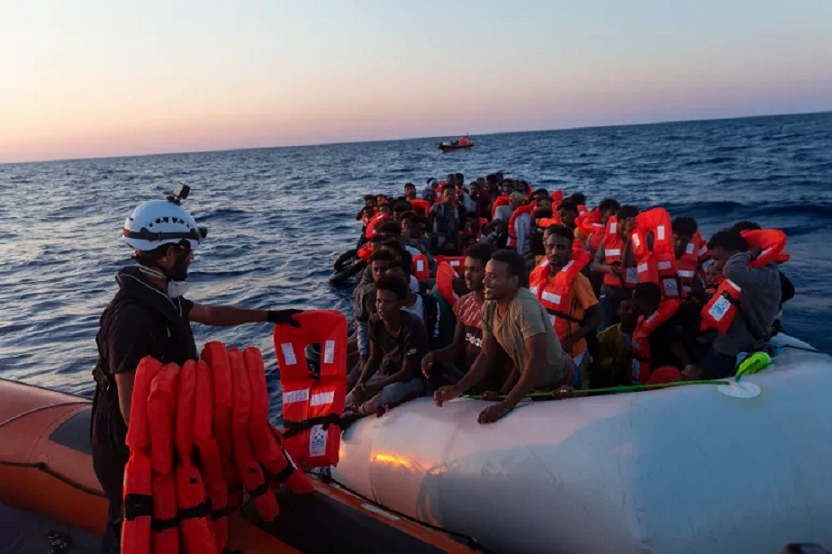
The aid group Doctors Without Borders has reported recovering 11 bodies and rescuing dozens of people off the coast of Libya as it criticised the migration policies of the North African country and European countries.
In a statement on Friday, the group, known by its French initials MSF, said its Geo Barents rescue vessel managed to recover the bodies following a search operation lasting more than nine hours after being alerted by German nongovernmental organisation Sea-Watch, which also rescues refugees and migrants.
“As we cannot determine the reason behind this tragedy, we know that people will continue to take dangerous routes in a desperate attempt to reach safety, and Europe must find safe and legal pathways for them,” MSF said in a post on X. “This catastrophe must end!”
Sea-Watch said it is unclear whether the bodies were victims of a previously unknown shipwreck, adding that they tried to contact Libya’s coastguard to go and retrieve the dead, but received no reply.
“The so-called Libyan coastguard – financed by the EU – ignored our call demanding that the bodies be recovered,” the group said.
Thousands of people trying to head from Africa to Europe use Libya as a departing point, with the Italian island of Lampedusa the nearest European destination as they undertake the dangerous journey across the Mediterranean to escape war, poverty and persecution.
Italy, which wants to put a stop to the migration stream, has said Libya and neighbouring Tunisia must do more to stop people from going to sea. It has also clamped down on the operation of the rescue ships, arguing that they encourage people to head to Europe, a charge that is denied by the charities.
Emphasising its policy on the rescue ships, Italy said on Friday that it forced the MSF rescue vessel to take the 165 people that it had saved from boats in the Mediterranean operation to the northern port of Genoa. The port was more than 650 nautical miles (1,200km) from their position and much farther than the more convenient ports in nearby Sicily, significantly delaying assistance to the rescued.
The route in the central Mediterranean is the most dangerous migrant crossing in the world, with the United Nations registering more than 20,000 deaths and disappearances in the area since 2014.
More than 3,000 refugees and migrants went missing in 2023 while attempting to use the route, according to the International Organization for Migration.
According to Italy’s interior ministry, the number of arrivals in the country has dropped in 2024 to fewer than 21,800 people since the beginning of the year, compared with close to 53,300 in the same period last year.
[Aljazeera]
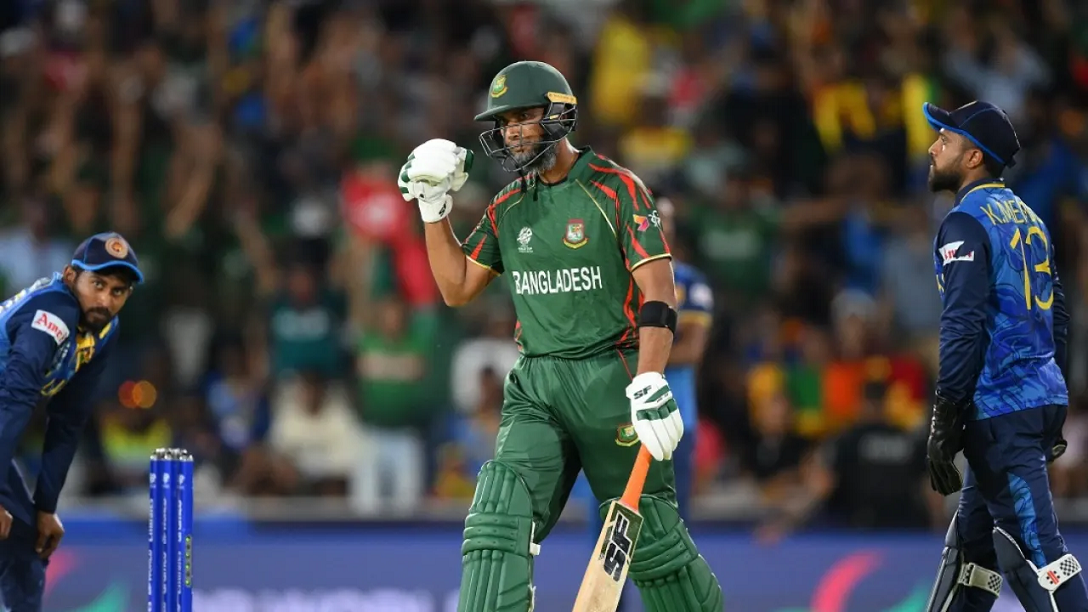
Nuwan Thushara’s last over brought Sri Lanka screaming back into the match,as he first bowled Rishad Hossain, and then nailed Taskin Ahmed in front of the stumps with a pinpoint swinging yorker. This left Bangladesh eight wickets down, with 12 runs still to get.
However, the experienced Mahmudullah was at the crease for Bangladesh, and despite some further nervy moments, pushed Bangladesh across the line off the last ball of the 19th over.
But this was a match chiefly decided by Bangladesh’s own outstanding bowling. Mustafizur Rahman was the best among them, using shorter lengths and his cutters efficiently, to claim figures of 3 for 17. Rishad Hossain’s three-for through the middle overs also kept Sri Lanka quiet.
Mustafizur was instrumental in Sri Lanka’s downward spiral through the middle overs, which culminated in a crash-and-burn end. Ultimately, their inability to find boundaries, or even rotate strike against good Bangladesh bowling resulted in their downfall. A score of 125 for 9 always seemed poor on a decent pitch, even if their bowlers made a match of it in the end.
Brief scores:
Bangladesh 125 for 8 in 19 overs (Towhid Hridoy 40, Litton Das 36; Dhanajaya de Silva 1-11, Nuwan Thushara 4-18, Wanidu Hasaranga 2-32, Matheesha Pathirana 1-27) beat Sri Lanka124 for 9 in 20 overs (Pathum Nissanka 47, Dhananjaya de Silva 21; Tanzim Hasan Sakib 1-24, Taskin Ahmed 2-25, Mustafizur Rahman 3-17, Rishad Hossain 3-22) by two wickets
[Cricinfo]
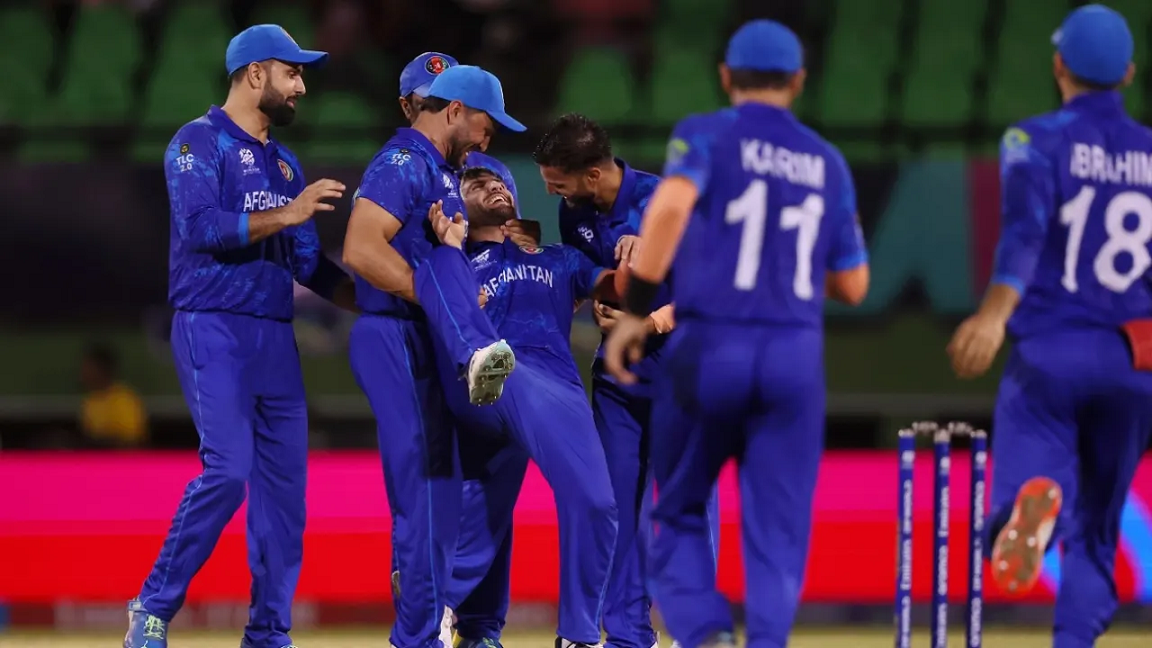
Afghanistan boosted their Super Eight chances with yet another dominating win, this time thumping New Zealand by 84 runs in Providence. Having beaten Uganda by 125 runs in their opening match, they are now at the top of Group C with a net run rate of 5.225.
After being sent in, Rahmanullah Gurbaz and Ibrahim Zadran gave Afghanistan a start of 103 in 14.3 overs. It came off the back of the 154 the pair added against Uganda, thus making them the first opening pair to register two successive century stands in the history of the T20 World Cup.
Afghanistan’s was an innings of two halves. They scored 55 for no loss in the first ten overs and 104 for 6 in the last ten, with Gurbaz contributing 80 off 56 balls. New Zealand, who had decided not to play any warm-up games, looked every bit rusty as their fielders dropped catches and missed run-out opportunities.
With the pitch assisting both seamers and spinners, chasing 160 was not going to be easy. But few would have expected New Zealand to collapse in the manner they did.
Fazalhaq Farooqi picked up three wickets in the powerplay and Rashid Khan three just after it. Eventually, both ended with identical figures of 4 for 17 as New Zealand were bowled out for 75 in the 15.2 overs. Glenn Phillips and Matt Henry were the only New Zealand batters to reach the double digits.
Trent Boult found some swing in the opening over but Gurbaz and Ibrahim showed their intent by picking up three fours off Henry from the other end. Both batters had luck on their side, too. Gurbaz got a second life when he skipped down the track to Santner and missed the ball, which went on to brush the leg stump but the bails did not budge. In the following over, Finn Allen dropped Ibrahim off Henry at the deep-square-leg boundary.
That was not all. Gurbaz got another reprieve after being involved in a miscommunication with Ibrahim. Having taken off for a single, Gurbaz had to retrace his steps and would have been run out had Conway not fumbled the throw.
Two balls later, New Zealand finally seemed to have found success when Santner pinged Ibrahim’s pads and umpire Kumar Dharmasena ruled it lbw. But the batter got the decision overturned on review as the ball was heading down the leg side. Immediately after that, Ibrahim hit Santner for an inside-out four as Afghanistan ended the powerplay on 44 for no loss.
New Zealand went against the prevailing wisdom of not bowling an offspinner when two right-hand batters at the crease, and Michael Bracewell repaid that faith by conceding only six off his first two overs.
Lockie Ferguson was even more frugal, going for five in his first two. He could have had Ibrahim off a slower full toss but a leaping Kane Williamson failed to pull off a one-handed stunner at mid-off. That meant while Afghanistan remained unscathed, they had only 55 on the board after ten overs.
Afghanistan had not hit a single six in the first ten overs, but there were five in the next three, including three in one Bracewell over as Gurbaz and Bracewell stepped on the accelerator. The pair took the side past 100 in the 14th over. New Zealand finally broke through when Ibrahim bottom-edged a short ball from Henry onto his stumps, after having been hit on the grille on the previous delivery.
Promoted to No. 3, Azmatullah Omarzai played his part with 22 off 13, which included two sixes in three balls off Henry. Mohammad Nabi fell for a first-ball duck but Gurbaz kept finding the boundary at regular intervals. However, a three-wicket, three-run final over by Boult kept Afghanistan to 159.
Farooqi gave Afghanistan a dream start with the ball. With the very first delivery of the innings, he uprooted Finn Allen’s leg stump as the ball moved in late. In the seamer’s next over, Conway pushed at one that seemed to come slower off the surface and was caught at extra cover.
The decision to give Farooqi a third over in the powerplay brought further rewards. This time, bowling around the wicket to Daryl Mitchell, he got a length delivery to just straighten and take the outside edge. Gurbaz took a regulation catch to complete the dismissal and leave New Zealand 28 for 3.
It could have been worse for New Zealand. In between, Naveen-ul-Haq had rapped Kane Williamson’s front pad after the batter had moved across to play a delivery. Afghanistan sent it upstairs for an lbw review but the umpire’s call saved the New Zealand captain.
Afghanistan did not have to wait too long for Williamson’s wicket. Rashid brought himself on after the powerplay and struck straightaway as Williamson guided one to first slip. But Rashid was just warming up. In his next over, he dismissed Mark Chapman and Bracewell off successive deliveries to leave New Zealand on 43 for 6. Chapman went for a pull and got bowled; Bracewell was late to bring his bat down and was lbw.
Phillips was New Zealand’s last hope. He did hit a couple of boundaries but was soon caught at long-on when he tried to take on Nabi. That ended any hopes of revival New Zealand might have had.
Brief scores:
Afghanistan 159 for 6 in 20 overs (Rahmanullah Gurbaz 80, Ibrahim Zadran 44, Azmatullah Omarzai 22; Trent Boult 2-22, Matt Henry 2-37, Lockie Fergusoan 1-28) beat New Zealand 75 in 15.2 overs (Glenn Phillips 18; Rashid Khan 4 for 17, Fazalhaq Farooqi 4 for 17, Mohammad Nabi 2-16) by 84 runs
[Cricinfo]



US sports envoys to Lanka to champion youth development

Rahuman questions sudden cancellation of leave of CEB employees


