Sat Mag
Linkages and breakages: Marxist historiography in Sri Lanka

By Uditha Devapriya
Halfway through Senake Bandaranayake’s Continuities and Transformations: Studies in Sri Lankan Archaeology and History, I stopped to wonder why we no longer produce exceptional sociologists, anthropologists, archaeologists, and historians. Bandaranayake gives us the most cohesive critique of Ananda Coomaraswamy’s theories on art and culture, a critique that Regi Siriwardena revisited in a later essay. His explorations into pre-modern urban settlements and architecture in Sri Lanka and his attempts at periodising local history, the latter an endeavour that occupied R. A. L. H. Gunawardana, are free of the kind of rigidity which so despairingly characterises, if not defines, scholarship in the country today.
The point that Dr Bandaranayake raises isn’t so much that we had an advanced civilisation – a point nationalists would be quick to assert – as that this advanced civilisation wasn’t just the work of kings: there were significant conjunctures between kings and monks, ruler and ruled, nobility and peasantry, that produced the feats of architecture for which Sri Lanka has gained a reputation today. This is not the great man thesis most historians before Bandaranayake had accepted and propounded: that kings were at the top of the social hierarchy, and that they had the final say on both secular and religious matters, including urban planning.
These concerns had occupied Dr Bandaranayake ever since his monograph, Monastic Sinhalese Architecture, appeared in 1974; it lead from a rigorous critique of the empiricist tradition which dominated intellectual life at the University of Peradeniya in the early 1960s. Laying an emphasis on cultural as opposed to material factors, this tradition stressed the role of hierarchies rather than social formations in pre-colonial Sri Lanka. Those who challenged it invariably hailed from the Marxist tradition and read Marxist historiography; they included Bandaranayake, and most prominently R. A. L. H. Gunawardana.
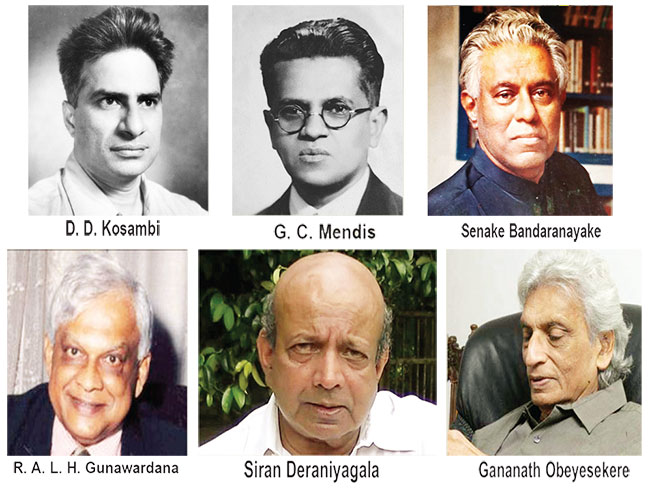

In Sri Lanka, these debates did not open up until after 1956. This is not a coincidence. 1956 liberated scholars, including archaeologists, from their empiricist moorings, and encouraged them to question accepted norms, demolish established standards, and set new ones. Having emerged from what one might tongue-in-cheek call the H. W. Codrington and G. C. Mendis School of History, they began exploring new areas of research which had been shut to them. Probably the most interesting and intriguing area among them was the link between the rise of the state in Sri Lanka and the evolution of a Sinhala nationalist consciousness.
With his forays into the evolution of Sinhala literature, Martin Wickramasinghe had outlined something of a historiography of medieval Sinhala society, beginning in the 8th century and breaking off somewhere in the 15th. Wickramasinghe’s core argument in Sinhala Sahithyaye Negeema was that the degree to which Sinhala had been allowed to be influenced by Sanskrit determined the course of history from the Polonnaruwa to the Kotte kingdom. In other words, these periods were marked by both continuities and transformations.
This argument would be developed and expanded by R. A. L. H. Gunawardana in his essay, “The People of the Lion” (1979), which asserted that not before the 10th century do we see the inklings of a national consciousness, and that Sinhala nationalism was fermented under conditions of colonialism, specifically British colonialism; “[i]t was,” he notes, “during the period of colonial rule that the Sinhala consciousness underwent a radical transformation and began to assume its current form.” As Senake Bandaranayake notes in his brilliant essay on Ananda Coomaraswamy, colonialism produced a disjuncture between opposition to political nationalism and embracement of cultural nationalism: hence, even as officials valorised an idealised and imagined conception of Sinhala culture, these same officials cracked down on anti-colonial struggles while “denying or neglecting the more recent or extant vitality of” the bearers of that culture. Bandaranayake’s argument that Coomaraswamy’s writings reflected these notions of tradition is certainly debatable, yet his central premise is not.
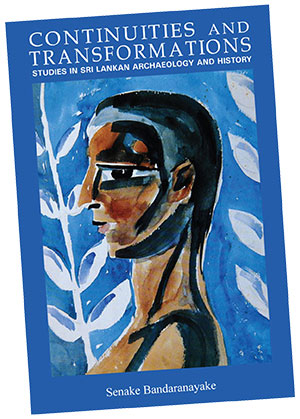

At the same time, historians and scholars tended to consider the cultural achievements of a particular era, most prominently Anuradhapura, as proof of its unbroken continuity. From what archaeological evidence has been gathered, however, Bandaranayake contends that not even the feats of architecture and engineering at Anuradhapura can be taken as proof of such continuity; as he points out, correctly, “[t]he familiar monuments at Anuradhapura… belong mostly to the period of the 8th to the 10th century.” Whether or not there were other epochs within such all encompassing eras is, of course, a matter of conjecture: what Bandaranayake calls the “Anuradhapura stratification thesis” can be neither verified nor denied unless further excavations are conducted at these sites. Yet the conclusion he derives from these arguments is irrefutable: that history is not one long arrow, but rather a series of arrows, more often than not shot from different bows and by different archers.
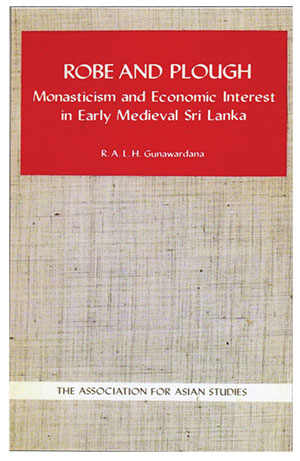

Deceptively similar as the periodisation schemes of these historians would have been, there were nevertheless important differences between their approaches to the question of “cutting up time.” Thus, while Bandaranayake’s classification of Lankan history divides it into early, middle, and late periods, encompassing both regional kingdoms and unitary polities, Leslie Gunawardana classifies them on the basis of chiefdoms, kingdoms, and colonial settlements, the latter of which he divides into periods of resistance and periods of subjugation, followed, logically, by the postcolonial era. Complicating these distinctions further was, and is, the lack of research into the country’s prehistory: with the exception of Siran Deraniyagala (1992) and Raj Somadeva (2006), hardly anyone has delved into this field properly.
To be sure, the significance of these ventures must be appreciated for the contribution they made to the study of local history. As Bandaranayake contends in his essay on the subject, once you assess history on the basis of materialist factors, you can adopt several criteria to distinguish one period from another. In other words, periodisation can be made on the basis of not just social relations or formations, but commercial networks, exchange systems, and cultural artefacts as well. Grounded in material factors, one set of criteria invariably overlaps with another: thus Bandaranayake’s early-middle-late timeline coincides with Martin Kuna’s “culture period timeline”, even though both scholars adopt different criteria. If one accounts for different factors, such as technology, one comes across overlaps with timelines based on other criteria, even if the dating of the periods in those timelines may differ.
Whatever the debates and disagreements these studies have led to, we must be thankful to the Marxists for having pioneered a historiography that steered clear of the dynasty centrism and empiricism of their predecessors. It essentially rescues a civilisation and a society from stasis and, as Bandaranayake notes, presents history “as a continuing and developing process rather than a series of static epochs.” That these approaches to history have not properly seeped into our textbooks is an unflattering testament to the lowering of standards and the predominance of the great man thesis which undergirds a dynastic approach to the subject.
Ideologically, the latter theory has penetrated all levels of intellectual activity in the country, which is why it’s hard to let go. Yet no study of a society will be complete without cohesive, comprehensive archaeological and historical research. Such research invariably needs literate scholars capable of not just applying theories conceived elsewhere, but also questioning such theories when the local context provides suitable grounds for departing from them.
Sri Lanka has so far seen Gananath Obeyesekere, Ralph Pieris, Leslie Gunawardana, Newton Gunasinghe, Kumari Jayawardena, Senake Bandaranayake, Michael Roberts, K. M. de Silva, S. B. D. de Silva, Siran Deraniyagala, SinhaRaja Tammita-Delgoda, Nira Wickramasinghe, and Sarath Amunugama, the latter the best anthropologist we have, after Obeyesekere. It is depressing to think there’s no one to take up their mantle. Having finished Bandaranayake’s book, I hence stopped to ask myself again: just where are our sociologists, anthropologists, archaeologists, and historians? Just where are our thinkers?
The writer can be reached at udakdev1@gmail.com